Project Builder Visa Pathway to Australia: Complete 2026 Guide
Updated: 16 August 2026
Australia classifies Project Builder under ANZSCO 133112. VETASSESS conducts the skills assessment as a Group A professional occupation. The role sits on the Core Skills Occupation List (CSOL) and the Regional Occupation List (ROL), unlocking subclasses 491, 494, 482 and 186. Typical 2026 salaries range AUD $100,000-$160,000, with strong regional demand tied to Australia's housing supply targets.
Quick Facts: Project Builder Migration Pathway
| Detail | Information |
|---|---|
| ANZSCO Code | 133112 (Project Builder) |
| Skill Level | 1 (Bachelor degree or higher in a highly relevant field) |
| Skills Assessment | VETASSESS (Vocational Education and Training Assessment Services) |
| Occupation List | CSOL and ROL — not on MLTSSL, so subclass 189 is unavailable |
| Visa Options | 491, 494, 482, 186 |
| Demand Level | High — construction managers and supervisors remain in national shortage per Jobs and Skills Australia |
| Salary Range | AUD $100,000-$160,000 (SEEK, 2026) |
| Assessment Fee | AUD $1,096 (VETASSESS Full Skills Assessment, from 22 October 2025) |
| Key Challenge | No 189 access — regional employer or state nomination route is mandatory |
What a Project Builder Actually Does in Australia
A Project Builder plans, organises, directs and coordinates the construction, alteration and renovation of dwellings and other buildings. The role sits one rung above a site supervisor and one rung below a Construction Project Manager (ANZSCO 133111). In practice, Project Builders run small-to-mid-sized residential and light commercial projects end-to-end: interpreting drawings, sequencing trades, ordering materials, managing budgets, liaising with engineers and certifiers, and signing off on compliance at each inspection stage.
Demand is concentrated where housing supply is under the most pressure. South-east Queensland, Western Sydney, regional Victoria and the Perth metropolitan growth corridors are absorbing the bulk of new residential starts. The National Housing Accord target of 1.2 million new homes by 2029 has kept hiring volumes high for licensed builders who can run their own jobs. Regional Australia in particular has a thin bench of qualified builders, which is why this occupation sits on the ROL with strong 491 and 494 access.
The ANZSCO 133112 Description
ANZSCO defines a Project Builder as a manager who plans, organises, directs, controls and coordinates the construction of dwellings and other buildings, including the physical and human resources involved in the building process. Skill level 1 applies — a Bachelor degree or higher in a closely related field, with at least five years of relevant experience as a partial substitute in some cases.
Typical tasks recognised by VETASSESS include:
- Interpreting architectural plans and specifications
- Negotiating with owners, architects, consultants and subcontractors
- Operating and implementing coordinated work programmes for sites
- Arranging submission of plans to local authorities
- Ensuring adherence to building legislation and codes
- Overseeing project finalisation including final inspections and defect rectification
Project Builder is distinct from Builder's Labourer (821711) and from licensed trades. It is the management role — the person who runs the build, not the person who swings the hammer. Many applicants confuse it with Construction Project Manager (133111). The difference matters: Construction Project Manager is on the MLTSSL with full 189 access; Project Builder is not.
Skills Assessment with VETASSESS
VETASSESS treats Project Builder as a Group A professional occupation. Two things have to align: qualification and employment.
Qualification requirement
A qualification assessed as comparable to an Australian Bachelor degree or higher, with a major in a highly relevant field. The fields VETASSESS accepts as highly relevant are:
- Building Science and Technology
- Building Construction Management
Degrees in civil engineering, architecture, quantity surveying or general project management are not automatically accepted as highly relevant. If your qualification is in one of these adjacent fields, VETASSESS may still issue a positive outcome but only if your employment history demonstrates the full scope of project building duties.
Employment requirement
Minimum one year of post-qualification, highly relevant paid employment at the appropriate skill level within the last five years. The work must be at least 20 hours per week. Self-employed applicants must supply business registration, accountant statements and a statutory declaration covering duties.
Assessment fee: AUD $1,096 (Full Skills Assessment, effective 22 October 2025). Priority processing costs AUD $1,921 total.
Processing time: 8-10 weeks for standard processing, 10 business days for priority.
Common rejection reasons: Qualification mapped to civil engineering or architecture rather than building construction management; employment references that read like a site supervisor's duties rather than a builder's; missing evidence of regulatory and code compliance work.
If your degree is borderline, consider lodging a Skills Assessment Support service (SAS) request before the full application — it lets VETASSESS flag issues before you spend the full fee.
Visa Pathways for Project Builders
Project Builder is on the CSOL and ROL, but not the MLTSSL. That single fact reshapes the pathway. Subclass 189 (skilled independent) is off the table. Your routes are employer-sponsored or state-nominated, with regional sponsorship the dominant path.
Subclass 491 — Skilled Work Regional (Provisional)
The most common route for Project Builders. Five-year provisional visa with a pathway to permanent residency via subclass 191 after three years of regional residence and earning above the income threshold.
- Visa fee: AUD $6,140 (primary applicant)
- Points boost: +15 for regional nomination
- Where it works: Anywhere in Australia except Sydney, Melbourne and Brisbane metropolitan zones
- Quirk: Several states pause or reopen 491 pathways during the year — NSW closed Pathway 1 and Pathway 3 in January 2026 after allocations were filled. Track the state portals monthly.
Subclass 494 — Skilled Employer Sponsored Regional (Provisional)
Employer-sponsored regional visa. Five years, with PR pathway via subclass 191.
- Visa fee: AUD $4,910 (primary applicant)
- Sponsor requirement: Approved regional employer
- Best for: Builders with an existing job offer from a regional construction firm
Subclass 482 — Skills in Demand
Employer-sponsored temporary visa. Project Builder is eligible under the Core Skills Stream.
- Visa fee: AUD $4,015 (primary applicant)
- Core Skills Income Threshold (CSIT): AUD $79,423 minimum salary
- Duration: Up to four years
- Reality check: Project Builder salaries comfortably exceed CSIT in most metro and regional markets
Subclass 186 — Employer Nomination Scheme
Permanent employer-sponsored visa. Two streams matter for this occupation: Direct Entry (DE) for applicants with positive VETASSESS plus three years of relevant work experience, and Temporary Residence Transition (TRT) after two years on a 482.
- Visa fee: AUD $6,140 (primary applicant)
- Pathway logic: Many Project Builders move 482 → 186 TRT rather than chasing points-based PR
State Nomination for Project Builders
Because Project Builder sits on the CSOL and ROL — not the MLTSSL — state and regional nomination is the practical PR route. Construction is a priority sector in most state programmes, but allocations move quickly.
New South Wales
NSW lists construction as one of its declared priority sectors for 2025-26. Project Builder is included in state-nominated pathways under both 190 and 491 frameworks. The March 2026 invitation round prioritised carpenters, civil engineers and developer programmers, and construction management roles have appeared in subsequent rounds. Be aware NSW closed two of its three 491 pathways in January 2026 after allocations filled — Pathway 2 may reopen during 2026.
Victoria
Victoria runs a rolling Registration of Interest (ROI) model rather than scheduled rounds. Construction trades and management occupations attract invitations at lower point scores than ICT roles. The most recent invitation round on 17 March 2026 issued nominations at 65-105 points depending on occupation and regional commitment. Victoria's preference for applicants with regional intent works strongly in a Project Builder's favour.
Queensland
Queensland's Business and Skilled Migration program lists construction management among targeted occupations, particularly outside Brisbane CBD. Regional Queensland — the Sunshine Coast, Townsville, Cairns and Mackay — has acute shortages of qualified builders.
South Australia and Western Australia
Both states regularly nominate Project Builder under 491 pathways. South Australia favours applicants with existing regional ties or job offers. Western Australia has prioritised construction roles tied to housing supply and resources sector accommodation projects in the Pilbara.
Salary and Employment Outlook
| Role / Seniority | Typical Salary Range |
|---|---|
| Project Builder (Junior, 1-3 yrs) | AUD $80,000-$100,000 |
| Project Builder (Mid-Level, 4-9 yrs) | AUD $100,000-$130,000 |
| Senior Project Builder / Construction Project Manager | AUD $130,000-$165,000 |
| Multi-Site Builder (Volume Builder) | AUD $140,000-$180,000+ |
| Builder-Director (Own Licence, Own Company) | AUD $150,000-$250,000+ |
Source: SEEK Career Advice and Glassdoor, May 2026. Superannuation at 11.5% is paid on top of base salary. Many builders also receive vehicle allowances or company utes, fuel cards, and project completion bonuses (typically 5-15% of base for residential, higher for commercial).
Highest-paying sectors:
- High-end residential — custom builders in Sydney's North Shore, Melbourne's inner east, and Perth's western suburbs pay the most for builders who can manage architect-designed homes.
- Volume residential — national builders like Metricon, Henley and Stockland Communities pay strong base salaries with project bonuses.
- Commercial fit-out — office, retail and hospitality fit-out specialists pay more than general builders.
- Government and defence — Defence Housing Australia and state government works require security clearances but pay premium rates.
- Mining and resources camps — remote project work commands the highest day rates, often $1,200-$1,800/day for FIFO Project Builders.
Tips for a Successful Application
1. Confirm Your Degree Major Before Anything Else
VETASSESS only accepts Building Science and Technology or Building Construction Management as highly relevant majors. If your degree is in civil engineering, architecture or quantity surveying, get a pre-assessment opinion before lodging. The fix is usually demonstrable through employment evidence — but spending AUD $1,096 to find out otherwise is an expensive mistake.
2. Distinguish Yourself From a Site Supervisor on Paper
Many otherwise-qualified applicants fail because their employment references describe site supervision rather than building management. Your references must show that you negotiated with owners and architects, submitted plans to councils, signed off on inspections, and managed budgets — not just that you ran a site.
3. Calculate Your Realistic Pathway Before Lodging
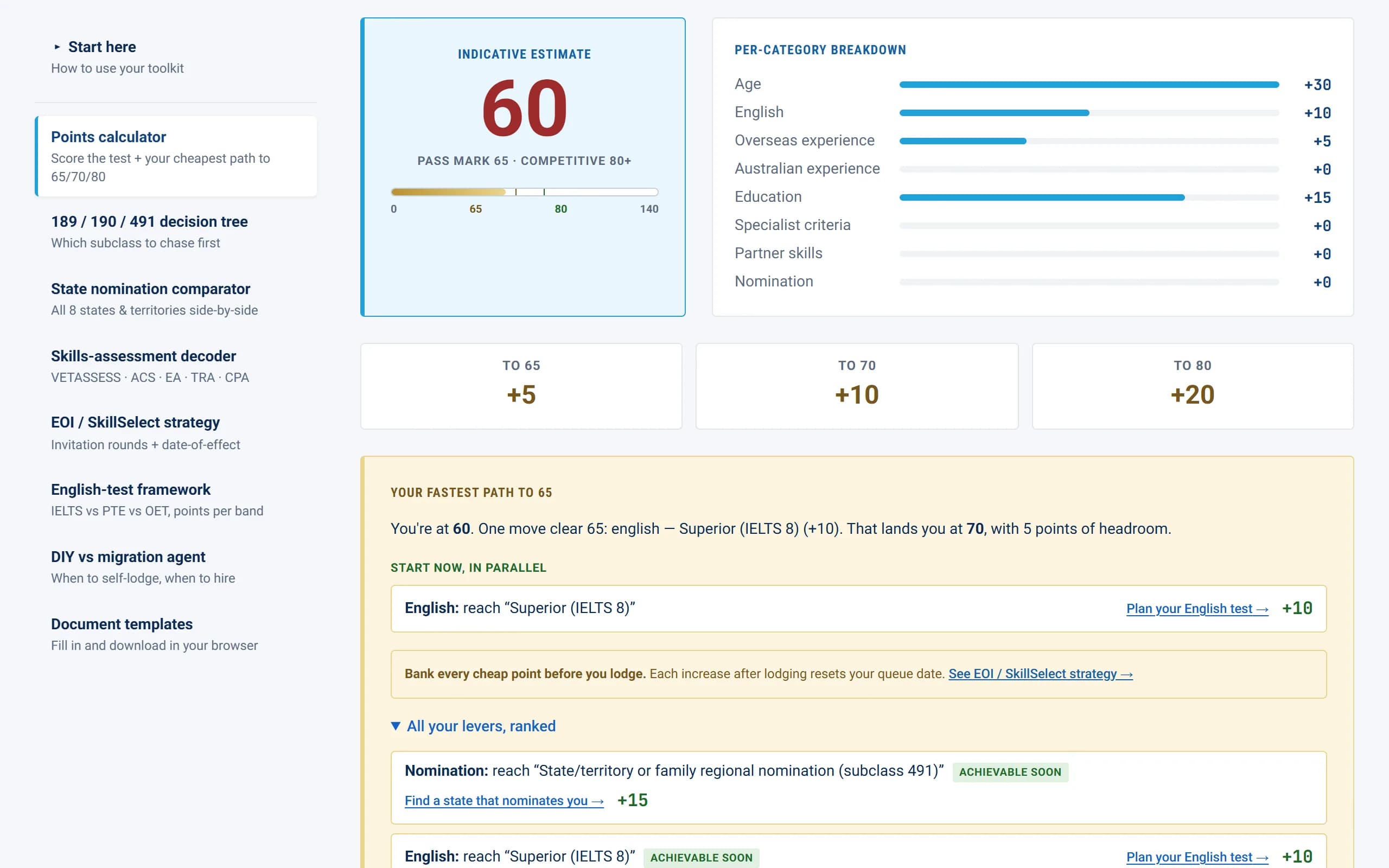
Without 189 access, the maths is different. Project Builders typically need either a regional nomination (491 = +15 points) or an employer sponsor. Run the points calculator with regional nomination factored in before committing to the VETASSESS fee.
4. Document Self-Employed Work Carefully
If you've run your own building company, VETASSESS wants ABN-equivalent registration, accountant statements, signed contracts from at least three projects, and a statutory declaration listing your duties. Bank statements alone are not enough.
5. Position for Regional Nomination Early
Regional employers move faster than metropolitan ones. If you have flexibility on location, a regional 491 or 494 is materially easier than chasing 190 in Sydney or Melbourne. Build a list of regional builders in your target state and approach them directly with your VETASSESS positive outcome in hand.
Step-by-Step Migration Roadmap
- Confirm ANZSCO code — use the ANZSCO code finder to verify Project Builder (133112) fits, not Construction Project Manager (133111)
- Check CSOL and ROL — verify current list status via the CSOL hub and the 2026 SOL
- Map degree to VETASSESS-accepted majors — Building Science and Technology or Building Construction Management
- Gather employment evidence — references, organisation charts, project contracts, payslips for the most recent five years
- Sit your English test — IELTS 6.0 minimum, aim for 7.0+ for points
- Lodge VETASSESS Full Skills Assessment — AUD $1,096, 8-10 weeks standard
- Submit EOI in SkillSelect — pick 491, 494 or both based on regional preference
- Lodge state or regional nomination — pick the state matching your target location
- Alternatively, secure a 482 or 494 employer sponsor — many regional builders are open to sponsorship
- Receive invitation and lodge visa — within 60 days of invitation
- Complete health and character checks
- Receive visa grant and relocate
Frequently Asked Questions
Is Project Builder on the MLTSSL?
No. Project Builder (133112) is on the Core Skills Occupation List (CSOL) and the Regional Occupation List (ROL), but not the MLTSSL. This means subclass 189 (skilled independent) is unavailable. Subclasses 491, 494, 482 and 186 are your options.
What's the difference between Project Builder (133112) and Construction Project Manager (133111)?
Construction Project Manager (133111) sits on the MLTSSL with full 189 access. Project Builder (133112) sits on the CSOL only. The ANZSCO descriptions overlap heavily, but Construction Project Manager is usually applied to larger commercial and infrastructure projects, while Project Builder applies to residential and small-to-mid commercial builds. Pick the one your duties actually match — not the one with better visa access.
Can I get a Project Builder visa without an Australian job offer?
Yes, via subclass 491 with state or regional nomination. You don't need a job offer for 491 nomination, but you must commit to living and working in regional Australia for at least three years to qualify for the PR transition (subclass 191).
Does VETASSESS accept civil engineering or architecture degrees for Project Builder?
Not automatically. Highly relevant majors for this occupation are Building Science and Technology or Building Construction Management. Civil engineering and architecture graduates can sometimes succeed if their employment history clearly demonstrates building management duties, but a pre-assessment is strongly advised before lodging the full application.
What's the realistic processing timeline from start to visa grant?
VETASSESS assessment: 8-10 weeks. EOI to invitation: 1-6 months depending on state and points. State nomination decision: 4-12 weeks. Visa lodgement to grant for 491: 8-12 months currently. Allow 18-24 months end-to-end for a typical Project Builder regional pathway.