Landscape Architect Visa Pathway to Australia: Complete 2026 Guide
Updated: 16 August 2026
Australia classifies Landscape Architect under ANZSCO 232112. VETASSESS conducts the skills assessment under its Group A professional pathway. The occupation is on the MLTSSL and CSOL, unlocking subclasses 189, 190, 491, 482, 186 and 494. Typical 2026 salaries range AUD $80,000-$120,000. Most demand sits with private practices and local councils delivering infrastructure, residential subdivisions and parks renewal across the eastern seaboard.
Quick Facts: Landscape Architect Migration Pathway
| Detail | Information |
|---|---|
| ANZSCO Code | 232112 (Landscape Architect) |
| Skill Level | 1 (Bachelor degree or higher in a highly relevant field) |
| Skills Assessment | VETASSESS — Group A Professional Occupation |
| Occupation List | MLTSSL and CSOL |
| Visa Options | 189, 190, 491, 482, 186, 494 |
| Demand Level | Moderate — infrastructure pipeline and housing supply targets drive consistent hiring |
| Salary Range | AUD $80,000-$120,000 (SEEK Career Advice, 2026) |
| Typical 189 Score | 75-85 (less competitive than ICT codes) |
| Key Challenge | VETASSESS distinguishes landscape architecture from architecture and landscape design — qualifications must be unambiguously landscape architecture |
Role Context in Australia
Landscape architects design exterior spaces — public parks, urban plazas, residential subdivisions, schools, hospitals, transport corridors, restoration of degraded ecosystems and the public-realm work that connects buildings to the city. The profession sits at the intersection of design, ecology, civil engineering and urban planning. In Australia, the work is regulated by professional convention rather than by statute, but the Australian Institute of Landscape Architects (AILA) registration matters for credibility and tender eligibility on government work.
Hiring concentrates in private multidisciplinary practices — Aspect Studios, McGregor Coxall, Tract Consultants, Hassell, Cox Architecture's landscape arm, Place Design Group, Urbis — plus local councils, state transport authorities (Transport for NSW, Department of Transport and Planning Victoria), and developer-side roles inside Lendlease, Mirvac and Stockland. Sydney and Melbourne carry most permanent roles. Brisbane and the Gold Coast have grown sharply because of population pressure and the 2032 Olympics infrastructure pipeline. Perth and Adelaide hold smaller but steady markets driven by suburban subdivision work.
The current driver of hiring is the federal Housing Accord target of 1.2 million new homes by 2029 — landscape architects are essential to subdivision approvals, public open space provision and the integrated water management strategies councils now require.
ANZSCO Code Mapping
ANZSCO 232112 covers planning and designing land areas for parks, schools, institutions, roads, building external areas, land subdivisions and commercial, industrial and residential sites. The tasks list spans site analysis, design concept development, preparation of detailed designs and specifications, supervising construction implementation and inspecting completed work.
There is no separately classified ANZSCO code for landscape designers (non-degree practitioners), urban designers or environmental restoration practitioners. Applicants whose work is dominated by garden design, residential horticultural work or facade greening without master-planning experience may not satisfy VETASSESS at this code. For practitioners whose work is closer to building design than open-space design, see the Architect visa pathway. For more detail on choosing the right code, see how to find your ANZSCO code.
Skills Assessment
VETASSESS — Group A Professional Occupation
Landscape Architect falls under VETASSESS's Group A assessment pathway, which requires both qualification and employment evidence.
Requirements:
- A qualification assessed as comparable to an Australian Bachelor degree or higher, in a field highly relevant to landscape architecture
- At least one year of post-qualification highly relevant employment in the past five years, at 20 hours per week or more
- A portfolio of design work — links or PDF samples, with each file under 5MB
A "highly relevant" qualification means landscape architecture itself — degrees in architectural studies, landscape design, horticulture or environmental management without specific landscape architecture subjects are routinely assessed unsuitable.
Assessment cost: AUD $1,096 (effective from 22 October 2025) for the full skills assessment under Group A.
Processing time: 8-10 weeks standard. Priority Processing is available at additional cost with results within 10 business days.
Common rejection reasons: Qualifications in architecture, landscape design (without "architecture" in the title or curriculum) or environmental studies that lack core landscape architecture subjects. Employment claims where the duties read as garden design rather than master planning. Portfolio submissions that show only residential work without public-realm or institutional projects.
For a wider view of every assessing body, see the skills assessment bodies complete list.
Australian Institute of Landscape Architects (AILA) Registration
AILA registration is not required for a visa or skills assessment, but it is essential for senior practice and for many government tender lists. Migrants typically apply for AILA Registered membership after arrival, supported by their Australian work experience. The institute runs a Registered Landscape Architect (RLA) program that assesses competencies against Australian professional standards.
Visa Pathways
The dominant route varies with experience. Mid-career landscape architects with five-plus years of senior project experience typically pursue 189 or 190. Recent graduates and early-career practitioners often need an Australian-based pathway via study or employer sponsorship.
Subclass 189 — Skilled Independent Visa
Permanent residency through the points system. Landscape Architect's MLTSSL listing makes it eligible.
- Visa fee: AUD $6,135 primary applicant
- Realistic invitation score: 75-85 in 2026
- Processing time: 6-12 months from invitation
- Quirk: Lower EOI volumes mean 189 invitations are achievable at 80 points — far less competitive than ICT or accounting codes
Subclass 190 — Skilled Nominated Visa
State nomination adds 5 points and grants permanent residency.
- Visa fee: AUD $6,140
- Obligation: Two years living and working in the nominating state
- Quirk: Victoria has shown strong nomination activity for landscape architects tied to Melbourne's housing accord delivery work
Subclass 491 — Skilled Work Regional Visa
Five-year provisional visa with a 191 pathway to permanent residency. Regional nomination adds 15 points.
- Visa fee: AUD $6,140
- Quirk: Regional councils in northern NSW, Tasmania and South Australia regularly nominate landscape architects working on township master plans, foreshore renewal and koala corridor projects
Subclass 482 — Skills in Demand Visa (Core Skills stream)
Employer-sponsored temporary visa.
- Visa fee: AUD $3,210 primary applicant
- Salary threshold: Core Skills Income Threshold AUD $76,515 (rising to AUD $79,499 from 1 July 2026)
- Duration: Up to 4 years
- Quirk: Salaries at the senior associate and principal level clear CSIT comfortably. Junior landscape architect roles can sit close to the threshold and need careful structuring
Subclass 186 — Employer Nomination Scheme
Permanent residency via employer sponsorship.
- Visa fee: AUD $6,140
- Streams: Direct Entry (three years skilled experience plus positive assessment) or Temporary Residence Transition after holding a 482
Subclass 494 — Skilled Employer Sponsored Regional
Five-year provisional regional employer-sponsored visa.
- Visa fee: AUD $4,910
- Quirk: Suits practitioners taking up roles with regional councils or developer-side roles in growth corridors outside the major capitals
Points Test Strategy
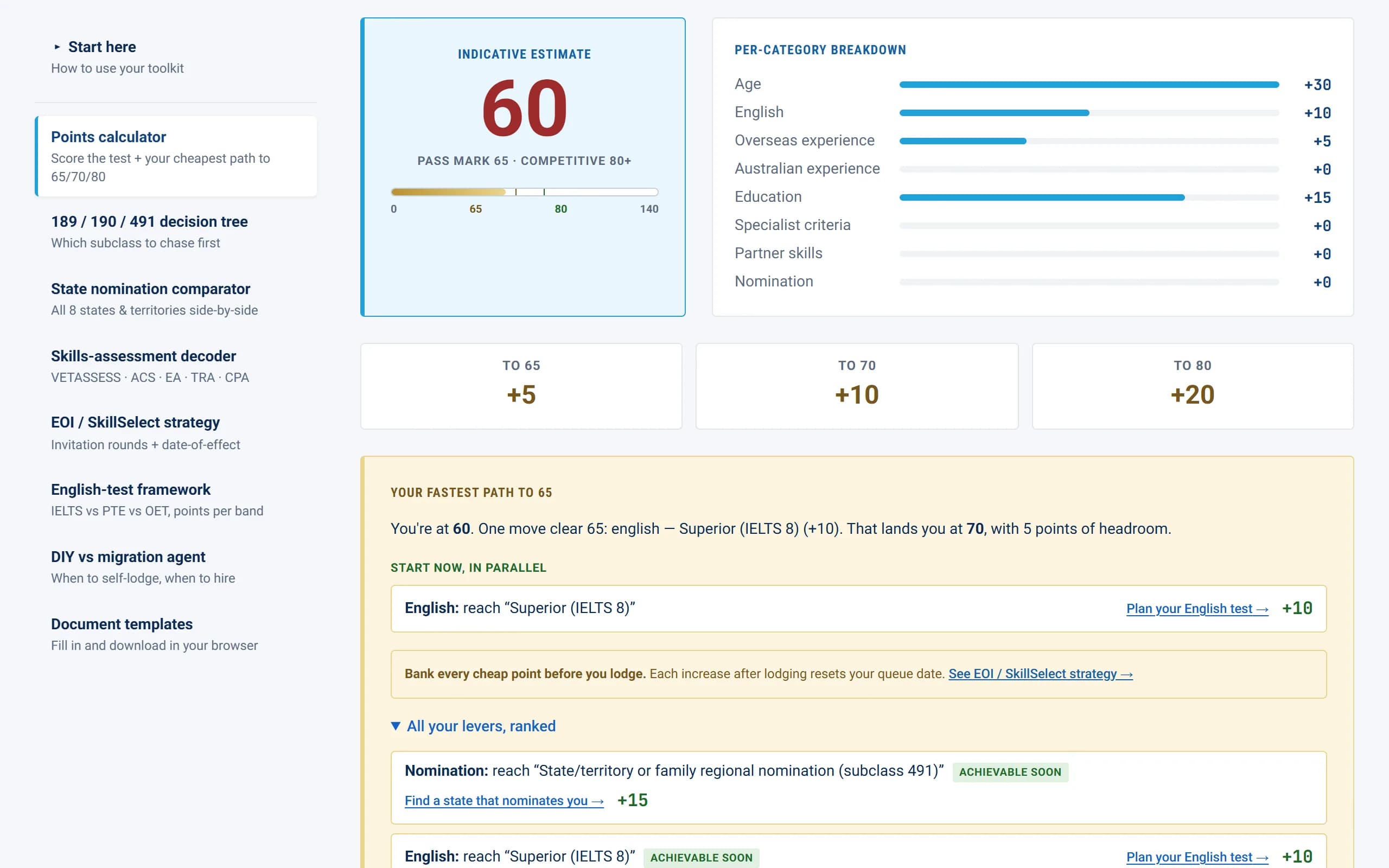
| Points Factor | Points | Notes |
|---|---|---|
| Age (25-32) | 30 | Maximum bracket |
| Qualification (Master's) | 15 | Common in landscape architecture |
| Qualification (Bachelor) | 15 | Minimum entry |
| Qualification (PhD) | 20 | Rare but valuable |
| English (Proficient, IELTS 7) | 10 | Standard target |
| English (Superior, IELTS 8) | 20 | Strong differentiator |
| Overseas experience 5-7 years | 10 | After VETASSESS deduction |
| Overseas experience 8+ years | 15 | After VETASSESS deduction |
| Australian experience | 5-20 | Where applicable |
| State nomination (190) | 5 | If invited |
| Regional nomination (491) | 15 | Largest single boost |
| Partner skills | 5-10 | If partner clears assessment |
| Australian study | 5 | Two years recent Australian study |
Realistic Scenarios
Scenario 1: Mid-career landscape architect with Master's degree
- Age 31 (30) + Master's (15) + Proficient English (10) + 5 years experience (10) = 65 points
- Add 491 regional nomination (+15) = 80 points — competitive for regional invitation
- With Superior English (20 instead of 10): 90 points — strong for 189
Scenario 2: Recent graduate with Australian Bachelor
- Age 27 (30) + Bachelor (15) + Superior English (20) + Australian study (5) = 70 points
- Add 190 nomination (+5) = 75 points — workable for 190 in less competitive years
- Add Professional Year (5) and partner skills (5) = 85 points — competitive
State Nomination
Victoria
Victoria has been an active nominator of landscape architects in recent years, tied to Melbourne's housing accord delivery and the state's Suburban Rail Loop public-realm work. The program requires recent professional experience and a clear Victorian settlement plan.
New South Wales
NSW publishes 190 and 491 lists at four-digit ANZSCO unit group level for 2025-26. 2321 Architects and Landscape Architects is captured at unit group level. NSW allocated 2,100 places to 190 and 1,500 to 491 for the program year, with strong activity in the construction and infrastructure priority sector.
Queensland
Queensland's 2,600-place allocation for 2025-26 (1,850 for 190 and 750 for 491) reflects pressure on the state's housing supply and the run-up to the 2032 Brisbane Olympics. The Queensland Skilled Occupation List has favoured construction-adjacent professional occupations, with landscape architecture appearing in nominations alongside urban planning and civil engineering.
South Australia
South Australia has historically nominated professional construction occupations for offshore candidates with two years recent overseas experience. Adelaide's CBD renewal and regional council master-planning work create steady demand.
Tasmania
Tasmania nominates landscape architects through its 491 stream for candidates with study or employment links to the state. Hobart's heritage-driven public realm work and the state government's regional revitalisation program drive most opportunities.
Salary and Employment Outlook
| Role | Typical Salary Range |
|---|---|
| Graduate Landscape Architect | AUD $65,000-$78,000 |
| Landscape Architect (3-5 years) | AUD $80,000-$100,000 |
| Senior Landscape Architect | AUD $100,000-$130,000 |
| Associate / Senior Associate | AUD $130,000-$160,000 |
| Principal / Director | AUD $160,000-$220,000+ |
| Contractor (day rate) | AUD $700-$1,100/day |
Sources: SEEK Career Advice Landscape Architect page (2026), AILA salary survey, Hays Salary Guide construction band. Total packages include 11.5% superannuation. Private practice associates often receive performance bonuses tied to fee-earning targets, while government roles use enterprise agreement structures with predictable progression.
The highest-paying segments in 2026 are large multidisciplinary practices working on infrastructure design (transport corridor, station precincts), developer-side senior roles, and specialist consulting in ecological restoration or water-sensitive urban design. Sydney and Melbourne sit roughly 10-15% above Brisbane, Perth and Adelaide on equivalent roles.
Tips for a Successful Application
-
Confirm your qualification is unambiguously landscape architecture. VETASSESS rejects degrees titled architecture, landscape design, environmental management or horticulture without core landscape architecture subjects. If your transcript is unclear, request a curriculum summary letter from your institution before lodging.
-
Build a portfolio for VETASSESS that shows master-planning, not garden design. The portfolio should demonstrate public-realm scale work, civic projects, subdivision masterplans or institutional landscape design. Residential garden work alone reads as landscape design, not landscape architecture.
-
Document employment with reference letters that name landscape architecture duties explicitly. Reference letters should list site analysis, design concept development, technical documentation, construction supervision and approvals coordination. Generic "design work" descriptions trigger VETASSESS queries.
-
Plan for AILA registration after arrival. AILA Registered (RLA) status opens senior practice opportunities and government tender lists. Start collecting Australian project evidence from day one so you can apply for RLA after two to three years of local practice.
-
Use the Priority Processing option if you have a sponsor or invitation deadline. VETASSESS Priority Processing returns outcomes within 10 business days for an additional fee, which is often cheaper than holding open a job offer while standard 8-10 week processing runs.
Step-by-Step Migration Roadmap
- Confirm your qualification is landscape architecture using the ANZSCO code finder
- Cross-check 232112 against the Skilled Occupation List 2026 and Core Skills Occupation List
- Sit an English test — target Proficient (IELTS 7) minimum
- Assemble your VETASSESS submission — qualifications, transcripts, employment references, portfolio
- Lodge VETASSESS Skills Assessment (AUD $1,096)
- Receive positive outcome and calculate points using assessed years of experience
- Submit an EOI in SkillSelect for 189, 190 or 491
- For employer-sponsored routes, secure an offer from a CSOL-eligible practice or developer and lodge nomination plus 482
- Apply for state nomination if pursuing 190 or 491
- Receive an invitation and lodge the visa within 60 days
- Complete health, character and biometric checks
- Receive grant — on arrival, register interest in AILA Registered membership and connect with local practice networks
Frequently Asked Questions
Can I migrate as a Landscape Designer rather than a Landscape Architect?
No — there is no separately classified ANZSCO code for landscape designers, and the 232112 Landscape Architect code requires a qualification at Bachelor degree level or higher in landscape architecture specifically. Practitioners without a degree-level qualification typically need to study a graduate-entry Master of Landscape Architecture in Australia before migration becomes feasible.
Is AILA registration required for the visa?
No. The visa requires only a positive VETASSESS skills assessment under 232112. AILA registration (Registered Landscape Architect) becomes important after arrival for senior practice and government tender eligibility, but it is not a migration requirement.
How does VETASSESS treat my five years of garden design experience?
VETASSESS distinguishes garden and residential design from landscape architecture. If your post-qualification employment was predominantly residential garden design — even paid professionally — it may not count toward the highly relevant employment requirement. Reference letters should emphasise public-realm scale, master-planning, institutional and infrastructure work where you have it.
Which Australian practices actively sponsor international landscape architects?
The largest multidisciplinary practices regularly sponsor 482 and 186 visas — Aspect Studios, McGregor Coxall, Tract Consultants, Hassell, Cox, Place Design Group, Urbis, TCL and others. Public sector employers (Transport for NSW, Major Transport Infrastructure Authority in Victoria, City of Melbourne) sponsor less frequently but pay well and offer permanent positions.
What's the demand outlook for landscape architects in Australia in 2026?
Demand is steady to strong. The federal Housing Accord targets 1.2 million new homes by 2029, every one of which requires open-space provision and council subdivision approvals. The 2032 Brisbane Olympics has accelerated infrastructure delivery in southeast Queensland. Climate-driven coastal protection and bushfire recovery work is creating new specialist niches in ecological restoration and water-sensitive urban design.