Interior Designer Visa Pathway to Australia: Complete 2026 Guide
Updated: 16 August 2026
Australia classifies the Interior Designer occupation under ANZSCO 232511. VETASSESS conducts the skills assessment. The occupation sits on the Core Skills Occupation List (CSOL), giving access to subclasses 190, 491, 482 and 186. Typical 2026 salaries run AUD $70,000-$110,000. A project portfolio is required, and the role is not on the MLTSSL, so subclass 189 is closed.
Quick Facts: Interior Designer Migration Pathway
| Detail | Information |
|---|---|
| ANZSCO Code | 232511 (Interior Designer) |
| Skill Level | 2 per ANZSCO (Diploma or three years experience); VETASSESS requires Bachelor level |
| Skills Assessment | VETASSESS (Vocational Education and Training Assessment Services) |
| Occupation List | CSOL (also legacy STSOL) |
| Visa Options | 190, 491, 482, 186 |
| Demand Level | Moderate — no national shortage flag; demand follows construction and fitout cycles |
| Salary Range | AUD $70,000-$110,000 (SEEK + PayScale, 2026) |
| Typical 189 Score | Not applicable — 232511 is not on the MLTSSL |
| Key Challenge | VETASSESS sets a Bachelor-level bar above the ANZSCO skill level, plus a mandatory portfolio |
What an Interior Designer Does in Australia
An Interior Designer plans and designs the layout, function and feel of interior spaces. The work runs from the brief through concept design, space planning, material and finish selection, and documentation for construction. Designers consult clients to define objectives and constraints, research spatial, safety and aesthetic requirements, and negotiate solutions with clients, suppliers and construction teams. The role covers commercial, retail, hospitality, residential and workplace interiors.
Demand follows the construction and commercial-fitout cycle. Work concentrates in Sydney, Melbourne and Brisbane, where most design studios, architecture practices with interiors arms, commercial fitout firms and retail and hospitality groups operate. SEEK city data shows Brisbane and Melbourne among the higher-paying markets. Smaller pools sit in Adelaide, Perth and Canberra.
Jobs and Skills Australia does not list Interior Designer as in shortage at the national level in its most recent assessment. That shapes the migration strategy. Without a shortage flag, independent points selection rarely favours the code, so most migrants rely on state nomination or employer sponsorship.
ANZSCO 232511 Mapping
The official ANZSCO description for 232511 covers professionals who plan and design interior environments for function and appearance. Typical tasks include:
- Consulting clients to determine the design brief objectives and constraints
- Researching spatial, functional, efficiency, safety and aesthetic requirements
- Formulating interior design concepts and preparing sketches, diagrams and plans
- Selecting and specifying materials, finishes, furniture and products
- Documenting designs for construction and supervising interior construction work
A point worth noting on skill level: the Australian Bureau of Statistics classifies 232511 at ANZSCO Skill Level 2, which indicates a Diploma or three years of relevant experience. VETASSESS, however, applies its own Group B criteria and requires a qualification comparable to an AQF Bachelor degree for a positive assessment. The two standards are separate. The ANZSCO skill level describes the occupation; the VETASSESS criteria decide your assessment outcome.
If your work leans toward building design and structure, you map closer to Architect (242111) or an architectural draftsperson code rather than 232511. Compare the descriptions using the ANZSCO code finder before committing.
Skills Assessment — VETASSESS
VETASSESS is the assessing authority for Interior Designer, and it is a Group B occupation. Group B means VETASSESS assesses both your qualification and your employment, through one of four pathways. The full list of assessors sits on the skills assessment bodies complete list.
Qualification requirement: A qualification assessed as comparable to an AQF Bachelor degree or higher, with a major in Interior Design or Interior Architecture. VETASSESS generally does not treat a general architecture degree as highly relevant unless it carries substantial interior design content, in which case it may be assessed case by case.
Four assessment pathways:
- Bachelor degree or higher in a highly relevant field, plus at least 1 year of post-qualification highly relevant employment in the past 5 years.
- Bachelor degree or higher in a non-relevant field, plus an additional AQF Diploma-level qualification in a highly relevant field, plus 2 years of employment in the past 5 years.
- Bachelor degree or higher in a non-relevant field, plus 3 years of employment in the past 5 years.
- Bachelor degree or higher in any field, plus 6 years of total employment, including at least 1 year of highly relevant work in the past 5 years.
Employment: All pathways require employment of at least 20 hours per week at an appropriate skill level, in tasks that match the 232511 description.
Portfolio: Expected. VETASSESS advises that a portfolio showing project documentation examples and project lists is appropriate, with each sample capped at 5MB. Self-employed applicants must also supply business registration, an accountant or solicitor statement, a statutory declaration of duties, and payment evidence.
Assessment cost: AUD $1,096 for the standard full skills assessment if you are a non-resident for tax purposes (AUD $1,205.60 including GST for applicants in Australia). Priority processing adds AUD $825.
Processing time: VETASSESS publishes a standard professional-assessment window of roughly 12 to 16 weeks. Priority processing shortens this.
Common rejection reasons: A qualification that VETASSESS reads as general architecture or interior decoration rather than interior design; employment references that describe decorating or sales duties rather than design and documentation; and missing portfolio evidence for self-employed applicants.
Visa Pathways for Interior Designers
Subclass 482 — Skills in Demand
A practical pathway because 232511 sits on the CSOL and commercial fitout firms, studios and retail groups sponsor designers.
- Visa fee: AUD $3,210 (Core Skills stream)
- Salary thresholds: Core Skills Income Threshold AUD $76,515; Specialist threshold AUD $141,210 (1 July 2025 to 30 June 2026)
- Processing time: Core Skills stream around two months for most applications
- Quirk: Senior interior designer salaries often clear the Core threshold, but junior salaries can sit below it, so confirm the offered salary meets the CSIT before lodging.
Subclass 190 — Skilled Nominated
Permanent residency with state nomination, which adds 5 points.
- Visa fee: AUD $6,140
- Points boost: +5
- Obligation: Live in the nominating state, usually for 2 years
- Quirk: With no national shortage flag, 190 invitations for 232511 are selective and often need a current local job offer.
Subclass 491 — Skilled Work Regional
A five-year provisional visa that adds 15 points and leads to permanent residency through subclass 191.
- Visa fee: AUD $6,140
- Points boost: +15
- Quirk: Regional fitout and hospitality projects, especially in tourism regions, can support 491 nomination where the capitals will not.
Subclass 186 — Employer Nomination Scheme
Permanent residency through employer sponsorship, via Direct Entry or the Temporary Residence Transition stream after a 482.
- Visa fee: AUD $6,140
- Quirk: Direct Entry requires three years of relevant experience and a positive skills assessment.
Subclass 189 is closed to Interior Designers because 232511 is not on the MLTSSL.
Points Test Strategy
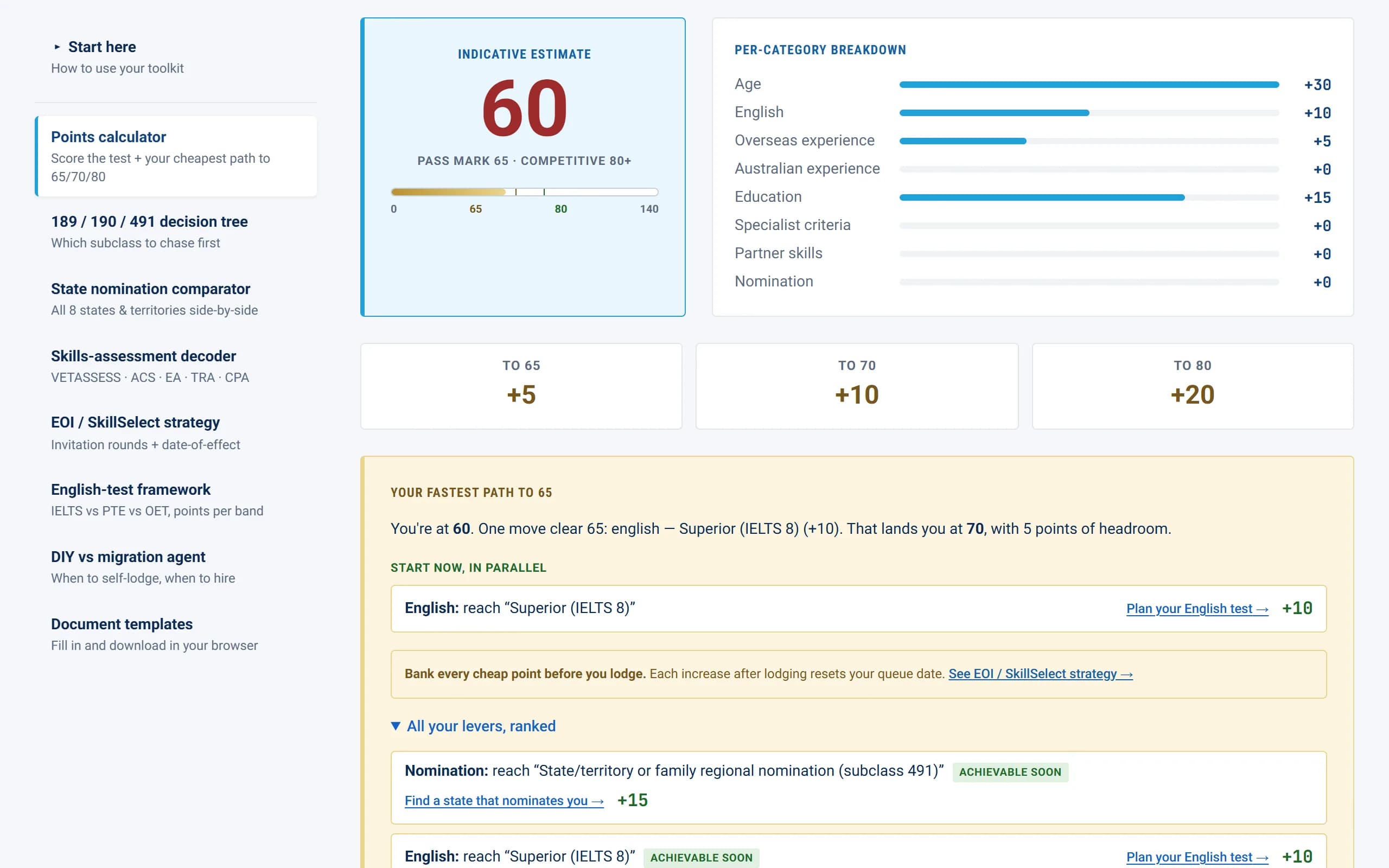
The points test applies to the 190 and 491 pathways.
| Points Factor | Maximum | Notes |
|---|---|---|
| Age (25-32) | 30 | Peak band |
| Age (33-39) | 25 | Strong |
| English (Superior 8.0) | 20 | Highest-value single factor |
| English (Proficient 7.0) | 10 | Floor for a competitive score |
| Qualification (Bachelor/Master) | 15 | Typical |
| Skilled experience overseas | 5-15 | Depends on assessed years |
| Skilled experience Australia | 5-20 | If you have worked locally |
| State nomination (190) | 5 | |
| Regional nomination (491) | 15 | |
| Partner skills | 5-10 | |
| Professional Year / NAATI CCL | 5 | Where applicable |
Scenario 1 — Offshore commercial interior designer, 7 years experience
Age 32 (30) + Bachelor in interior design (15) + Proficient English (10) + skilled experience (10) = 65. Add 491 regional nomination (15) = 80. A realistic score for a regional state listing 232511.
Scenario 2 — Onshore designer with Australian study and a job offer
Age 29 (30) + Master's (15) + Australian study (5) + Superior English (20) + two years local work (5) = 75. Add 190 (5) = 80. Competitive where a state nominates the code and a local job offer supports the claim.
State Nomination for Interior Designers
State nomination for 232511 is selective and changes each program year. Verify the current status of the code on each state's published occupation list before lodging, because state lists are a subset of the CSOL and turn over frequently.
Regional 491 pathways tend to be more reliable for interior designers than capital-city 190 streams, because regional programs weight a current local job offer and genuine settlement intent more heavily than raw points. A job offer from an Australian employer changes your odds more than any single points factor.
Confirm list status on the skilled occupation list for 2026 and the Core Skills Occupation List before you commit time and fees.
Salary and Employment Outlook
| Role | Typical Salary Range (AUD) |
|---|---|
| Junior Interior Designer | $50,000-$62,000 |
| Interior Designer (mid-level) | $70,000-$90,000 |
| Senior Interior Designer | $90,000-$111,000 |
| Associate / Design Lead | $100,000-$130,000 |
| Design Director (Sydney) | $120,000-$150,000+ |
| Contract day rate | $400-$700/day |
Source: SEEK May 2026 data and PayScale Australia, cross-referenced with Indeed Australia and Glassdoor Australia. SEEK reports a national average near AUD $80,000-$95,000, with Brisbane and Melbourne among the higher city figures. PayScale puts junior roles around AUD $50,000 and senior roles around AUD $90,000. Superannuation adds 11.5% to base salary.
Highest-paying contexts:
- Commercial and workplace fitout — large fitout firms and corporate interiors
- Hospitality and retail design — hotel, restaurant and flagship-store projects
- Architecture practices with interiors teams — integrated design firms
- Property developers — in-house design roles on residential and mixed-use projects
- Design directors and associates at established Sydney and Melbourne studios
Sydney commands the highest senior salaries, while regional roles sit below the metropolitan average.
Tips for a Successful Application
-
Confirm your degree reads as interior design, not architecture or decoration. VETASSESS treats a general architecture degree as not highly relevant unless it carries substantial interior content. Supply unit transcripts that show space planning, interior documentation and materials specification so the assessor maps you cleanly to 232511.
-
Prepare a documentation-led portfolio. VETASSESS wants project documentation examples and project lists, not just glossy renders. Include floor plans, finishes schedules, and construction documentation alongside concept imagery. Keep each sample under 5MB.
-
If you are self-employed, gather the extra evidence early. VETASSESS requires business registration, a statement from an accountant or solicitor, a statutory declaration of duties, and payment evidence. Assembling these late is a common cause of delay.
-
Plan around sponsorship or regional nomination. With no national shortage flag and no 189 access, the fastest route is a sponsoring employer on 482 or a regional 491 backed by a job offer. Apply directly to Australian fitout firms and studios from offshore.
-
Maximise English points. Superior English is worth 20 points against 10 for Proficient. For a nomination-dependent occupation, those 10 points often decide whether you are invited.
Step-by-Step Migration Roadmap
- Confirm 232511 fits your duties better than an architecture or draftsperson code using the ANZSCO code finder
- Check list status on the 2026 skilled occupation list and the CSOL
- Gather employment references and a documentation-led portfolio
- Sit your English test, aiming for Superior bands
- Lodge the VETASSESS skills assessment (AUD $1,096 offshore) and wait roughly 12 to 16 weeks
- Calculate your points across age, English, qualification and experience
- Submit an Expression of Interest in SkillSelect for 190 and 491 — see how SkillSelect works
- Apply for state nomination where 232511 is listed, prioritising regional 491
- In parallel, apply to Australian fitout firms and studios for 482 sponsorship
- Receive your invitation and lodge the visa within 60 days
- Complete health checks and police certificates
- Receive the grant and relocate
Frequently Asked Questions
Why does VETASSESS require a Bachelor degree when ANZSCO lists Interior Designer at Skill Level 2?
The two standards measure different things. The ANZSCO Skill Level 2 classification describes the occupation in the labour market and indicates a Diploma or three years of experience as the indicative entry point. VETASSESS applies its own Group B assessment criteria for migration and requires a qualification comparable to an AQF Bachelor degree for a positive outcome. You must meet the VETASSESS standard to pass the skills assessment, regardless of the ANZSCO level.
Can an Interior Designer apply for the subclass 189 visa?
No. Subclass 189 is reserved for occupations on the MLTSSL. Interior Designer sits on the CSOL and the legacy STSOL, not the MLTSSL, so the independent 189 is closed. The realistic pathways are 190, 491, 482 and 186. Confirm current list status on the skilled occupation list page.
Is interior decorating the same as interior design for migration purposes?
No. Interior decoration focuses on furnishing and styling existing spaces and is treated differently by VETASSESS. Interior Designer (232511) covers space planning, documentation for construction and technical design work. References that describe styling, sales or decoration rather than design and documentation can lead to a negative assessment, so frame your duties against the 232511 task list.
What is the demand outlook for Interior Designers in Australia in 2026?
Moderate and cyclical. Jobs and Skills Australia does not flag Interior Designer as a national shortage, so demand tracks the construction and commercial-fitout cycle rather than a structural shortfall. Senior and specialist designers in commercial and hospitality work see the strongest demand, and a current Australian job offer is the single most useful asset in an application.
Will my interior design qualification from overseas be recognised?
VETASSESS assesses your qualification against the Australian Qualifications Framework. A Bachelor degree in interior design from an accredited overseas institution is usually mapped to AQF Bachelor level. The harder question is whether VETASSESS accepts your major as highly relevant to 232511. Degrees badged as architecture, interior decoration or general design can attract closer scrutiny, so include detailed unit transcripts.