Illustrator Visa Pathway to Australia: Complete 2026 Guide
Updated: 16 August 2026
Australia classifies the Illustrator occupation under ANZSCO 232412. VETASSESS conducts the skills assessment. The occupation sits on the Core Skills Occupation List (CSOL), giving access to subclasses 190, 491, 482 and 186. Typical 2026 salaries run AUD $68,000-$110,000. A portfolio is mandatory, and the role is not on the MLTSSL, so subclass 189 is closed.
Quick Facts: Illustrator Migration Pathway
| Detail | Information |
|---|---|
| ANZSCO Code | 232412 (Illustrator) |
| Skill Level | 1 (Bachelor degree or higher, or five years relevant experience) |
| Skills Assessment | VETASSESS (Vocational Education and Training Assessment Services) |
| Occupation List | CSOL (also legacy STSOL) |
| Visa Options | 190, 491, 482, 186 |
| Demand Level | Low to moderate — no national shortage flag; a freelance-heavy market |
| Salary Range | AUD $68,000-$110,000 (SEEK + Indeed, 2026) |
| Typical 189 Score | Not applicable — 232412 is not on the MLTSSL |
| Key Challenge | A small, freelance-dominated employment market and a mandatory portfolio |
What an Illustrator Does in Australia
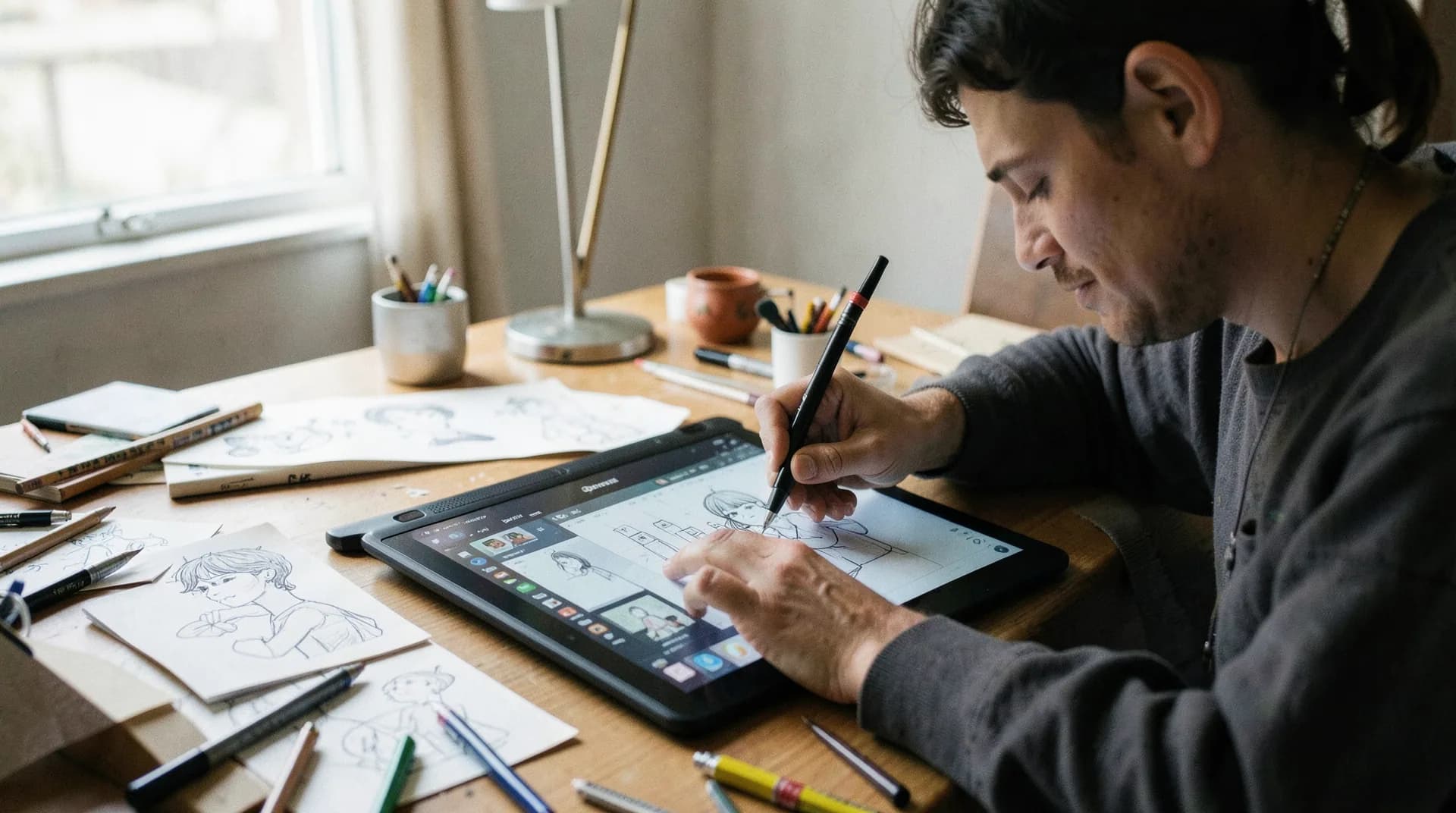
An Illustrator plans and creates pictures, diagrams and visual narratives that communicate a message or tell a story. The work spans traditional and digital media, from drawing and painting to image-manipulation software and 3D modelling. Illustrators study a brief, choose a style, technique and medium, research reference material, and prepare sketches, layouts and storyboards before producing final artwork. The ANZSCO unit group also covers specialisations such as Animator, Cartoonist and Technical Illustrator.
Illustration work in Australia concentrates in Sydney and Melbourne, which carry the higher salary figures and the densest pool of publishers, agencies, studios and media companies. Sectors include book and editorial publishing, advertising and marketing, games and animation studios, and scientific, medical and technical illustration. A large share of the market is freelance and project-based rather than salaried full-time, which shapes how migration realistically works for this code.
Jobs and Skills Australia does not list Illustrator as in shortage anywhere in the country in its most recent assessment. That has a direct consequence: independent points selection will not favour the code, so a sponsoring employer or state nomination is essential.
ANZSCO 232412 Mapping
The official ANZSCO description for 232412 covers professionals who plan and design pictures and diagrams to illustrate stories and communicate messages. Typical tasks include:
- Studying the brief and selecting the style, technique and medium
- Researching reference material relevant to the subject
- Preparing sketches, layouts and storyboards
- Creating 2D and 3D illustrations using traditional or digital media
- Liaising with clients, editors, writers and the production team
Illustrator sits in ANZSCO unit group 2324 alongside Graphic Designer (232411), Multimedia Designer (232413) and Web Designer (232414). It is not grouped with Photographer, which falls under a separate ANZSCO code. If your work is mostly layout, branding and typography, you map closer to Graphic Designer. If it blends animation, video and scripting for interactive products, 232413 Multimedia Designer fits better. Compare the descriptions using the ANZSCO code finder before choosing.
Skills Assessment — VETASSESS
VETASSESS is the assessing authority for Illustrator, and it is a Group B occupation. Group B means VETASSESS assesses both your qualification and your employment through one of four pathways. See the skills assessment bodies complete list for how this compares to other assessors.
Qualification requirement: A qualification assessed as comparable to an AQF Bachelor degree or higher, with a major in a highly relevant field. VETASSESS names Illustration, Visual Art, Visual Communication, Graphic or Multimedia Design, and Fine Art. A broader design qualification may be considered case by case where it includes drawing and illustration subjects and is backed by highly relevant employment.
Four assessment pathways:
- Bachelor degree or higher in a highly relevant field, plus at least 1 year of post-qualification highly relevant employment in the past 5 years.
- Bachelor degree or higher in a non-relevant field, plus an additional AQF Diploma-level qualification in a highly relevant field, plus 2 years of employment in the past 5 years.
- Bachelor degree or higher in a non-relevant field, plus 3 years of employment in the past 5 years.
- Bachelor degree or higher in any field, plus 6 years of total employment, including at least 1 year of highly relevant work in the past 5 years.
Employment: All pathways require employment of at least 20 hours per week at an appropriate skill level, in tasks that match the 232412 description.
Portfolio: Mandatory. You must provide a link to your portfolio or upload samples of your illustration work, with each sample capped at 5MB.
Assessment cost: AUD $1,096 for the standard full skills assessment if you are a non-resident for tax purposes (AUD $1,205.60 including GST for applicants in Australia). Priority processing adds AUD $825.
Processing time: VETASSESS publishes a standard professional-assessment window of roughly 12 to 16 weeks. Priority processing shortens this.
Common rejection reasons: A freelance employment history that lacks the documentary evidence VETASSESS needs to verify 20 hours per week of paid work; a portfolio or qualification that reads as general fine art rather than commercial illustration; and references that do not describe illustration duties clearly.
Visa Pathways for Illustrators
Subclass 482 — Skills in Demand
The most workable salaried pathway, since 232412 sits on the CSOL and studios, publishers and agencies can sponsor.
- Visa fee: AUD $3,210 (Core Skills stream)
- Salary thresholds: Core Skills Income Threshold AUD $76,515; Specialist threshold AUD $141,210 (1 July 2025 to 30 June 2026)
- Processing time: Core Skills stream around two months for most applications
- Quirk: Many illustrator salaries sit near or below the Core threshold, so a sponsored role must offer at least the CSIT to qualify.
Subclass 190 — Skilled Nominated
Permanent residency with state nomination, which adds 5 points.
- Visa fee: AUD $6,140
- Points boost: +5
- Obligation: Live in the nominating state, usually for 2 years
- Quirk: South Australia has listed Illustrator on its skilled occupation list, which makes it one of the more realistic 190 or 491 targets for this code. Verify current status before lodging.
Subclass 491 — Skilled Work Regional
A five-year provisional visa that adds 15 points and leads to permanent residency through subclass 191.
- Visa fee: AUD $6,140
- Points boost: +15
- Quirk: Remote and freelance illustration suits regional living, and regional programs apply more flexible criteria than the capitals.
Subclass 186 — Employer Nomination Scheme
Permanent residency through employer sponsorship, via Direct Entry or the Temporary Residence Transition stream after a 482.
- Visa fee: AUD $6,140
- Quirk: Direct Entry requires three years of relevant experience and a positive skills assessment, which is a high bar for a freelance career.
Subclass 189 is closed to Illustrators because 232412 is not on the MLTSSL.
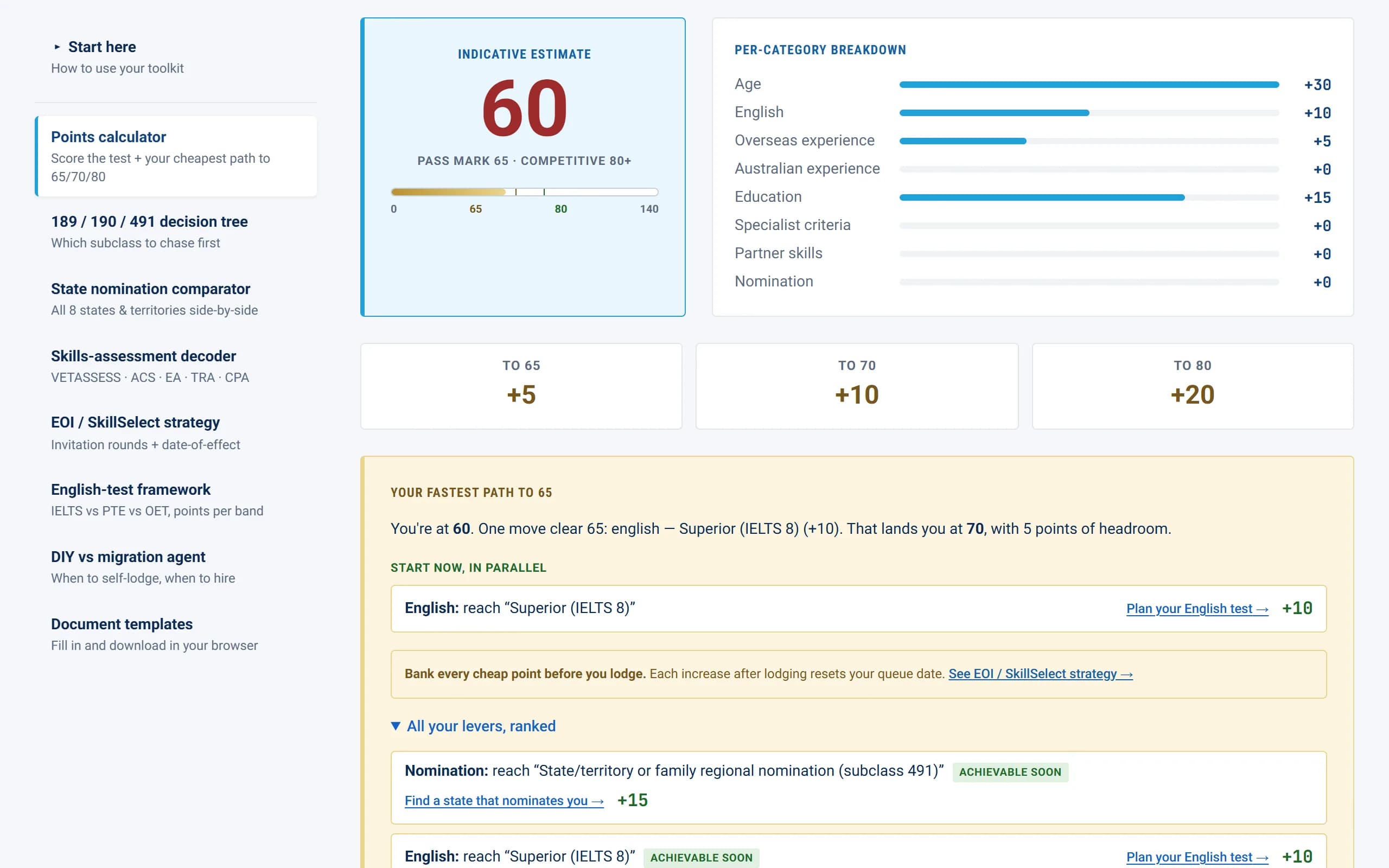
Points Test Strategy
The points test applies to the 190 and 491 pathways.
| Points Factor | Maximum | Notes |
|---|---|---|
| Age (25-32) | 30 | Peak band |
| Age (33-39) | 25 | Strong |
| English (Superior 8.0) | 20 | Highest-value single factor |
| English (Proficient 7.0) | 10 | Floor for a competitive score |
| Qualification (Bachelor/Master) | 15 | Typical |
| Skilled experience overseas | 5-15 | Depends on assessed years |
| Skilled experience Australia | 5-20 | If you have worked locally |
| State nomination (190) | 5 | |
| Regional nomination (491) | 15 | |
| Partner skills | 5-10 | |
| Professional Year / NAATI CCL | 5 | Where applicable |
Scenario 1 — Offshore editorial illustrator, 6 years salaried experience
Age 30 (30) + Bachelor in illustration (15) + Proficient English (10) + skilled experience (10) = 65. Add 491 regional nomination (15) = 80. Workable for a regional state that lists 232412.
Scenario 2 — Onshore illustrator with Australian study
Age 27 (30) + Master's (15) + Australian study (5) + Superior English (20) + two years local work (5) = 75. Add 190 (5) = 80. Competitive where a state nominates the code, such as South Australia.
State Nomination for Illustrators
State nomination is the realistic permanent-residency route for 232412, and it is narrow. South Australia has listed Illustrator on its skilled occupation list, which makes it the most commonly cited nominator for this code. The specific subclass and any conditions change each program year, so confirm directly on the state's live list before lodging an Expression of Interest.
Other states publish smaller, more selective lists, and inclusion of 232412 varies year to year. Treat any state claim as something to verify against the official source rather than assume. Regional 491 backed by a current job offer is generally the strongest position for a creative occupation without a shortage flag.
Confirm the code's current status on the skilled occupation list for 2026 and the Core Skills Occupation List before you commit.
Salary and Employment Outlook
| Role | Typical Salary Range (AUD) |
|---|---|
| Entry-level Illustrator | $60,000-$68,000 |
| Illustrator (mid-level) | $70,000-$82,000 |
| Senior Illustrator | $90,000-$114,000 |
| Animator / Concept Artist | $75,000-$110,000 |
| Technical / Medical Illustrator | $80,000-$110,000 |
| Freelance | Highly variable, project-based |
Source: SEEK May 2026 data and Indeed Australia, cross-referenced with Talent.com Australia. SEEK reports city averages near AUD $82,500 in Sydney and AUD $80,000 in Melbourne. Talent.com Australia puts the national average near AUD $70,000 with entry-level around AUD $68,000. Indeed reports senior illustrator roles above AUD $110,000. Superannuation adds 11.5% to salaried base pay. Freelance income varies widely and is not captured by these salaried figures.
Highest-paying contexts:
- Games and animation studios — concept art and character design roles
- Scientific, medical and technical illustration — specialised, higher-paying niches
- Advertising and marketing agencies — campaign and brand illustration
- Publishing — book, editorial and children's illustration
- In-house brand teams at larger companies
Salaried full-time roles are the minority. Many illustrators work freelance or on contract, which complicates the VETASSESS employment evidence requirement.
Tips for a Successful Application
-
Document freelance work rigorously. VETASSESS needs to verify paid employment of at least 20 hours per week. For freelance illustrators, that means contracts, invoices, client letters and payment records, not just a portfolio. Assemble this evidence before you apply, because it is the most common point of failure for this occupation.
-
Build a commercial, not fine-art, portfolio. VETASSESS distinguishes commercial illustration from fine art. Show client work, briefs delivered and applied illustration rather than gallery pieces. Keep each sample under 5MB and link out where files are larger.
-
Target South Australia first for nomination. SA has listed Illustrator on its occupation list, which makes it the most realistic nominating state for the code. Confirm the current subclass and conditions on the state's live list, then build your Expression of Interest around it.
-
Plan around sponsorship or nomination, not 189. With no shortage flag and no MLTSSL access, independent migration is not viable. A sponsoring studio on 482 or a state nomination is the route. Apply directly to Australian studios, publishers and agencies from offshore.
-
Push for Superior English. Superior English is worth 20 points against 10 for Proficient. For an occupation that depends entirely on nomination or sponsorship, those points often make the difference at invitation.
Step-by-Step Migration Roadmap
- Confirm 232412 fits your duties better than Graphic Designer or Multimedia Designer using the ANZSCO code finder
- Check list status on the 2026 skilled occupation list and the CSOL
- Gather employment evidence, including freelance contracts and payment records, and a commercial portfolio
- Sit your English test, aiming for Superior bands
- Lodge the VETASSESS skills assessment (AUD $1,096 offshore) and wait roughly 12 to 16 weeks
- Calculate your points across age, English, qualification and experience
- Submit an Expression of Interest in SkillSelect for 190 and 491 — see how SkillSelect works
- Apply for state nomination, prioritising South Australia and regional 491
- In parallel, apply to Australian studios, publishers and agencies for 482 sponsorship
- Receive your invitation and lodge the visa within 60 days
- Complete health checks and police certificates
- Receive the grant and relocate
Frequently Asked Questions
Is Illustrator grouped with Photographer in ANZSCO?
No. Illustrator (232412) sits in unit group 2324 with Graphic Designer, Multimedia Designer and Web Designer. Photographer is classified under a separate ANZSCO code. The grouping matters because VETASSESS assesses Illustrator against design and illustration criteria, not photographic ones, and your qualification and portfolio must align with illustration work.
Can a freelance illustrator pass the VETASSESS assessment?
Yes, but the evidence bar is higher. VETASSESS must verify paid employment of at least 20 hours per week at an appropriate skill level. Freelance applicants need contracts, invoices, client confirmation letters and payment records to prove this. A strong portfolio alone is not enough. The most common reason freelance applications stall is thin or unverifiable employment evidence.
Can an Illustrator apply for the subclass 189 visa?
No. Subclass 189 is only available for occupations on the MLTSSL. Illustrator sits on the CSOL and the legacy STSOL, not the MLTSSL, so the independent 189 is closed. The realistic pathways are 190, 491, 482 and 186. Confirm current status on the skilled occupation list page.
Which state is best for an Illustrator seeking nomination?
South Australia has listed Illustrator on its skilled occupation list, which makes it the most commonly cited nominator for the code. Other states include it less consistently. Because state lists change each program year, verify the current status and subclass on the relevant state's official page before lodging an Expression of Interest.
What is the demand outlook for Illustrators in Australia in 2026?
Limited and freelance-heavy. Jobs and Skills Australia records no shortage for Illustrator across the country, and salaried full-time roles are the minority. Specialised niches such as games, animation and medical illustration hold up better than general editorial work, and any successful migration application leans on sponsorship or state nomination rather than independent points selection.