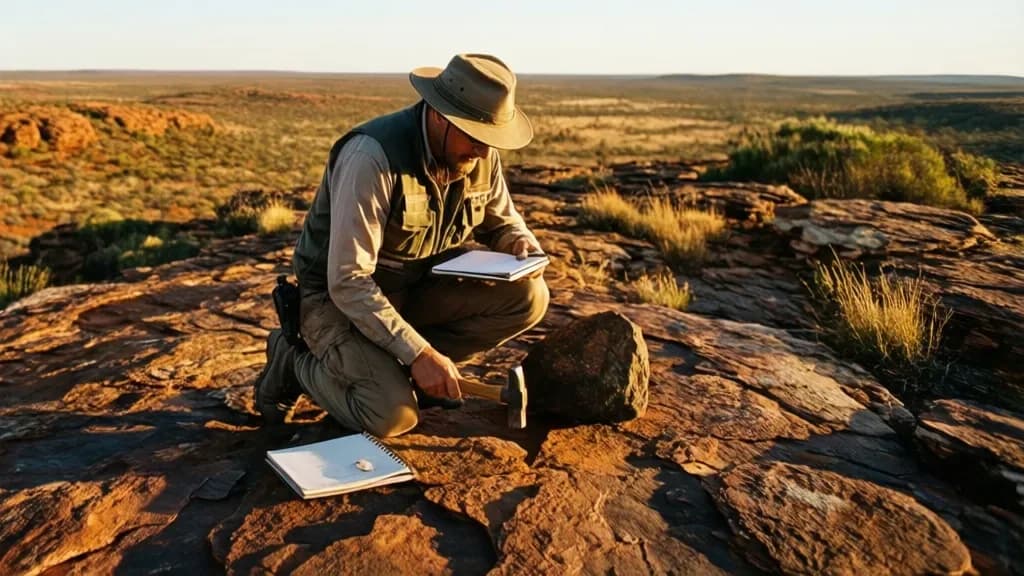
Environmental Manager Visa Pathway to Australia: Complete 2026 Guide
Updated: 16 August 2026
Australia classifies Environmental Managers under ANZSCO 139912. VETASSESS conducts the skills assessment. The occupation sits on the Core Skills Occupation List (CSOL) and the MLTSSL, unlocking subclasses 189, 190, 491, 482 and 186. Typical 2026 salaries range AUD $130,000-$200,000, with shortage status currently flagged in Victoria and Tasmania.
Quick Facts: Environmental Manager Migration Pathway
| Detail | Information |
|---|---|
| ANZSCO Code | 139912 (Environmental Manager) |
| Skill Level | 1 (Bachelor degree or higher, or five years of relevant experience) |
| Skills Assessment | VETASSESS (Vocational Education and Training Assessment Services) |
| Occupation List | CSOL and MLTSSL |
| Visa Options | 189, 190, 491, 482, 186 |
| Demand Level | High — shortage flagged in Victoria and Tasmania (2024 OSL) |
| Salary Range | AUD $130,000-$200,000 (SEEK, 2026) |
| Typical 189 Score | 80-90 points |
| Key Challenge | Demonstrating strategic environmental management scope rather than coordinator-level compliance work |
Role Context in Australia
Environmental Managers run environmental management systems inside organisations — identifying, mitigating and resolving pollution, waste, biodiversity, water and emissions issues to keep the business compliant with environmental legislation and on track with sustainability commitments. The job spans technical assessment, regulatory liaison, internal training, audit and incident response, and increasingly carbon and climate-risk reporting under ASRS, TCFD-aligned frameworks and the new Australian climate disclosure rules that began phasing in from 2025.
Around 2,800 people are employed in this occupation in Australia. The workforce skews older (median age 43), reflecting that this is a manager-level role typically reached after 8-12 years of progression from environmental scientist, environmental engineer, or HSE adviser roles. Employment is concentrated in New South Wales (about 33%), Victoria (about 26%) and Queensland (about 17%), with the rest spread across WA's resources sector, SA, Tasmania, ACT and NT.
The sectors hiring hardest are mining and resources, construction, infrastructure, water utilities, public administration, and consulting. The 2024 Occupation Shortage List records shortage status in Victoria and Tasmania, with the remaining states classed as "no shortage." Future demand is rated as strong because of the regulatory build-out around climate disclosure, EPBC reform, and the post-2030 emissions reduction trajectory.
ANZSCO 139912 Code Mapping
ANZSCO 139912 covers managers who develop, lead and implement environmental management systems within organisations. Tasks typically include setting environmental policy, leading compliance with legislation (Environment Protection and Biodiversity Conservation Act, state EPA Acts, NGER, Safeguard Mechanism), managing pollution prevention and waste programs, leading internal training, overseeing audit cycles and incident investigations, reporting to executives or boards, and increasingly leading carbon accounting and ESG disclosure programs.
This is a management code, not a technical code. Environmental scientists sit under 234312, environmental engineers under 233915, environmental consultants and officers under 234399, and environmental research scientists under 234399 or related codes. If your work is primarily technical analysis without team or program leadership, 139912 will be the wrong code and VETASSESS will reject it. Substantive titles that fit cleanly include Environmental Manager, Group Environmental Manager, Head of Sustainability, Environmental Compliance Manager, and Manager — Environment, Health and Safety (where the Environment scope dominates).
Skills Assessment with VETASSESS
VETASSESS is the assessing authority for Environmental Manager (139912).
Requirements
- A qualification assessed as comparable to an Australian Qualifications Framework (AQF) Bachelor degree or higher in a highly relevant field (environmental science, environmental engineering, environmental management, natural resource management, sustainability, related applied sciences with environmental content)
- At least one year of post-qualification employment at an appropriate skill level in the last five years, with additional pre-qualification or supporting employment under the four VETASSESS pathways
- Evidence of managerial scope — direct reports, budget responsibility, program ownership, executive reporting
- A current organisational chart on company letterhead. VETASSESS treats this as mandatory for managerial occupations.
Assessment Cost
VETASSESS charges AUD $1,205.60 for a full skills assessment for applicants in Australia (GST inclusive), or AUD $1,096.00 for applicants assessed as non-resident for Australian tax purposes. Priority Processing adds AUD $907.50 (in Australia) or AUD $825.00 (overseas). The current fee schedule applied from 22 October 2025.
Processing Time
Standard processing is 8-10 weeks from a complete lodgement. Priority Processing reduces this to 2-4 weeks for applications that submit all required evidence upfront.
Common Rejection Reasons
The most frequent reason for a negative outcome is qualification-field mismatch. Applicants with civil engineering, mining engineering or general business qualifications can struggle to demonstrate the "highly relevant" link unless their thesis, electives, or postgraduate studies have explicit environmental content. The second pattern is scope creep in employment evidence — applications that describe HSE advisory work or compliance officer duties without a clear leadership step up.
Visa Pathways for Environmental Managers
Subclass 189 — Skilled Independent Visa
Permanent residency through the points test. MLTSSL access applies.
- Visa fee: AUD $6,135 (primary applicant)
- Minimum points: 65, with realistic invitation thresholds at 80-90 in 2026
- Processing time: 6-12 months
- Reality: Lower-volume occupation than ICT, so 189 invitations clear at more accessible scores than for software roles — but still expect to need Proficient or Superior English.
Subclass 190 — State Nominated Visa
State nomination provides 5 points and permanent residency, with a 2-year commitment to live and work in the nominating state.
- Visa fee: AUD $6,140 (primary applicant)
- Points boost: +5
- Best states: Victoria and Tasmania currently flag shortage status; NSW and WA also nominate this code where state allocations allow.
Subclass 491 — Skilled Work Regional (Provisional) Visa
Five-year regional visa with transition to PR via subclass 191 after three years on a qualifying income.
- Visa fee: AUD $6,140 (primary applicant)
- Points boost: +15 (regional nomination)
- Reality: Tasmania's full state is regional. Regional QLD, regional NSW and regional WA are also major sources of mining and infrastructure roles for environmental managers.
Subclass 482 — Skills in Demand Visa
Employer-sponsored temporary visa, usually Core Skills stream and often Specialist Skills stream for senior hires given salary levels.
- Visa fee: AUD $3,210 (primary applicant, Core Skills stream)
- Salary threshold: Core Skills Income Threshold AUD $76,515; Specialist Skills Income Threshold AUD $141,210
- Duration: Up to 4 years
- Reality: Most Environmental Manager salaries clear the Specialist Skills threshold, which materially shortens processing under the post-2024 SID framework. Mining, utilities and tier-1 contractors sponsor regularly.
Subclass 186 — Employer Nomination Scheme
Permanent residency via employer sponsorship — Direct Entry or TRT.
- Visa fee: AUD $6,140 (primary applicant)
- Streams: Direct Entry or TRT (after 2+ years on a 482)
- Reality: Major employers in resources and utilities increasingly use Direct Entry 186 for senior environmental hires to lock in talent quickly.
Points Test Strategy
| Points Factor | Points | Notes |
|---|---|---|
| Age (25-32) | 30 | Maximum bracket |
| Age (33-39) | 25 | Common bracket given typical career arc |
| Bachelor degree | 15 | Required floor |
| Master's degree | 15 | Common — MEnvMgmt, MSc Sustainability |
| Doctorate | 20 | Useful in research-adjacent corporate roles |
| English (Superior 8.0+) | 20 | Strong upside |
| English (Proficient 7.0) | 10 | Realistic floor |
| Skilled employment overseas (5-7 yrs) | 10 | Typical for mid-career applicants |
| Skilled employment in Australia (3-4 yrs) | 10 | If already onshore |
| State Nomination (190) | 5 | Adds via VIC or TAS most reliably |
| Regional Nomination (491) | 15 | Strongest single booster |
| Partner skills | 5-10 | Often the deciding margin |
Realistic Score Scenarios
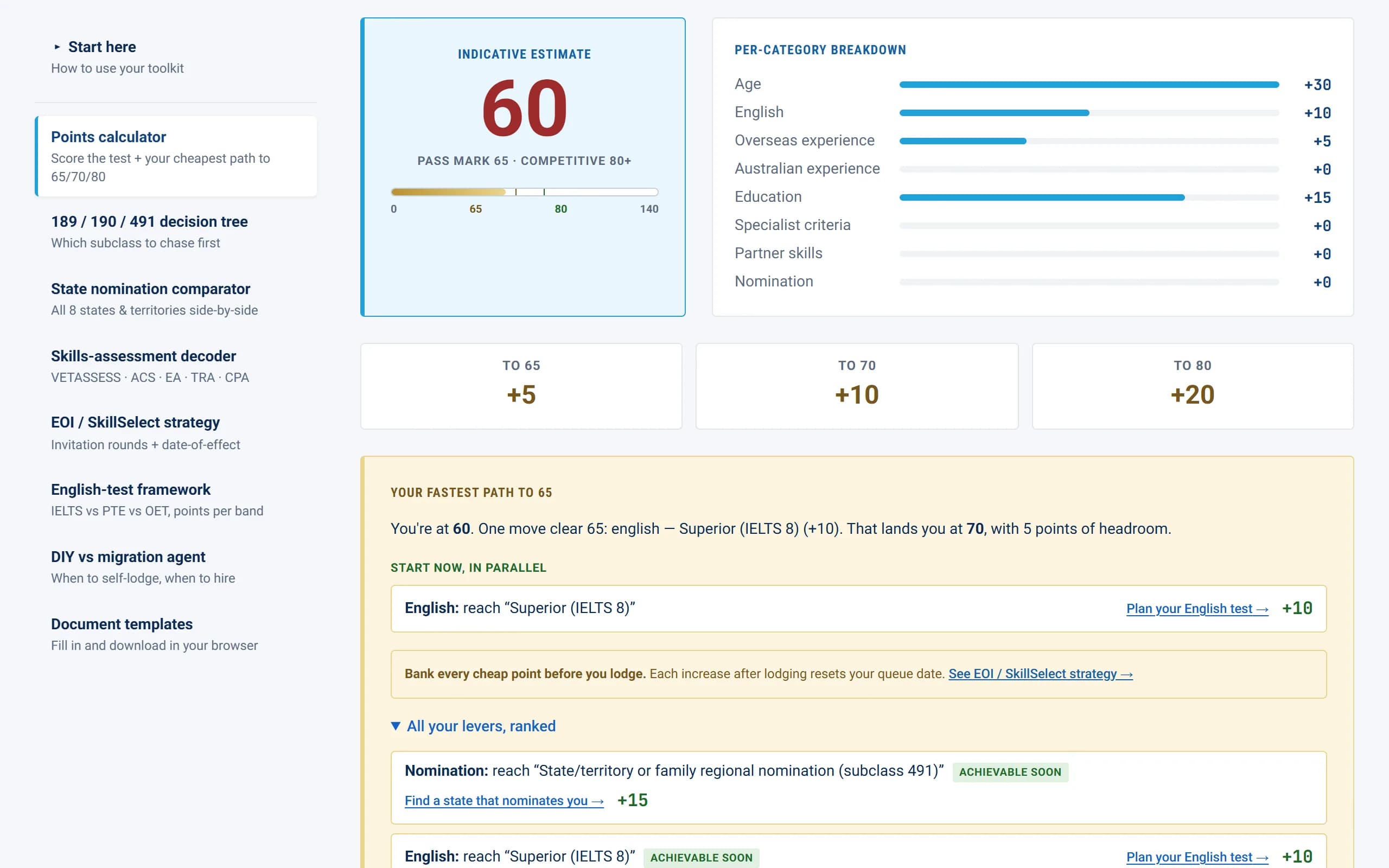
Scenario 1: Senior environmental manager, 34 years old, UK-trained MSc, Superior English, 9 years experience, partner with skilled occupation. Age 25 + Master's 15 + English 20 + Experience 15 + Partner 10 = 85 points. Competitive for 189 in 2026.
Scenario 2: Mid-career manager, 31 years old, Bachelor's, Proficient English, 6 years post-qualification experience, no partner skills. Age 30 + Bachelor 15 + English 10 + Experience 10 = 65 points. Needs 190 (+5 → 70) or 491 (+15 → 80) plus state nomination targeting Victoria or Tasmania.
State Nomination
Victoria
Victoria's 2024 Occupation Shortage List flags this occupation as in shortage. The state's nomination program prioritises candidates working in or moving into priority sectors — clean energy, water utilities, infrastructure and major projects all qualify. Melbourne's renewable energy build-out and the state's net-zero legislation create sustained demand at the manager level.
Tasmania
Tasmania records shortage status for this occupation. The state's onshore pathway requires applicants to have worked in Tasmania for six months immediately before nomination, in a closely related occupation, working at least 20 hours per week. Offshore applicants targeting Tasmania need a job offer or strong genuine intent to relocate.
New South Wales
NSW does not currently flag shortage but does nominate Environmental Manager where state allocations permit. Sydney's tier-1 infrastructure pipeline (Western Sydney Airport, metro extensions, road and rail projects) creates demand for environmental compliance managers at major contractors.
Queensland and Western Australia
Both states nominate periodically rather than as a priority. Queensland's resources and renewables build, and WA's mining-driven environmental scope, can generate state-nomination opportunities for candidates with sector-relevant experience and a job offer.
South Australia
SA recently expanded its nomination program around renewables, hydrogen and grid infrastructure projects. Candidates with sector-relevant experience are well-positioned for SA 491 nomination.
Salary and Employment Outlook
Environmental Manager salaries are well above the national professional median, reflecting the seniority required to enter the role and the regulatory exposure carried by the position.
| Role | Typical Salary Range (AUD) |
|---|---|
| Environmental Coordinator / Officer (pre-manager) | $90,000-$115,000 |
| Environmental Manager (early) | $130,000-$160,000 |
| Environmental Manager (mid) | $150,000-$185,000 |
| Senior Environmental Manager / Head of Sustainability | $180,000-$230,000 |
| Group / Principal Environmental Manager (major resources or infrastructure) | $220,000-$280,000+ |
| Director, Environment & Sustainability | $250,000-$350,000+ |
Source: SEEK Salary Hub (April 2026), with average advertised salaries of $168,510 in Engineering and $168,100 in Construction. Top regional roles in Bunbury & South West and Wagga Wagga & Riverina advertise at $217,500-$225,000 on SEEK. Total packages typically include 11.5% superannuation; resources-sector packages often add bonus structures and FBT-effective vehicle or housing benefits.
Highest-paying sectors are mining and resources (BHP, Rio Tinto, Fortescue, mid-tier iron ore and lithium operators), tier-1 construction and infrastructure (CIMIC, John Holland, Lendlease, Multiplex), water utilities, major energy and utilities groups, and the Big 4 / specialist sustainability consultancies (KPMG, Deloitte, EY, PwC, ERM, GHD, AECOM, Jacobs). The public sector — EPAs, federal department of climate change, energy and water, and major-project state authorities — pays less in base but adds strong leave, super and job stability.
Tips for a Successful Application
1. Audit Your Qualification's Relevance Honestly
VETASSESS rates qualification "highly relevant" by field of study. A general engineering or science degree without an environmental specialisation may score lower than a postgraduate environmental qualification. If your undergraduate degree is borderline, consider whether a Graduate Certificate or Master's in Environmental Management strengthens your case before lodging.
2. Reference Letters Must Read Like Manager, Not Adviser
For VETASSESS, references that describe analytical and compliance work read like environmental officer (a different ANZSCO code). Push referees to describe team leadership, budget control, board reporting, audit ownership, and policy decisions — these are the markers of the manager-level role.
3. Target Sectors with Shortage Signal
Victoria, Tasmania, and the renewables/major-projects pipelines in QLD and SA carry the strongest nomination signal. Aligning your EOI and job search to these sectors materially shortens the timeline.
4. Track the Australian Climate Disclosure Regulations
The phase-in of mandatory climate disclosure (AASB S2 / Australian Sustainability Reporting Standards) from 2025 has created hiring demand for environmental managers with carbon accounting, scope 3 and TCFD-aligned reporting skills. Highlighting these in your CV and references positions you above peers with pure compliance backgrounds.
5. If Time-Sensitive, Pay for Priority
VETASSESS Priority Processing turns the assessment around in 2-4 weeks for an extra $907.50. For applicants stacking parallel processes (English test, partner skills assessment, state EOI), this is often worth it.
Step-by-Step Migration Roadmap
- Confirm your duties match ANZSCO 139912 using the ANZSCO code finder and VETASSESS information sheet.
- Compile qualifications, transcripts and certified translations.
- Build a current organisational chart on letterhead and signed employment references that quantify scope.
- Sit your English test (IELTS, PTE or equivalent) aiming for Proficient or Superior.
- Lodge a VETASSESS skills assessment ($1,096-$1,205.60).
- Submit an Expression of Interest in SkillSelect for 189, 190 or 491.
- Apply for state nomination — Victoria or Tasmania flagged shortage, SA and QLD via project pipelines.
- Alternatively, secure an employer who will sponsor you for 482 or Direct Entry 186.
- Receive your invitation and lodge the substantive visa within 60 days.
- Complete health and character checks and biometrics.
- Provide additional evidence if requested by the case officer.
- Receive visa grant and finalise relocation.
Frequently Asked Questions
Is Environmental Manager on the Core Skills Occupation List in 2026?
Yes. ANZSCO 139912 sits on the CSOL and the MLTSSL, with full access to 189, 190, 491, 482 and 186 pathways. It is one of the better-positioned codes in the sustainability and environmental category.
What's the difference between Environmental Manager (139912) and Environmental Scientist (234312)?
139912 is a management code — leading environmental management systems, teams and programs. 234312 is a professional code for environmental scientists who conduct technical investigations, field studies, modelling and reporting. The two often overlap early in a career; the manager code requires explicit team and program leadership scope.
Can I claim ESG or sustainability consulting experience for this code?
Yes, if the consulting role had genuine management of client environmental programs, sustainability strategy or system implementation. Pure ESG-rating analyst roles (reviewing portfolio company disclosures, building screening models) sit closer to financial analyst codes. Sustainability strategy consultants embedded in client teams to lead environmental management implementation typically fit 139912.
Which Australian states have the strongest demand for Environmental Managers?
Victoria and Tasmania are flagged as in shortage on the 2024 OSL. Western Australia carries strong unlisted demand from the mining and resources sector. NSW has the largest absolute headcount and the deepest infrastructure pipeline. Choosing between them depends on your sector specialisation and personal circumstances.
Do I need an Australian environmental qualification to be assessed positively?
No. VETASSESS routinely accepts overseas qualifications. The test is whether the qualification is comparable to an AQF Bachelor degree (or higher) and is in a highly relevant field. Many successful applicants hold environmental qualifications from the UK, India, the EU, North America and South Africa.