Architectural Draftsperson Visa Pathway to Australia: Complete 2026 Guide
Updated: 16 August 2026
Australia classifies Architectural Draftsperson under ANZSCO 312111. VETASSESS conducts the skills assessment as a Group C professional occupation. The role is on the Core Skills Occupation List (CSOL), not the MLTSSL, so subclasses 190, 491, 482 and 186 are open but the 189 is closed. Typical 2026 salaries range AUD $65,000-$110,000 depending on seniority and city.
Quick Facts: Architectural Draftsperson Migration Pathway
| Detail | Information |
|---|---|
| ANZSCO Code | 312111 (Architectural Draftsperson) |
| Skill Level | 2 (AQF Diploma or higher) |
| Skills Assessment | VETASSESS (Group C) |
| Occupation List | CSOL (not MLTSSL — 189 unavailable) |
| Visa Options | 190, 491, 482, 186 |
| Demand Level | Moderate — steady demand tied to residential and commercial construction pipelines |
| Salary Range | AUD $65,000-$110,000 (SEEK, PayScale 2026) |
| Typical 482 Salary | Most roles sit below the Specialist threshold; Core Skills stream is the common entry |
| Key Challenge | Distinguishing the role from Architect (232111) and proving Diploma-level qualification + employment match |
What Architectural Draftspersons Do in Australia
Architectural Draftspersons translate architects' concepts into detailed drawings and plans. Day-to-day, that means working in Revit, ArchiCAD, AutoCAD or Vectorworks to produce working drawings, construction details, schedules and planning submission packages. The work sits between conceptual design (the architect's territory) and on-site delivery (the builder's), and good draftspersons own the technical accuracy of what gets built.
Demand follows construction activity. Sydney and Melbourne dominate by volume, but Brisbane, the Gold Coast and Perth all have active residential and commercial pipelines absorbing draftspersons. The work is concentrated in three employer types: architectural practices (from small studios to mid-tier firms like Bates Smart and Hassell at the senior end), building-design studios, and the in-house drafting teams of volume residential builders. The Housing Australia Future Fund and state-level infrastructure pipelines have kept demand steady through 2025 and into 2026.
A separate but related code is 312113 Building Designer (not in active CSOL use the same way). For migrants who hold a Bachelor of Architecture but cannot get registered, ANZSCO 312111 is often the most viable migration code — particularly through VETASSESS Group C, which accepts Diploma-level qualifications.
ANZSCO 312111 — The Code in Detail
The ABS description: Architectural Draftspersons prepare detailed drawings of architectural designs and plans for buildings according to specifications, calculations and sketches provided by Architects and other professionals.
Typical tasks:
- Preparing detailed working drawings and construction documentation
- Producing 3D models, renderings and visualisations
- Calculating dimensions, quantities and materials
- Preparing drawings for development approval and building approval submissions
- Liaising with architects, engineers, builders and clients to resolve technical issues
- Reviewing and amending drawings during construction
The boundary against Architect (232111) is firm: registered architects design buildings and take professional responsibility for them. Draftspersons execute the documentation. Holding a Bachelor of Architecture does not make you an architect for ANZSCO purposes — registration with a state Architects Board does. Many migrant applicants with overseas architecture degrees end up assessing under 312111 because the registration route is slow and difficult.
Skills Assessment — VETASSESS
VETASSESS classifies Architectural Draftsperson as a Group C occupation. The assessment looks at both qualification (must reach AQF Diploma level in a highly relevant field) and employment history.
Assessment fees (current schedule, October 2025):
- Full skills assessment (offshore applicants): AUD $1,096
- Full skills assessment (onshore, GST inclusive): AUD $1,205.60
- Priority Processing (additional): AUD $825 (offshore) / $907.50 (onshore)
- Points Test Advice add-on (post-positive outcome): AUD $311 / $342.10
Processing time: VETASSESS publishes standard processing of 12-14 weeks for Group C assessments. Priority Processing reduces this to roughly 10 business days. Add 4-8 weeks if your case requires document verification with overseas institutions.
Group C qualification + employment criteria. VETASSESS offers four pathway combinations:
- AQF Diploma equivalent in a highly relevant field + 1 year post-qualification highly relevant employment in the past 5 years
- AQF Diploma equivalent in a less relevant field + AQF Certificate IV in a highly relevant field + 1 year post-qualification employment
- AQF Diploma equivalent in a less relevant field + 2 years post-qualification highly relevant employment
- No relevant qualification + 4 years employment including at least 1 year in the past 5 years
Highly relevant fields include Architecture, Architectural Drafting, Building Design, and closely related drafting disciplines.
Common rejection reasons. Two patterns dominate. First, applicants with architecture degrees whose employment letters describe design rather than drafting — VETASSESS reads "designed buildings" as Architect activity and looks for the documentation-focused tasks listed in 312111. Second, interior design or general drafting backgrounds where the qualification is not assessed as "highly relevant" to architectural drafting specifically.
Visa Pathways for Architectural Draftsperson
312111 sits on the CSOL but not the MLTSSL. The 189 is closed. The realistic routes are 190, 491, 482 and 186.
Subclass 190 — State Nominated Visa
Permanent residency through state nomination. Adds 5 points to your EOI.
- Visa application fee: AUD $6,140
- Commitment: 2 years in the nominating state
- Reality for 312111: Few states actively nominate architectural draftspersons in open rounds. Tasmania and Northern Territory have historically been the most accessible programs for this code.
Subclass 491 — Skilled Work Regional (Provisional)
5-year provisional visa with PR pathway via subclass 191. Adds 15 points.
- Visa application fee: AUD $6,140
- Best states for 312111: Tasmania, South Australia, Northern Territory, and parts of regional Queensland and WA where construction pipelines drive demand.
Subclass 482 — Skills in Demand Visa
Employer-sponsored temporary visa, up to 4 years.
- Visa application fee (primary): AUD $4,015
- Salary thresholds (to 30 June 2026): Core Skills $76,515; Specialist Skills $141,210. Both rose from 1 July 2026 to $79,423 and $146,576 respectively.
- Reality for draftspersons: Most roles sit between the Core threshold and around $100k, so the Core Skills stream is the usual route. Labour Market Testing applies.
Subclass 186 — Employer Nomination Scheme
Permanent residency through employer sponsorship.
- Visa application fee: AUD $6,140
- Streams: Direct Entry (3+ years experience + skills assessment) or Temporary Residence Transition (after time on a 482)
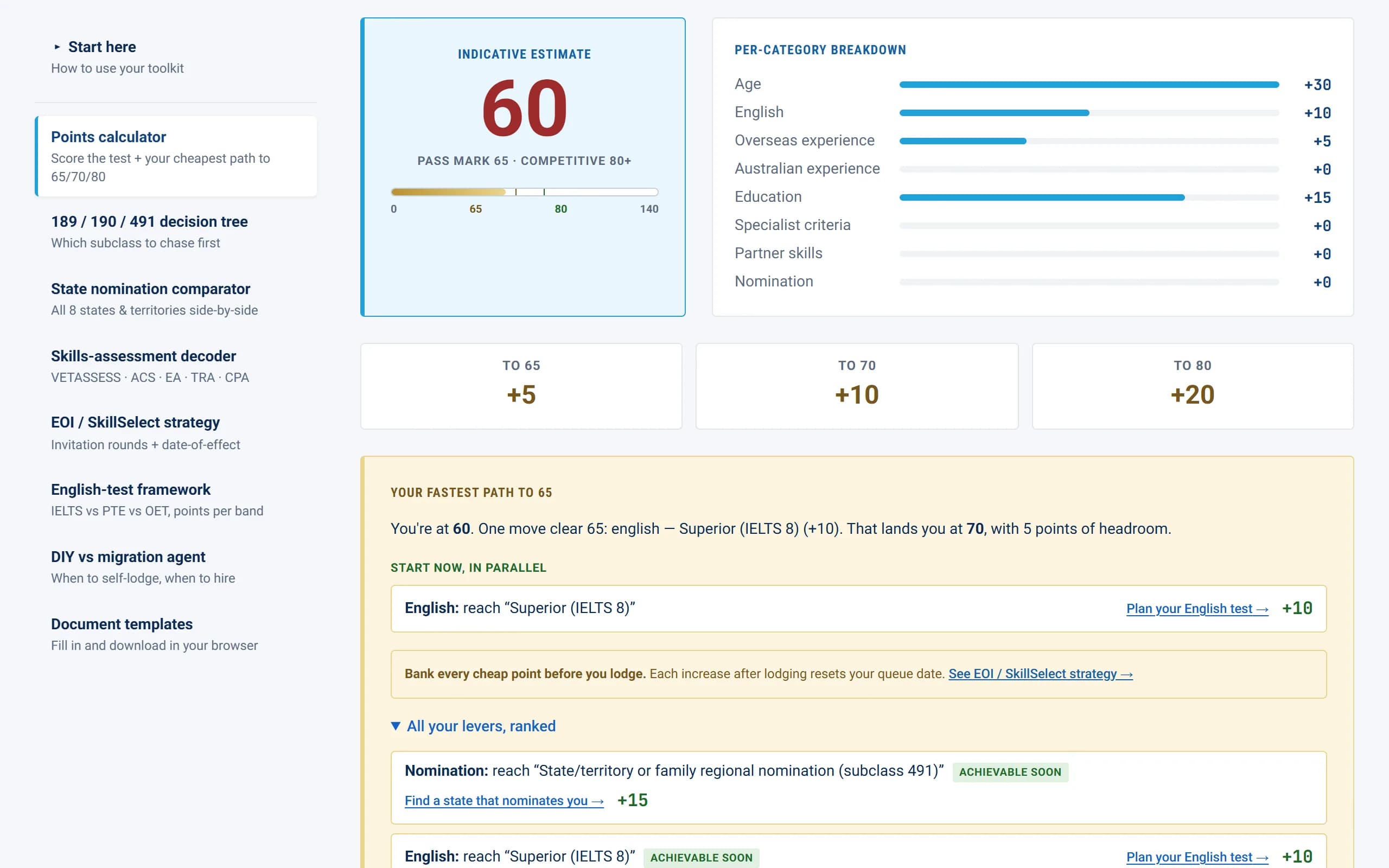
Points Test Strategy
| Points Factor | Points | Notes |
|---|---|---|
| Age 25-32 | 30 | Maximum |
| Age 33-39 | 25 | |
| AQF Diploma | 10 | Minimum for the code |
| Bachelor degree | 15 | Most migrant applicants |
| Master's | 15 | |
| English Proficient (IELTS 7) | 10 | |
| English Superior (IELTS 8) | 20 | |
| Overseas experience 3-5 years | 5 | |
| Overseas experience 5-8 years | 10 | |
| Overseas experience 8+ years | 15 | |
| Australian study | 5 | |
| State nomination 190 | 5 | |
| Regional 491 | 15 | |
| Partner skills | 5-10 |
Realistic Scenarios
Scenario A — Indonesian draftsperson, 31, 6 years experience, IELTS 7: 30 + 15 (bachelor) + 10 (English) + 10 (experience) = 65. With 491 regional (+15) reaches 80, which clears Tasmania and NT for this code in recent rounds.
Scenario B — UK draftsperson with HND, 28, 5 years experience, IELTS 8: 30 + 10 (Diploma) + 20 (Superior English) + 5 (experience) = 65. With 190 (+5) reaches 70, marginal — adding regional 491 (+15) reaches 80 and opens Tasmania and SA.
State Nomination
Few states open 312111 in their main streams. Verify each state's current list before lodging.
Tasmania
Tasmania has historically been the most accessible state for architectural draftspersons under both 190 and 491. The Tasmanian Skilled Migration Program prioritises applicants who have completed Tasmanian study or hold a job offer with a Tasmanian employer. Hobart's construction sector is small but consistent.
Northern Territory
The Northern Territory Government Designated Area Migration Agreement (DAMA) and Skilled Migration Program both include architectural drafting in some streams. The NT is the lowest-volume program in the country but has the lowest competition for niche CSOL codes.
South Australia
SA's Skilled Migration program lists architectural drafting under specific construction-related streams when housing-pipeline demand is high. Adelaide's defence-led construction program (including the AUKUS shipyards expansion) has driven recent demand.
Australian Capital Territory
The ACT runs a Critical Skills List. Architectural drafting appears intermittently linked to commercial fit-out work for federal government tenants. Onshore candidates already working in Canberra have the strongest position.
Salary and Employment Outlook
| Role | Typical Range (AUD) |
|---|---|
| Junior Draftsperson (0-2 yrs) | $55,000-$70,000 |
| Draftsperson (3-7 yrs) | $70,000-$90,000 |
| Senior Draftsperson (8+ yrs) | $85,000-$110,000 |
| Lead Documenter / BIM Coordinator | $100,000-$130,000 |
| Revit Specialist / Technical Architect | $110,000-$140,000 |
| Contract drafter (day rate) | $400-$700/day |
Sources: SEEK Career Advice (Apr-May 2026) for Draftsperson salaries; PayScale Sydney and Melbourne 2026 data; cross-checked against current SEEK job-ad listings for ANZSCO 312111.
Superannuation is 11.5% on top of base. The bigger architectural practices (Bates Smart, Hassell, BVN, Cox, Woods Bagot) typically pay 10-15% above industry median and offer career progression toward BIM management or registration as an architect. Volume residential builders (Metricon, McDonald Jones, GJ Gardner) pay near the median but offer stable pipelines. Contract drafting through agencies (Hays Architecture, Bespoke Careers) is common for senior specialists and can clear $130k-$150k a year.
Geographically, Sydney pays the highest median ($70k according to PayScale), with Melbourne slightly below ($64k median) and Brisbane and Perth around the same band. Tasmania and regional cities run 10-15% below the capital-city average but with materially lower living costs.
Tips for a Successful Application
1. If you trained as an architect overseas, build your reference letters around drafting, not design
VETASSESS reads job-duty language carefully. References that describe "designed schools and apartment buildings" map to ANZSCO 232111 Architect, which has its own registration pathway via AACA. References that describe "produced working drawings, prepared council submission packages, coordinated drawing sets with consultants" map cleanly to 312111. Ask your referees to rewrite around the latter framing.
2. Push for a Group C "highly relevant" qualification finding
VETASSESS Group C requires the qualification to be assessed as highly relevant. Architecture, architectural drafting and building-design qualifications usually pass. Interior design, industrial design and general drafting often do not. If your degree is borderline, attach detailed transcripts and unit outlines emphasising structural, materials, and documentation subjects.
3. Consider Tasmania or NT early in your planning
Open 190/491 rounds for 312111 are narrow. Tasmania and NT consistently nominate this code when other states do not. Both states require genuine intent — a job offer, family ties or completed study — so plan ahead rather than treating them as fall-backs.
4. Get Revit or ArchiCAD certified before lodging
The biggest single multiplier on salary and sponsorship interest is BIM skill. Autodesk Certified Professional (Revit Architecture) and ArchiCAD certification both add credibility on a CV and frequently surface in sponsoring employers' shortlists.
5. Document your role clearly if you also do design work
Many overseas draftspersons also do conceptual sketching or schematic design. If that's more than a small fraction of your time, you face an awkward fit with 312111. Either tighten the role description to the documentation activities that ANZSCO recognises, or consider whether 232111 Architect (with full AACA registration) is the better long-term route.
Step-by-Step Migration Roadmap
- Confirm role match against ANZSCO 312111 — see how to find your ANZSCO code
- Gather qualification documents (degree certificate, transcripts, syllabus where available)
- Prepare employment reference letters describing drafting and documentation duties
- Sit IELTS, PTE or OET — push for Superior (IELTS 8) where the gap to Proficient is small
- Lodge VETASSESS Group C application (AUD $1,096 offshore, 12-14 weeks)
- Calculate points
- Choose route: 482 sponsorship, 190 nomination or 491 regional
- For 482, target architectural practices and volume builders on the active sponsor list
- For 190/491, lodge EOI in SkillSelect and apply to Tasmania, NT or SA programs
- Receive invitation and lodge visa within 60 days
- Complete medicals and police checks
- Receive grant and relocate
Internal references: skills assessment bodies complete list, CSOL hub, civil engineering draftsperson pathway, SOL 2026.
Frequently Asked Questions
Can I work as an architect in Australia under the 312111 visa?
No. ANZSCO 312111 is for draftspersons — applicants performing documentation work under the supervision of registered architects. To practise as an architect (use the title, sign drawings, contract directly with clients) you must register with the relevant state Architects Board through the AACA. The 312111 pathway is faster and more accessible, but it constrains the title you can use.
Why does VETASSESS keep classifying my architecture degree as "less relevant"?
VETASSESS distinguishes between a qualification trained for design (architecture) and one trained for documentation (architectural drafting, building design). An overseas Bachelor of Architecture is sometimes assessed as relevant but not "highly relevant" for 312111 because its emphasis is on design rather than the technical documentation core of the draftsperson role. Detailed transcripts emphasising drafting, CAD and construction-documentation units help.
Is 312111 easier to migrate under than 232111 Architect?
For applicants who do not hold Australian architectural registration, yes — significantly. AACA registration requires the National Program of Assessment, which costs more and takes longer than a VETASSESS Group C assessment. Most overseas architects looking at a fast migration route choose 312111 first, then pursue AACA registration after arrival if they want to practise as architects.
Which BIM software do Australian employers expect?
Revit dominates the commercial and institutional segments, ArchiCAD has strong adoption among smaller practices and building designers, and AutoCAD remains widespread for documentation legacy projects. Vectorworks appears in landscape-adjacent practices. If you only know one, Revit gives the broadest sponsorship reach.
Will the construction downturn affect demand in 2026?
Residential approvals dipped through 2024-2025 but the Housing Australia Future Fund, the National Housing Accord target of 1.2 million new homes by 2029, and state-level pipelines (especially Victoria's Big Housing Build and NSW's Transport Oriented Development program) underpin steady documentation work. Senior draftspersons with BIM specialisations remain in shortage; junior roles are more cyclically exposed.
Do I need an Australian construction-code certification before I arrive?
No. Familiarity with the National Construction Code (NCC) helps in interviews but is not a formal requirement. Most employers expect a 6-12 month ramp on local code and standards once you start. Investing in a short NCC primer course before arrival signals seriousness and shortens the ramp.