Audiologist Visa Pathway to Australia: Complete 2026 Guide
Updated: 16 August 2026
Australia classifies Audiologist under ANZSCO 252711. VETASSESS is the designated skills assessing authority, and Audiology Australia (AudA) handles professional accreditation. The occupation sits on the MLTSSL and CSOL, unlocking subclasses 189, 190, 491, 482 and 186. Typical 2026 salaries range AUD $89,000-$125,000. Regulation transitions to AHPRA by 2030.
Quick Facts: Audiologist Migration Pathway
| Detail | Information |
|---|---|
| ANZSCO Code | 252711 (Audiologist) |
| Skill Level | 1 (Bachelor degree or higher) |
| Skills Assessment | VETASSESS (Group A — professional occupation) |
| Professional Accreditation | Audiology Australia (AudA) — required for clinical practice and Hearing Services Program access |
| Occupation List | MLTSSL and CSOL |
| Visa Options | 189, 190, 491, 482, 186 |
| Demand Level | High — ageing population and Hearing Services Program expansion |
| Salary Range | AUD $89,000-$125,000 (SEEK, 2026) |
| Typical 189 Score | 80-85 points |
| Key Challenge | VETASSESS Group A processing runs 12-20 weeks; AudA Stage 1 and Stage 2 add a parallel timeline |
What Audiologists Actually Do in Australia
Australian audiologists assess hearing, balance and related disorders, fit and program hearing aids, manage cochlear implants, and provide aural rehabilitation. The largest employer is Hearing Australia (the government's hearing services provider for veterans, pensioners and children), followed by national private retailers (Specsavers Audiology, Bay Audio, Audika), private hospital and ENT-attached audiology clinics, and a growing university and research sector centred on the Macquarie University Australian Hearing Hub.
Demand is structural. The Australian Government's Hearing Services Program (HSP) subsidises hearing services for over a million pensioners and veterans, and the program expanded its eligibility criteria through 2024-25. NDIS-funded paediatric and adult audiology adds another sustained driver. Combined with the ageing population, employment forecasts run consistently positive through 2030.
Workforce gaps are most visible outside the major capitals — regional NSW, regional Queensland and the Northern Territory have persistent shortages. Hearing Australia and the larger retail networks routinely sponsor international audiologists.
ANZSCO 252711 — The Code
ANZSCO 252711 covers audiologists who diagnose hearing-related disorders and dispense hearing-rehabilitation devices. Core tasks include:
- Conducting diagnostic hearing assessments (pure-tone, speech, immittance, auditory brainstem response)
- Assessing balance disorders and vestibular function
- Fitting, programming and managing hearing aids and assistive listening devices
- Managing cochlear implant patients (mapping, troubleshooting)
- Providing rehabilitation, counselling and tinnitus management
ANZSCO groups audiologists and speech pathologists/therapists together at the unit-group level (2527), but they migrate under separate 6-digit codes — 252711 for audiologists, 252712 for speech pathologists.
Skills Assessment
VETASSESS
For ANZSCO 252711, VETASSESS is the designated skills assessing authority. Audiology is classified as a Group A occupation, which is the most stringent of the VETASSESS professional categories.
Requirements:
- AQF Bachelor degree or higher in Audiology, Clinical Audiology or Audiology Studies (general health science or medical degrees do not satisfy the qualification requirement)
- At least 1 year of post-qualification employment at appropriate skill level, undertaken in the last five years
- Minimum 20 hours per week
- Employment must be highly relevant to audiology practice
Assessment cost: AUD $1,096 (Group A, 2026) Processing time: 12-20 weeks from the date of submission and payment, depending on document completeness
Common rejection reasons: Degrees marketed as "audiology" that are actually general communication-disorders or speech-language qualifications, employment evidence that doesn't distinguish audiology tasks from broader hearing-aid dispensing, and references that fail to demonstrate the 20-hour weekly threshold for the required year.
Audiology Australia (AudA)
Clinical practice in Australia requires AudA accreditation for any role under the Hearing Services Program — which covers Hearing Australia, all private HSP-contracted retailers and the bulk of paid audiology roles. AudA is the de-facto regulator until AHPRA registration commences (formal AHPRA regulation was approved in September 2025; preliminary policy work runs through 2026, public consultation in H2 2026, with AHPRA registration expected by 2030 at the earliest).
Significant change as of 1 May 2026: AudA enhanced its overseas-qualified pathway. The current pathway has two stages:
-
Stage 1 — Overseas Candidacy: Application review, qualification recognition, English-language evidence and completion of Introduction to the Australian Audiology Landscape training plus Cultural Competency Training (working with Aboriginal and Torres Strait Islander peoples). Required for all candidates except New Zealand graduates.
-
Stage 2 — Supervised Practice and Exam: Applicants can work under supervision while preparing for the AudA examination. A new Limited Scope Accredited Audiologist option is available for overseas-qualified audiologists working as accredited audiometrists in Australia, restricting practice to adult rehabilitation as an interim step.
AudA fees: Application and exam fees vary by stage; current schedule on the AudA website.
For the full assessing-body reference, see the skills assessment bodies complete list.
Visa Pathways for Audiologists
Subclass 189 — Skilled Independent Visa
Permanent residency through the points system.
- Visa fee: AUD $6,135
- Realistic points: 80-85 in 2026
- Processing: 6-12 months
- Quirk: Audiology has a small applicant pool relative to its CSOL/MLTSSL listing. Cut-offs are noticeably lower than physiotherapy or registered nursing, which means 189 remains a realistic primary target for well-credentialled applicants.
Subclass 190 — State Nominated Visa
Permanent visa with +5 points and a 2-year obligation to live and work in the nominating state.
- Visa fee: AUD $6,140
- Active states for 252711 in 2025-26: NSW (unit group 2527), Victoria (when open), Tasmania, South Australia, Western Australia
- Best fit: NSW's healthcare focus combined with Sydney's Macquarie University hub and Hearing Australia's national headquarters makes NSW a leading destination
Subclass 491 — Skilled Work Regional Visa
5-year provisional visa, +15 points, pathway to permanent 191 after 3 years.
- Visa fee: AUD $6,140
- Why 491 fits audiology: Hearing Australia operates regional outreach hubs across every state and the NT. Regional postings frequently include accommodation support and retention bonuses.
Subclass 482 — Skills in Demand (Core Skills Stream)
Employer-sponsored, up to 4 years. 252711 qualifies under the Core Skills stream.
- Visa fee: AUD $3,210
- Core Skills salary threshold: AUD $76,515 (TSMIT, 2025-26)
- Processing: 90% of Core Skills applications now finalising within 8 months; faster for accredited sponsors
- Reality: Hearing Australia, Specsavers Audiology, Audika and Bay Audio are all experienced 482 sponsors. The Specialist Skills stream applies for senior or specialised audiology roles paying above AUD $141,210.
Subclass 186 — Employer Nomination Scheme
Direct permanent residency through employer sponsorship.
- Visa fee: AUD $6,140
- Streams: Direct Entry (3+ years' experience + positive skills assessment) or TRT (2+ years on a qualifying 482)
- Processing: 12-20+ months for standard applications
Points Test Strategy
| Points Factor | Points | Notes |
|---|---|---|
| Age (25-32) | 30 | Maximum bracket |
| Age (33-39) | 25 | Typical mid-career bracket |
| Master's degree | 15 | Standard entry qualification in Australia |
| Bachelor degree | 15 | Common in UK and US qualifications |
| English (Superior — 8.0+) | 20 | High but achievable |
| English (Proficient — 7.0) | 10 | Floor for most accreditation pathways |
| Overseas experience (5-7 years) | 10 | Typical for migrating audiologists |
| State Nomination (190) | 5 | |
| Regional (491) | 15 | Common pathway |
| Partner Skills | 5-10 | If applicable |
Scenario 1: Offshore audiologist, 32, Master's, 6 years' experience, Proficient English
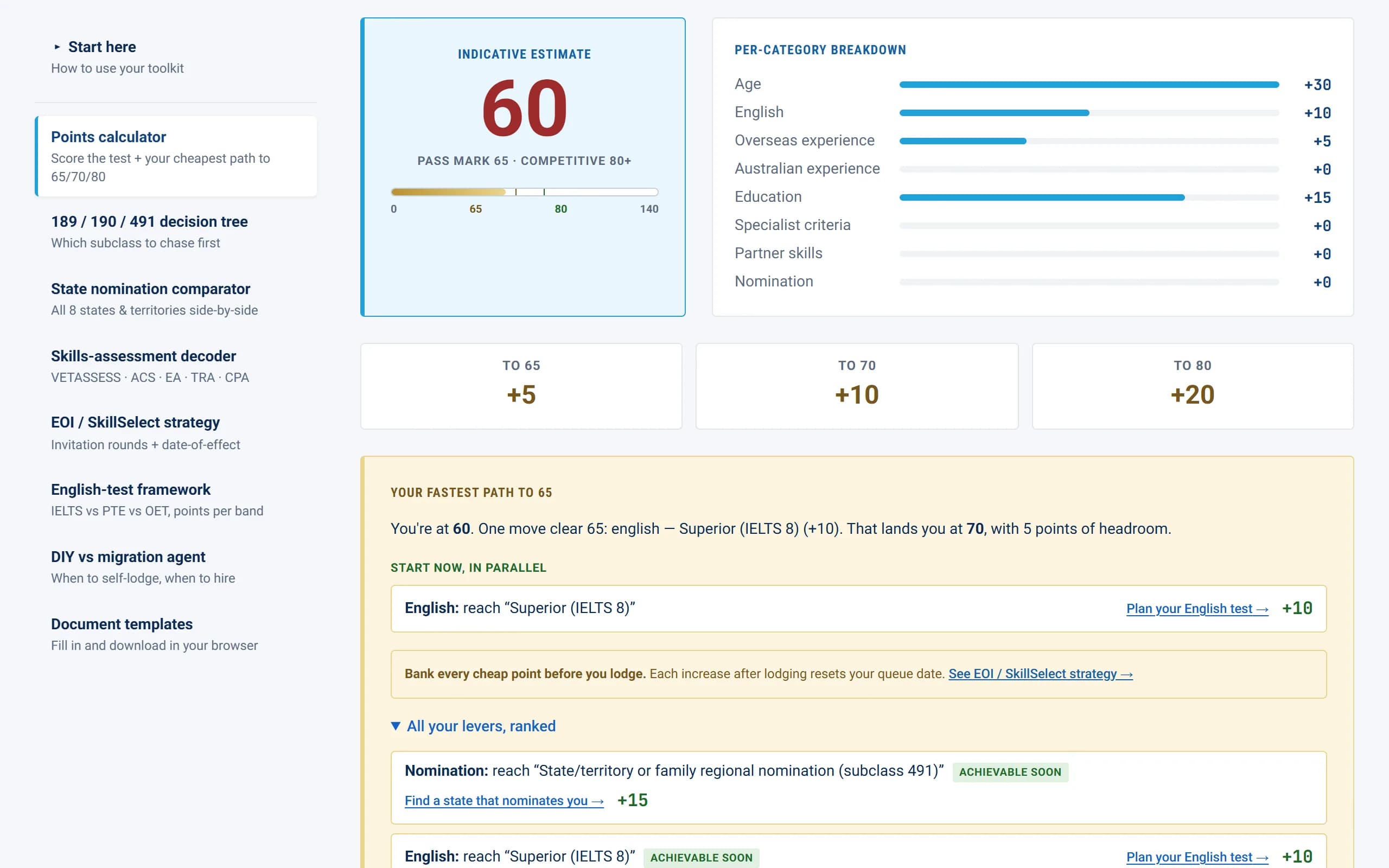
Age 32 (25 points) + Master's (15) + Proficient English (10) + Overseas experience 6 years (10) = 60 base. State nomination 190 lifts to 65, regional 491 to 75. 491 is the most reliable pathway at this profile.
Scenario 2: Australian-trained graduate, 27, Master's, Superior English
Age 27 (30) + Master's (15) + Superior English (20) + Australian study (5) = 70 base. With state nomination, 75 — strong invitation profile for 190 in most states.
State Nomination for Audiologists
New South Wales
NSW nominates unit group 2527 (which includes audiologists and speech pathologists) on both 190 and 491. Sydney is home to Hearing Australia's national headquarters and Macquarie University's Australian Hearing Hub — the largest concentration of audiology employment in the country. Successful 190 applicants in 2026 typically hold 80-95 points.
Victoria
Victoria includes audiology on its skilled occupation list under the 2527 unit group when the program is open. Victoria's 2025-26 program closed to new ROIs on 28 April 2026; applicants must wait for the 2026-27 round. Current AudA accreditation strengthens the ROI significantly.
Tasmania
Tasmania's 2025-26 allocation included 1,200 places for 190 and 650 for 491. Healthcare carries Gold-priority ranking. Hearing Australia operates Tasmanian regional services and is an active employer.
South Australia
SA invited 141 healthcare professionals in a single recent quarter (128 on 190, 13 on 491). The nomination fee is AUD $381. SA's regional streams suit audiologists open to working outside metropolitan Adelaide.
Western Australia
WA's 2025-26 allocation totals 2,000 places for 190 and 1,400 for 491. Healthcare on the Gold-priority list raises audiology ROIs in WA's ranking system. Perth's growing private audiology market combined with regional WA Hearing Australia outreach creates a broad employer base.
Salary and Employment Outlook
What Audiologists Earn in 2026
| Setting | Typical Salary Range |
|---|---|
| New graduate (private retail) | AUD $75,000-$90,000 |
| New graduate (Hearing Australia) | AUD $75,000-$85,000 |
| Mid-career (3-7 years) | AUD $90,000-$115,000 |
| Senior audiologist | AUD $110,000-$135,000 |
| Clinical lead / regional manager | AUD $130,000-$160,000 |
| Private practice owner / franchisee | AUD $150,000-$300,000+ |
| University academic (Senior Lecturer) | AUD $130,000-$165,000 |
SEEK's national data for 2026 places the average advertised salary range between AUD $89,000-$125,000, with the highest-paying locations clustered around Adelaide, Brisbane, Gold Coast, Sydney and South West Coast Victoria — all advertising at AUD $125,000.
Highest-Paying Employer Types
- Private retail franchisees and owner-operators — top of the salary range, often well into six figures plus profit share
- Specsavers Audiology, Audika, Bay Audio — large national networks with structured pay bands and bonus components
- Hearing Australia — secure public-sector role with strong leave entitlements and salary packaging
- University and research roles — Macquarie, University of Melbourne, Flinders, Curtin
- Cochlear and hearing-aid manufacturers — clinical specialist and trainer roles attached to Cochlear, Sonova, GN ReSound and WS Audiology
Superannuation at 11.5% applies on top of base. Retail roles often include commission components tied to hearing-aid fittings.
Tips for a Successful Application
1. Match your qualification name to the VETASSESS expectation
VETASSESS specifies a degree in Audiology, Clinical Audiology or Audiology Studies. Communication Sciences and Disorders, Speech-Language-Hearing Sciences and similar US programmes need to evidence audiology specialisation in the transcript. Get the transcript translated into clear "audiology subject" language before submitting.
2. Lodge VETASSESS and AudA Stage 1 in parallel
The two assessments have minimal document overlap but run on different timelines. Lodging Stage 1 of the AudA pathway in parallel with VETASSESS shaves 3-6 months off the total. Hearing Australia and the major retail sponsors expect both to be in progress when negotiating an offer.
3. Plan for the 1 May 2026 AudA pathway changes
The new Stage 1 requirements include compulsory Introduction to the Australian Audiology Landscape training and Cultural Competency Training. These have set sitting windows. Budget 4-8 weeks for completing the training modules before progressing.
4. If you're a paediatric audiologist, target Hearing Australia and NDIS roles
Paediatric audiology is the deepest of the workforce shortages, and Hearing Australia is the dominant paediatric employer. NDIS-funded paediatric audiology in private practice is the second pole. References that demonstrate paediatric assessment experience are strong differentiators.
5. Consider the Limited Scope option as a bridge
The new Limited Scope Accredited Audiologist pathway (introduced 1 May 2026) allows overseas-qualified audiologists already working as accredited audiometrists in Australia to gain interim recognition restricted to adult rehabilitation. This is useful for migrants on partner or working-holiday visas building experience before lodging a skilled application.
Step-by-Step Migration Roadmap
- Confirm your degree title and content match VETASSESS Group A requirements
- Sit IELTS Academic or OET — target 7.0 across all bands minimum
- Lodge VETASSESS skills assessment — AUD $1,096, 12-20 weeks
- Lodge AudA Stage 1 Overseas Candidacy — runs in parallel with VETASSESS
- Complete Introduction to Australian Audiology Landscape + Cultural Competency Training
- Confirm 252711 is on the relevant occupation list — see skilled occupation list 2026
- Calculate points — see how to find your ANZSCO code
- Lodge EOI in SkillSelect — for 189, 190 or 491
- Apply for state nomination — NSW, Tasmania, SA or WA
- Alternatively, accept a 482 offer from Hearing Australia, Specsavers Audiology, Audika or similar
- Receive invitation, lodge visa within 60 days, complete health and character checks
- Receive visa grant, complete AudA Stage 2 supervised practice and examination, commence clinical practice
Frequently Asked Questions
Why doesn't audiology have a single AHPRA pathway like physiotherapy?
Audiology is not yet regulated under AHPRA. Audiology Australia accredits practitioners under the Hearing Services Program until AHPRA regulation commences. Federal health ministers approved AHPRA regulation in September 2025; preliminary policy work runs through 2026 with formal registration expected by 2030 at the earliest. Until then, AudA accreditation remains the practical requirement for clinical work.
How does the new Limited Scope option work?
Introduced 1 May 2026, the Limited Scope Accredited Audiologist designation allows overseas-qualified audiologists already working in Australia as accredited audiometrists to progress to a restricted accreditation focused on adult rehabilitation. It's a bridge to full accreditation rather than a permanent endpoint.
Which ANZSCO code applies if I work primarily with cochlear implants?
ANZSCO 252711 covers cochlear implant audiology — the work falls squarely within the audiologist scope. There is no separate code for implant audiologists. The migration outcome is the same regardless of subspecialty.
Is paediatric audiology a stronger migration profile than adult audiology?
Workforce demand for paediatric audiologists is deeper because Hearing Australia is the dominant paediatric employer and faces persistent recruitment gaps. Adult-rehabilitation specialists are also in demand because of HSP-program growth. The Limited Scope pathway specifically targets adult rehabilitation, so paediatric audiologists must complete the full pathway.
Can I work for Cochlear or a hearing-aid manufacturer on a 482?
Yes. Cochlear, Sonova, GN ReSound and WS Audiology all sponsor clinical specialist, training and applications-engineering roles. These positions often qualify for the Specialist Skills stream of the 482 because of the salary level, which has faster processing — as quick as 7 days at the leading edge.
What's the most under-served region for audiologists in 2026?
Regional NSW, regional Queensland and the Northern Territory consistently report the deepest gaps. Hearing Australia's regional outreach hubs are the primary employer in these areas and operate active international recruitment programs. See the most in-demand occupations list for the broader allied-health context.