Chemist Visa Pathway to Australia: Complete 2026 Guide
Updated: 16 August 2026
Australia classifies Chemists under ANZSCO 234211. VETASSESS conducts the skills assessment under its Professional Occupations programme. The occupation sits on the MLTSSL and CSOL, unlocking subclasses 189, 190, 491, 482 and 186. Typical 2026 salaries range AUD $80,000-$155,000 depending on industry and seniority — pharmaceuticals and mining-analytical chemistry pay at the top of the range. Pharmacists are not 234211 — they sit under 251513.
Quick Facts: Chemist Migration Pathway
| Detail | Information |
|---|---|
| ANZSCO Code | 234211 (Chemist) |
| Skill Level | 1 (Bachelor degree or higher in chemistry or related field) |
| Skills Assessment | VETASSESS (Vocational Education and Training Assessment Services) |
| Occupation List | MLTSSL and CSOL |
| Visa Options | 189, 190, 491, 482, 186 |
| Demand Level | Moderate — niche shortages in pharmaceutical and analytical chemistry; not on broad shortage list |
| Salary Range | AUD $80,000-$155,000 (SEEK, PayScale, SalaryExpert 2026) |
| Typical 189 Score | 80-90 (non-pro-rata; less competitive than ICT) |
| Key Challenge | Highly relevant qualification + work history match; VETASSESS rigorously checks subject content |
What Chemists Do in Australia
The ANZSCO 234211 description covers analysing the chemical composition and properties of substances; researching, developing and testing chemical products and processes; and applying chemistry to manufacturing, mining, environmental and medical contexts.
Australian chemists work across several settings:
- Pharmaceutical and biotechnology — CSL, Mayne Pharma, Sun Pharma, Pfizer Australia, Astrazeneca, Telix
- Mining and resources — analytical chemistry for ore-body assays at BHP, Rio Tinto, Fortescue, Newmont
- Food and beverage — Lion, CCA, Treasury Wine Estates, Fonterra (R&D and quality)
- Environmental and water — ALS, Eurofins, SGS, state EPA laboratories
- Forensic and government — Australian Federal Police, state forensic labs, NMI, ANSTO
- Universities and CSIRO — research and applied chemistry roles
Demand is steadier than ICT but smaller in absolute numbers. Pharmaceutical R&D, mining analytical chemistry, and environmental water chemistry have the strongest 2025-2026 hiring signals. Wine chemistry maintains consistent demand in SA and Victoria.
ANZSCO 234211 — Code Mapping
The ABS description for Chemist covers analysing and applying chemical principles to research, development, quality control, and process improvement across industries. Tasks include preparing samples, conducting tests, developing new compounds, supervising laboratory work, interpreting results, and applying findings to industrial processes.
Related Codes to Distinguish
- 234212 Food Technologist — food product development
- 234213 Wine Maker — winemaking specific
- 234411 Geologist — for geochemistry crossover
- 234511 Life Scientist (General) — biology rather than chemistry
- 234513 Biochemist — overlaps with 234211 for some applicants
- 251513 Hospital Pharmacist or 251511 Industrial Pharmacist — for pharmacy work
- 234999 Natural and Physical Science Professionals nec — residual
VETASSESS will reject a 234211 application if your degree majored in biology, environmental science, or pharmacy without sufficient chemistry coursework. Map honestly to your transcript.
Skills Assessment — VETASSESS
VETASSESS is the sole assessing authority for 234211 under its Professional Occupations stream.
Fees (current 2026)
| Service | Fee (AUD) |
|---|---|
| Full Skills Assessment — non-AU resident for tax (no GST) | $1,096 |
| Full Skills Assessment — AU resident for tax (inc GST) | $1,205.60 |
| Priority Processing (additional) | varies by occupation |
| Reassessment | varies |
| Review | varies |
| Points Test Advice | additional, optional |
Fees increased in line with CPI on 22 October 2025. Applications received before that date were charged at the previous rates.
Processing Time
VETASSESS publishes current processing times on its Current Processing Times page. Standard processing for Professional Occupations typically runs 10-14 weeks in 2026, with priority processing available at additional cost for faster outcomes.
Requirements
A positive 234211 assessment requires both:
-
Qualification — assessed as comparable to an AQF Bachelor degree or higher, with a major in a highly relevant field. Relevant fields include Chemistry, Applied Chemistry, Analytical Chemistry, Biochemistry, Medicinal Chemistry, Pharmaceutical Chemistry, Forensic Chemistry, Polymer Science and certain specialist majors in Nanotechnology, Biotechnology and Materials Science.
-
Employment — at least 1 year of post-qualification employment in the last 5 years, at an appropriate skill level (Skill Level 1 — analytical or research chemistry work), at least 20 hours per week, in a highly relevant role.
Common VETASSESS Rejection Reasons
- Degree majored in biology or environmental science rather than chemistry — common with applied biology graduates
- Employment that is laboratory technician work (Skill Level 2-3) rather than chemist work (Skill Level 1)
- Employment letters that describe routine sample testing without analytical decision-making
- Insufficient duration of post-qualification work (less than 12 months in the past 5 years)
Lodge clear evidence: transcripts with subject lists, position descriptions on company letterhead, payslips covering the qualifying period, and statutory declarations only where original references cannot be obtained.
Visa Pathways for Chemists
Subclass 189 — Skilled Independent
Permanent residency through the points test.
- Visa fee: AUD $6,135 (primary applicant, 2026)
- Realistic invitation score: 80-90 points
- Processing: 6-12 months
- Reality: 234211 is non-pro-rata; invitations have been more reachable than ICT codes
Subclass 190 — State Nominated
State nomination adds 5 points.
- Visa fee: AUD $6,140
- Best states: SA, Tasmania, Victoria, WA all nominate chemistry-related occupations
- Points boost: +5
Subclass 491 — Skilled Work Regional
Five-year provisional visa with PR via subclass 191 after three years of regional work.
- Visa fee: AUD $6,140
- Points boost: +15
- Reality: strong fit for chemists willing to work in regional mining centres (Kalgoorlie, Mt Isa, Mackay), wine regions (Barossa, Hunter, Margaret River), or environmental labs in regional Australia
Subclass 482 — Skills in Demand
Employer-sponsored temporary visa.
- Visa fee: AUD $4,015 (primary applicant, 2026)
- Salary thresholds: Core Skills AUD $79,423 / Specialist Skills AUD $146,576
- Duration: up to 4 years
- Reality: most chemist roles meet the Core threshold but only senior or specialist positions hit Specialist Skills
Subclass 186 — Employer Nomination Scheme
Permanent residency through an employer.
- Visa fee: AUD $6,140
- Streams: Direct Entry (3+ years experience) or TRT after two years on 482
Points Test Strategy
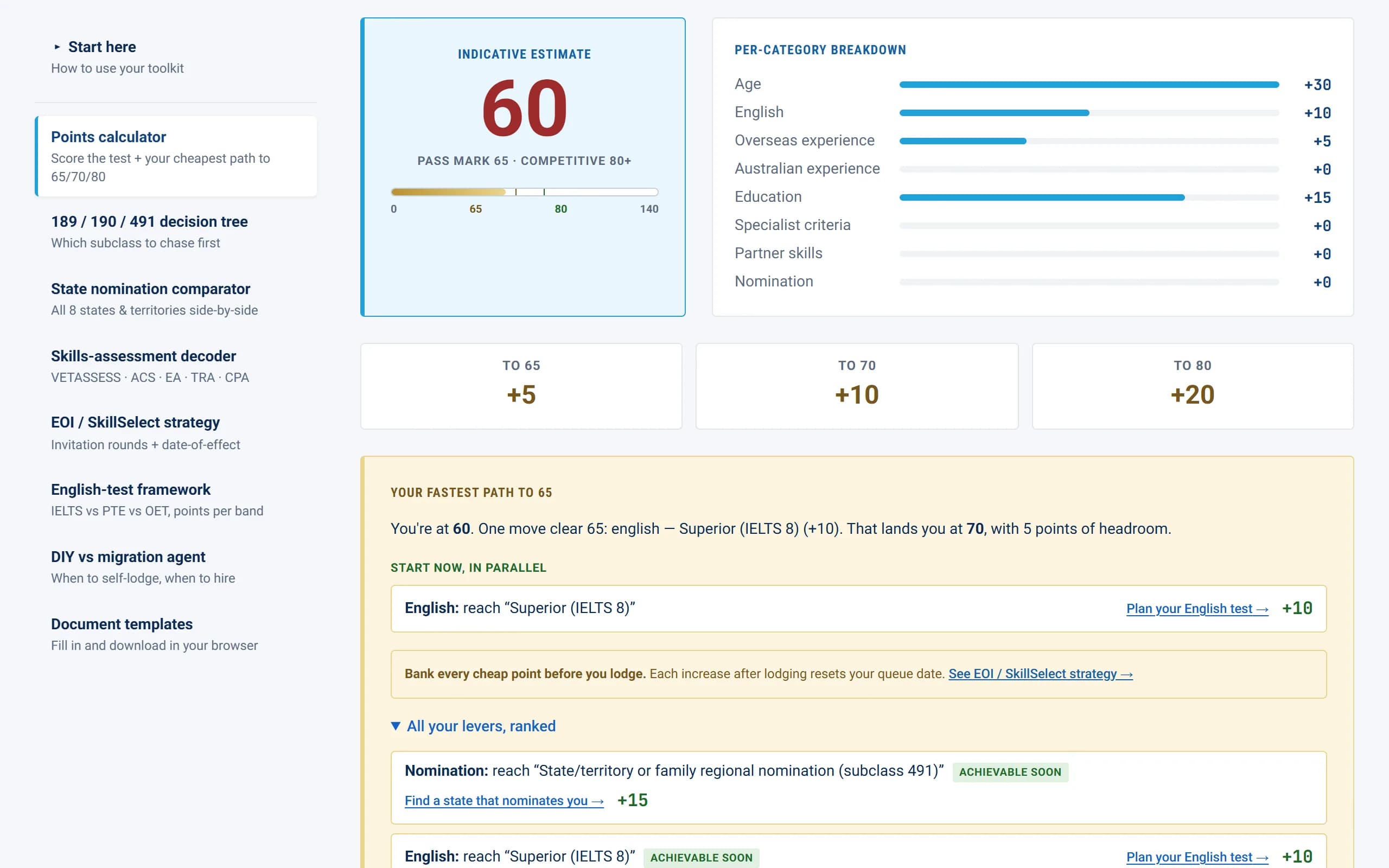
| Points Factor | Points | Notes |
|---|---|---|
| Age 25-32 | 30 | Maximum |
| Age 33-39 | 25 | |
| Qualification (PhD) | 20 | Common in research and pharma chemistry |
| Qualification (Master) | 15 | |
| Qualification (Bachelor) | 15 | |
| English (Superior 8.0+) | 20 | |
| English (Proficient 7.0) | 10 | |
| Overseas experience | 5-15 | VETASSESS does not deduct years like ACS — advantage |
| Australian experience | 5-20 | |
| State nomination (190) | 5 | |
| Regional (491) | 15 | |
| Partner skills | 5-10 |
Realistic Scenarios
Scenario 1 — Research chemist, 30, PhD, 4 years post-PhD experience, IELTS 7: Age 30 + PhD 20 + English 10 + Exp 5 = 65 points. Add Superior English (+10) = 75. Add 190 (+5) = 80. Add 491 (+15 instead of 190) = 90. Competitive for 491; borderline for 190.
Scenario 2 — Analytical chemist, 35, Master's in Chemistry, 10 years experience, IELTS 8: Age 25 + Master 15 + English 20 + Exp 15 = 75 points. Add 190 (+5) = 80. Add 491 (+15) = 90. Strong 491/190 candidate; reachable 189.
State Nomination for Chemists
South Australia
SA is consistently the most chemist-friendly state. The wine industry (Penfolds, Yalumba, Barossa wineries), defence chemistry (Edinburgh Defence Precinct), and pharmaceutical manufacturing (Pfizer Adelaide) drive demand. SA's offshore concessions for skilled migrants are more generous than larger states.
Western Australia
WA nominates chemists for mining-analytical roles in Perth, Kalgoorlie and the Pilbara. Mining-services firms (ALS, SGS, Bureau Veritas) run high-volume analytical labs.
Victoria
Victoria's 2025-26 program prioritises critical-skills sectors including pharmaceuticals and biotechnology. Melbourne's Parkville biomedical precinct (CSL, Bionics Institute, Murdoch Children's, Walter and Eliza Hall Institute) is the largest single chemistry-research employer cluster in Australia.
Tasmania
Tasmania nominates chemists with genuine commitment to remain. Hobart and Launceston have niche chemistry employment around aquaculture, Antarctic Division research, and pharmaceuticals.
New South Wales
NSW Skills List includes 234211 selectively. Sydney pharmaceutical (Sigma, AstraZeneca, GSK), water utilities (Sydney Water) and forensics (NSW Forensic Analytical Science Service) hire chemists steadily.
Queensland and ACT
Queensland Department of Health Forensic and Scientific Services, plus mining-analytical labs in Brisbane and Townsville, employ chemists. ACT nominations cover Canberra-based research roles (CSIRO, NMI, ANU).
Salary and Employment Outlook
| Role | Typical Salary Range |
|---|---|
| Graduate Chemist | AUD $65,000-$80,000 |
| Analytical Chemist | AUD $80,000-$105,000 |
| Senior Analytical Chemist | AUD $100,000-$135,000 |
| Pharmaceutical Chemist / Formulation Chemist | AUD $95,000-$135,000 |
| Research Chemist (postdoc, university) | AUD $90,000-$115,000 |
| Research Chemist (industry, mid-level) | AUD $110,000-$145,000 |
| Senior Research Chemist (8+ yrs) | AUD $140,000-$180,000 |
| Quality Control Chemist (pharma, mining) | AUD $85,000-$120,000 |
| Laboratory Manager | AUD $130,000-$170,000+ |
Sources: SEEK Chemist salary May 2026 (average AUD $85,000-$105,000), SalaryExpert 2026 (senior level avg AUD $155,752), ERI 2026, PayScale 2026. Add 11.5% superannuation; industry bonuses 5-15% in pharma and mining.
Highest-Paying Sectors
- Pharmaceutical R&D — CSL, Telix, Mayne Pharma, multinational pharma Australian operations
- Mining and resources analytical — BHP, Rio Tinto, Fortescue plus analytical-services providers (ALS, SGS)
- Specialty chemicals and polymers — Orica, Incitec Pivot
- Defence chemistry — DSTG (Defence Science and Technology Group)
- Wine and food — chief chemists at major wineries and food manufacturers earn premium
Geographic spread: Sydney and Melbourne pay the highest base; Adelaide and Perth offer strong mid-band salaries with lower living costs. Regional Australia (mining sites, wine regions) often pays premium with FIFO loadings.
Tips for a Successful Application
1. Verify your degree's chemistry content before lodging VETASSESS
VETASSESS counts chemistry subject hours, not the degree title. A Bachelor of Science with a chemistry major counts; a Bachelor of Environmental Science with two chemistry electives may not. Pull your transcript, identify chemistry subjects, and lodge transcripts that show explicit chemistry content.
2. Document Skill Level 1 work clearly
The most common rejection reason for 234211 is employment that VETASSESS classifies as Laboratory Technician (Skill Level 2-3) rather than Chemist (Skill Level 1). Get employment references to describe analytical decision-making, method development, troubleshooting and supervision — not just "operated HPLC".
3. Choose the right ANZSCO code carefully
If your work is biochemistry-focused, 234513 Biochemist might fit better. If you do food chemistry, 234212 Food Technologist applies. If pharmacy, 251511 or 251513. Picking 234211 with biology-leaning evidence is a fast track to rejection.
4. Target state nomination from offshore
SA, Tasmania and WA all have offshore-friendly nomination programmes for chemists. From offshore, you can secure 190 or 491 nomination without first arriving in Australia, which is materially faster than ICT-style invitation cycles.
5. Consider PhD timing
If you are mid-PhD overseas, completing the PhD before lodging is worth 5 extra points (PhD 20 vs Master 15). For chemists pursuing research careers, the PhD also opens postdoc roles that frequently lead to 482/186 sponsorship.
Step-by-Step Migration Roadmap
- Verify your chemistry qualification's subject content matches VETASSESS's highly-relevant field requirements
- Gather employment references describing Skill Level 1 chemist duties
- Sit IELTS, PTE Academic or OET — Superior (8.0+) where possible
- Lodge VETASSESS Professional Occupations skills assessment (AUD $1,096-$1,205)
- Receive positive assessment (typically 10-14 weeks)
- Submit EOI in SkillSelect — 189, 190 or 491
- Apply for state nomination if pursuing 190 or 491
- Alternatively secure a job offer and 482 sponsorship
- Receive invitation — lodge visa within 60 days
- Complete health (panel medical) and character (police clearance) checks
- Receive grant
- Relocate — see the skills assessment bodies complete list for related occupations
Frequently Asked Questions
Is a Chemistry degree from outside Australia recognised?
Generally yes, provided the major qualifies as a highly relevant field. VETASSESS assesses comparability to an AQF Bachelor degree based on duration, subject content and academic level. Indian B.Sc and M.Sc Chemistry degrees from UGC-recognised universities are commonly accepted. Filipino BS Chemistry and Pakistani BSc/MSc Chemistry are accepted. Some Bachelor degrees from countries with three-year norms may need a postgraduate qualification to reach Bachelor-equivalent.
What's the difference between 234211 Chemist and 234513 Biochemist?
234211 covers core chemistry — analytical, organic, inorganic, physical, applied. 234513 Biochemist covers chemistry applied to biological systems (proteins, enzymes, metabolism, molecular biology). VETASSESS distinguishes the two based on your degree major and work history. If your work is roughly half-and-half, choose the code that better matches your most recent employer's description of your role.
Is Chemist on the Australian shortage list in 2026?
Chemist is on the Core Skills Occupation List (CSOL) and MLTSSL, making it eligible for all skilled migration visas. The 2025 Jobs and Skills Australia Occupation Shortage List did not flag general chemists as in national shortage, but pharmaceutical, analytical and water chemistry roles show regional shortages, particularly in SA, WA and Tasmania.
Can a pharmacist apply as a Chemist (234211)?
No. Pharmacists must use 251513 Hospital Pharmacist, 251511 Industrial Pharmacist, or 251512 Retail Pharmacist, all of which require AHPRA registration via the Pharmacy Board. 234211 is for laboratory and research chemists, not registered pharmacists.
Do I need Australian registration to work as a chemist?
No. Unlike pharmacists or doctors, chemists do not require professional registration to work in Australia. Some positions in defence, food safety or pollution control may require Australian citizenship or specific security clearances, but the underlying profession is unregulated at the practitioner level.
How long does the full migration pathway take?
For an offshore applicant with VETASSESS assessment, EOI, state nomination, and visa: typically 14-20 months from lodging the assessment to visa grant. Faster via employer sponsorship — 6-10 months from job offer to grant on a 482, with subsequent 186 PR after two years.
For broader context, see the most in-demand occupations 2026 hub or the skilled occupation list 2026.