Cartographer Visa Pathway to Australia: Complete 2026 Guide
Updated: 16 August 2026
Australia classifies Cartographer under ANZSCO 232213. VETASSESS conducts the skills assessment. The occupation sits on the Core Skills Occupation List and the MLTSSL, opening access to subclasses 189, 190, 491, 482 and 186. Typical 2026 salaries range AUD $80,000-$140,000 for cartographers and senior GIS-capable spatial scientists, with mining, defence and government employers paying at the top of the range.
Quick Facts: Cartographer Migration Pathway
| Detail | Information |
|---|---|
| ANZSCO Code | 232213 (Cartographer) |
| Skill Level | 1 (Bachelor degree or higher in surveying, cartography, GIS or geospatial science) |
| Skills Assessment | VETASSESS (Vocational Education and Training Assessment Services) |
| Occupation List | CSOL and MLTSSL — full visa access |
| Visa Options | 189, 190, 491, 482, 186 |
| Demand Level | Moderate — strong in mining, defence, climate adaptation and infrastructure planning |
| Salary Range | AUD $80,000-$140,000 (SEEK Salary Hub and SalaryExpert, 2026) |
| Typical 189 Score | 80-90 points (less competitive than ICT codes) |
| Key Challenge | Few applications submitted nationally; expect intense VETASSESS scrutiny on qualification fit |
Role Context: Cartography and GIS in Australia in 2026
Cartography in Australia has shifted from traditional map-making into a wider geospatial discipline blending GIS, remote sensing, satellite imagery and 3D digital twins. The federal government, state planning agencies, mining majors, defence (including the Spatial Industry Transformation and Growth Agenda), and emergency services all rely on cartographic and spatial outputs daily.
Demand concentrates in Perth and Brisbane (mining), Canberra (defence and federal government), Sydney and Melbourne (infrastructure planning, urban analytics) and regional centres supporting agriculture, forestry and water management. Geoscience Australia, the Bureau of Meteorology, state cadastral and lands departments, NearMap, Aerometrex, Fugro, Hexagon, Esri Australia, and engineering consultancies (Aurecon, GHD, AECOM, Jacobs) are among the principal employers.
Most international migrants enter under VETASSESS's Group A assessment with a degree in cartography, surveying, geomatics or GIS. The pool is smaller than ICT or engineering; applications volumes published by Home Affairs typically sit in the low hundreds nationally each year, which means invitations are achievable at moderate points scores.
ANZSCO 232213: Code Definition
The official ANZSCO entry covers professionals who apply scientific, mathematical and cartographic design principles to prepare and revise maps, charts and other forms of cartographic output. Typical duties:
- Compiling and editing topographic, thematic and digital maps from survey data, aerial photography and satellite imagery
- Designing cartographic symbology, projection systems and map layouts
- Operating GIS software (ArcGIS, QGIS), CAD and remote-sensing platforms
- Producing digital terrain models, orthophotos and 3D visualisations
- Maintaining spatial data libraries and cadastral records
Adjacent codes within the same unit group include:
- 232212 Surveyor — assessed by the Surveyors Board of the relevant state (not VETASSESS); requires registration
- 232214 Other Spatial Scientist — fallback for geospatial analysts whose duties extend beyond traditional cartography
If your day-to-day role centres on cadastral surveying, control networks and licensed survey practice, nominate 232212 instead. If you build spatial models, analyse satellite imagery, write Python for geoprocessing and rarely produce traditional maps, 232214 often fits better.
Skills Assessment: VETASSESS
VETASSESS classifies Cartographer as a Group A occupation. The body publishes detailed criteria on its Cartographer occupation page.
Qualification requirement: A qualification assessed as comparable to an Australian Qualifications Framework Bachelor degree or higher, in a field highly relevant to cartography. Recognised fields include cartography, surveying, geomatics, geospatial science, GIS, geography (with spatial specialisation), and remote sensing.
Employment requirement: At least one year of highly relevant post-qualification employment at an appropriate skill level in the last five years. Where the degree is in a closely related but not directly relevant field, VETASSESS may require additional years of work experience.
Highly relevant fields: Pure geography or geology degrees without spatial science content are usually treated as closely related rather than highly relevant — which triggers an additional experience requirement.
Assessment cost (effective 22 October 2025):
- Full Skills Assessment: AUD $1,096 (non-resident) / AUD $1,205.60 (Australian resident, inc. GST)
- Priority Processing surcharge: AUD $825 (non-resident) / AUD $907.50 (Australian resident)
- Points Test Advice: AUD $311 / AUD $342.10
Processing time: 12-14 weeks standard; 10 business days under priority once eligibility is confirmed.
Common rejection reasons: Degrees in pure geography or geology without demonstrable spatial science content; employment references that describe field surveying rather than cartographic production; positions where GIS use was incidental rather than the primary duty.
For a full overview of assessing authorities, see the skills assessment bodies hub.
Visa Pathways for Cartographers
Subclass 189 — Skilled Independent
Permanent residency with no employer or state involvement. Cartographer is on the MLTSSL, giving full 189 access. Because the national applicant pool is small, invitations are obtainable at points scores below the ICT-occupation ceilings.
- Visa fee: AUD $6,135 (primary applicant)
- Realistic points threshold: 80-90 — well below ICT-occupation ceilings
- Processing: 6-12 months once invited
Subclass 190 — Skilled Nominated
State nomination adds 5 points and grants permanent residency. The applicant must live in the nominating state for two years.
- Visa fee: AUD $6,140
- Best states: Western Australia and Queensland (mining and resources); ACT (federal government, Geoscience Australia, defence)
- Processing: 9-19 months from invitation
Subclass 491 — Skilled Work Regional
Regional nomination adds 15 points and grants a 5-year provisional visa. Permanent residency follows via subclass 191 after three years and meeting the income threshold.
- Visa fee: AUD $6,140
- Useful regions: Most of Australia outside Sydney, Melbourne and Brisbane qualifies as regional. Mining hubs in WA's Pilbara and Goldfields, and Queensland's Bowen Basin, are particularly receptive
Subclass 482 — Skills in Demand (Core Skills stream)
Employer-sponsored temporary visa. Mining majors and federal agencies regularly sponsor international hires.
- Visa fee: AUD $3,115 (primary applicant)
- Core Skills Income Threshold: AUD $76,515 (rising to AUD $79,499 from 1 July 2026)
- Duration: Up to 4 years
- Processing: 6-14 months for Core Skills
Subclass 186 — Employer Nomination Scheme
Permanent residency through employer sponsorship.
- Visa fee: AUD $6,140
- Streams: Direct Entry or Temporary Residence Transition (after 2 years on 482)
- Processing: 11-20 months standard; 4-9 months for priority cases
Points Test Strategy
| Points Factor | Maximum | Typical Cartographer |
|---|---|---|
| Age (25-32) | 30 | 25-30 |
| English (Superior 8.0+) | 20 | 10-20 |
| English (Proficient 7.0) | 10 | 10 (common) |
| Bachelor degree | 15 | 15 |
| Master's degree | 15 | 15 (where held) |
| PhD | 20 | Rare in this field |
| Skilled employment overseas (5-7 yrs) | 10 | 10 |
| Skilled employment overseas (8+ yrs) | 15 | 15 |
| State nomination (190) | 5 | If applicable |
| Regional (491) | 15 | If applicable |
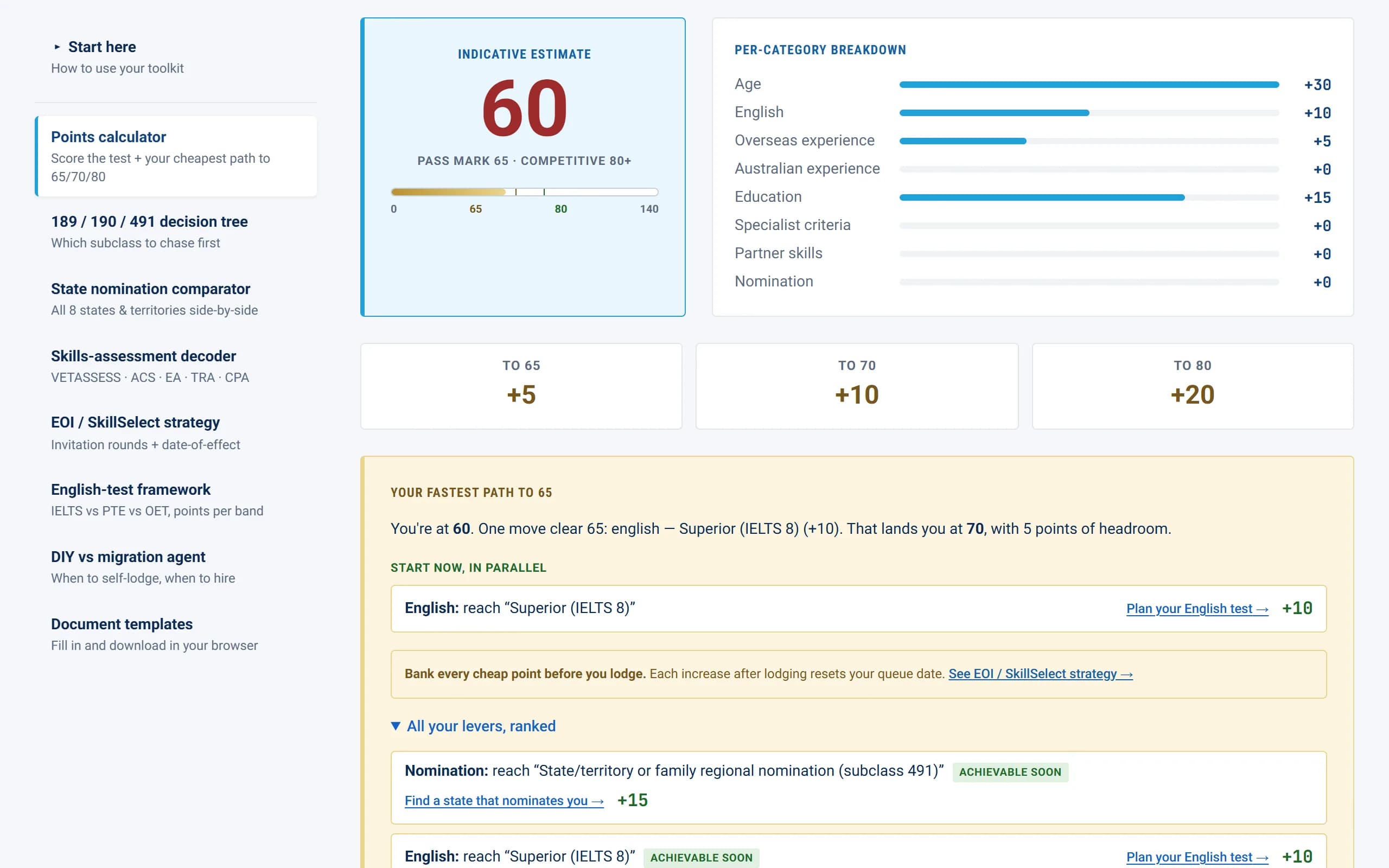
Scenario 1: Mid-30s GIS specialist, Master's, Proficient English, 7 years overseas
Age 25 + Master's 15 + English 10 + Overseas 10 = 60 points. State nomination (+5) or regional (+15) lifts to 65 or 75 — competitive given the small applicant pool.
Scenario 2: Senior cartographer, late 30s, Bachelor's, Superior English, 10 years overseas
Age 15 + Bachelor's 15 + English 20 + Overseas 15 = 65 points. Regional nomination (+15) reaches 80 — well within reach for 491 grants.
State Nomination for Cartographers
Western Australia
Perth hosts the headquarters of BHP, Rio Tinto, Fortescue and Woodside, all major employers of cartographers and spatial scientists. WA's nomination program includes 232213 with priority for applicants holding a WA employer offer or current WA residence.
Queensland
Queensland's mining sector (Anglo American, Glencore, BMA) and significant infrastructure pipeline make Brisbane and regional Queensland active recruiters. The state nominates 232213 under both 190 and 491.
Australian Capital Territory
Canberra concentrates federal demand: Geoscience Australia, the Bureau of Meteorology, the Department of Defence, the Australian Geospatial-Intelligence Organisation, and the Digital Atlas of Australia. The ACT's Matrix-based nomination system rewards Canberra employment and residence.
South Australia
South Australia includes 232213 in its nomination program. Defence SA, BHP Olympic Dam and Naval Group sponsor cartographers and spatial scientists for the resources and shipbuilding programs.
Tasmania
Tasmania nominates 232213 where the applicant holds a Tasmanian job offer or studied in Tasmania. The University of Tasmania's School of Geography and Spatial Sciences is a recognised pathway.
Salary and Employment Outlook
| Role | Typical Salary Range |
|---|---|
| Junior Cartographer / GIS Analyst | AUD $70,000-$95,000 |
| Cartographer (Mid-Level) | AUD $90,000-$120,000 |
| Senior Cartographer / Senior GIS Analyst | AUD $110,000-$140,000 |
| GIS Specialist / Spatial Lead | AUD $120,000-$160,000 |
| Geospatial Manager | AUD $140,000-$180,000+ |
Sources: SEEK Salary Hub (2026); ERI SalaryExpert 2026 average AUD $118,730; Hays Salary Guide 2026.
Total packages typically include superannuation at the 11.5 per cent national minimum, occasional mining-sector site allowances, and project completion bonuses. Defence-cleared positions can carry security clearance loadings.
Highest-Paying Sectors
- Mining and resources — BHP, Rio Tinto, Fortescue, Woodside, Anglo American pay above-market rates for FIFO-capable spatial roles
- Defence and national security — clearance-cleared cartographers attract significant premiums
- Federal government — Geoscience Australia, Bureau of Meteorology, Australian Bureau of Statistics
- Engineering consultancies — Aurecon, GHD, AECOM, Jacobs, WSP
- Spatial technology firms — NearMap, Aerometrex, Esri Australia, Fugro
Tips for a Successful Application
1. Choose Between 232213, 232212 and 232214 Carefully
The three codes look similar on paper but have very different assessing-body processes. Surveyors (232212) need state board licensure. Spatial scientists (232214) suit GIS and remote sensing analysts. Map-makers and cartographic-design professionals fit 232213.
2. Demonstrate Cartographic Output in References
VETASSESS wants to see evidence of completed maps, charts and cartographic products. Reference letters should describe specific deliverables: "produced 1:50,000 topographic series", "designed thematic web maps in QGIS", "delivered cadastral updates to state lands department". Generic GIS references rarely pass Group A scrutiny.
3. Document GIS and Remote Sensing Tooling
List specific software (ArcGIS Pro, QGIS, ENVI, ERDAS, Global Mapper, MapInfo), data formats (GeoTIFF, LiDAR LAS/LAZ, Shapefile, GeoPackage), and scripting (Python, R, JavaScript for web maps). Australian employers expect tool-specific competence.
4. Target Mining and Defence Employers Early
Both sectors sponsor 482 visas routinely and pay premium salaries. The 482 to 186 transition is well established and faster than a points-test 189 in practice.
5. Consider Regional Pathways
Outside Sydney and Melbourne, every Australian postcode qualifies as regional for 491 purposes. Mining-hub roles in WA, Queensland and SA carry 15 nomination points and lower competition.
Step-by-Step Migration Roadmap
- Confirm 232213 (not 232212 or 232214) fits your duties — review the ANZSCO code finder
- Verify the occupation's status on the 2026 SOL and the CSOL
- Gather degree certification, transcripts and detailed employment references describing cartographic deliverables
- Lodge the VETASSESS Full Skills Assessment (AUD $1,096 non-resident)
- Sit IELTS, PTE Academic or TOEFL iBT — Proficient (7.0) is the realistic target, Superior (8.0+) maximises points
- If pursuing 189/190/491: submit Expression of Interest in SkillSelect
- If pursuing 482/186: secure a sponsoring employer offer and complete nomination
- Apply for state nomination where pursuing 190 or 491
- Receive invitation (skilled visas) or nomination grant (employer-sponsored)
- Lodge visa application in ImmiAccount within 60 days of invitation
- Complete health checks and Australian Federal Police character clearances
- Receive grant and relocate
Frequently Asked Questions
Why is the salary range for Cartographer so wide?
Title inflation in spatial roles is significant. A "Cartographer" at a small consultancy may be a recent graduate earning AUD $75,000; a "Senior GIS Analyst" or "Spatial Scientist" at BHP or Geoscience Australia carrying out the same cartographic functions can earn AUD $140,000+ once site allowances are included. SEEK Salary Hub and SalaryExpert both publish national averages around AUD $100,000-$120,000, but specialist or sector roles diverge sharply from this median.
Should I nominate Cartographer or Spatial Scientist if I do both?
VETASSESS expects applicants to nominate the code that best matches their primary duties. If 60 per cent or more of your work is map production and cartographic design, nominate 232213. If most of your work is geoprocessing, remote sensing analysis or 3D spatial modelling without a strong map-production component, 232214 (Other Spatial Scientist) fits better and is also on the MLTSSL.
Can I qualify with a Geography degree?
It depends on the content. Geography degrees with substantial GIS, cartography, surveying or remote sensing units are usually accepted as highly relevant. Pure human geography or physical geography degrees without applied spatial coursework are often classified as closely related, which means VETASSESS will demand additional years of work experience.
Is regional Australia a viable career path for cartographers?
Yes — arguably more viable than the major cities for some specialisations. Mining hubs in WA's Pilbara and Goldfields, Queensland's Bowen Basin, and SA's Olympic Dam region all employ resident and FIFO cartographers at strong salaries. Regional locations also unlock the 15-point bonus under subclass 491.
What software should I prioritise learning before applying?
ArcGIS Pro and QGIS remain the dominant production tools. Australian employers increasingly expect Python scripting (geopandas, arcpy), familiarity with cloud platforms (Google Earth Engine, AWS Open Data), and exposure to web-mapping stacks (Mapbox GL, Leaflet, deck.gl). Defence and intelligence roles add ENVI, ERDAS and GIS Server. Demonstrating tool-specific competence in your CV materially improves both employer interest and the VETASSESS assessment.