Civil Engineering Technician Visa Pathway to Australia: Complete 2026 Guide
Updated: 16 August 2026
Australia classifies Civil Engineering Technicians under ANZSCO 312212. VETASSESS is the assessing authority, under Group C. The occupation sits on the MLTSSL and the CSOL, unlocking subclasses 189, 190, 491, 482, and 186. Typical 2026 salaries range AUD $70,000-$110,000. The role differs from Civil Engineering Draftsperson: technicians work on-site rather than in CAD.
Quick Facts: Civil Engineering Technician Migration Pathway
| Detail | Information |
|---|---|
| ANZSCO Code | 312212 (Civil Engineering Technician) |
| Skill Level | 2 (AQF Diploma / Associate Degree or higher) |
| Skills Assessment | VETASSESS (Group C) |
| Occupation List | MLTSSL and CSOL |
| Visa Options | 189, 190, 491, 482, 186 |
| Demand Level | High — civil works pipeline across all major states in 2026 |
| Salary Range | AUD $70,000-$110,000 (SEEK, 2026) |
| Typical 189 Score | 80-85 points |
| Key Challenge | VETASSESS Group C requires both qualification and employment to be highly relevant — borderline qualifications are commonly downgraded |
What Civil Engineering Technicians Do in Australia
Civil engineering technicians provide on-site technical support to civil engineers and engineering technologists. The work is field-led: setting out surveys, supervising sub-contractors, testing materials, recording field data, monitoring quality, and feeding back to design teams. Where draftspersons design in CAD, technicians implement on the ground.
Typical employers in 2026 include tier-1 contractors (CPB, Lendlease Engineering, John Holland, Acciona), tier-2 civil contractors, state road and rail authorities, local councils, and geotechnical and materials-testing labs (Coffey, Douglas Partners, Golder). The role is concentrated wherever civil construction is active: Western Sydney for the airport and Metro West, Melbourne's Suburban Rail Loop and North East Link, Brisbane's Cross River Rail and Olympics pipeline, and Perth's Metronet extensions.
Demand has stayed firm in 2026 because civil works are not subject to the same housing-cycle volatility as residential construction. Federal and state infrastructure budgets are funded on multi-year envelopes, and the technician role is the on-ground execution capacity that bottlenecks delivery when short.
ANZSCO 312212: Code Mapping
ANZSCO 312212 sits inside unit group 3122 (Civil Engineering Draftspersons and Technicians), alongside ANZSCO 312211 Civil Engineering Draftsperson. The two codes share a skill level but cover different scopes.
Typical tasks for 312212 include supervising civil construction; inspecting and testing soils, concrete, asphalt, and aggregates; preparing field surveys and setting out works to design drawings; collecting and analysing field data; monitoring environmental and safety compliance on site; and preparing progress reports for civil engineers.
If your work is desk-based and CAD-led, Civil Engineering Draftsperson (312211) is the right code. If your duties span surveying and field measurement specifically, Surveying or Spatial Science Technician (312116) may be a better fit. Match your duties to the description, not the other way around — see how to find your ANZSCO code.
Skills Assessment: VETASSESS
VETASSESS is the sole assessing authority for ANZSCO 312212. The occupation sits in Group C, which means the indicative qualification is an AQF Diploma or Associate Degree.
Requirements:
- AQF Diploma or higher in a highly relevant field — civil engineering, civil construction, surveying, or closely related
- If the qualification is highly relevant: at least 1 year of highly relevant post-qualification employment at an appropriate skill level in the last 5 years
- If the qualification is not highly relevant: at least 2 years of highly relevant post-qualification employment in the last 5 years
- English is not assessed by VETASSESS, but the visa stage requires it
Highly relevant fields: Civil Engineering, Civil Construction, Civil Engineering Technology, Roads and Highways Engineering. Project Management or Building Construction qualifications without civil specialisation are commonly assessed as not highly relevant.
Assessment cost: AUD $1,070-$1,177 (Professional Occupations schedule, October 2025 update). Renewal within 3 years: AUD $520.30.
Processing time: Standard 8-12 weeks. Priority 10 business days for an additional fee.
Common rejection reasons: Qualification assessed as not highly relevant (the most frequent issue); employment evidence that fails to demonstrate at least 20 hours per week of skilled technician duties; references that describe labouring or trade tasks rather than technician-level supervision and testing; and gaps between qualification completion and the assessed employment period.
Visa Pathways
Subclass 482 — Skills in Demand Visa
Employer-sponsored. The most efficient route where a tier-1 or tier-2 contractor sponsors the technician.
- Visa fee: AUD $4,015 (Core Skills stream primary applicant)
- Salary threshold: Core Skills AUD $79,423; Specialist Skills AUD $146,576
- Processing: Core Skills up to eight months in the 90th percentile (April 2026 data); Specialist Skills 7-51 days
- Quirk: Technician salaries usually sit in the Core Skills band — processing is the constraint, not eligibility
Subclass 189 — Skilled Independent Visa
Permanent residency through the points system. Civil Engineering Technician is on the MLTSSL.
- Visa fee: AUD $6,135 (primary applicant)
- Realistic invitation score: 80-85 points
- Processing: 6-12 months
Subclass 190 — Skilled Nominated Visa
State nomination adds 5 points; PR on grant.
- Visa fee: AUD $6,140
- Best states: NSW, Victoria, Queensland
- Obligation: Two-year residence in the nominating state
Subclass 491 — Skilled Work Regional Visa
Regional nomination adds 15 points. Provisional visa with a pathway to PR via subclass 191 after three years.
- Visa fee: AUD $6,140
- Best regions: Regional NSW, regional Victoria, regional Queensland, Tasmania
- Quirk: Civil construction technician roles are abundant in regional Australia because civil works follow infrastructure, not population centres
Subclass 186 — Employer Nomination Scheme
Permanent residency via employer sponsorship. Direct Entry or TRT stream after two years on 482.
- Visa fee: AUD $6,140
- Processing: Direct Entry 6-15 months
Points Test Strategy
| Points Factor | Points | Notes |
|---|---|---|
| Age (25-32) | 30 | Maximum bracket |
| English (Superior, 8.0+) | 20 | Often the swing factor |
| English (Proficient, 7.0) | 10 | Common minimum |
| AQF Diploma | 10 | Skill Level 2 standard |
| Bachelor degree | 15 | Common in the applicant pool |
| Overseas experience (5-7 yrs) | 10 | |
| Overseas experience (8+ yrs) | 15 | Maximum |
| Australian experience (3+ yrs) | 10 | Strong leverage if you start on 482 |
| State nomination (190) | 5 | |
| Regional nomination (491) | 15 | |
| Partner skills | 10 | If partner has a skilled occupation |
Scenario 1: Diploma holder, mid-career
Aged 30, Diploma in Civil Engineering, IELTS 7.0 across bands, 7 years experience.
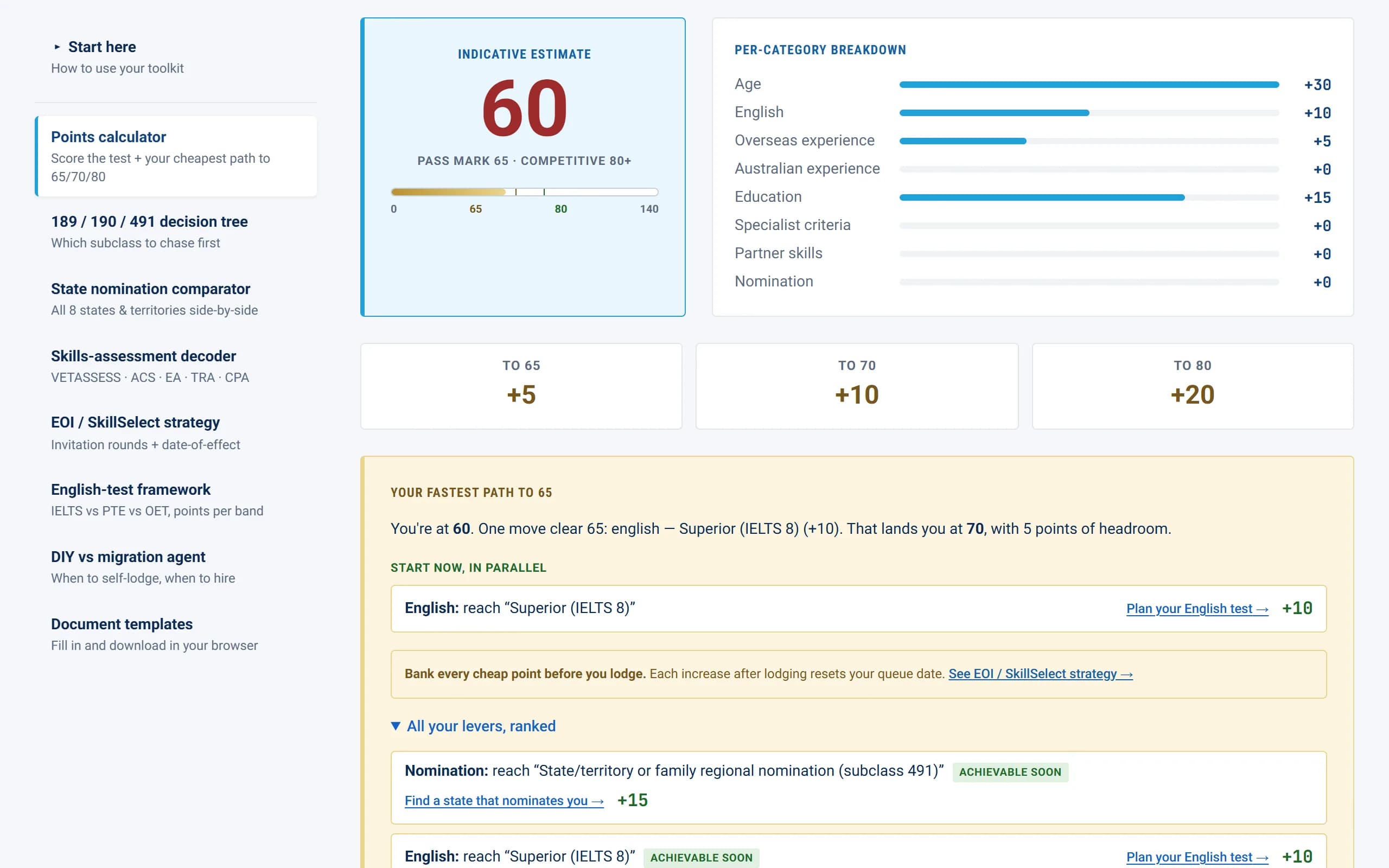
- Age 30 + Diploma 10 + English 10 + Experience 10 = 60 points
- Add 190 = 65 points, add 491 = 75 points
- 491 to regional NSW or Queensland is the realistic invitation path
Scenario 2: Bachelor's holder, strong English
Aged 28, Bachelor in Civil Engineering, IELTS 8.0+, 5 years experience.
- Age 30 + Bachelor 15 + English 20 + Experience 10 = 75 points
- Add 190 = 80 points
- Competitive in Queensland or Victoria for 190 invitations
State Nomination
New South Wales
NSW invites Civil Engineering Technicians on its 190 and 491 lists. Construction is a NSW priority sector in 2026, driven by Western Sydney Airport, Sydney Metro West, social housing delivery, and the broader infrastructure pipeline. Onshore applicants in current technician roles take priority.
Victoria
Victoria nominates the occupation on its 190 and 491 lists. The Suburban Rail Loop, North East Link, and rolling rail upgrades absorb technician capacity. Victoria's nomination programme strongly favours applicants already onshore and working in the field — recent data shows 85-90% of nominations went to onshore applicants.
Queensland
Queensland's 2025-26 programme places Civil Engineering Technician under the Building and Construction Pathway. The state requires 9 months onshore work experience for 190 and 6 months for 491. The Brisbane 2032 Olympics pipeline drives multi-year demand. Casual work now counts toward the experience requirement.
Tasmania
Tasmania nominates the occupation through its Skilled Migration Programme, with priority to onshore applicants. Major works include the Bridgewater Bridge replacement, the Macquarie Point Precinct, and AUD $1.6 billion of rolling road and water infrastructure.
Northern Territory
The NT nominates Civil Engineering Technicians where the role supports local civil works, particularly around Darwin and Alice Springs. Defence-led infrastructure investment is the dominant demand signal.
Salary and Employment Outlook
| Role | Typical Salary Range |
|---|---|
| Junior Civil Technician (0-2 yrs) | AUD $60,000-$75,000 |
| Mid-level Civil Technician (3-6 yrs) | AUD $75,000-$95,000 |
| Senior Civil Technician (7+ yrs) | AUD $90,000-$115,000 |
| Site / Project Engineer (technician progression) | AUD $105,000-$140,000 |
| Materials testing technician (NATA-credentialed) | AUD $85,000-$110,000 |
| FIFO civil technician (resources / remote) | AUD $110,000-$160,000 |
Source: SEEK Career Advice (Engineering Technician, April 2026), VETASSESS Information Sheet 312212, plus published role advertisements from CPB, John Holland, and Lendlease Engineering. Add 11.5% superannuation. Site allowances, vehicle allowances, and remote / FIFO uplifts can add 15-40% on top of base.
Highest-paying employers in 2026: tier-1 contractors (CPB Contractors, Lendlease Engineering, John Holland, Acciona, Webuild), tier-2 civil contractors (Fulton Hogan, Downer, BMD, Georgiou), and resources contractors (Civmec, Decmil, Macmahon) for FIFO work in WA and QLD.
Tips for a Successful Application
-
Choose your VETASSESS qualification field carefully. Diplomas in Civil Engineering, Civil Construction, and Civil Engineering Technology are typically assessed as highly relevant. Building Construction, Construction Management, or Project Management diplomas without civil specialisation are commonly assessed as not highly relevant, which doubles your required employment experience.
-
Document field duties, not office duties. VETASSESS reviewers separate 312211 (drafting) from 312212 (technician) on the basis of where you spend your time. Site supervision, materials testing, setting out, and field data collection should dominate your employment evidence. Pure CAD work should be minimised in references for 312212.
-
Get NATA accreditation if you work in materials testing. Civil technicians who hold NATA (National Association of Testing Authorities) signatory status earn 15-20% above the median and are heavily recruited by Coffey, Douglas Partners, Golder, and SMEC.
-
Treat 491 regional as a feature, not a downgrade. Civil works are inherently regional — roads, rail, water, dams. A 491 to Geelong, Newcastle, Wollongong, the Sunshine Coast, or Hobart puts you in a market with strong technician demand and lower competition.
-
Apply for VETASSESS priority processing. Standard is 8-12 weeks; priority is 10 business days. The fee differential is small relative to the time saved when an employer is waiting to sponsor a 482.
Step-by-Step Migration Roadmap
- Confirm ANZSCO 312212 fits your duties — use the code-finder guide
- Check your qualification is highly relevant for VETASSESS Group C
- Sit your English test — Proficient (7.0) minimum, Superior (8.0+) for points leverage
- Apply for VETASSESS skills assessment — consider priority processing
- Submit EOI in SkillSelect for 189, 190, and 491
- Apply for state nomination — NSW, Victoria, Queensland, Tasmania, or NT
- Or pursue 482 sponsorship with a tier-1 contractor or civil consultancy
- Receive invitation and lodge visa within 60 days
- Complete health and character checks
- Receive grant and relocate
- Register with relevant state professional bodies if required (no national registration for 312212)
- Begin work — consider chartering with Engineers Australia at Engineering Associate level if you progress
Frequently Asked Questions
What's the actual difference between Civil Engineering Technician and Civil Engineering Draftsperson?
Both sit at Skill Level 2 in ANZSCO unit group 3122. Draftspersons (312211) work primarily in CAD software producing drawings and design documentation. Technicians (312212) work on site supervising construction, testing materials, setting out works, and collecting field data. VETASSESS and Engineers Australia treat these as separate codes with different evidence requirements, so the choice affects which authority you apply to.
Why does Civil Engineering Technician go through VETASSESS instead of Engineers Australia?
Engineers Australia assesses Civil Engineering Draftsperson (312211) but not Civil Engineering Technician (312212). The split reflects the historical division between the engineering-design support pathway (EA) and the technician / inspection pathway (VETASSESS). For migration outcomes the distinction is procedural rather than substantive — both codes are on the MLTSSL with the same visa access.
Can I switch ANZSCO codes if my duties span both 312211 and 312212?
VETASSESS and EA both expect a single nominated occupation. If your duties genuinely span both, nominate the code that matches the majority of your time and where your employment references most clearly support the duties. A 70/30 split favouring site work points to 312212. A 70/30 split favouring CAD points to 312211.
Is there a route from technician to civil engineer once I'm in Australia?
Yes. Many technicians complete a Bachelor of Engineering (Civil) part-time at Australian universities while working, and then pursue a separate Engineers Australia assessment at Professional Engineer level. The migration outcome doesn't depend on this — Civil Engineering Technician is fully eligible on its own — but the progression is well-established and supported by tier-1 contractors.
Which state hires the most civil technicians in 2026?
NSW by absolute volume because of the Western Sydney infrastructure pipeline, followed by Victoria for the Suburban Rail Loop and metropolitan upgrades, and Queensland for the Olympics-driven pipeline. Western Australia offers the highest pay for FIFO resources work. Tasmania and the NT have smaller markets but lower competition for state nomination.