Environmental Consultant Visa Pathway to Australia: Complete 2026 Guide
Updated: 16 August 2026
Australia classifies Environmental Consultant under ANZSCO 234312. VETASSESS conducts the skills assessment. The occupation sits on the Core Skills Occupation List and the MLTSSL, unlocking subclasses 189, 190, 491, 482 and 186. Typical 2026 salaries range AUD $85,000-$160,000. Western Australia's iron-ore and lithium pipeline plus the federal EPBC reform have created sustained demand for impact-assessment specialists.
Quick Facts: Environmental Consultant Migration Pathway
| Detail | Information |
|---|---|
| ANZSCO Code | 234312 (Environmental Consultant) |
| Skill Level | 1 (Bachelor degree or higher in environmental science, ecology, environmental engineering or related field) |
| Skills Assessment | VETASSESS (Vocational Education and Training Assessment Services), Group A |
| Occupation List | CSOL and MLTSSL |
| Visa Options | 189, 190, 491, 482, 186 |
| Demand Level | High — driven by mining approvals, EPBC reform and renewables EIA workload |
| Salary Range | AUD $85,000-$160,000 (SEEK, April 2026) |
| Typical 189 Score | 80-90 points (mid-range CSOL competition) |
| Key Challenge | VETASSESS will reject "environmental policy" desk-research roles that don't include impact-assessment fieldwork or modelling |
What an Environmental Consultant Actually Does in Australia
The Australian environmental consulting market is shaped by three forces: a mining sector that needs Environmental Impact Statements (EIS) before it can break ground; a federal Environment Protection and Biodiversity Conservation (EPBC) reform programme that has expanded the matters of national environmental significance assessment workload; and a renewables build-out that means every wind farm, transmission line and solar field requires ecology surveys, biodiversity offsets and approvals.
The big employers in the sector are the multidisciplinary consultancies — ERM, Jacobs, GHD, AECOM, WSP, Stantec, SLR Consulting and Tetra Tech — alongside a long tail of specialist boutiques (Umwelt, Niche Environmental, Biosis, Eco Logical Australia). They sell to mining majors (BHP, Rio, Fortescue, Pilbara Minerals, IGO), to state road and rail authorities, to developers, and to government clients.
Geographically the work clusters in Perth (mining), Brisbane (coal, gas, infrastructure), Sydney (transport, urban development), and Melbourne (transport, renewables). Regional placements in the Pilbara, Hunter Valley, Galilee Basin and Bowen Basin are common — and well paid.
ANZSCO 234312 — Code Mapping
ANZSCO 234312 covers the analysis of policies and the technical assessment work that supports the design, implementation and modification of government or commercial environmental programmes. The official tasks include:
- Carrying out environmental impact assessments for development projects
- Studying and analysing pollution, atmospheric conditions, demographic characteristics, ecology, mineral, soil and water samples
- Proposing solutions to address negative environmental impact
- Advising on environmental management, sustainability and rehabilitation
- Preparing environmental reports for regulatory submissions
A close-but-different code is 234313 Environmental Research Scientist, which is for people whose primary output is published research rather than client deliverables. 234399 Environmental Scientists nec catches specialists who don't fit 234311 (Conservation Officer), 234312 or 234313. If you spend most of your week writing EIS chapters, conducting fauna surveys for development applications, modelling air or water quality for client projects, or advising on rehabilitation plans for mine closures, 234312 is the correct fit.
Skills Assessment — VETASSESS
VETASSESS is the designated assessing authority and treats 234312 as a Group A professional occupation.
Highly relevant degree fields:
- Environmental Science
- Environmental Engineering
- Ecology and Conservation Science
- Climate Science
- Environmental Policy and Management
- Maritime and Coastal Engineering
A general science (BSc) degree with an environmental major is accepted. A geography or planning degree without environmental-science units usually is not. Engineering degrees are accepted if the major was environmental or civil-environmental — straight civil engineering is borderline.
Experience requirements:
- Minimum one year post-qualification at appropriate skill level
- Within the last five years
- 20+ hours per week
- Highly relevant to the ANZSCO task list
The "highly relevant" test bites here. VETASSESS expects evidence of technical environmental work — fieldwork, modelling, EIA chapters, monitoring programmes, audits — not pure policy or administration. A graduate working in a sustainability team writing internal reports without external regulatory submissions can fail the experience test.
Assessment fees (October 2025 schedule):
- Full skills assessment, applicant in Australia: AUD $1,058.20 (incl. GST)
- Full skills assessment, applicant outside Australia: AUD $962.00 (no GST)
- Priority processing: additional AUD $658.30 in Australia / AUD $623.00 offshore
Processing time: 8-12 weeks standard, 2-4 weeks under priority.
Common rejection reasons: Policy-only experience without technical or assessment work; a planning or geography degree without environmental units; reference letters that describe project-management duties without specifying the technical environmental scope; and confusion between 234312 (consultant, applied) and 234313 (research scientist, academic). For a wider overview of the system, see the skills assessment bodies complete list.
Visa Pathways for Environmental Consultants
Subclass 482 — Skills in Demand visa
The most common entry route for offshore applicants, because the big consultancies (ERM, Jacobs, GHD) sponsor continuously to meet mining and infrastructure project workloads.
- Visa fee: AUD $4,015 (primary)
- Salary threshold: Core stream AUD $79,423, Specialist stream AUD $146,576
- Duration: Up to 4 years
- Quirk: Senior consultants and Principal Consultants frequently clear the Specialist stream salary threshold, which reduces some of the labour-market-testing friction.
Subclass 189 — Skilled Independent visa
Permanent residency without sponsorship.
- Visa fee: AUD $6,135
- Realistic invitation score: 85+ points in the current cycle
- Processing: 8-12 months from invitation
- Quirk: 234312 has been invited steadily in 189 rounds at lower volumes than ICT but higher than many true niche codes. Strong English, a Master's degree and 5+ years of impact-assessment experience tend to clear the threshold.
Subclass 190 — Skilled Nominated visa
- Visa fee: AUD $6,140
- Points bonus: +5
- Obligation: Two years living and working in the nominating state
- Quirk: Western Australia is the strongest nomination market — the mining approvals pipeline drives sustained demand. Victoria and NSW also nominate.
Subclass 491 — Skilled Work Regional (Provisional)
- Visa fee: AUD $6,140
- Points bonus: +15
- Quirk: Almost all heavy-industry environmental consulting happens in regional postcodes (Pilbara, Hunter, Bowen Basin, Galilee Basin). If your job offer is in Karratha, Newman, Singleton or Mackay, the 491 fit is natural and the path to subclass 191 PR is well defined.
Subclass 186 — Employer Nomination Scheme
- Visa fee: AUD $6,140
- Quirk: Most 186 grants for this occupation come through the Temporary Residence Transition (TRT) stream after two years on a 482. Direct Entry is harder but is granted to Principal Consultants and Technical Directors with global firms.
Points Test Strategy
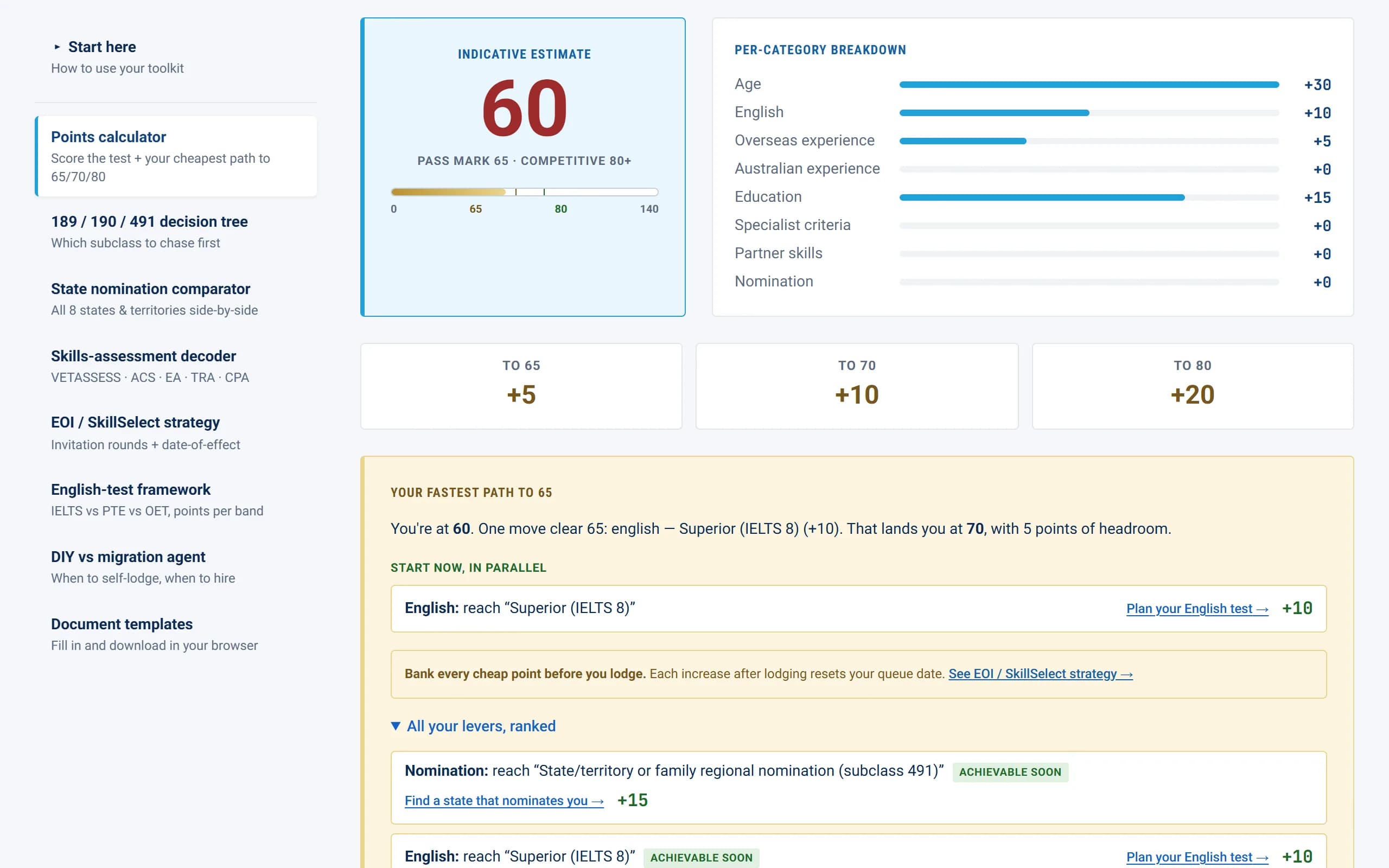
| Points Factor | Maximum |
|---|---|
| Age 25-32 | 30 |
| Age 33-39 | 25 |
| English Superior (IELTS 8) | 20 |
| English Proficient (IELTS 7) | 10 |
| Bachelor degree | 15 |
| Masters or Doctorate | 20 |
| Overseas experience 5-7 years | 10 |
| Overseas experience 8+ years | 15 |
| Australian work experience 3+ years | 10 |
| State nomination (190) | 5 |
| Regional nomination (491) | 15 |
| Partner skills | 5-10 |
Scenario 1 — South African EIA consultant, 30 years old, Honours degree, six years' experience, IELTS 7: 30 (age) + 15 (Bachelor) + 10 (English) + 10 (experience) = 65. Needs 491 (+15) or 190 (+5) plus a partner skills claim to land at competitive levels.
Scenario 2 — UK senior ecologist with PhD, 33 years old, eight years' experience, IELTS 8: 25 (age) + 20 (PhD) + 20 (Superior English) + 15 (experience) = 80 base. Strong 189 candidate, especially with the +10 specialist STEM education bonus for a research Master's or PhD.
State Nomination — Where Demand Sits
Western Australia
The strongest market for environmental consultants. WA's mining-approvals pipeline (iron ore, lithium, rare earths, gas) drives demand for EIA practitioners, hydrogeologists with environmental backgrounds, and biodiversity consultants. WA's 190 and 491 programs have nominated 234312 in most recent rounds. Premium remote rosters (8/6, 2/1) for fieldwork pay above metropolitan rates.
New South Wales
NSW nominates for transport-infrastructure and urban-renewal EIA work — Transport for NSW, Sydney Metro, the Great Western Highway upgrade, and the Powering Australia transmission build-out all need environmental consultants. The state's 190 program has historically included the code, but check the live list.
Victoria
Victoria's renewables build (Western Renewables Link, offshore wind, transmission) and rail program (Suburban Rail Loop, regional rail upgrades) generate steady consulting demand. Victoria runs a Registration of Interest model — register early.
Queensland
Queensland's coal, gas and emerging critical-minerals sectors drive demand for impact-assessment specialists, with Brisbane the corporate base for most consultancies. Mining-environmental specialists often place in Mackay or Townsville on rotation.
South Australia and Tasmania
Both nominate occasionally — SA driven by hydrogen and defence-precinct work, Tasmania driven by forestry, salmon farming and renewables.
Salary and Employment Outlook
SEEK's April 2026 data shows an average range of $85,000-$105,000 for "Environmental Consultant" as a job title. Senior and Principal roles sit substantially higher, and remote-roster premiums in WA and Queensland push total package figures into the $160,000-$200,000 band for experienced practitioners.
| Role | Typical Salary Range (AUD) |
|---|---|
| Graduate Environmental Consultant | $70,000-$85,000 |
| Consultant (2-5 years) | $85,000-$110,000 |
| Senior Consultant | $110,000-$140,000 |
| Principal Consultant | $140,000-$180,000 |
| Technical Director / Service Line Lead | $180,000-$250,000+ |
| Mining EIA Specialist (FIFO, WA/QLD) | $130,000-$200,000 (with roster premium) |
Total packages add 11.5% superannuation. Bonuses at the global firms (ERM, AECOM, Jacobs, WSP) run 5-15% on top. Mining-client work attracts site allowances and roster premiums of $20,000-$60,000.
Highest-paying sectors:
- Mining and resources — BHP, Rio, Fortescue, IGO, Pilbara Minerals all use both in-house environmental teams and major consultancies
- Multidisciplinary engineering consultancies — ERM, Jacobs, GHD, AECOM, WSP, SLR
- Government — state EPAs, federal DCCEEW, regional councils (lower base but secure tenure)
- Renewables developers — Squadron Energy, AGL, Tilt Renewables, Iberdrola Australia
- Specialist environmental firms — Umwelt, Niche, Biosis, Eco Logical Australia, RPS
Tips for a Successful Application
1. Position your CV around impact assessment, not policy
VETASSESS rejects 234312 applications where the work history reads as policy analysis or administration. Re-write your reference letters to surface fieldwork, modelling, sampling, EIA chapters, monitoring programmes and audits. If your most recent role has been policy-heavy, lean on earlier consulting work for the qualifying year.
2. Use Points Test Advice if your degree is a generalist BSc
If your degree is "Bachelor of Science" with majors split across geography, biology and chemistry, VETASSESS may query the highly-relevant requirement. The Points Test Advice service ($311-$342) gives you a binding opinion in writing before you commit to the full assessment.
3. Target WA if mining EIA is your speciality
The Pilbara approvals workload is the largest concentration of environmental-consulting work in the country. Perth-based firms (Preston Consulting, Onshore Environmental, the major consultancies' WA offices) recruit internationally and sponsor visas continuously. The 491 regional concession applies across most of WA outside the Perth metro CBD.
4. Time your application around state ROI windows
NSW, Victoria and WA all run Registration of Interest systems for 190/491 nominations. ROIs do not expire until the program year closes, so lodging early ranks you ahead of late entries with similar points scores. Register as soon as your skills assessment is in flight, not after it comes through.
5. Don't conflate 234312 with 234313
Environmental Research Scientist (234313) is a different code for academic and pure-research practitioners. Mapping to the wrong one is the single most common error on first-attempt applications. If your output is client reports filed with regulators, use 234312. If your output is peer-reviewed journal articles, use 234313.
Step-by-Step Migration Roadmap
- Confirm the right ANZSCO code — 234312 vs 234313 vs 234399 — via the how to find your ANZSCO code guide
- Audit your degree transcript and employment history against the VETASSESS task list
- Order verified employment references that emphasise technical environmental work
- Sit IELTS, PTE or OET (aim for IELTS 7 minimum; IELTS 8 for points)
- Lodge VETASSESS Full Skills Assessment (or Points Test Advice first if borderline)
- Lodge an Expression of Interest in SkillSelect for 189/190/491
- Lodge a state Registration of Interest in WA, NSW or Victoria
- If pursuing 482, target an employer with active SBS approval (ERM, Jacobs, GHD, AECOM, WSP) or a mining company in-house environmental team
- Receive invitation to apply or 482 grant; lodge visa within 60 days
- Complete health and character checks
- Receive grant and relocate
Frequently Asked Questions
How does VETASSESS distinguish Environmental Consultant from Environmental Research Scientist?
Output type and client. Consultants produce reports for regulators, developers and government — typically EIAs, audits, monitoring programmes and management plans. Research scientists produce peer-reviewed publications, theses and academic-style research. If your last five years has been client-facing project work governed by approval timelines, you're a consultant. See the environmental scientists nec page for the catch-all code.
Is the occupation on the MLTSSL or just the CSOL?
Both. 234312 sits on the Core Skills Occupation List and retains MLTSSL eligibility for 189/190/491. Full mainstream visa access, no carve-outs.
Can I migrate as an Environmental Consultant if my degree is in Geography or Planning?
It depends on the unit mix. A geography degree with environmental science units (ecology, climate, hydrology, GIS) can pass. A pure human-geography or urban-planning degree usually fails the "highly relevant" test. Get a Points Test Advice from VETASSESS before lodging.
Which state offers the best pathway for offshore environmental consultants?
Western Australia. Mining-approvals work in the Pilbara and Goldfields drives sustained demand, and WA's program has consistently nominated 234312 across recent rounds. The state also recognises remote and regional postcodes for 491, which compounds the points advantage.
Do mining companies sponsor environmental consultants directly, or only through consultancies?
Both. BHP, Rio Tinto, Fortescue, IGO and Pilbara Minerals run sizeable in-house environment, approvals and closure teams that sponsor 482 and 186 visas. The consultancy route (ERM, Jacobs, GHD) is more common for early-career and mid-career migrants; in-house mining roles tend to attract senior practitioners after 3-5 years of consulting experience in Australia.
What's the demand outlook for the occupation in 2026?
Strong and durable. The federal EPBC reform programme has not reduced approvals workload — it has added matters of national environmental significance complexity. The renewables build-out, Sydney and Melbourne transport megaprojects, the WA critical-minerals pipeline and the AUKUS-driven defence-estate work all generate ongoing EIA, ecology and contamination workload. See the most in-demand occupations list for further detail.