Physicist Visa Pathway to Australia: Complete 2026 Guide
Updated: 16 August 2026
Australia classifies Physicist under ANZSCO 234914. VETASSESS conducts the skills assessment. The occupation sits on the Core Skills Occupation List and the MLTSSL, unlocking subclasses 189, 190, 491, 482 and 186. Typical 2026 salaries range AUD $90,000-$160,000. ANSTO, CSIRO, the quantum-computing cluster around Sydney and Brisbane, and the medical-physics workforce in radiation oncology are the main employers.
Quick Facts: Physicist Migration Pathway
| Detail | Information |
|---|---|
| ANZSCO Code | 234914 (Physicist) |
| Skill Level | 1 (Bachelor degree or higher; Master's or PhD typical for research roles) |
| Skills Assessment | VETASSESS (Vocational Education and Training Assessment Services), Group A |
| Occupation List | CSOL and MLTSSL |
| Visa Options | 189, 190, 491, 482, 186 |
| Demand Level | High at the specialist end — medical physics, quantum technology and defence research are short-staffed |
| Salary Range | AUD $90,000-$160,000 (PayScale and SEEK, April 2026); $200,000+ for senior medical physicists |
| Typical 189 Score | 80-85 points (small pool, low invitation threshold) |
| Key Challenge | Long VETASSESS processing window (12-20 weeks) and tight degree-content scrutiny — generalist science degrees fail |
What a Physicist Actually Does in Australia
The Australian physicist workforce splits into four buckets.
Research physics sits in CSIRO, ANSTO, defence-research organisations (DSTG), and the Group of Eight universities. CSIRO covers manufacturing, mining, agriculture, climate and quantum applied research. ANSTO operates the OPAL nuclear research reactor at Lucas Heights, the Australian Synchrotron in Clayton, and the Centre for Accelerator Science, producing radiopharmaceuticals and supporting nuclear-physics, materials-science and biomedical work.
Quantum and photonics is the fastest-growing private sector. Silicon Quantum Computing, Diraq, Q-CTRL, Quantum Brilliance and PsiQuantum's Australian operations are all hiring quantum engineers and applied physicists. The federal government's National Quantum Strategy and the AUD $1 billion PsiQuantum deal announced in 2024 have anchored the sector.
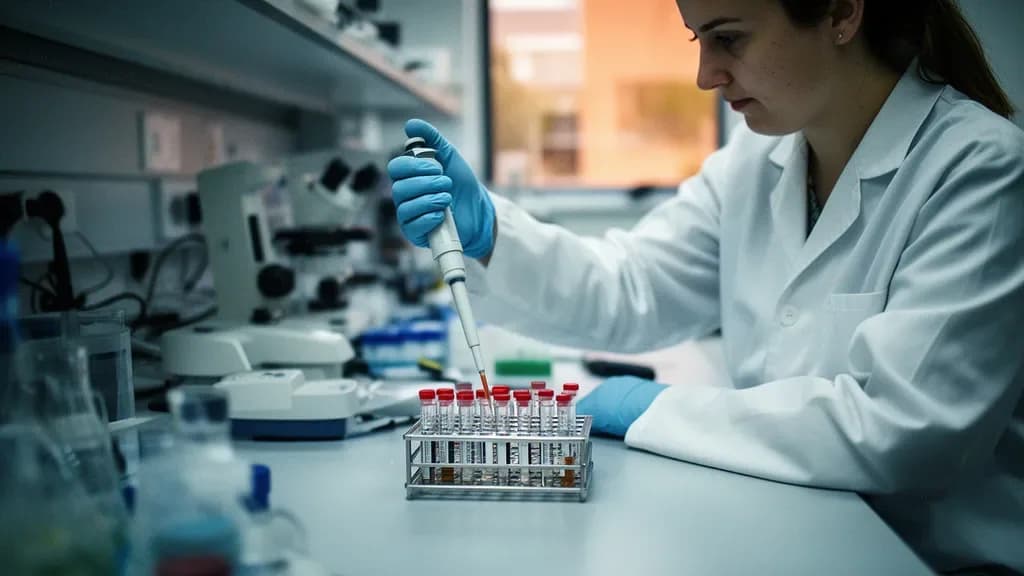
Medical physics sits inside hospital radiation-oncology departments (Peter MacCallum, Royal North Shore, the SAHMRI/Royal Adelaide cluster, the Brisbane and Perth comprehensive cancer centres). Australia certifies medical physicists through the Australasian College of Physical Scientists and Engineers in Medicine (ACPSEM) — a separate registration pathway alongside VETASSESS.
Defence and intelligence physics employs researchers across DSTG and through prime contractors (Lockheed Martin Australia, BAE Systems, Thales). AUKUS Pillar 2 work has expanded demand for applied physicists with security-clearance eligibility.
Geographically, Sydney and Melbourne dominate. Canberra (DSTG, ANU), Adelaide (defence, SAHMRI), Brisbane (quantum, UQ), and Perth (mining, defence) are secondary clusters.
ANZSCO 234914 — Code Mapping
ANZSCO 234914 covers physicists who study matter, space, time, energy, forces and fields and the interrelationships between these to advance understanding of the laws governing the universe. The code sits within unit group 2349 (Other Natural and Physical Science Professionals).
Core tasks include:
- Studying matter, space, time, energy, forces and fields
- Developing and testing analytical methodologies through experiments
- Preparing scientific papers and reports
- Supervising technicians and technologists
- Specialising in branches such as electrical, nuclear, atmospheric, optical or computational physics
- Applying physical laws to develop new materials, products and processes
Specialisations explicitly captured under 234914 include nuclear physics, electrical physics, atmospheric physics (where the role is research-focused rather than operational forecasting — see meteorologist visa pathway), and computational physics. Medical physicists are usually assessed under 234914 too, with their ACPSEM certification handled as a parallel registration.
Astrophysicists, biophysicists and computational physicists who don't fit cleanly into 234914 can be assessed under 234999 (Natural and Physical Science Professionals nec). Geophysicists have their own code (234412). For closely related research codes, see the geophysicist visa pathway.
Skills Assessment — VETASSESS
VETASSESS is the assessing authority and treats 234914 as a Group A professional occupation.
Highly relevant degree fields:
- Physics
- Astrophysics
- Engineering Physics
- Nuclear Physics
- Computational Physics
- Applied Physics with strong theoretical content
A general Bachelor of Science with a physics major is acceptable provided the transcript shows substantial physics content (mechanics, electromagnetism, quantum, thermodynamics, statistical physics). Engineering degrees other than Engineering Physics are usually too applied to qualify under 234914 — they map better to specific engineering ANZSCO codes.
Experience requirements:
- Minimum one year post-qualification at appropriate skill level
- Within the last five years
- 20+ hours per week
- Highly relevant to the ANZSCO task list
For physicists, "highly relevant" typically means research-active employment: post-doctoral fellowships, applied-physics roles in industry, medical-physics positions in hospitals, or research-scientist roles in national labs. Teaching physics at school level is not enough; teaching-and-research academic positions usually qualify.
Assessment fees (October 2025 schedule):
- Full skills assessment, applicant in Australia: AUD $1,058.20 (incl. GST)
- Full skills assessment, applicant outside Australia: AUD $962.00 (no GST)
- Priority processing: additional AUD $658.30 in Australia / AUD $623.00 offshore
Processing time: 12-20 weeks standard (longer than most VETASSESS occupations due to academic-credential checks), 4-6 weeks priority.
Common rejection reasons: Engineering degrees being assessed under 234914 instead of the relevant engineering code; experience claims based on teaching physics at secondary or undergraduate level without research output; post-doctoral cycles that produce gaps in the five-year recency window; and applicants from heavily-research-focused careers struggling to document the 20-hours-per-week threshold during fellowship transitions. The skills assessment bodies complete list covers the wider context.
Visa Pathways for Physicists
Subclass 189 — Skilled Independent visa
Permanent residency through the points system. The most natural fit for highly-qualified physicists.
- Visa fee: AUD $6,135
- Realistic invitation score: 80-85 points; the pool is small, invitations are issued regularly to candidates above the threshold
- Processing: 8-12 months
- Quirk: This is one of the few CSOL codes where 189 invitations clear at score ranges well below the ICT threshold. A PhD in physics with Superior English and three years of post-doctoral work routinely scores 85+.
Subclass 482 — Skills in Demand visa
- Visa fee: AUD $4,015
- Salary threshold: Core stream AUD $79,423 / Specialist stream AUD $146,576
- Duration: Up to 4 years
- Quirk: Quantum-tech firms (Silicon Quantum, Q-CTRL, Diraq, Quantum Brilliance, PsiQuantum) sponsor regularly. Medical-physics roles in radiation oncology sponsor where the candidate already holds ACPSEM provisional certification. ANSTO and CSIRO sponsor researchers but with longer recruitment cycles.
Subclass 186 — Employer Nomination Scheme
- Visa fee: AUD $6,140
- Quirk: Universities and research institutes use Direct Entry 186 for senior academic and principal-research-scientist hires. Most commercial physicist sponsorships come through TRT after 482.
Subclass 190 — Skilled Nominated visa
- Visa fee: AUD $6,140
- Points bonus: +5
- Quirk: ACT (Canberra — defence research, ANU) and NSW (Sydney — quantum cluster, ANSTO Lucas Heights) are the most likely nominators. Victoria nominates for the medical-physics workforce at Peter MacCallum and other Melbourne cancer centres.
Subclass 491 — Skilled Work Regional (Provisional)
- Visa fee: AUD $6,140
- Points bonus: +15
- Quirk: Regional postcodes include the Hunter Valley (close to Lucas Heights operations), Wollongong (University of Wollongong's physics work), and parts of Adelaide and Hobart that house defence-research operations.
Points Test Strategy
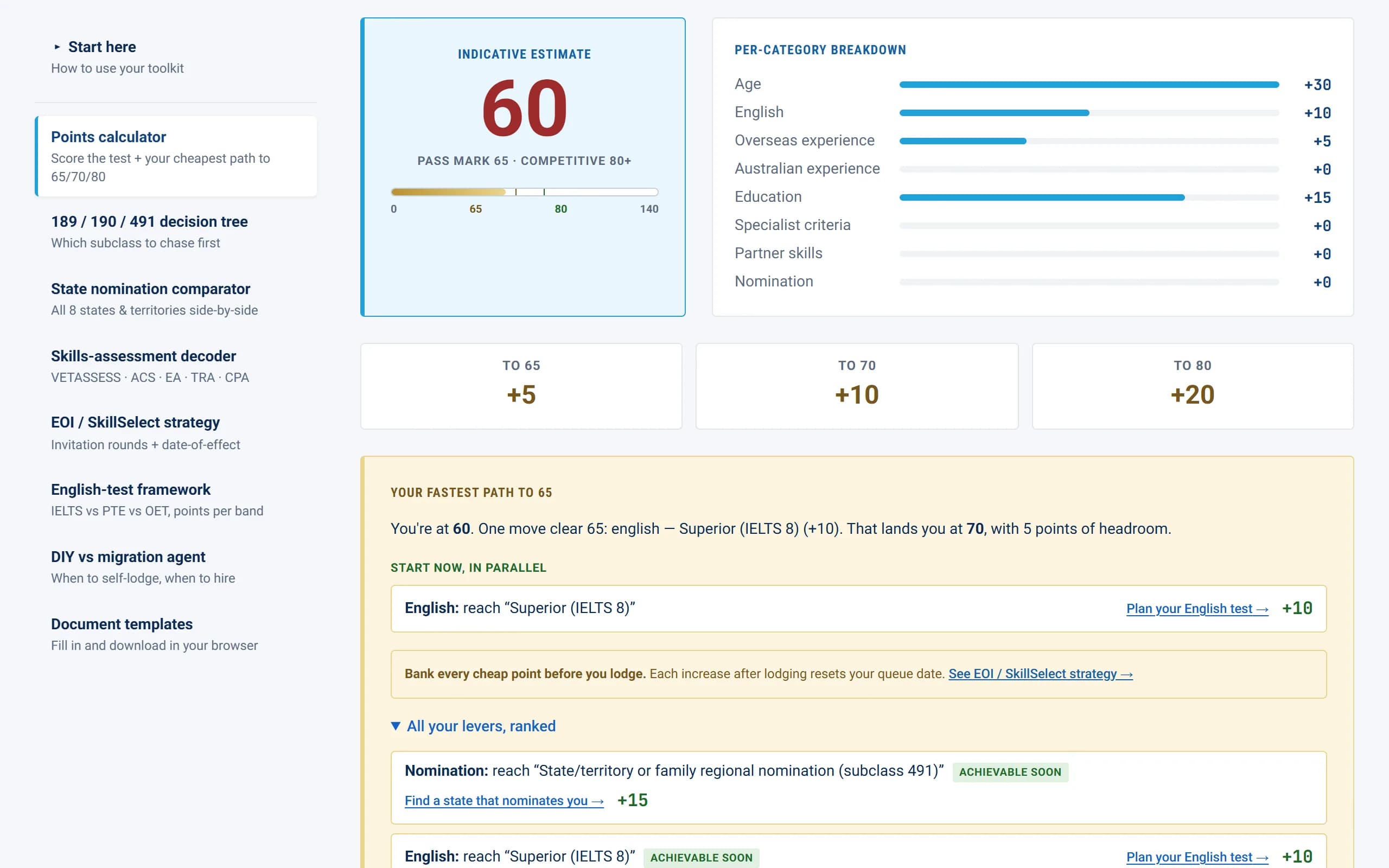
| Points Factor | Maximum |
|---|---|
| Age 25-32 | 30 |
| Age 33-39 | 25 |
| English Superior (IELTS 8) | 20 |
| English Proficient (IELTS 7) | 10 |
| Bachelor degree | 15 |
| Masters or Doctorate | 20 |
| Overseas experience 5-7 years | 10 |
| Overseas experience 8+ years | 15 |
| Australian work experience 3+ years | 10 |
| State nomination (190) | 5 |
| Regional nomination (491) | 15 |
| Partner skills | 5-10 |
| Specialist education (research Masters/PhD in STEM) | 10 |
Scenario 1 — Chinese quantum-computing PhD, 31 years old, three years' post-doc experience, IELTS 8: 30 (age) + 20 (PhD) + 20 (Superior English) + 5 (experience) + 10 (specialist STEM PhD) = 85 points. Strong independent 189 candidate.
Scenario 2 — Indian medical physicist with Master's, 33 years old, seven years' hospital experience, IELTS 7: 25 (age) + 15 (Bachelor — VETASSESS assesses many Indian Master's qualifications as Bachelor-equivalent depending on institution) + 10 (English) + 10 (experience) = 60 base. Adds +5 with 190 nomination, +10 with partner-skills claim, lands at 75. May need 491 (+15) for clearance, or pursue 482 sponsorship through a radiation-oncology centre.
State Nomination
Australian Capital Territory
Canberra hosts the Defence Science and Technology Group (DSTG), the Australian National University's physics departments, and the federal science agencies' headquarters. The ACT's program has nominated physicists in recent years. Security-clearance eligibility (which generally requires citizenship eventually) is relevant for DSTG work.
New South Wales
Sydney is the largest physicist employer base — ANSTO at Lucas Heights, the quantum-computing cluster (Silicon Quantum, Diraq), and University of Sydney's School of Physics. NSW's 190 program has included 234914 in most recent rounds.
Victoria
Melbourne hosts the Australian Synchrotron at Clayton, Peter MacCallum Cancer Centre's medical-physics group, Monash and Melbourne University physics departments. Victoria's Registration of Interest model lets candidates with relevant job offers register early.
Queensland
Brisbane's quantum cluster (UQ, Quantum Brilliance) plus medical-physics work at the Royal Brisbane and Princess Alexandra hospitals creates steady demand. Queensland's program is smaller but less competitive.
South Australia
Adelaide's defence and medical-research base (DSTG, SAHMRI, Royal Adelaide Hospital, Flinders University) makes SA a viable option, particularly for applied physicists with defence-relevant specialisations.
Salary and Employment Outlook
PayScale's 2026 figure is AU$97,210 average. Glassdoor data shows experienced physicists at AU$119,500. SEEK's "Research Scientist" category sits at $110,000-$125,000. Senior medical physicists in radiation oncology clear $180,000-$220,000.
| Role | Typical Salary Range (AUD) |
|---|---|
| Post-doctoral Researcher (university) | $90,000-$115,000 |
| Research Scientist (CSIRO, ANSTO, Levels 4-5) | $100,000-$135,000 |
| Senior Research Scientist (CSIRO Level 6-7) | $135,000-$175,000 |
| Quantum Engineer / Applied Physicist (industry) | $120,000-$200,000 (often plus equity) |
| Medical Physicist (Registrar) | $90,000-$120,000 |
| Senior Medical Physicist | $160,000-$220,000+ |
| Principal Research Scientist (CSIRO Level 8 / EL2) | $175,000-$230,000 |
| Defence Scientist (DSTG, EL2) | $145,000-$180,000 |
CSIRO and ANSTO salaries follow research-organisation enterprise agreements and include generous superannuation (15.4% for federal-sector employees). Quantum-sector employers offer lower base but often include equity participation. Medical physicists are paid under state health-service awards.
Highest-paying employers and sectors:
- Medical physics — Peter MacCallum (Melbourne), Royal North Shore (Sydney), the Royal Adelaide cluster, Princess Alexandra (Brisbane), Sir Charles Gairdner (Perth)
- Quantum computing and photonics — Silicon Quantum Computing, Diraq, Q-CTRL, Quantum Brilliance, PsiQuantum (Brisbane build)
- National research agencies — CSIRO, ANSTO, DSTG
- Defence primes — Lockheed Martin Australia, BAE Systems Australia, Thales Australia, Northrop Grumman Australia
- Universities — Group of Eight physics departments (Sydney, Melbourne, ANU, UQ, Monash, UWA, Adelaide, UNSW)
Tips for a Successful Application
1. Plan around the 12-20 week VETASSESS processing window
VETASSESS treats 234914 as a slower assessment than many Group A occupations because of the academic-credential checks required for research-track applicants. If your visa deadline is tight, pay for priority processing (AUD $623-$658 on top of the base fee) — it cuts the window to 4-6 weeks.
2. Separate your medical-physics registration from the VETASSESS pathway
If you intend to work as a medical physicist in Australian radiation oncology, you need to start ACPSEM certification (Australasian College of Physical Scientists and Engineers in Medicine) in parallel with VETASSESS. The two processes are independent. ACPSEM offers an overseas-qualified pathway with provisional registration leading to full TEAP (Training Education and Accreditation Program) accreditation. Most hospitals will sponsor 482 visas conditional on ACPSEM provisional status.
3. Use the +10 specialist STEM bonus
Physicists with a research Master's or Doctorate qualify for the +10 specialist-education points bonus on top of the base qualification points. Combined with the Doctorate +20, that is 30 points from qualifications alone. The bonus is checked against your degree being research-based and in a STEM field — both of which are easy to evidence for most physicist applicants.
4. Target the quantum cluster if you have hands-on hardware experience
Australia's quantum-technology sector is one of the most active hiring markets for applied physicists globally. Silicon Quantum, Diraq, Q-CTRL, Quantum Brilliance and PsiQuantum all sponsor visas. CV positioning around hands-on hardware (qubit fabrication, cryogenic systems, control electronics, photonic circuits, error correction) is more valuable than pure-theory output for industry roles.
5. Don't try to map an engineering degree under 234914
VETASSESS will reject an Engineering degree (other than Engineering Physics) assessed under the Physicist code. Electrical engineers, mechanical engineers, electronics engineers and chemical engineers should map to their own ANZSCO codes through Engineers Australia, not VETASSESS. If your work spans physics and engineering, choose the code that matches your degree, not your most recent job.
Step-by-Step Migration Roadmap
- Confirm 234914 is the right code — 234999 (Natural and Physical Science Professionals nec) and 234412 (Geophysicist) are common alternatives; check the how to find your ANZSCO code guide
- Audit your degree transcript against the VETASSESS list of highly relevant physics fields
- If pursuing medical physics, start ACPSEM provisional registration in parallel with VETASSESS
- Order verified employment references emphasising research output, publications and grants
- Sit IELTS, PTE or OET (aim for IELTS 8 to maximise points)
- Lodge VETASSESS Full Skills Assessment with priority processing if timeline matters
- Lodge an Expression of Interest in SkillSelect for 189/190/491
- Lodge state Registration of Interest where applicable (ACT, NSW, Victoria, Queensland)
- For 482 sponsorship, target quantum employers, radiation-oncology hospitals, ANSTO, CSIRO, defence primes
- Receive invitation to apply or 482 grant; lodge visa within 60 days
- Complete health and character checks
- Receive grant and relocate
Frequently Asked Questions
Can I migrate as a Physicist if my PhD is in Astrophysics or Biophysics?
Usually yes, though it depends on the unit content. Astrophysics PhDs with strong physics core content typically pass VETASSESS under 234914. Biophysics is borderline — the assessment may direct you to 234999 (Natural and Physical Science Professionals nec) if the work is closer to biology than physics. Apply for Points Test Advice ($311-$342) before committing to the full assessment.
Is medical physics a separate pathway?
The visa side is the same — VETASSESS under 234914. The professional-practice side requires ACPSEM certification, which runs in parallel and is needed before you can work clinically in a hospital. Most radiation-oncology employers sponsor 482 visas conditional on you already holding ACPSEM provisional registration, so start that process early.
How competitive is the 189 invitation for Physicist?
Less competitive than for ICT codes. The pool is small and the candidates who clear tend to have PhDs and Superior English. Recent invitation rounds have cleared at 80-85 points for 234914 — far below the ICT threshold. A PhD-holding applicant with Superior English and post-doctoral experience can realistically target the 189 without needing state nomination.
Will my PhD from China, India or Russia be recognised?
Yes, in most cases. VETASSESS recognises doctorates from internationally recognised universities. The assessment focuses on whether the degree is research-based and in a relevant field, not on the country of issue. Documentation needs to include the official transcript, certified copies of the degree certificate, and (where applicable) a thesis title with brief description.
Does the Australian quantum-computing sector actually sponsor visas?
Yes — actively. Silicon Quantum Computing, Diraq, Q-CTRL, Quantum Brilliance and PsiQuantum's Brisbane operation all sponsor 482 and 186 visas for experienced applied physicists. The PsiQuantum AUD $1 billion Queensland deal has expanded the market further. Sponsor lists are concentrated in Sydney and Brisbane.
What's the demand outlook for the occupation in 2026?
Strong at the specialist end. Medical-physics demand is structural (radiation-oncology workforce is short-staffed nationally), quantum-tech hiring is accelerating, and AUKUS Pillar 2 defence research is expanding applied-physics roles. Generalist research-physics roles in universities remain tight due to academic-job market conditions globally. See the most in-demand occupations list for further context.