Dietitian Visa Pathway to Australia: Complete 2026 Guide
Updated: 16 August 2026
Australia classifies Dietitians under ANZSCO 251111. Dietitians Australia conducts the skills assessment. The occupation sits on the Core Skills Occupation List (CSOL) and the STSOL, unlocking subclasses 190, 491, 482 and 186 — but not subclass 189. Typical 2026 salaries range AUD $80,000-$110,000 (SEEK), with public-sector roles paying more than private practice. Dietetics is not regulated by AHPRA — APD credentialing through Dietitians Australia is the de facto requirement.
Quick Facts: Dietitian Migration Pathway
| Detail | Information |
|---|---|
| ANZSCO Code | 251111 (Dietitian) |
| Skill Level | 1 (Bachelor degree or higher in dietetics) |
| Skills Assessment | Dietitians Australia (DAA) |
| Occupation List | CSOL and STSOL |
| Visa Options | 190, 491, 482, 186 (not 189) |
| Demand Level | Moderate — listed as no shortage nationally but consistent allied-health hiring |
| Salary Range | AUD $80,000-$110,000 (SEEK, 2026); Government & Defence roles average $97,025 |
| Typical 190 Score | 65-80 points with state nomination |
| Key Challenge | Most employers require Accredited Practising Dietitian (APD) status; overseas graduates usually need to sit the DAA Examination |
Role Context in Australia
Dietitians in Australia work across hospitals, community health, private practice, aged care, sports performance, food industry, public health and research. The occupation is allied health rather than medicine — Dietitians are not registered with AHPRA, because dietetics is not currently a regulated health profession under the National Registration and Accreditation Scheme. Instead, the profession self-regulates through Dietitians Australia, which administers the Accredited Practising Dietitian (APD) credential. Almost every Australian employer (public hospital, Medicare-rebate private practice, aged-care provider, NDIS provider) requires APD status as a precondition of employment.
The largest employers are state hospital networks, community health services, aged-care providers, private hospitals, NDIS-registered allied-health practices, and food and consumer-goods companies. The 2024 Occupation Shortage List records this occupation as "no shortage" nationally, which is consistent with a steady allied-health pipeline meeting baseline demand. That said, regional Australia, aged-care and NDIS providers continue to advertise unfilled positions, particularly for clinical dietitians with paediatric, oncology, renal or critical-care experience.
For overseas-trained dietitians, the credentialing pathway is more involved than the visa pathway. A successful migration plan typically runs three parallel processes: Dietetic Skills Recognition (DSR) and APD eligibility through Dietitians Australia; the DAA Examination in Dietetics for Overseas Educated Dietitians where Mutual Recognition does not apply; and the visa pathway itself.
ANZSCO 251111 Code Mapping
ANZSCO 251111 covers professionals who apply the principles of nutrition science to plan and evaluate nutrition programs, assess nutritional needs of patients, and counsel individuals and groups on diet and nutrition. Tasks include clinical assessment of nutritional needs, designing therapeutic dietary plans for hospital and outpatient settings, counselling patients with chronic disease, working with multidisciplinary care teams, and contributing to public health nutrition programs.
Dietitian (251111) is distinct from Nutritionist (251112). The clinical, hospital-eligible practitioner role with Medicare provider number access maps to 251111. Nutritionists working in food industry, public health or wellness who do not hold a dietetics-accredited qualification typically map to 251112. The two codes have different assessing arrangements and different visa list status — confirming the correct code is the first migration decision.
Skills Assessment with Dietitians Australia
Dietitians Australia is the assessing authority for Dietitian (251111).
Requirements
- A qualification in dietetics from a program recognised as comparable to an Australian AQF Bachelor degree (or higher) in dietetics
- Evidence of post-qualification professional dietetics practice
- For most overseas graduates: completion of the DAA Examination in Dietetics for Overseas Educated Dietitians, unless a Mutual Recognition agreement applies (notably with the UK's BDA Dietitians and IDDS programs)
Assessment Cost
Dietitians Australia charges AUD $305 for the skills migration assessment used for an Australian visa. This is materially lower than VETASSESS or ACS fees. The fees are valid until 31 March 2026, with annual fee review on 1 April. Mid-year applicants should confirm the current fee on the DA website before lodging.
Processing Time
Dietitians Australia does not publish a fixed processing-time service standard for the migration assessment. The processing window depends on the completeness of evidence at lodgement and on parallel DSR processes if APD eligibility is also being established. Plan for a comparable timeline to other allied-health assessing bodies (8-12 weeks is a reasonable working assumption).
Parallel Process: DSR and APD
Dietetic Skills Recognition (DSR) is a separate, voluntary process for overseas-trained dietitians who wish to practise in Australia. It assesses skills against the National Competency Standards and is the gateway to APD status. The skills migration assessment used for the visa does not on its own confer APD status — for that, you need DSR plus, where required, the DAA Examination, plus the supervised practice and continuing professional development pathway. Many migrating dietitians choose to run both processes in parallel because almost every Australian employer requires APD.
Common Rejection Reasons
The biggest pitfall is qualification scope. Dietetics-accredited programs combine biochemistry, clinical placements, food service systems and nutrition counselling. Nutrition-only or food-science qualifications without the clinical dietetics components typically fail the skills assessment for 251111. Mutual Recognition currently applies to programs accredited by the British Dietetic Association and a small number of other international accreditors — graduates outside those agreements should plan to sit the DAA Examination.
Visa Pathways for Dietitians
The STSOL listing means subclass 189 is not available. The pathway centres on 190, 491, 482 and 186.
Subclass 482 — Skills in Demand Visa
Employer-sponsored temporary visa, almost always Core Skills stream given dietitian salary levels.
- Visa fee: AUD $3,210 (primary applicant, Core Skills stream)
- Salary threshold: Core Skills Income Threshold AUD $76,515 (achievable for full-time positions in public health or hospital settings)
- Duration: Up to 4 years
- Reality: State public-health services, aged-care providers and NDIS allied-health groups all sponsor at this level, particularly for clinical dietitians.
Subclass 190 — State Nominated Visa
State nomination adds 5 points and provides permanent residency directly.
- Visa fee: AUD $6,140 (primary applicant)
- Points boost: +5
- Reality: Best targeted at states with allied-health priorities. Tasmania, SA and regional WA historically include allied-health roles on their lists. Confirm the current list status before lodging an EOI.
Subclass 491 — Skilled Work Regional (Provisional) Visa
Five-year regional visa with a pathway to PR via subclass 191 after three years on qualifying income.
- Visa fee: AUD $6,140 (primary applicant)
- Points boost: +15 (regional nomination)
- Reality: Aged-care and community-health vacancies in regional Australia create real demand. Designated regional areas include Hobart, Adelaide, Newcastle, Wollongong, Cairns, and most of regional NSW, QLD, SA, WA, TAS and NT.
Subclass 186 — Employer Nomination Scheme
Permanent residency via employer sponsorship — Direct Entry or TRT after 2 years on 482.
- Visa fee: AUD $6,140 (primary applicant)
- Streams: Direct Entry or TRT
- Reality: Public hospital networks and major private health providers do sponsor 186 Direct Entry for senior or specialist dietitian roles. TRT after two years on 482 is the more common pattern.
Points Test Strategy
| Points Factor | Points | Notes |
|---|---|---|
| Age (25-32) | 30 | Maximum bracket |
| Bachelor degree | 15 | Required floor |
| Master's degree | 15 | Common — Master of Dietetics, MND |
| Doctorate | 20 | Less common; valued in research-clinical hybrid roles |
| English (Superior 8.0+) | 20 | Strong upside |
| English (Proficient 7.0) | 10 | Realistic floor |
| Skilled employment overseas (3-4 yrs) | 5 | Typical for early-career applicants |
| Skilled employment overseas (5-7 yrs) | 10 | Typical for mid-career applicants |
| State Nomination (190) | 5 | The key 190 booster |
| Regional Nomination (491) | 15 | Strongest single booster |
| Partner skills | 5-10 | Often the difference between an invitation and not |
Realistic Score Scenarios
Scenario 1: UK-trained dietitian, 29 years old, BDA-accredited Bachelor's, Superior English, 5 years experience, partner with skilled occupation. Age 30 + Bachelor 15 + English 20 + Experience 10 + Partner 10 = 85 points. Strong candidate for 190.
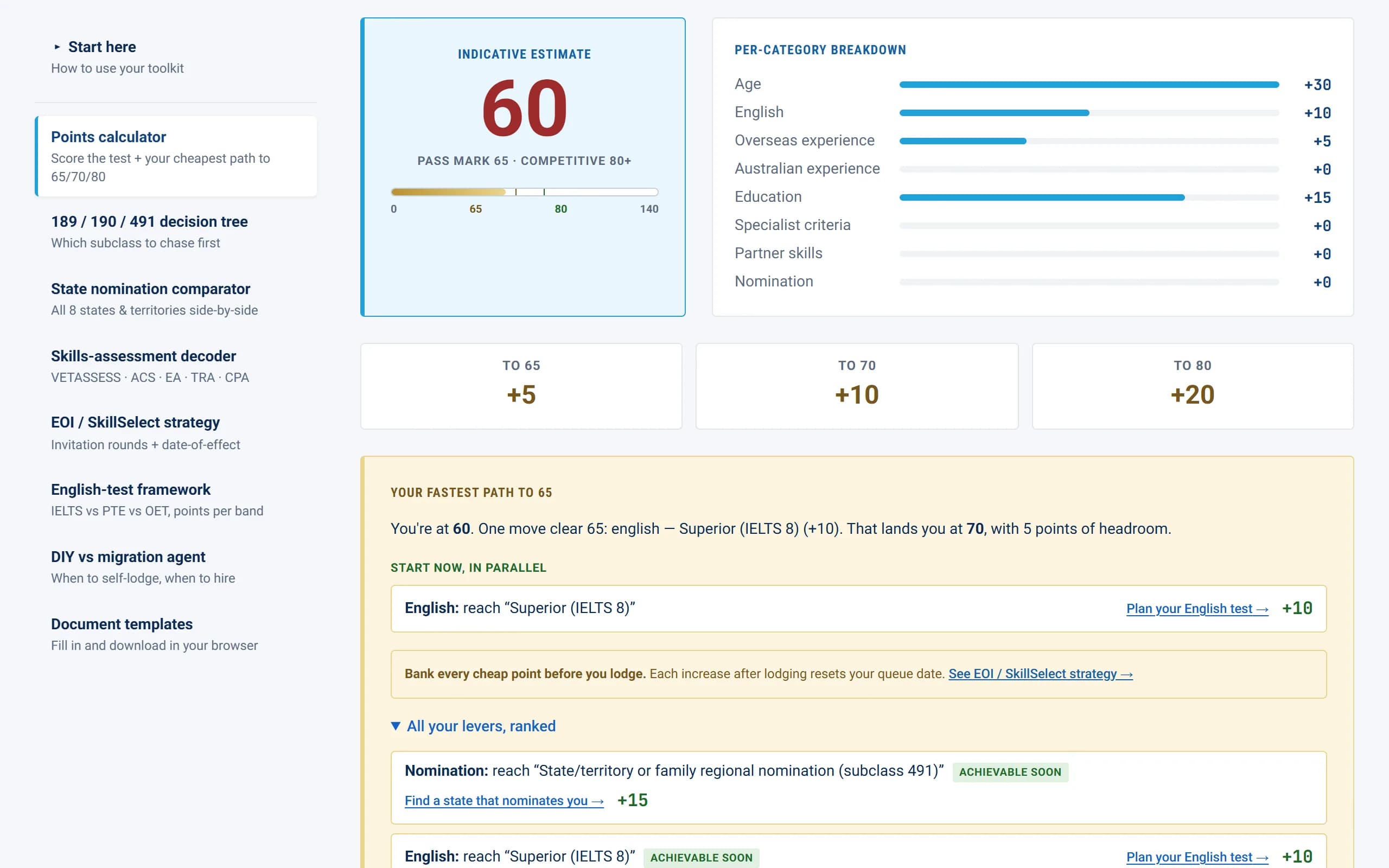
Scenario 2: India-trained dietitian, 27 years old, Master's, Proficient English, 3 years experience, no partner skills. Age 30 + Master's 15 + English 10 + Experience 5 = 60 points. Needs 190 (+5 → 65) plus state nomination, or 491 (+15 → 75) for regional invitation. Sitting the DAA Examination is also a precondition.
State Nomination
Tasmania
Tasmania's onshore pathway has historically included allied-health occupations, with the requirement that applicants have been working in Tasmania for at least six months immediately before nomination, in a closely related occupation, at least 20 hours per week.
South Australia
SA has supported allied-health migration, particularly into regional health services and aged-care providers. SA's nomination program prioritises offshore candidates with relevant clinical experience and a clear genuine intent to settle in SA.
Regional Western Australia
WA Country Health Service and aged-care providers in regional WA recruit dietitians regularly. WA's 491 program supports candidates with relevant skills and, ideally, an employment offer.
Northern Territory
The NT recruits actively across allied health and has historically supported dietitian nominations under both 190 and 491 streams, particularly into community-controlled health services.
Other States
NSW, Victoria and Queensland nominate this occupation on a more selective basis. Specific 251111 nomination availability changes by financial-year quota release — verify the current state list before targeting an EOI.
Salary and Employment Outlook
Dietitian salaries in Australia are tied closely to the public-sector health awards (state Health Professional or equivalent enterprise agreements) and to NDIS pricing for private practice.
| Role | Typical Salary Range (AUD) |
|---|---|
| New Graduate Dietitian | $68,000-$78,000 |
| Clinical Dietitian (Grade 1-2) | $80,000-$100,000 |
| Senior Clinical Dietitian (Grade 3) | $100,000-$120,000 |
| Advanced Practice / Team Leader Dietitian | $115,000-$135,000 |
| Dietitian — Government & Defence (average) | $97,025 (SEEK 2026) |
| Dietitian — Healthcare & Medical (average) | $87,540 (SEEK 2026) |
| Private Practice / NDIS Sole Trader | $90,000-$160,000+ (variable, billing-driven) |
Source: SEEK Salary Hub (2026). Total packages typically include 11.5% superannuation. Public-sector roles add not-for-profit salary packaging (currently up to $9,010 of meal entertainment plus $15,900 of general expenses per FBT year for eligible employers), which materially boosts net take-home compared to private-sector equivalents.
Highest-paying employers include state hospital networks (NSW Health, Queensland Health, Department of Health Victoria, SA Health, WA Health), the Defence Forces (uniformed and civilian dietitian roles), major private hospital groups (Ramsay, Healthscope, St Vincent's), large aged-care providers, and high-volume sports performance roles at AIS, AFL, NRL and elite cycling and swimming programs. Government and Defence roles consistently advertise above the healthcare median.
Tips for a Successful Application
1. Verify Your Qualification Sits Inside an Accredited Dietetics Program
Nutrition or food-science qualifications without clinical dietetics components fail the Dietitians Australia assessment. Confirm your program is accredited or comparable to a dietetics qualification before paying for an assessment.
2. Plan for the DAA Examination
Outside Mutual Recognition agreements (notably the BDA in the UK), most overseas-trained dietitians need to sit the DAA Examination in Dietetics for Overseas Educated Dietitians. The exam has fixed sitting windows during the year — booking early avoids waiting six months for the next intake.
3. Run Skills Assessment and DSR Simultaneously
The migration skills assessment ($305) is for the visa. APD eligibility is for employment. Almost every employer requires APD. Run both processes in parallel rather than sequentially.
4. Target Allied-Health-Friendly States
Tasmania, SA, regional WA and the NT have consistently better track records for nominating allied-health professionals than the larger states. Aligning your EOI and job search to these jurisdictions improves invitation odds.
5. Consider NDIS-Registered Private Practice
NDIS dietetics is a growth area — service demand from people with intellectual disability, autism, severe mental illness and chronic disease is strong. Many private practices recruit overseas-trained dietitians via 482, then transition to 186. NDIS billing also unlocks higher private-practice earnings than traditional private allied-health work.
Step-by-Step Migration Roadmap
- Confirm your duties and qualification match ANZSCO 251111 using the ANZSCO code finder.
- Check your qualification's accreditation status with Dietitians Australia's overseas-qualification process.
- If required, register for the DAA Examination in Dietetics for Overseas Educated Dietitians.
- Sit your English test (IELTS or equivalent) aiming for Proficient or Superior for points.
- Lodge the Dietitians Australia skills migration assessment ($305).
- In parallel, consider lodging DSR for APD eligibility — needed for almost every Australian dietetics job.
- Submit an Expression of Interest in SkillSelect for 190 or 491 (189 is not available).
- Apply for state nomination — Tasmania, SA, regional WA and NT are the most allied-health-friendly.
- Alternatively, secure an employer who will sponsor you for 482 or 186.
- Receive your invitation and lodge the substantive visa within 60 days.
- Complete health, character and biometrics checks.
- Receive visa grant, complete DSR/APD if not already done, and start practising.
Frequently Asked Questions
Is Dietitian on the Skilled Occupation List in 2026?
Yes. ANZSCO 251111 is on the CSOL and the STSOL, but not on the MLTSSL. This means 190, 491, 482 and 186 visas are available, but the 189 Skilled Independent visa is not.
Why isn't Dietitian regulated by AHPRA?
Dietetics is currently a self-regulated profession in Australia, sitting outside the National Registration and Accreditation Scheme that covers medicine, nursing, pharmacy, physiotherapy and several other allied-health groups. Self-regulation is administered through Dietitians Australia's Accredited Practising Dietitian credential. Whether dietetics joins AHPRA in future is a long-running policy discussion, but as of 2026 it remains outside that scheme.
Can I work as a dietitian in Australia without APD status?
Legally, yes — there is no statutory restriction on the use of the title "dietitian" in most contexts (although some states regulate the title). In practice, no public hospital, no Medicare-rebated allied-health service, and very few private practices or NDIS providers will hire a dietitian without APD status. Plan on APD as a practical employment requirement.
How long does the full process take from overseas?
A typical timeline for an overseas-trained dietitian without Mutual Recognition runs: skills migration assessment 8-12 weeks; DSR and APD pathway including the DAA Examination 6-12 months; visa lodgement and grant 6-12 months. End-to-end planning of 12-18 months from first action to taking up a substantive Australian role is realistic. Mutual-Recognition applicants (e.g. BDA-accredited UK graduates) move much faster.
Which states recruit dietitians most actively?
Public-sector demand is strongest in NSW, Victoria and Queensland by raw volume. State nomination is most accessible in Tasmania, SA, regional WA and the NT. The misalignment between where the jobs are and where state nomination is most achievable is one of the realities of this pathway — many applicants use 482 employer sponsorship in the larger states rather than waiting for 190 invitations.