School Principal Visa Pathway to Australia: Complete 2026 Guide
Updated: 16 August 2026
Australia classifies School Principal under ANZSCO 134311. VETASSESS conducts the skills assessment. The occupation sits on the Core Skills Occupation List (CSOL) and STSOL, unlocking subclasses 190, 491, 482 and 186 (subclass 189 is not available). Typical 2026 salaries range AUD $130,000-$200,000+, with private and independent school principals at the top of the band. State teacher registration is required in every Australian jurisdiction before a principal can lead a school.
Quick Facts: School Principal Migration Pathway
| Detail | Information |
|---|---|
| ANZSCO Code | 134311 (School Principal) |
| Skill Level | 1 (Bachelor degree or higher + at least five years relevant experience) |
| Skills Assessment | VETASSESS (Vocational Education and Training Assessment Services) |
| Occupation List | CSOL + STSOL — no 189 access |
| Visa Options | 190, 491, 482, 186 |
| Demand Level | High — school leadership pipelines under sustained pressure across Australia |
| Salary Range | AUD $130,000-$200,000+ (SEEK 2026; private schools at top of band) |
| Typical 190 Score | 75-85 with state nomination |
| Key Challenge | Dual hurdle: VETASSESS skills assessment + state teacher registration |
What a School Principal Does in Australia
A School Principal plans, organises, directs and coordinates the educational and administrative running of a primary, middle or secondary school. The role covers staffing, curriculum delivery, student welfare, regulatory compliance, parent and community engagement, and the school's financial and physical resources. In Australia, principals operate inside one of three school systems: government (state-run public schools), Catholic (diocesan or order-run), and independent (private schools governed by their own boards).
Workload and authority vary by sector. Government school principals report to a regional director and a state department of education, and pay scales are fixed by award. Independent and Catholic principals report to a school board or diocese, and their packages can be significantly higher — including housing allowances, school fee remission for their own children, and performance bonuses. The geographic spread of demand is national. Rural and remote schools have struggled hardest to fill principal vacancies, which is why most state teacher recruitment incentives now sit in regional and remote zones.
The 2024 Australian Principal Occupational Health, Safety and Wellbeing Survey reported that more than half of surveyed principals signalled an intention to leave the role, citing workload and stress. That churn is exactly why migration matters: state education departments are now actively considering overseas-trained leaders to plug the pipeline.
ANZSCO Code Mapping
The relevant code is 134311 — School Principal — under ANZSCO Major Group 1 (Managers), Sub-Major Group 13 (Specialist Managers). Skill Level 1 applies: a bachelor degree or higher qualification is required, with at least five years of relevant experience in many cases substituting for part of the formal qualification.
Tasks captured under this code include: determining school objectives in consultation with school councils or boards; planning curriculum; managing teaching, administrative and ancillary staff; allocating budgets; monitoring student performance and welfare; reporting to school authorities and parents; and representing the school externally.
If your role is principal of a tertiary or vocational faculty rather than a school, the correct code is 134411 Faculty Head. If you manage education programs outside a single-school setting (e.g. curriculum policy, regional director, RTO manager), look at 134499 Education Managers nec. Use the ANZSCO code finder to confirm the closest match before lodging.
Skills Assessment
VETASSESS
School Principal is assessed by VETASSESS as a Group A professional occupation. VETASSESS checks both your qualifications and your employment history.
Requirements:
- A qualification assessed as comparable to an Australian Qualifications Framework (AQF) Bachelor degree or higher, in a highly relevant field (typically education, education administration, or teaching)
- At least one year of post-qualification employment in a highly relevant role at an appropriate skill level within the last five years
- Evidence of employment as a school principal, deputy principal or equivalent senior leadership role — not classroom teaching
Assessment cost (2026):
- Full skills assessment (online, non-resident): AUD $1,096
- Full skills assessment (online, Australia resident): AUD $1,205.60
- Priority processing (non-resident): AUD $825 additional
- Points test advice (qualifications only, non-resident): AUD $311
Processing time: VETASSESS targets professional occupation assessments within around 12-14 weeks. Priority processing is finalised within 10 business days from lodgement (subject to documentation being complete).
Common rejection reasons: insufficient evidence of leadership responsibility (references describing classroom teaching duties rather than school management); employment outside the five-year currency window; qualifications in fields too distant from education (a generic MBA without education-specific units often fails the "highly relevant" test).
State Teacher Registration
Holding a positive VETASSESS outcome is not enough to legally serve as a principal in Australia. Every state and territory requires you to be registered as a teacher with the relevant regulatory body before you can lead a school:
- NSW Education Standards Authority (NESA)
- Victorian Institute of Teaching (VIT)
- Queensland College of Teachers (QCT)
- Teachers Registration Board of South Australia
- Teacher Registration Board of WA
- Teachers Registration Board of Tasmania
- Teacher Quality Institute (ACT)
- Teacher Registration Board NT
AITSL conducts the offshore initial assessment of overseas teachers, which feeds into state registration. Treat AITSL + state registration as parallel processes running alongside VETASSESS — start them early. See the skills assessment bodies complete list for direct links.
Visa Pathways for School Principals
Subclass 190 — Skilled Nominated Visa
Permanent residency through state nomination. School Principal sits on the CSOL, which gives 190 access where states choose to nominate the occupation.
- Visa fee: AUD $6,140 (primary applicant)
- Points boost: +5 from state nomination
- Obligation: Live and work in the nominating state for two years
- Processing: typically 6-12 months
- Reality: competitive. Education leadership rarely sits at the top of state nomination quotas, but several states have used Designated Area Migration Agreements (DAMAs) to fast-track rural school staffing.
Subclass 491 — Skilled Work Regional Visa
A five-year provisional visa with a pathway to permanent residency through subclass 191 after three years of regional work and income compliance.
- Visa fee: AUD $6,140 (primary applicant)
- Points boost: +15 from regional nomination
- Regional definition: everywhere outside Sydney, Melbourne and Brisbane metro areas — which includes most school principal vacancies
- Best fit: principals willing to take regional or remote postings where shortage is sharpest
Subclass 482 — Skills in Demand Visa
Employer-sponsored temporary visa, increasingly used for independent and Catholic schools recruiting overseas leaders.
- Visa fee: AUD $4,015 (primary applicant, Core Skills stream)
- Salary thresholds (2025-26): Core Skills Income Threshold AUD $76,515; Specialist Skills Income Threshold AUD $141,210. From 1 July 2026 these rise to $79,423 and $146,576 respectively.
- Duration: up to four years
- Reality: principal salaries comfortably clear the Core threshold. Senior independent school heads often clear the Specialist threshold, which simplifies the nomination.
Subclass 186 — Employer Nomination Scheme
Permanent residency through employer sponsorship. Common for principals after a 482 stint, or via Direct Entry for highly experienced overseas candidates.
- Visa fee: AUD $6,140 (primary applicant)
- Streams: Direct Entry (three years relevant experience) or Temporary Residence Transition (after holding a 482 for two years)
- Skilling Australians Fund levy: $3,000-$5,000 per nomination depending on employer turnover
For the full subclass-by-subclass breakdown, see the skilled occupation list 2026 and the core skills occupation list.
State Nomination
New South Wales
NSW publishes a 190 and 491 list each program year. Education leadership has appeared on NSW lists in recent years, with stronger pull from regional school districts than from Sydney metro. NSW typically asks for evidence of a confirmed or strongly indicated job offer in the nominating region for education roles, alongside the standard points score.
Victoria
Victoria's Skilled and Business Migration Program targets sectors with critical skill shortages, and the state has been explicit about education shortages in regional Victoria. Faculty Heads and senior school managers have been included in recent Victorian focus areas. Expect Victoria to ask for at least three years of recent relevant experience and a clear plan to settle outside Melbourne metro.
South Australia
South Australia has used DAMA pathways to recruit education leadership for regional districts. SA also waives some English requirements for offshore healthcare and selected critical roles, though principals should plan for at least Proficient English.
Tasmania and the Northern Territory
Both jurisdictions have ongoing shortages in school leadership for rural and remote schools and are typically the most accessible 491 pathways for education roles. Expect direct engagement with the relevant state education department or DAMA endorser.
Verify status against each state's published list before lodging — state lists update at least annually and education occupations move on and off based on local supply.
Salary and Employment Outlook
Typical 2026 Salaries (SEEK, May 2026)
| Role | Typical Salary Range |
|---|---|
| Deputy Principal (government) | AUD $115,000-$140,000 |
| Primary School Principal (government) | AUD $130,000-$170,000 |
| Secondary School Principal (government) | AUD $150,000-$190,000 |
| Catholic School Principal | AUD $140,000-$210,000 |
| Independent School Principal (mid-sized) | AUD $180,000-$300,000 |
| Independent School Head (large GPS/AGSV) | AUD $400,000-$700,000+ |
| Regional/Remote Principal (with allowances) | AUD $150,000-$220,000 |
Total packages typically include superannuation at 11.5%, leave loading, and in independent schools, housing, vehicle and fee remission for the principal's own children.
Highest-Paying Sectors
- Independent schools — particularly the long-established GPS, AGSV and PSA schools in Sydney, Melbourne, Adelaide and Perth
- Catholic systemic and independent schools — sector growth in outer-metro and regional dioceses
- International schools — strong demand for Australia-registered principals returning from overseas postings
- DAMA regions — premium loading for remote and very remote postings
Geographic variation is significant. Sydney and Melbourne metro principals earn more in base salary but face higher living costs. Regional and remote principals often clear similar gross packages after locality allowances and subsidised housing.
Tips for a Successful Application
1. Document leadership, not teaching
VETASSESS will reject employment evidence that reads like classroom teaching. Your references must describe budget responsibility, staff management, curriculum oversight, statutory reporting and community engagement — the work of running a school, not teaching in one.
2. Run AITSL + state registration in parallel
The AITSL initial teacher assessment is independent of VETASSESS. Lodge it as soon as you have your full transcripts and registration certificate from your home jurisdiction. State teacher registration then follows AITSL. Treat this as a 6-9 month parallel track.
3. Match qualifications to "highly relevant"
A Master of Educational Leadership or Master of Education is the cleanest qualification path. A generic MBA without education units risks a "not highly relevant" finding. If your degree is borderline, include a course-by-course transcript and prepare a written argument linking your subjects to school management.
4. Pick the right visa lane early
If you have a confirmed job offer at an independent school, 482 (often with a 186 follow-on) is faster than the points-based route. If you do not yet have an employer, target a 491 in a state with a documented school leadership shortage and a track record of nominating education occupations.
5. Score the points test honestly
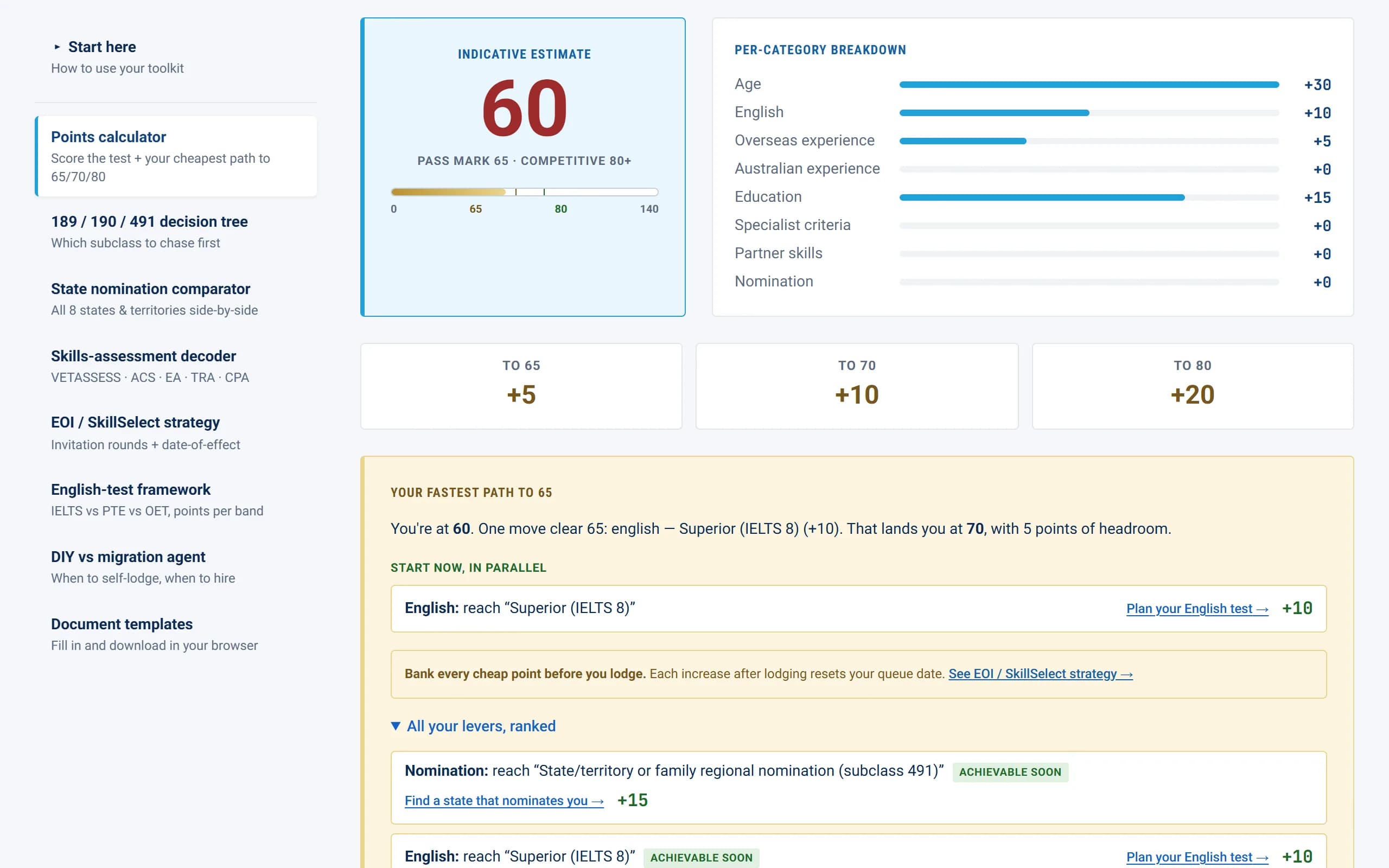
For 134311, the realistic invitation threshold sits at 75-85 with state nomination. PhD is uncommon; most successful applicants hold a Master's plus 8-15 years of experience. Superior English (8.0) is worth 20 points and is the single highest-leverage adjustment most applicants can still make.
Step-by-Step Migration Roadmap
- Confirm 134311 fits — read the ANZSCO description against your duties. If you currently teach but have not led a school, you do not yet qualify.
- Check current state lists — verify School Principal is open for 190 or 491 nomination in your target state.
- Prepare employment evidence — references on letterhead, signed, with full duties, hours, salary and dates.
- Sit IELTS, PTE or OET — aim for Superior (IELTS 8.0 in each band) for maximum points and registration smoothness.
- Lodge VETASSESS — full skills assessment ($1,096 non-resident, $1,205.60 Australia resident).
- Lodge AITSL — offshore initial assessment of your overseas teaching qualification.
- Apply for state teacher registration — NESA, VIT, QCT or equivalent.
- Submit EOI in SkillSelect — for 190 or 491.
- Apply for state nomination — separate application to each state you target.
- Receive invitation and lodge visa — 60-day window from invitation.
- Complete health, character and biometrics
- Receive grant and relocate
For step-by-step EOI mechanics, see the skills assessment complete guide.
Frequently Asked Questions
Can I apply as a School Principal without ever having held the principal title?
Probably not. VETASSESS expects evidence of actual school leadership — typically the title of Principal, Head of School, Deputy Principal with substantial acting principal experience, or a clearly equivalent senior role. A long teaching career without a leadership transition is more likely to be assessed under the relevant teacher code (e.g. 241411 Secondary School Teacher) than under 134311.
Why isn't School Principal on the MLTSSL or eligible for subclass 189?
The MLTSSL feeds the points-tested independent visa (189), which the Department reserves for occupations with the deepest, most enduring national shortages. School Principal sits on the Core Skills Occupation List and STSOL, which gives access to state-sponsored and employer-sponsored pathways but not 189. The shortage data shows pressure on leadership pipelines, but not at the level that historically triggers MLTSSL inclusion.
Do I need state teacher registration before I can be nominated?
You don't necessarily need it before your skills assessment or EOI, but you will need it before you can lawfully take up a principal role in any Australian state or territory. Some employers will sponsor a 482 conditional on you completing AITSL and state registration after arrival. Most won't. Start AITSL early.
Will my overseas principal experience count if my country uses different terminology?
Yes, provided the substance of the work matches the ANZSCO 134311 description. VETASSESS looks past titles. A "Head Teacher" in the UK system, a "Director" in some European systems, or a "Principal" in North America are all assessable under 134311 if the duties — staffing, budget, curriculum, statutory reporting — line up. Translate references into English with NAATI-certified translations.
Which state has the strongest demand for principals in 2026?
Demand is national, but the sharpest pressure sits in regional NSW, regional Victoria, regional and remote Queensland, the NT, and remote SA and WA. Department-of-education incentive programs (locality allowances, accelerated registration, principal relocation grants) cluster in these zones. For migration purposes, that translates into stronger 491 nomination prospects than 190 nomination prospects.
How long does the whole pathway take from VETASSESS lodgement to visa grant?
Plan for 18-30 months end to end. VETASSESS (12-14 weeks standard, or 10 business days with priority), AITSL and state registration (3-6 months each, running in parallel), state nomination decision (1-4 months after EOI), and visa processing (6-12 months for 190 and 491). Employer-sponsored 482 routes can compress this to 6-9 months when an employer is already approved as a Standard Business Sponsor.