Arts Administrator or Manager Visa Pathway to Australia: Complete 2026 Guide
Updated: 16 August 2026
Australia classifies Arts Administrators and Managers under ANZSCO 139911. VETASSESS conducts the skills assessment. The occupation sits on the Core Skills Occupation List (CSOL) and the MLTSSL, unlocking subclasses 189, 190, 491, 482 and 186. Typical 2026 salaries range AUD $85,000-$150,000, with senior performing arts roles reaching $180,000+ in major institutions.
Quick Facts: Arts Administrator or Manager Migration Pathway
| Detail | Information |
|---|---|
| ANZSCO Code | 139911 (Arts Administrator or Manager) |
| Skill Level | 1 (Bachelor degree or higher, or five years of relevant experience) |
| Skills Assessment | VETASSESS (Vocational Education and Training Assessment Services) |
| Occupation List | CSOL and MLTSSL |
| Visa Options | 189, 190, 491, 482, 186 |
| Demand Level | Moderate — shortage flagged in SA and WA in the 2024 Occupation Shortage List |
| Salary Range | AUD $85,000-$150,000 (SEEK, 2026) |
| Typical 189 Score | 80-90 points (smaller occupation pool, less competitive than ICT) |
| Key Challenge | Demonstrating managerial scope and budget responsibility to VETASSESS |
Role Context in Australia
Arts Administrators and Managers run the operational and strategic side of galleries, theatres, festivals, orchestras, dance companies, public arts agencies and cultural precincts. The work spans budgeting, programming, grant writing, sponsorship, venue management, board reporting and staff leadership. Around 1,600 people work in this occupation across Australia, with roughly 71% identifying as female and a median age in the mid-forties — a workforce that skews experienced rather than entry-level.
The sector is geographically concentrated in Melbourne and Sydney, where major institutions such as Arts Centre Melbourne, the Sydney Opera House, the Australia Council, state galleries, the Melbourne International Arts Festival and the major performing arts companies cluster. Adelaide and Hobart also punch above their weight, with the Adelaide Festival, WOMADelaide and Dark Mofo creating sustained demand for festival and venue managers. Funding pressure is real — the sector relies on a mix of state grants, philanthropy and earned revenue — and that volatility filters into hiring patterns. Roles requiring fundraising and commercial revenue skills are easier to find than purely curatorial-management positions.
Demand is moderate nationally. The 2024 Occupation Shortage List flags Arts Administrator or Manager as a shortage occupation in South Australia and Western Australia, while most other states sit in the "no shortage" band. Future demand is described as strong, mainly because the existing workforce is ageing and replacement hiring is steady rather than because the sector is expanding.
ANZSCO 139911 Code Mapping
ANZSCO 139911 covers people who plan, organise, direct, control, coordinate and promote artistic and cultural policies, programs, projects and services. Tasks typically include developing strategic plans for cultural organisations, managing budgets and box-office revenue, overseeing programming and venue operations, liaising with government funding bodies, leading marketing and audience development, and reporting to a board of directors.
This is a manager-classified code (group 1399), not a creative occupation. Curators sit under 224412, performing arts professionals under 211, and event producers without strategic remit may fall outside ANZSCO's professional bands entirely. If your role is primarily curatorial, programming-only, or event-execution rather than running an organisation or major program, 139911 is the wrong code and VETASSESS will reject the application. Senior roles such as Executive Director, General Manager, Festival Director, Artistic Administrator and Head of Operations at a recognised arts organisation typically map here cleanly.
Skills Assessment with VETASSESS
VETASSESS is the assessing authority for Arts Administrator or Manager (139911).
Requirements
- A qualification assessed as comparable to an Australian Qualifications Framework (AQF) Bachelor degree or higher in a field highly relevant to the occupation (arts management, business, public administration, fine arts with management content, cultural studies)
- At least one year of post-qualification employment at an appropriate skill level in the last five years, plus additional years of relevant employment at lower or pre-qualification levels depending on which of the four VETASSESS pathways you use
- Employment evidence showing managerial scope — budget authority, direct reports, programming or strategic responsibility
- A current organisational chart on company letterhead showing your position, the positions above you, and the positions reporting into you. VETASSESS treats the chart as non-negotiable for managerial occupations.
Assessment Cost
VETASSESS charges AUD $1,205.60 for a full skills assessment for applicants in Australia (inclusive of GST), or AUD $1,096.00 for applicants assessed as non-resident for Australian tax purposes. Priority Processing adds AUD $907.50 (in Australia) or AUD $825.00 (overseas). Fees were last increased on 22 October 2025.
Processing Time
Standard processing is 8-10 weeks from the date the application is lodged and paid. Priority Processing turns assessments around in 2-4 weeks but is only offered for completed applications where all evidence is already in place.
Common Rejection Reasons
Two patterns drive most negative outcomes. First, applicants whose employment evidence describes execution and coordination rather than strategy and leadership — VETASSESS wants to see budget figures, headcount supervised, programming decisions owned, and board-level reporting. Second, applicants from small organisations where the role title says "Manager" but the duties read like a coordinator's. If your team is fewer than three people and you do not control a discrete budget, your case is harder.
Visa Pathways for Arts Administrators and Managers
Subclass 189 — Skilled Independent Visa
Permanent residency through the points test, no sponsorship required. MLTSSL access applies.
- Visa fee: AUD $6,135 (primary applicant)
- Minimum points: 65, with realistic invitation thresholds at 80-90 in 2026
- Processing time: 6-12 months
- Reality: The smaller occupation pool means 139911 invitations clear at a lower score than ICT codes, but the 189 still demands strong English and ideally a partner-skills boost.
Subclass 190 — State Nominated Visa
State nomination adds 5 points and provides permanent residency, with a 2-year commitment to live and work in the nominating state.
- Visa fee: AUD $6,140 (primary applicant)
- Points boost: +5
- Best states: South Australia and Western Australia, both of which currently flag shortage status for this occupation. Tasmania also lists this code on its onshore pathway lists from time to time.
Subclass 491 — Skilled Work Regional (Provisional) Visa
Five-year regional visa with a transition to permanent residency via subclass 191 after three years on a qualifying income.
- Visa fee: AUD $6,140 (primary applicant)
- Points boost: +15 (regional nomination)
- Reality: Suits applicants targeting regional festivals, regional galleries, and arts officers in regional councils. Adelaide and Hobart are both designated regional for migration purposes, which materially helps this occupation.
Subclass 482 — Skills in Demand Visa
Employer-sponsored temporary visa, typically the Core Skills stream for this occupation given salary levels.
- Visa fee: AUD $3,210 (primary applicant, Core Skills stream)
- Salary threshold: Core Skills Income Threshold AUD $76,515; Specialist Skills Income Threshold AUD $141,210
- Duration: Up to 4 years
- Reality: Most arts management salaries clear the Core Skills threshold but only senior executive roles in major institutions hit Specialist Skills levels. Employer sponsorship works best for hires into Executive Director or General Manager roles at well-funded organisations.
Subclass 186 — Employer Nomination Scheme
Permanent residency via employer sponsorship, either Direct Entry or through the Temporary Residence Transition (TRT) stream after two years on a 482.
- Visa fee: AUD $6,140 (primary applicant)
- Streams: Direct Entry or TRT
- Reality: Senior leadership hires at major cultural institutions occasionally come via Direct Entry 186; mid-career professionals more commonly land on 482 and convert later.
Points Test Strategy
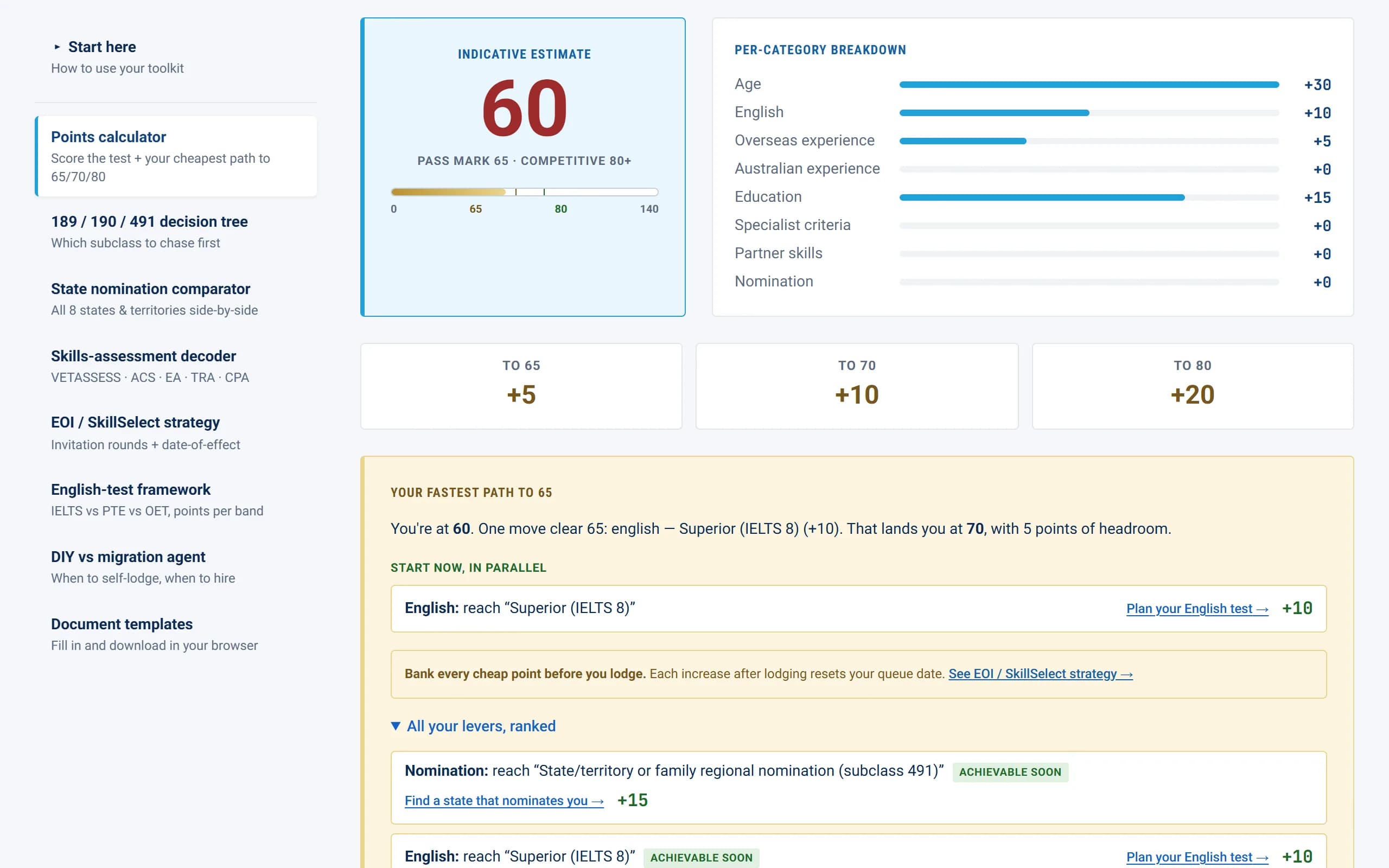
The points test rewards age, qualifications, English, experience and a state-nomination or partner boost. For Arts Administrator or Manager applicants, the typical mix looks like this:
| Points Factor | Points | Notes |
|---|---|---|
| Age (25-32) | 30 | Maximum bracket |
| Age (33-39) | 25 | Common bracket for this occupation given experience requirements |
| Bachelor degree | 15 | Required floor |
| Master's degree | 15 | Common — MBA, MA Arts Management, Masters of Cultural Leadership |
| Doctorate | 20 | Less common in this profession |
| English (Superior 8.0+) | 20 | Strong upside in arts roles where written English is central |
| English (Proficient 7.0) | 10 | Realistic floor |
| Skilled employment overseas (5-7 yrs) | 10 | Typical for mid-career applicants |
| Skilled employment in Australia (3-4 yrs) | 10 | If already in country |
| State Nomination (190) | 5 | Strongest path for this code |
| Regional Nomination (491) | 15 | Best total points booster |
| Partner skills | 5-10 | Often the deciding factor |
Realistic Score Scenarios
Scenario 1: Senior festival manager, 36 years old, UK qualifications, Superior English, 8 years experience, partner with skilled occupation. Age 25 + Master's 15 + English 20 + Experience 15 + Partner 10 = 85 points. Competitive for 189 in 2026.
Scenario 2: Mid-career gallery manager, 32 years old, Bachelor's, Proficient English, 5 years post-qualification experience. Age 30 + Bachelor 15 + English 10 + Experience 10 = 65 points. Needs state nomination (+5 → 70) or regional (+15 → 80) to be competitive.
State Nomination
South Australia
The 2024 Occupation Shortage List records Arts Administrator or Manager as a shortage occupation in South Australia, which has historically translated into 190 and 491 invitations for offshore and onshore candidates with relevant arts management experience. South Australia's strong festival economy (Adelaide Festival, WOMADelaide, OzAsia, the Fringe) drives genuine demand for venue and program managers.
Western Australia
WA also flags this occupation as in shortage. Perth's major cultural institutions and the state government's investment in arts precincts produce a steady stream of senior arts management roles. WA's nomination program prioritises candidates with a job offer or strong local ties; offshore candidates without WA connection face a harder path.
Tasmania
Tasmania's onshore skilled list periodically includes Arts Administrator or Manager. The state requires six months of recent Tasmanian employment in a closely related occupation, working at least 20 hours per week, immediately before nomination. Dark Mofo, MONA and the Tasmanian Symphony Orchestra anchor the local arts economy.
Victoria and New South Wales
Victoria and NSW currently treat this occupation as available for nomination on a case-by-case basis rather than as a priority shortage. Strong candidates with major-institution offers in Melbourne or Sydney can still secure nomination, but the path is more competitive than in SA or WA.
Salary and Employment Outlook
Salary varies sharply by sub-sector, institution size, and seniority. Performing arts roles in major companies pay materially more than visual arts roles in small-to-medium galleries.
| Role | Typical Salary Range (AUD) |
|---|---|
| Arts Coordinator (entry-level admin) | $68,000-$78,000 |
| Arts Administrator (mid) | $80,000-$100,000 |
| Festival or Program Manager | $95,000-$130,000 |
| General Manager (small-to-medium organisation) | $110,000-$140,000 |
| General Manager / Executive Director (major institution) | $150,000-$220,000 |
| CEO of major performing arts company | $200,000-$350,000+ |
Source: SEEK Salary Hub (2026), Performing Arts Administrator data via SalaryExpert (average AUD $119,174). Total packages typically include 11.5% superannuation. Major institutions sometimes offer not-for-profit salary packaging (a meaningful tax advantage on a portion of salary, currently up to $15,900 per FBT year).
The highest-paying employers are state arts agencies, major performing arts companies, the Australia Council/Creative Australia, large galleries and museums, university arts programs, and a small number of commercial arts businesses. Regional roles pay less in raw terms but often come with lower cost of living and a more senior scope of work than a comparable city role.
Tips for a Successful Application
1. Build the Organisational Chart Early
VETASSESS will reject managerial applications without a clean, current organisational chart on letterhead. Get this drafted, signed and ready before you lodge.
2. Quantify Everything in Employment Evidence
References that say "managed the program" fail. References that say "managed a $3.2m annual program budget across 14 productions, reporting to the Board, with 6 direct reports" succeed. Get your referees to put numbers on every claim — budget, headcount, audience, revenue.
3. Target SA or WA for the 190 Pathway
Both states currently flag shortage status for this occupation, which materially improves invitation odds at lower scores. If your circumstances allow it, prioritise an SA or WA-targeted EOI.
4. Use VETASSESS Priority Processing if Time-Sensitive
The standard 8-10 week timeline can stretch in busy periods. If your visa lodgement window is tight or you are stacking parallel processes, Priority Processing brings it down to 2-4 weeks for an extra $907.50.
5. Treat Mid-Career Career Breaks Honestly
Many arts administrators have non-linear careers spanning artistic practice, freelance project work and full-time roles. VETASSESS assesses the last five years against the appropriate-skill-level test — be clear about which roles you are nominating, and avoid stretching coordinator-level engagements into "manager" claims.
Step-by-Step Migration Roadmap
- Confirm your duties match ANZSCO 139911 using the ANZSCO code finder and the VETASSESS information sheet.
- Compile qualifications, transcripts and certified translations for any non-English documents.
- Draft a current organisational chart and signed employment references with quantified scope.
- Sit your English test (IELTS, PTE, TOEFL) and aim for Proficient (7.0) or Superior (8.0) for points.
- Lodge a VETASSESS skills assessment ($1,096-$1,205.60).
- Submit an Expression of Interest in SkillSelect for 189, 190 or 491.
- Apply for state nomination — SA or WA if available, Tasmania for the onshore pathway.
- Alternatively, secure an employer who will sponsor you for 482 or 186.
- Receive your invitation and lodge the substantive visa within 60 days.
- Complete health checks and police clearances.
- Submit biometrics if required.
- Receive visa grant and finalise your relocation.
Frequently Asked Questions
Is Arts Administrator or Manager on the Core Skills Occupation List?
Yes. ANZSCO 139911 sits on the CSOL and the MLTSSL in 2026, which unlocks all five mainstream skilled pathways: 189, 190, 491, 482 and 186. It is one of the broader-access codes for the arts sector.
What's the difference between Arts Administrator (139911) and Curator (224412)?
139911 is a management code — strategic, financial and operational leadership of a cultural organisation or program. 224412 is a professional code for curators who research, develop and present collections or exhibitions. A Director of a regional gallery who also curates would typically nominate under 139911 if the management remit is the substantive part of the role.
Can I get state nomination if I've never worked in Australia?
Yes, but the path is narrower. South Australia and Western Australia both consider offshore applicants for this occupation, with stronger weight given to candidates who have a job offer or demonstrable connection to the state. Tasmania's onshore pathway requires existing local employment.
Why is the VETASSESS assessment so focused on the organisational chart?
VETASSESS uses the chart to validate managerial scope objectively. Job titles in the arts sector vary widely between organisations — a "General Manager" at a 4-person company is not equivalent to a "General Manager" at a 60-person institution. The chart establishes hierarchical position and reporting lines that titles alone cannot.
Is employer sponsorship a realistic pathway for arts roles?
For senior leadership hires at well-resourced institutions, yes — the salary threshold is achievable and the recruitment process is comfortable with international candidates. For mid-career and emerging managers, the 190 or 491 state nomination route is usually a stronger bet than waiting for a 482 sponsor.