Cardiac Technician Visa Pathway to Australia: Complete 2026 Guide
Updated: 16 August 2026
Australia classifies Cardiac Technician under ANZSCO 311212. VETASSESS conducts the skills assessment. The occupation sits on the Core Skills Occupation List (CSOL), unlocking subclasses 190, 491, 482, and 186 — there is no 189 pathway. Typical 2026 salaries range AUD $85,000-$130,000, with cardiac sonographers (a closely related role) earning higher. Public hospital cardiology departments, private cardiology practices, and catheterisation laboratories drive most hiring.
Quick Facts: Cardiac Technician Migration Pathway
| Detail | Information |
|---|---|
| ANZSCO Code | 311212 (Cardiac Technician) |
| Skill Level | 2 (Associate degree, advanced diploma, or diploma — AQF Level 5-6) |
| Skills Assessment | VETASSESS (Vocational Education and Training Assessment Services) |
| Occupation List | CSOL (not on MLTSSL — no subclass 189) |
| Visa Options | 190, 491, 482, 186 |
| Demand Level | Moderate to high — driven by ageing population, expanding cath labs, and private cardiology growth |
| Salary Range | AUD $85,000-$130,000 (SEEK, PayScale, Glassdoor 2026) |
| Typical 190/491 Score | 65-80 points |
| Key Challenge | No 189 pathway and a narrow field of qualifying degrees — Cardiac Technology, Medical Science, or Nursing with cardiac specialisation |
What Cardiac Technicians Actually Do in Australia
Cardiac Technicians (also called Cardiac Technologists or Cardiac Scientists in Australian usage) perform diagnostic and monitoring tests on patients with known or suspected heart conditions. The work covers ECG and stress testing, ambulatory monitoring (Holter, event recorders, implantable loops), echocardiography in some scopes of practice, and supporting cardiologists in catheterisation laboratories during angiography, pacemaker and ICD implantation, and electrophysiology procedures.
The Australian cardiology sector is expanding. Public hospital cardiac catheterisation labs continue to scale across NSW, Victoria, Queensland, and WA. Private cardiology groups — Australian Cardiology Services, Sydney Adventist Heart and Vascular Clinic, Heart Centre at Macquarie University Hospital, Victorian Heart Hospital — have grown sharply through 2024-2026. Newer cath labs are commencing in regional centres like the Sunshine Coast University Hospital and the new Footscray Hospital.
Demand concentrates in three settings. First, major tertiary hospitals with high-volume cardiology services (Royal Prince Alfred, St Vincent's Sydney, Royal Melbourne, Alfred Heart Centre, Royal Brisbane, Royal Perth). Second, private cardiology practices that run busy outpatient ECG, stress test, and Holter services. Third, regional and rural cardiology outreach services that rotate technicians through small hospitals.
The role splits in Australia depending on training. Pure cardiac technicians focus on non-imaging diagnostics. Cardiac sonographers (a higher-paid pathway) perform echocardiography. ICD/pacemaker technicians work alongside electrophysiologists. Many migrants transition between these specialisations once established.
ANZSCO 311212: How the Code Works
Cardiac Technician sits inside ANZSCO Unit Group 3112 — Medical Technicians — alongside Anaesthetic Technician (311211), Medical Laboratory Technician (311213), Operating Theatre Technician (311214), and Pharmacy Technician (311215).
The 311212 code covers professionals who:
- Conduct tests on patients to record heart activity using specialised equipment, recording devices, and laboratory instruments
- Perform resting and exercise (stress) electrocardiography
- Apply and analyse Holter, event, and implantable cardiac monitors
- Assist cardiologists during invasive procedures including coronary angiography, pacemaker and defibrillator implantation, and electrophysiology studies
- Operate haemodynamic monitoring systems in cardiac catheterisation laboratories
- Maintain cardiac equipment and contribute to quality control programs
- Educate patients on cardiac investigations and post-procedure care
- Support cardiologists and medical practitioners in diagnosing, monitoring, and treating heart disease
What does not count under 311212: cardiac surgery scrub work (311214 Operating Theatre Technician), cardiology medical practice (253915 Cardiologist Specialist), or pure echocardiography work in some configurations (which may be assessed by the Australian Sonographers Accreditation Registry — ASAR — for sonographer-stream applicants).
Skills Assessment: VETASSESS
VETASSESS is the assessing authority for Cardiac Technician. The occupation is a VETASSESS Group E classification, with a diploma-level qualification floor and a strict relevance test on field of study.
Qualification requirement: Qualification assessed as comparable to an AQF Diploma level (or higher) in a highly relevant field. VETASSESS publishes a defined list of highly relevant major fields:
- Cardiac Technology
- Diagnostic Radiography
- Health Science
- Medical Science
- Nursing
- Physiotherapy
- Exercise Physiology
- Biophysics
- Exercise and Sport Science
A general science, biology, or biomedical degree without one of these majors typically fails the relevance test.
Employment requirement: At least one year of post-qualification, highly relevant, paid employment in the last five years, working 20 hours or more per week, performed at an appropriate skill level.
Assessment cost: AUD $1,096 (offshore, from 22 October 2025). Onshore applicants pay $1,205.60 including GST.
Priority processing: Additional $825 (excl. GST). Cuts the wait to around 10 business days.
Standard processing time: 8-10 weeks.
Common rejection reasons: Qualification is in general science or biomedical without one of the listed cardiac-relevant majors; employment references describe administrative cardiology work rather than diagnostic test performance; or applicant has worked as a cardiology nursing assistant without independent diagnostic responsibilities.
For wider context see the skills assessment bodies complete list.
Registration and Professional Bodies
Cardiac Technicians are not registered under AHPRA. There is no national board for the profession in Australia. The Australian and New Zealand Society of Cardiac and Vascular Sciences (ANZSCVS) and the Cardiac Society of Australia and New Zealand (CSANZ) offer voluntary professional recognition that employers value.
Each state health service runs its own credentialing for cath lab and diagnostic cardiology staff. Sonographer-stream technicians who want to perform echocardiography independently can pursue ASAR (Australian Sonographers Accreditation Registry) registration after completing accredited Australian sonography qualifications — typically a 1-2 year postgraduate diploma.
Visa Pathways for Cardiac Technicians
Subclass 482 — Skills in Demand (SID)
Employer-sponsored temporary visa. The dominant route into Australian cardiology departments.
- Visa fee: AUD $4,015 (primary applicant)
- Core Skills Income Threshold (CSIT): AUD $79,423 from 1 July 2026 (AUD $76,515 until 30 June 2026)
- Duration: Up to 4 years
Major public hospitals, private cardiology groups, and growing regional cath labs sponsor regularly. UK-trained Clinical Physiologists (Cardiac) and Cardiac Scientists, Irish Cardiac Physiologists, and US Cardiovascular Technologists are routinely placed through health recruitment agencies.
Subclass 190 — Skilled Nominated Visa
State nomination plus permanent residency. Adds 5 points.
- Visa fee: AUD $6,140 (primary applicant)
- Processing time: 6-9 months once nominated
- Best states: Queensland, Victoria, South Australia, New South Wales
Subclass 491 — Skilled Work Regional (Provisional)
Five-year provisional visa with pathway to permanent residency through subclass 191. Adds 15 points.
- Visa fee: AUD $6,140
- Processing time: 6-12 months
- Best regions: Sunshine Coast, Townsville, Newcastle, Geelong, Ballarat, Bendigo — all with established or growing cardiac services
Subclass 186 — Employer Nomination Scheme
Permanent residency through employer sponsorship.
- Visa fee: AUD $6,140
- Streams: Direct Entry (3 years post-qualification experience) or Temporary Residence Transition (after 2 years on 482)
Why no Subclass 189?
Cardiac Technician is on the CSOL but not the MLTSSL. The 189 Skilled Independent visa is restricted to MLTSSL occupations. Plan around 190, 491, 482, or 186.
Points Test Strategy
| Points Factor | Points | Notes |
|---|---|---|
| Age 25-32 | 30 | |
| Age 33-39 | 25 | |
| Diploma | 10 | |
| Bachelor degree | 15 | |
| Master's degree | 15 | |
| English — Proficient (7.0 IELTS) | 10 | |
| English — Superior (8.0 IELTS) | 20 | |
| Overseas experience (5-8 years) | 10-15 | |
| Australian experience (3-4 years) | 10 | |
| State nomination 190 | 5 | |
| Regional nomination 491 | 15 | |
| Partner skills | 5-10 |
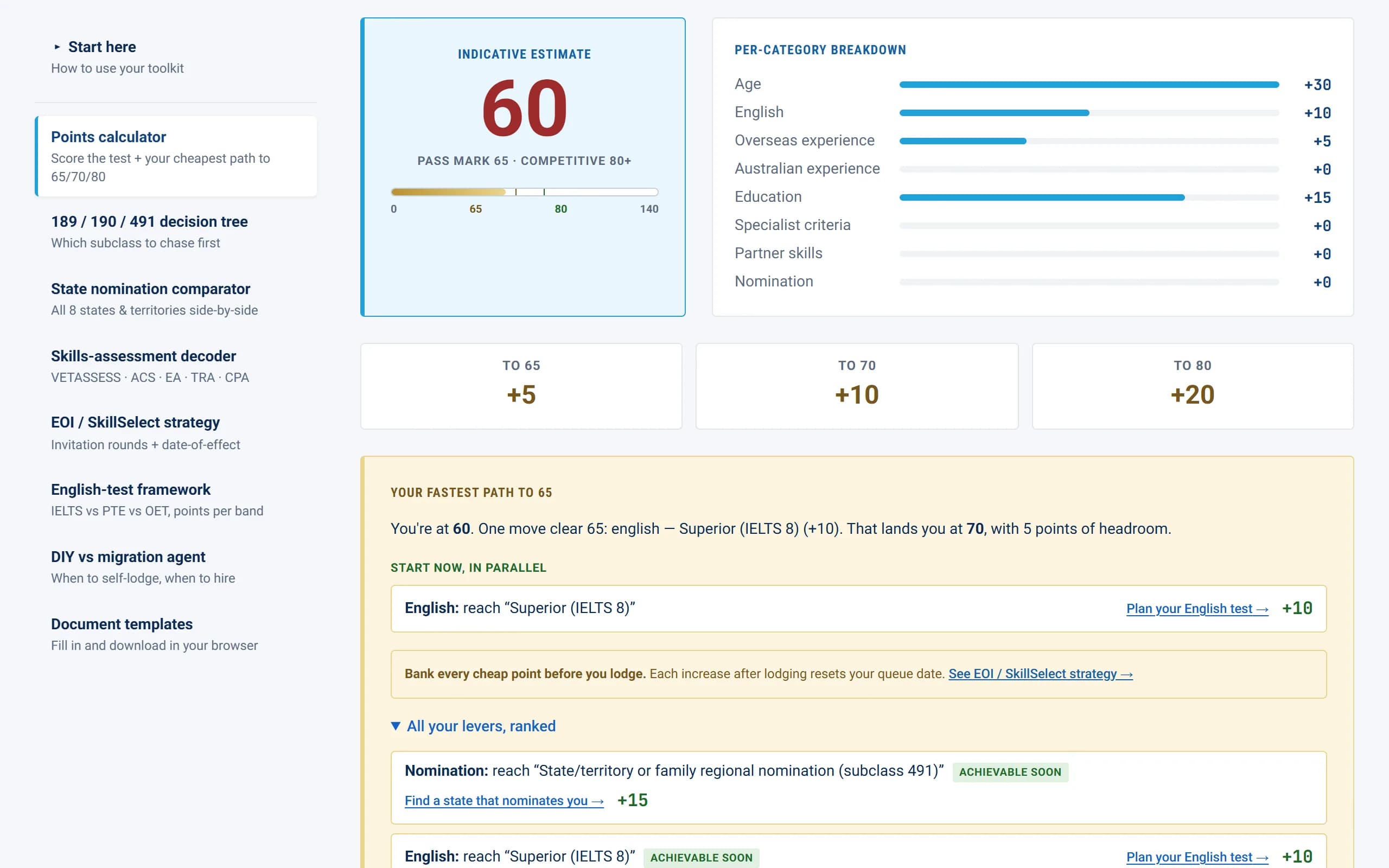
Scenario A — UK Clinical Physiologist Cardiac, age 29: Age 29 (30) + Bachelor (15) + Superior English (20) + 5 years overseas (10) + 491 regional nomination (15) = 90 points. Very strong for regional invitation.
Scenario B — Indian Cardiac Technologist, age 33: Age 33 (25) + Bachelor (15) + Proficient English (10) + 8 years overseas (15) + 190 QLD nomination (5) = 70 points. Realistic for QLD or VIC.
State Nomination for Cardiac Technicians
Queensland
Queensland Health runs an expanding cardiology footprint, including the new Cardiac Catheterisation Lab planned to commence in 2026 at one of the major regional hospitals. Brisbane, Sunshine Coast, Townsville, and the Gold Coast all recruit. Queensland nominates Cardiac Technicians under its skilled migration program with priority for regional and outer-metro postings.
Victoria
The Victorian Heart Hospital at Monash, opened in 2023, has expanded cardiology capacity significantly. Victorian public health services and private cardiology providers continue to grow capacity through 2026. Regional Victoria (Geelong, Ballarat, Bendigo, Latrobe) has steady demand and is suited to 491 pathways.
New South Wales
NSW Health employs the largest concentration of cardiac technicians in Australia. RPA, St Vincent's Sydney, Westmead, Royal North Shore, and John Hunter all run high-volume cardiology services. NSW prioritises applicants with current NSW employment or a NSW employment offer.
South Australia
SA Health nominates Cardiac Technicians for Adelaide and regional centres. South Australia runs one of the more accessible state nomination programs and occasionally waives English requirements for offshore healthcare applicants.
Western Australia
WA nominates cardiac technicians for Perth metropolitan hospitals and selected regional services. Demand is steady but smaller in volume than the east coast states.
Salary and Employment Outlook
Typical 2026 Salary Bands
| Role | Typical Salary Range |
|---|---|
| Graduate Cardiac Technician | AUD $70,000-$85,000 |
| Cardiac Technician (2-5 years) | AUD $85,000-$110,000 |
| Senior Cardiac Technician | AUD $110,000-$130,000 |
| Cath Lab Specialist | AUD $115,000-$145,000 |
| Cardiac Sonographer (after Australian post-grad) | AUD $115,000-$145,000 |
| Senior Cardiac Sonographer | AUD $145,000-$180,000 |
Source: SEEK Australia Career Advice (May 2026), PayScale (2026), Glassdoor Australia (February 2026), Jora Australia (2026).
Superannuation adds 11.5%. Public hospital pay is governed by state Health Professional Salaries Awards; private cardiology generally pays 10-20% above award. Cath lab on-call rosters add significant penalty earnings. Sonographer-stream technicians can earn AUD $150,000+ once independently registered with ASAR.
Highest-Paying Settings
- Private cardiology groups — Australian Cardiology Services, Genesis Heart Care, Sydney Adventist Heart and Vascular Clinic
- Specialist cardiac hospitals — Victorian Heart Hospital, Macquarie University Hospital
- Tertiary cath labs — RPA, Alfred, St Vincent's, Royal Brisbane, Royal Perth
- Regional locum work — short-term contracts pay premium rates
- Sonography specialisation — after completing Australian ASAR-accredited postgrad
Tips for a Successful Application
- Confirm your degree fits the VETASSESS list of highly relevant fields. Cardiac Technology, Medical Science, Health Science, Nursing, Physiotherapy, Exercise Physiology, Biophysics, Diagnostic Radiography, and Exercise and Sport Science all qualify. A general BSc or BSc Biotechnology without one of these majors typically fails — plan for a postgraduate bridging course before lodging.
- Map your employment references to cardiac-specific tasks. "Performed resting and exercise ECG", "applied and analysed Holter monitor recordings", "assisted cardiologists during diagnostic coronary angiography in cath lab", "operated haemodynamic monitoring systems". Avoid generic "supported cardiology services" or "patient care".
- Consider sonographer-stream training after arrival. Cardiac Sonographers earn 20-40% above pure Cardiac Technicians and have stronger Australian demand. A 1-2 year postgraduate diploma in cardiac sonography while working on a 482 visa is the standard pathway.
- UK and Irish Cardiac Physiologists transition smoothly. UK NHS Clinical Physiologist (Cardiac) qualifications and Irish Cardiac Physiologist qualifications are well-recognised by VETASSESS and Australian hospitals. Many migrants make the move within 6 months of starting the process.
- Public hospitals offer the cleanest 482 to 186 pathway. Tertiary hospitals routinely sponsor on 482, support PR transitions after 2 years, and offer structured rotation through cath lab, electrophysiology, and pacing services. Private practice pays better but offers less structured progression.
Step-by-Step Migration Roadmap
- Confirm your duties fit ANZSCO 311212 — use the how to find your ANZSCO code guide
- Check 311212 sits on the Core Skills Occupation List
- Compile cardiac-specific employment references and case logs
- Sit English test — Proficient (7.0) minimum, Superior (8.0) for points
- Lodge VETASSESS application (AUD $1,096)
- Receive positive skills assessment in 8-10 weeks
- Submit Expression of Interest in SkillSelect for 190 or 491
- Apply for state nomination — QLD, VIC, NSW, SA
- Alternatively, pursue 482 sponsorship through health recruitment agencies
- Receive invitation and lodge visa within 60 days
- Complete health and character checks
- Visa grant, hospital credentialing, and planned sonography upskilling
Frequently Asked Questions
Can I work as a Cardiac Sonographer with a Cardiac Technician background?
Yes, but you will need additional Australian qualifications. Cardiac Sonographers require ASAR (Australian Sonographers Accreditation Registry) registration, which depends on completing an ASAR-accredited postgraduate qualification in Australia or a recognised overseas equivalent. Most migrants complete a 1-2 year postgraduate diploma in cardiac sonography while working on a 482 visa.
What's the difference between Cardiac Technician and Cardiac Sonographer in Australia?
Cardiac Technicians perform non-imaging tests (ECG, stress testing, Holter monitoring) and assist in cath labs. Cardiac Sonographers perform echocardiography independently — transthoracic, transoesophageal, and stress echo. Sonographers are registered with ASAR; technicians are not registered with any national body. Pay differs by 20-40%.
Is Cardiac Technician on the Australian skills shortage list?
Cardiac Technician is on the CSOL, which the Department of Home Affairs uses to identify occupations with demand sufficient to warrant skilled visa pathways. Jobs and Skills Australia tracks occupation shortages annually; cardiac technicians are not always listed in headline shortage occupations but have persistent demand driven by population ageing and growing cath lab capacity.
Which UK and Irish qualifications transfer cleanly?
UK NHS Clinical Physiologist (Cardiac), Healthcare Science Practitioner (Cardiac), and Irish Cardiac Physiologist qualifications are recognised by VETASSESS for ANZSCO 311212. Many UK and Irish-trained applicants transition smoothly with 482 sponsorship.
Can I work in private cardiology practice straight after arrival?
Yes, with employer credentialing. Private cardiology groups across Sydney, Melbourne, Brisbane, and Adelaide routinely employ overseas-trained cardiac technicians on 482 sponsorship. Public tertiary hospital experience is often preferred but not required. See the Anaesthetic Technician pathway for the related theatre-based technician role.