Earth Science Technician Visa Pathway to Australia: Complete 2026 Guide
Updated: 16 August 2026
Australia classifies Earth Science Technicians under ANZSCO 311412. VETASSESS conducts the skills assessment. The occupation sits on the Core Skills Occupation List (CSOL) and STSOL, unlocking subclasses 190, 491, 482 and 186. Typical 2026 salaries range AUD $75,000-$115,000, with FIFO mining roles in WA and central Queensland paying premiums of 25-40% above metro base.
Quick Facts: Earth Science Technician Migration Pathway
| Detail | Information |
|---|---|
| ANZSCO Code | 311412 (Earth Science Technician) |
| Skill Level | 2 (AQF Associate Degree, Advanced Diploma or Diploma) |
| Skills Assessment | VETASSESS (Vocational Education and Training Assessment Services) |
| Occupation List | CSOL + STSOL (not on MLTSSL — no 189) |
| Visa Options | 190, 491, 482, 186 |
| Demand Level | High — critical-minerals boom drives sustained mining-sector hiring |
| Salary Range | AUD $75,000-$115,000 (SEEK Salary Hub 2026) |
| Typical 190 Score | 65-80 points with state nomination |
| Key Challenge | Field experience must be evidenced, not just described |
What Earth Science Technicians Do in Australia
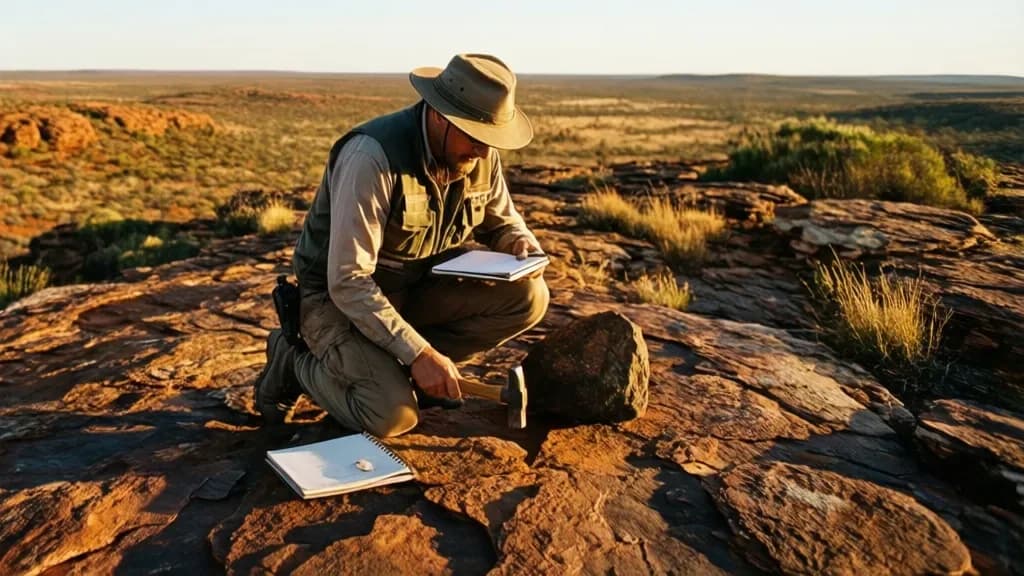
Earth Science Technicians collect and test earth and water samples, record field observations, and provide technical support to geologists and geophysicists. The role sits across exploration, mining operations, environmental monitoring and academic research. Around 1,600 people work in this occupation nationally according to Jobs and Skills Australia, with 86% in full-time roles and concentrations in Western Australia (Pilbara, Goldfields), Queensland (Bowen Basin, Galilee Basin), and South Australia (Olympic Dam, Gawler Craton).
Australia's critical-minerals strategy and the ongoing lithium, copper and rare-earth boom have lifted demand sharply since 2023. The federal Critical Minerals Strategy 2023-2030 explicitly identifies technician-level skills as a workforce priority. Major exploration companies — IGO, Pilbara Minerals, Liontown Resources, Bellevue Gold — recruit field technicians year-round, often via FIFO contracts on 2:1 or 8:6 rosters.
Daily work depends on setting. In exploration, technicians log drill core, prepare samples for assay, run downhole geophysics, and maintain field equipment. In producing mines, they support grade-control mapping, monitor water and tailings, and run on-site geotech instrumentation. In environmental consultancies (Golder, AECOM, GHD), they conduct contaminated-land sampling, hydrogeological monitoring and acid-mine-drainage testing.
ANZSCO 311412 Code Mapping
Earth Science Technician sits in unit group 3114 alongside Chemistry Technician (311411), Life Science Technician (311413), School Laboratory Technician (311414) and Hydrographer (311415). The named code covers field- and lab-based geological, geophysical, hydrological and mining-related technical work.
Borderline cases:
- Assay technicians running ICP-MS on rock samples — usually 311411 (the analysis is chemical)
- Mud loggers and core technicians at exploration sites — 311412
- Hydrographers with downhole and surveying duties — 311415
- Geotechnical field staff doing soil and rock mechanics — 311412
- Survey technicians — different unit group (3122), not 311412
For mixed roles, lead with the dominant duty. If field-based earth-science work exceeds half the position, 311412 is the right code. Otherwise Science Technicians nec (311499) is the fallback.
Skills Assessment with VETASSESS
VETASSESS is the assessing authority. Current process at vetassess.com.au.
Requirements (Pathway 1):
- AQF Diploma or higher in a highly relevant field — geology, geoscience, applied geology, geophysics, environmental geoscience, hydrogeology, mining-related technologies
- At least one year of post-qualification employment at appropriate skill level in the last five years
- Documented duties matching the ANZSCO description
Alternative pathways:
- Pathway 2: AQF Certificate IV plus higher employment threshold
- Pathway 3: Non-highly-relevant degree plus three years employment
- Pathway 4: No formal qualification plus six years employment
Assessment cost: AUD $1,070 (Full Skills Assessment, current from 22 October 2025) Priority processing: AUD $825 additional, 10 business days Processing time: 8-10 weeks standard
Common rejection reasons: References that describe office-based GIS work without field component; qualifications in general science or environmental management without geology depth; vague mentions of "fieldwork" with no specific techniques (drill-log, core sampling, geophysical survey, hydrogeological testing).
Visa Pathways
Subclass 482 — Skills in Demand Visa
The dominant offshore route. Exploration companies and consultancies sponsor regularly because field projects cannot wait for slower migration channels.
- Visa fee: AUD $3,210 (primary applicant)
- Core Skills salary floor: AUD $76,515 + super (most field technicians clear this with site allowances)
- Processing: 1-3 months for Core Skills nominations
- Duration: Up to 4 years
- Reality: WA-based exploration companies sponsor the highest volume
Subclass 491 — Skilled Work Regional Visa
The natural fit for this code. Most earth-science work is regional by definition.
- Visa fee: AUD $6,140 (primary applicant)
- Points boost: +15
- Five-year provisional, pathway to PR via 191 after three years of compliant regional employment
- Active regions: Pilbara, Goldfields, Bowen Basin, Galilee Basin, Eyre Peninsula
Subclass 190 — Skilled Nominated Visa
PR with state nomination.
- Visa fee: AUD $6,140 (primary applicant)
- Points boost: +5
- Two-year residency obligation in nominating state
- Active states: Western Australia, Queensland, South Australia, Tasmania, Northern Territory
Subclass 186 — Employer Nomination Scheme
Permanent residency via employer sponsorship.
- Visa fee: AUD $6,140 (primary applicant)
- Streams: Direct Entry (3+ years experience) or TRT (after 2 years on 482)
- Used by: Major miners (BHP, Rio Tinto, Fortescue, IGO) with established sponsorship infrastructure
189 is not available — 311412 is not on the MLTSSL.
Points Test Strategy
| Points Factor | Points | Notes |
|---|---|---|
| Age (25-32) | 30 | Maximum |
| Age (33-39) | 25 | Strong |
| Bachelor degree | 15 | Common for geology graduates |
| Master's degree | 15 | Slight VETASSESS edge |
| Diploma | 10 | The skill-level floor |
| English (Proficient — 7.0) | 10 | Realistic target |
| English (Superior — 8.0) | 20 | Worth the prep |
| Overseas experience (5-7 yrs) | 10 | Common mid-career |
| Australian study | 5 | If 2 years study completed in Australia |
| State nomination (190) | 5 | Mandatory in practice |
| Regional (491) | 15 | Strongest single boost |
| Partner skills | 5-10 | Assess if eligible |
Realistic scenario — South African geology technician, age 32, Bachelor of Geology, 7 years exploration experience, IELTS 7:
Age 30 + Bachelor 15 + English 10 + Experience 10 = 65, then +15 regional = 80 points — very strong for WA or QLD 491.
Realistic scenario — Indian environmental geoscientist, age 29, Master's, 5 years experience, IELTS 7:
Age 30 + Master's 15 + English 10 + Experience 10 = 65, then +5 state nom = 70 — competitive for SA or QLD 190.
State Nomination for Earth Science Technicians
Western Australia
WA is the dominant employer of this code in Australia. The state's iron-ore, lithium and gold sectors generate consistent technician demand. WA's nomination list is shorter than QLD's but it consistently includes earth-science-related occupations. Pilbara, Kalgoorlie-Boulder and Geraldton are active regional centres for 491. Confirm the current WA list before lodging.
Queensland
Queensland nominates 311412 under both 190 and 491 in 2025-26. The state's central coal belt (Bowen Basin, Galilee Basin) and emerging critical-minerals operations create steady demand. Brisbane and regional QLD have active sponsoring employers.
South Australia
South Australia's strong mining sector — Olympic Dam (BHP), Carrapateena (BHP), Prominent Hill (BHP) and the Gawler Craton exploration belt — creates structural demand for earth-science technicians. SA includes 311412 on its offshore list and is one of the cleanest 491 routes for offshore applicants.
Northern Territory
The NT's McArthur River, Tanami and emerging critical-minerals tenements need technicians. The NT's nomination program is small but accepts the code. The 491 obligation is straightforward to meet in Darwin or Alice Springs.
Tasmania
Tasmania has a smaller but consistent demand profile — mineral sands, polymetallic mines on the west coast, and University of Tasmania research. 491 only.
Victoria
Victoria occasionally nominates for the code under regional schemes (Bendigo, Stawell gold operations) but is not a primary route for 311412.
Salary and Employment Outlook
| Role | Typical Salary Range (AUD) |
|---|---|
| Junior field technician | $68,000-$82,000 |
| Core logger / sample tech (FIFO) | $85,000-$110,000 |
| Senior field technician | $95,000-$120,000 |
| Mud logger | $90,000-$115,000 |
| Geotech field technician | $85,000-$115,000 |
| Lead technician / supervisor | $110,000-$145,000 |
| Environmental consultant tech | $80,000-$105,000 |
Source: SEEK Salary Hub (April 2026) and PayScale Australia, cross-referenced with the 2026 Hays Salary Guide for Resources and Mining.
Total packages on FIFO contracts typically include base, site/roster allowances (often $15,000-$30,000 a year on top), super at 11.5%, return flights and on-site accommodation. Mining contractors (Boart Longyear, DDH1, Major Drilling) often pay higher base than mid-tier exploration companies but with less stability between contracts.
Sectors and employers
- Major miners — BHP, Rio Tinto, Fortescue, Newmont, IGO, Northern Star
- Mid-tier and explorer — Pilbara Minerals, Liontown Resources, Bellevue Gold, De Grey Mining
- Drilling contractors — Boart Longyear, DDH1, Major Drilling, Mitchell Services
- Environmental and geotech consultancies — Golder (WSP), AECOM, GHD, Coffey, Douglas Partners
- Government — Geoscience Australia, state geological surveys (GSWA, GSQ, GSSA)
- Research — CSIRO, University of WA, University of Queensland
Tips for a Successful Application
1. Evidence field time, not just title
VETASSESS scrutinises whether the work is technician-level field and lab work, not office-bound or graduate-geologist territory. Reference letters should specify the number of field rotations, drill metres logged, samples prepared, and instruments operated. Time stamps and project names help.
2. Pick named over nec where you can
If 70%+ of work fits earth-science tasks, choose 311412 over 311499. The named code is faster to assess and easier to nominate.
3. Don't undersell the qualification
A Bachelor of Geology assessed at AQF Bachelor level earns the same points as a Diploma (15 vs 10) but gives a much stronger VETASSESS outcome and more state-nomination options. Lodge with the highest qualification.
4. Tie the application to a specific Australian region
In your state-nomination application, name the region you intend to work in and link it to your experience profile. "Pilbara iron-ore exploration" reads more credibly than "Australia generally" — state nomination officers reward specificity.
5. Consider WA for fastest 482 conversion
WA's mining sector has the highest sponsorship volume in this code. Offshore applicants targeting 482 should focus job applications on Perth-based exploration companies and FIFO contractors. The market is genuinely short of mid-career technicians.
Step-by-Step Migration Roadmap
- Map duties to ANZSCO 311412 using the ANZSCO code finder
- Confirm the code is on your target state's 2025-26 list
- Sit IELTS or PTE — push for 7+ across all bands, aim Superior where possible
- Compile employment evidence: field-time logs, project names, instrument lists, references
- Lodge VETASSESS Full Skills Assessment (AUD $1,070)
- Wait 8-10 weeks; use priority processing if a state round is imminent
- Submit EOI in SkillSelect with the positive outcome
- Apply for state nomination through the relevant portal (e.g. Migration WA, Migration Queensland)
- Or pursue 482 sponsorship with a WA or QLD exploration employer in parallel
- Receive invitation and lodge visa within 60 days
- Complete health checks and police certificates
- Meet regional or state residency obligations after arrival
Cross-reference against the Skills Assessment Bodies Complete List and the most in-demand occupations 2026 hub.
Frequently Asked Questions
Is Earth Science Technician on the MLTSSL in 2026?
No. ANZSCO 311412 is on the CSOL and STSOL, not the MLTSSL. The 189 Skilled Independent visa is not available. State-nominated 190, regional 491, employer-sponsored 482 and 186 are the four pathways. See the 2026 SOL guide.
Can a geology graduate without lab work qualify?
Field work counts equally with lab work for 311412 — the code is about technician-level earth-science support generally. Drill-core logging, geophysical surveys, water sampling and geotech testing all qualify. The issue is when work is purely office-based GIS or modelling, which fits geologist or geographic information specialist codes instead.
Which Australian state has the best mining job market for this code?
Western Australia, by a clear margin. The state's iron-ore, lithium, gold and nickel sectors recruit technicians year-round. The Pilbara and Goldfields are the active regions. Queensland is second on volume (coal and emerging critical minerals), followed by South Australia (copper, gold).
Do I need Australian field experience before applying?
No, but it helps. International field experience in similar geological settings (Andean copper-gold, African gold, Canadian shield, Indian shield) is treated favourably by Australian employers and VETASSESS. Two years on a Working Holiday or 485 visa in Australian exploration is a strong springboard to 482 sponsorship.
How does 311412 compare to 234411 Geologist or 234412 Geophysicist?
234411 Geologist and 234412 Geophysicist are Skill Level 1 (Bachelor degree minimum), assessed by VETASSESS as professional occupations, and on the MLTSSL with 189 access. 311412 Earth Science Technician is Skill Level 2 (Diploma+), assessed under technician pathways, and CSOL/STSOL only. Geologists who hold a Bachelor and meet the 234411 task description should use that code — it opens more visa options.
What does a FIFO roster actually look like in WA?
Common rosters are 2:1 (two weeks on site, one week off), 8:6, or 9:5 for senior staff. Flights from Perth to Pilbara or Kalgoorlie are usually included. Site work runs 12-hour shifts. Off-rotation weeks are unpaid leisure unless on annual leave. Australian residents living anywhere can take FIFO contracts — many technicians base themselves in Perth, Brisbane or even interstate.