Petroleum Engineer Visa Pathway to Australia: Complete 2026 Guide
Updated: 16 August 2026
Australia classifies Petroleum Engineer under ANZSCO 233612. Engineers Australia conducts the skills assessment via the Migration Skills Assessment program. The occupation sits on both the MLTSSL and the Core Skills Occupation List, unlocking subclasses 189, 190, 491, 482, and 186. Typical 2026 salaries range AUD $141,000-$255,000 across mid-career and senior bands, with Perth and Brisbane averaging above AUD $196,000. Demand concentrates in Western Australia, Queensland, and the Northern Territory LNG corridors plus the emerging carbon capture and storage workstream.
Quick Facts: Petroleum Engineer Migration Pathway
| Detail | Information |
|---|---|
| ANZSCO Code | 233612 (Petroleum Engineer) |
| Skill Level | 1 (Bachelor degree in petroleum, chemical, or mechanical engineering) |
| Skills Assessment | Engineers Australia (Migration Skills Assessment) |
| Occupation List | MLTSSL and CSOL |
| Visa Options | 189, 190, 491, 482, 186 |
| Demand Level | Moderate to high — concentrated in WA, QLD, and NT LNG corridors; expanding into CCS and hydrogen |
| Salary Range | AUD $141,000-$255,000+ (mid-career to senior, 2026); Perth average AUD $196,523; Sydney AUD $217,873 |
| Typical 189 Score | 75-85 points |
| Key Challenge | Narrow employer base (concentrated in WA and QLD) and a sector under transition pressure as the energy mix evolves |
What Petroleum Engineers Do in Australia
Australian petroleum engineers design, supervise, and optimise the extraction and processing of hydrocarbons. Work splits across upstream (drilling engineering, completions, reservoir engineering, production engineering, well integrity), midstream (pipeline and gas-processing engineering), and the rapidly growing subsurface specialisations — carbon capture and storage well design, geothermal, and underground hydrogen storage.
Major employers include the LNG operators (Woodside, Santos, Inpex, Chevron, Shell QGC, Origin Energy, ConocoPhillips), the upstream independents (Beach Energy, Cooper Energy, Karoon Energy, Tamboran Resources), the service companies (Baker Hughes, Halliburton, Schlumberger / SLB, Weatherford, Worley, Wood, KBR), and the regulator-side teams (NOPSEMA, Geoscience Australia, the state resources departments).
The Australian petroleum sector concentrates in three geographies. Western Australia carries the North West Shelf, Pluto, Wheatstone, Gorgon, Prelude FLNG, Scarborough and Crux development projects, plus a long pipeline of brownfield work and the West Erregulla onshore gas project. Queensland carries the coal-seam-gas LNG projects (Curtis Island — Shell QGC, Origin APLNG, Santos GLNG), plus the Surat and Bowen Basin upstream operations. The Northern Territory carries Darwin LNG, Bayu-Undan / Barossa development, and the Beetaloo Basin shale gas frontier.
The energy transition is reshaping the demand profile. Carbon capture and storage (Gorgon CCS, Moomba CCS, the Bonaparte CCS hub), hydrogen production (Western Green Energy Hub, Asian Renewable Energy Hub), and abandonment/decommissioning (the federal Offshore Petroleum Decommissioning Plan) are creating adjacent demand for the same subsurface skill set. Petroleum engineers with reservoir, well integrity, or completions backgrounds are migrating into CCS and hydrogen roles.
ANZSCO Code Mapping
Petroleum Engineer is ANZSCO 233612, within the unit group 2336 Mining Engineers. The code covers engineers who design and direct petroleum exploration, well drilling, and production operations and who carry out the reservoir, production, and completions engineering that supports them.
Adjacent codes: 233611 Mining Engineer (Excluding Petroleum) covers hard-rock and coal mining. 233511 Industrial Engineer and 233512 Mechanical Engineer cover the equipment and process side of petroleum operations. The duty test is straightforward — if your work involves wells, reservoirs, completions, drilling, or hydrocarbon production engineering, nominate 233612.
There is no separate ANZSCO code for reservoir engineer, drilling engineer, completions engineer, production engineer, well integrity engineer, subsurface engineer, or CCS injection engineer — all map to 233612 if duties align.
Skills Assessment with Engineers Australia
Engineers Australia is the Department of Home Affairs-nominated assessing authority for 233612. EA runs three pathways depending on qualification origin.
The Three EA Pathways
- Washington Accord pathway — for graduates of programs accredited under the Washington Accord (UK, Ireland, USA, Canada, Hong Kong, Singapore, India NBA-accredited from 2014 onward, and others). Fastest route; no CDR required.
- Sydney/Dublin Accord pathway — for engineering technologist and associate engineer programs from accredited countries.
- Competency Demonstration Report (CDR) pathway — for graduates of programs not covered by the Accords. Requires three career episodes, a summary statement, and a continuing professional development record.
Requirements
- A four-year bachelor degree (or higher) in engineering with a major in petroleum, chemical, or mechanical engineering and significant petroleum content
- Curriculum vitae covering the full professional career
- For CDR applicants: three career episodes (each 1,000-2,500 words), a summary statement, and a CPD log
- English language evidence at IELTS 6.0 across each band (or PTE equivalent) for the assessment
Cost and Processing Time
- Standard CDR: AUD $1,001 inc GST (AUD $910 ex GST) through 30 June 2026; increasing 3-4% from 1 July 2026
- Washington/Sydney/Dublin Accord pathway: AUD $539 inc GST (AUD $490 ex GST)
- Fast-track service: Additional AUD $385 inc GST — assigns to an assessor within 20 business days
- Processing time: Washington Accord pathway 8-12 weeks; CDR pathway 10-16 weeks after submission of a complete application
Common Rejection Reasons
The two recurring failure modes are CDR plagiarism — Engineers Australia uses similarity-detection software and a single matched section triggers refusal and a five-year ban — and career episodes that describe team work without isolating the applicant's personal engineering contribution. For petroleum engineers, a third pattern matters: chemical or mechanical engineering graduates trying to nominate 233612 without substantial documented petroleum-specific work history sometimes get reassigned to 233511 Industrial Engineer or 233512 Mechanical Engineer.
Visa Pathways
Subclass 482 — Skills in Demand Visa
Often the dominant pathway for petroleum engineers in 2026. The talent pool is thin, the salary thresholds are easily cleared, and operators sponsor regularly.
- Visa application charge: AUD $3,210 (Core Skills stream, primary applicant)
- Core Skills income threshold: AUD $76,515 — petroleum engineer salaries clear this comfortably
- Specialist Skills threshold: AUD $141,210 — most petroleum engineer roles qualify, opening faster processing
- Duration: Up to 4 years, with a permanent pathway via 186
- Reality: Woodside, Santos, Inpex, Chevron, Shell, and the major service companies all sponsor 482 visas as a routine part of their workforce planning
Subclass 186 — Employer Nomination Scheme
Permanent residency through employer sponsorship. Often used directly by operators bringing senior international hires.
- Visa application charge: AUD $6,140
- Streams: Direct Entry for senior offshore hires, or Temporary Residence Transition after two years on a 482
Subclass 190 — Skilled Nominated Visa
State nomination adds 5 points. Less commonly used because employer sponsorship is usually faster.
- Visa application charge: AUD $6,140
- Points boost: +5 from state nomination
- Obligation: Live and work in the nominating state for 2 years
- State activity: Western Australia is the primary state for petroleum engineers. Queensland and the Northern Territory also nominate.
Subclass 491 — Skilled Work Regional Visa
Regional nomination adds 15 points. The Pilbara, the Surat Basin, the Bowen Basin, and Darwin all sit inside designated regional areas for 491 purposes.
- Visa application charge: AUD $6,140
- Points boost: +15 from regional nomination
- Pathway: 3 years of regional residence and qualifying income, then 191 PR
Subclass 189 — Skilled Independent Visa
Points-tested permanent visa. Available because 233612 is on the MLTSSL but rarely the fastest path for petroleum engineers because employer sponsorship works so well.
- Visa application charge: AUD $6,135
- Realistic invitation score: 80+ points; petroleum-specific invitation volumes are small
- Processing time: 6-12 months from invitation
Points Test Strategy
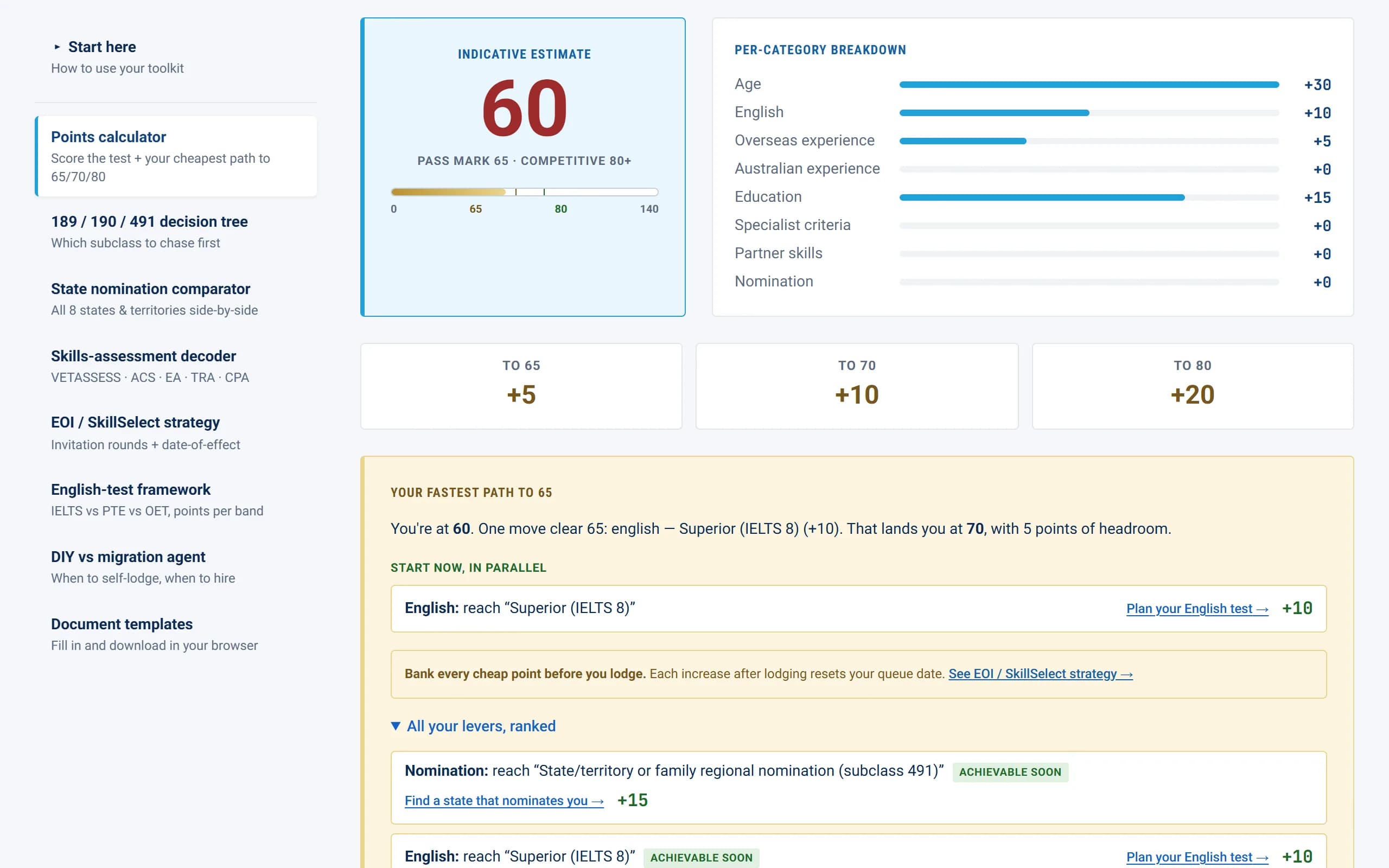
| Points Factor | Points | Notes |
|---|---|---|
| Age (25-32) | 30 | Maximum bracket |
| Age (33-39) | 25 | Common for mid-career engineers |
| English (Superior, 8.0+) | 20 | Biggest controllable lever |
| English (Proficient, 7.0) | 10 | Achievable for most non-native applicants |
| Bachelor degree | 15 | Skill Level 1 baseline |
| Master's degree | 15 | Same band as bachelor |
| PhD | 20 | Common among reservoir-engineering specialists |
| Overseas experience 8+ years | 15 | After any EA experience deductions |
| Australian experience 3+ years | 15 | If you are already onshore |
| State nomination (190) | 5 | Adds 5 |
| Regional nomination (491) | 15 | Adds 15 |
| Partner skills (assessed) | 10 | If partner is also assessed in a relevant occupation |
Realistic Score Scenarios
Scenario 1: Mid-career UK MEng petroleum engineer, 34 years old, 10 years North Sea and West Africa experience, IELTS 8.0
- Age (33-39): 25 + Superior English: 20 + Bachelor: 15 + Overseas experience 8+: 15 = 75 points
- Direct Entry 186 via Woodside or Santos is often faster than the 189/190 route
- Or add 190 (WA): 80 points
Scenario 2: Indonesian B.Eng petroleum graduate, 30 years old, 7 years Pertamina/Total experience, IELTS 7.0
- Age: 30 + Proficient English: 10 + Bachelor: 15 + Overseas experience 5-7: 10 = 65 points
- Add 491 (regional WA): 80 points; or pursue 482 with a service company
State Nomination
Western Australia
WA is the centre of gravity for petroleum engineering in Australia. The LNG operators (Woodside, Chevron, Shell, Inpex), the upstream independents, the service companies, and the regulator NOPSEMA all run sizable petroleum-engineering teams in Perth. WA's 2025-26 list includes 233612 for both 190 and 491. The Pilbara qualifies as a regional area for 491 purposes.
Queensland
Queensland's coal-seam-gas LNG operations (Curtis Island — Shell QGC, Origin APLNG, Santos GLNG) plus the Surat and Bowen Basin upstream pipeline anchor demand. Brisbane is the head-office concentration for QLD petroleum work, with rotational work into the Surat Basin and Gladstone. Queensland's onshore list includes 233612 for both 190 and 491.
Northern Territory
The NT carries Darwin LNG, the Bayu-Undan / Barossa development, and the Beetaloo Basin frontier exploration. The territory's program is small but Petroleum Engineer features on its list with sustained invitation activity for both 190 and 491.
South Australia
South Australia carries the Cooper Basin onshore operations (Santos, Beach Energy, Origin Energy) and the Moomba CCS project. SA's 2026 invitation rounds have included engineering occupations as a priority sector.
Salary and Employment Outlook
What Petroleum Engineers Earn in Australia (2026)
| Role / Seniority | Typical Salary Range (2026) |
|---|---|
| Graduate Petroleum Engineer | AUD $90,000-$110,000 |
| Petroleum Engineer (4-9 yrs) | AUD $141,000-$180,000 |
| Senior Petroleum Engineer (10+ yrs) | AUD $200,000-$255,000 |
| Discipline Lead / Subsurface Manager | AUD $250,000-$320,000+ |
| Contract / FIFO rotational | AUD $1,800-$2,800/day |
The 2026 salary data from PayScale, ERI, Indeed, and SEEK shows mid-career petroleum engineers (4-9 years) at AUD $141,000-$180,000 nationally, senior (10+ years) at AUD $200,000-$255,000 including 10-20% bonuses, and the Perth average for petroleum engineers at AUD $196,523. Sydney averages higher at AUD $217,873, reflecting head-office concentrations of senior staff. Indeed reports the average petroleum engineer at AUD $147,494 in 2026.
Total packages typically include 12% superannuation (per the 2025-26 increase), 10-20% performance bonuses, share plans for operator-side roles, FIFO allowances or location loadings, and continuing professional development support.
Highest-Paying Sectors
- LNG operators — Woodside, Chevron Australia, Shell QGC, Inpex, Origin Energy, Santos
- Upstream independents — Beach Energy, Cooper Energy, Karoon Energy, Tamboran
- Service companies — Baker Hughes, Halliburton, SLB, Weatherford, Worley, Wood, KBR
- CCS and hydrogen — Adjacent demand growing fast as carbon-capture and hydrogen projects move past FID
- Regulators and government — NOPSEMA, Geoscience Australia, state resources departments
Geographic Concentration
Perth holds the largest single concentration of petroleum-engineering roles. Brisbane is the secondary head-office market. Darwin, Karratha, and Gladstone carry the operational FIFO populations. Sydney holds some senior strategic and consulting roles. Adelaide carries the Cooper Basin head-office presence.
Tips for a Successful Application
1. Lead with Employer Sponsorship Where Possible
Petroleum engineering is one of the few skilled-migration occupations where 482 employer sponsorship is reliably faster than the points-based route. Operators and service companies hire internationally as a matter of course, salary thresholds clear easily, and the Specialist Skills stream applies to most mid-career and senior roles. If you can secure an offer, 482 → 186 is typically the shortest path.
2. Use Project and Field Specifics in Your CDR
Career episodes that name specific assets (Gorgon, Wheatstone, Pluto, Prelude, Ichthys, APLNG, GLNG, QGC), reservoir types (sandstone, carbonate, CBM, tight gas, shale), well types (deviated, horizontal, multilateral), completions (cased-hole, open-hole, sand-control, fracturing), and software (Petrel, Eclipse, CMG, OFM, Prosper, GAP, Olga, Pipesim) demonstrate hands-on competence in a way generic descriptions do not.
3. Avoid CDR Plagiarism Without Exception
Engineers Australia runs similarity-detection software on every career episode. Buying career episodes from a writing service is the single most common trigger for refusal and a five-year ban. Write your own from a detailed project list and CV.
4. Document the Pivot to CCS and Hydrogen
The Australian sector is broadening into CCS, hydrogen, and decommissioning. If your background includes reservoir engineering, well integrity, or subsurface modelling, document any CCS, geothermal, or underground hydrogen storage work explicitly. The pivot is creating new sponsor-side demand in 2026.
5. Build Australian Industry Connections Early
The Australian petroleum sector is small and tight-knit. The SPE (Society of Petroleum Engineers) Australian sections in Perth and Brisbane run monthly events; APPEA (now Australian Energy Producers) holds an annual conference that is the dominant industry gathering. LinkedIn-led outreach into Woodside, Santos, Inpex, Chevron, and the service companies is more productive than generic applications.
Step-by-Step Migration Roadmap
- Confirm your ANZSCO code — 233612 if your work is primarily petroleum subsurface or production; 233511/233512 if it's industrial or mechanical. Use the ANZSCO code finder
- Verify your degree's Accord status — Washington/Sydney/Dublin via the IEA register
- Prepare your assessment — CDR if outside the Accords; otherwise the Accord application
- Sit your English test — push for Superior on at least one attempt
- Lodge Engineers Australia assessment — AUD $1,001 inc GST for CDR, AUD $539 for Accord pathway
- Confirm CSOL/MLTSSL status — 233612 sits on both per the SOL 2026
- Pursue 482 employer sponsorship as the primary route — Woodside, Santos, Inpex, Chevron, and the major service companies
- Submit EOI in SkillSelect as a parallel option — 189, 190 (WA, QLD, NT), 491 (regional WA, regional QLD)
- Receive invitation and lodge visa — within 60 days
- Complete health, character, and biometrics checks
- Receive visa grant and relocate to Perth, Brisbane, or Darwin depending on employer
Frequently Asked Questions
Is Petroleum Engineer still on the 2026 occupation lists given the energy transition?
Yes. ANZSCO 233612 sits on both the MLTSSL and the Core Skills Occupation List in 2026. The energy transition has reshaped the demand profile rather than eliminating it — LNG continues to be a major Australian export, CCS and hydrogen are creating adjacent demand for the same subsurface skill set, and decommissioning is a multi-decade workstream. Sector employment has stabilised, not contracted.
Can I migrate as a Petroleum Engineer if I work on Carbon Capture and Storage?
Yes. CCS work that involves subsurface reservoir engineering, well design, well integrity, or injection-well engineering maps cleanly to 233612 because the skill set is identical to conventional oil and gas. Document the CCS work explicitly in your career episodes — Engineers Australia recognises the equivalence.
What's the difference between 233612 Petroleum Engineer and 233611 Mining Engineer?
Mining Engineer (233611) covers hard-rock and coal mining — operations where the resource is extracted as a solid. Petroleum Engineer (233612) covers fluid extraction — oil, gas, and increasingly CO2 injection. Coal-seam gas is petroleum (it's a fluid), so CSG engineers nominate 233612 even when the parent company also operates coal mines.
Where should I live as a Petroleum Engineer in Australia?
Perth holds the largest single concentration of petroleum-engineering roles and is the head-office base for Woodside, Chevron Australia, Inpex, Shell, and most of the service companies' Australian operations. Brisbane is the secondary base, anchored by APLNG, GLNG, QGC, and the Surat Basin operations. Darwin, Karratha, and Gladstone carry the operational FIFO populations.
Do I need professional registration to practise as a Petroleum Engineer in Australia?
Skilled visas do not require registration. Queensland requires Registered Professional Engineer of Queensland (RPEQ) for engineering work that involves signing off services in Queensland. Most operators sponsor RPEQ applications for staff working on Queensland assets. NOPSEMA-regulated offshore work has its own competency framework that operates separately.
What's the demand outlook through 2030?
Moderate to high. LNG export demand from Asia is forecast to hold through the late 2030s. The CCS and hydrogen pipelines are still pre-FID for most projects but will add demand from 2027 onward as projects move to construction. Decommissioning of mature North West Shelf and Bass Strait assets is a multi-decade workstream. The talent pool is thinning as the sector matures, which is increasing sponsor-side urgency. See the most in-demand occupations list for 2026.