Dog Handler or Trainer Visa Pathway to Australia: Complete 2026 Guide
Updated: 16 August 2026
Australia classifies a Dog Handler or Trainer under ANZSCO 361111, a Skill Level 3 occupation. VETASSESS conducts the skills assessment. The occupation sits on the Core Skills Occupation List (CSOL), opening subclasses 190, 491, 482 and 186. Typical 2026 salaries run AUD $75,000 to $100,000. Registration or licensing applies for security and assistance-dog work.
Quick Facts: Dog Handler or Trainer Migration Pathway
| Detail | Information |
|---|---|
| ANZSCO Code | 361111 (Dog Handler or Trainer) |
| Skill Level | 3 (AQF Certificate III with on-the-job training, or Certificate IV, or relevant experience) |
| Skills Assessment | VETASSESS (Vocational Education and Training Assessment Services) |
| Occupation List | CSOL (also historically on the STSOL) |
| Visa Options | 190, 491, 482, 186 |
| Demand Level | Moderate — niche but steady across security, assistance and pet-training sectors |
| Salary Range | AUD $75,000-$100,000 (SEEK / Jora, 2026) |
| Typical 189 Score | Not applicable — 361111 is not on the MLTSSL, so no subclass 189 |
| Key Challenge | Demonstrating a qualification plus the right length of relevant experience |
What a Dog Handler or Trainer Does in Australia
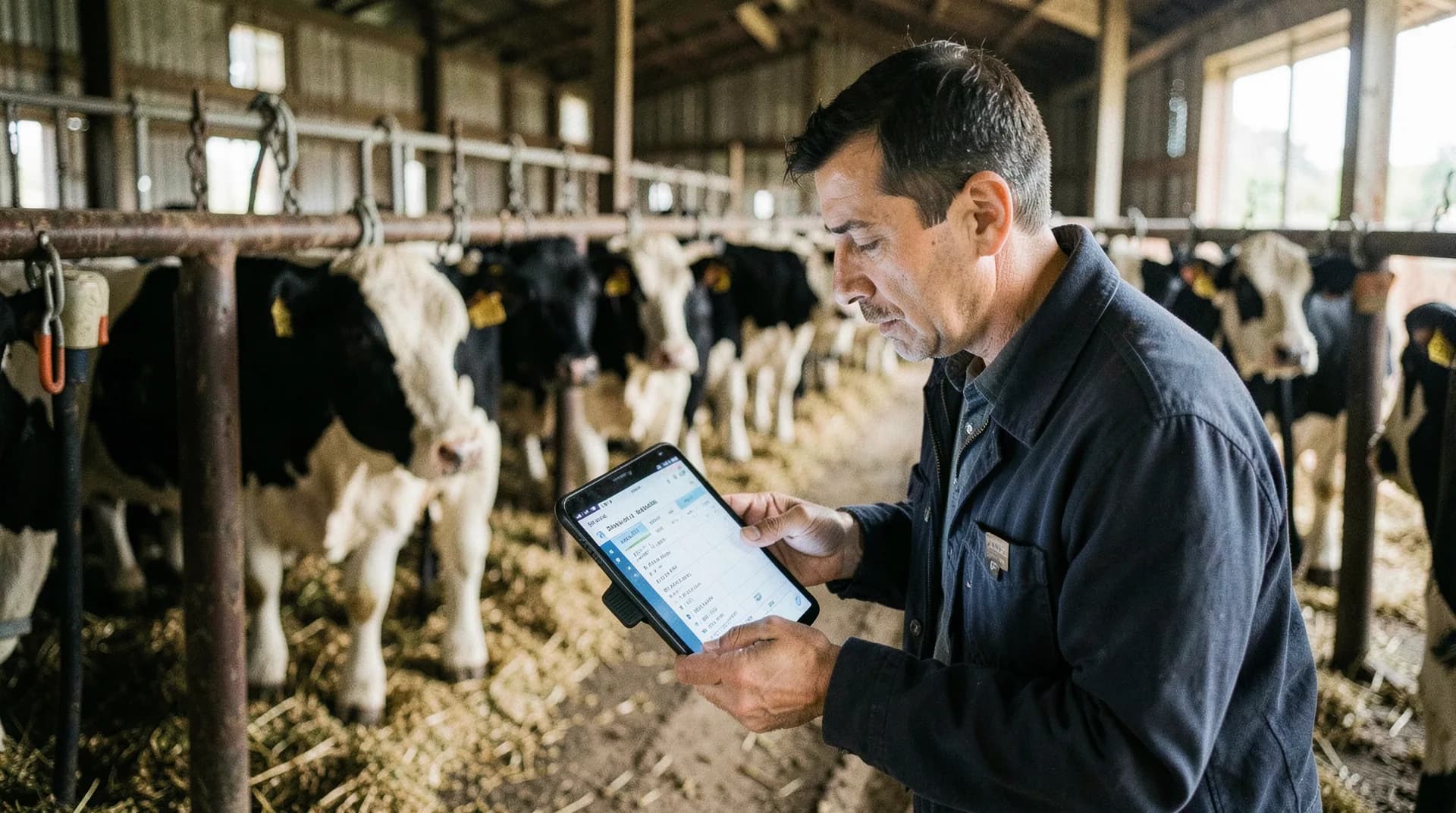
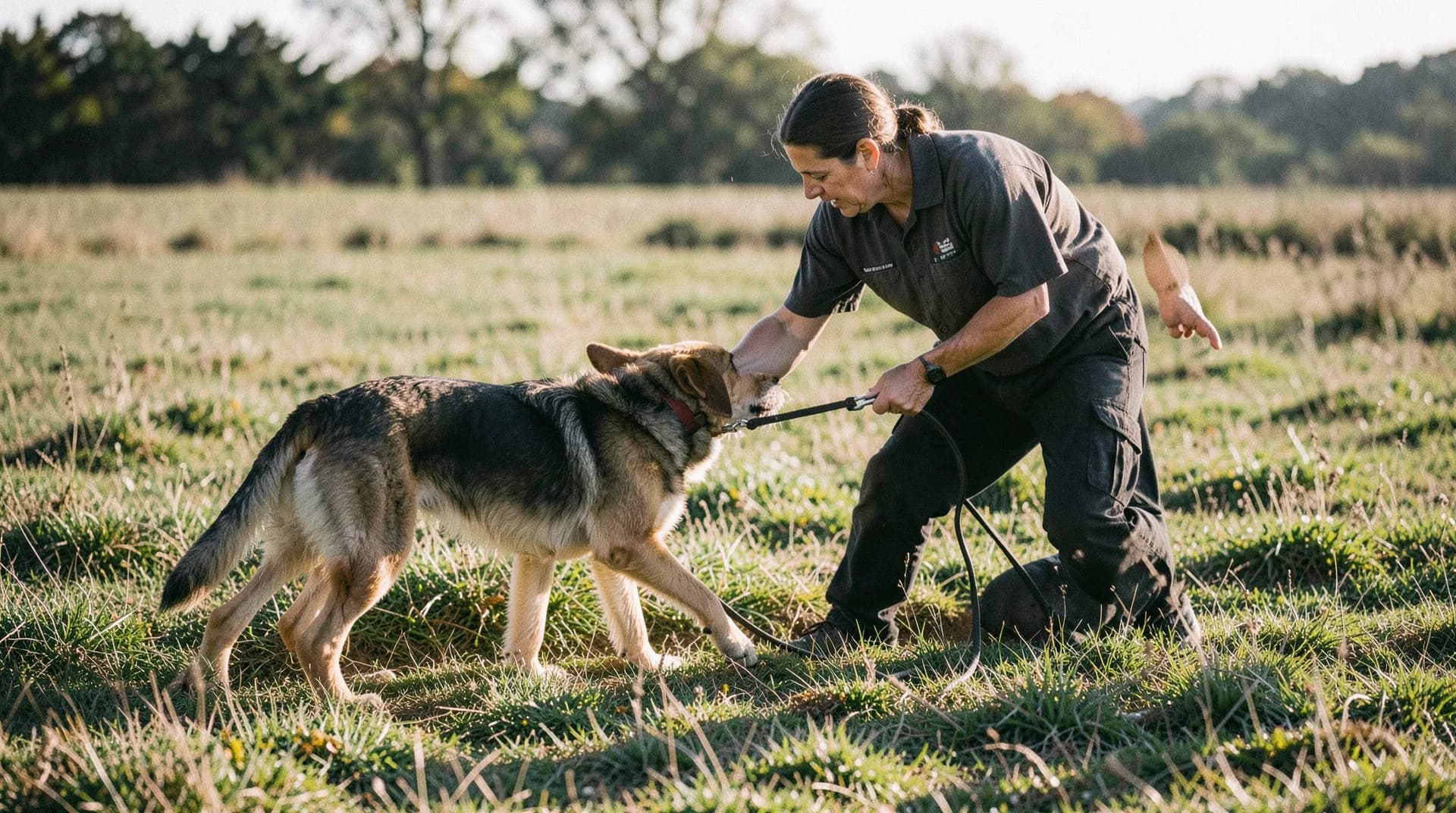
A Dog Handler or Trainer teaches dogs to obey commands and perform specific tasks. The work splits across several sectors. Security and detection work involves training dogs for guarding, patrol and substance detection. Assistance-dog work prepares animals for guide, hearing and disability support roles. Pet behaviour work covers obedience training and behaviour correction for the general public. Some handlers also work in racing, herding and film or media production.
Australian demand is niche but stable. Security firms employ handlers for site protection and event work. Assistance-dog charities train and place animals with people who have disabilities. Veterinary behaviour clinics, boarding businesses and private training schools round out the market. Government roles in customs, corrections and defence exist but usually require Australian residency and security clearances, so they are not realistic entry points for new migrants.
Work spreads across metropolitan and regional areas. Security and assistance roles concentrate near population centres, while working-dog and herding roles appear in rural districts. That mix supports both nominated and regional visa strategies.
ANZSCO Code 361111 Explained
ANZSCO 361111 sits within Unit Group 3611, Animal Attendants and Trainers. The official duties centre on teaching dogs to obey commands and undertake specific tasks. The code captures security and detection handlers, assistance-dog trainers, obedience trainers and working-dog trainers under one heading.
Registration or licensing may be required depending on the sector. Security dog handling is licensed at state level, and assistance-dog work is governed by training and accreditation standards. The code is separate from general animal attendant and kennel roles. Read the full description on the ANZSCO code finder, because VETASSESS assesses your duties against this exact description and looks for genuine training work rather than general animal care.
Skills Assessment
VETASSESS (Group A Trade-Equivalent Occupation)
VETASSESS assesses Dog Handler or Trainer as a Skill Level 3 occupation. Confirm current requirements on the VETASSESS occupation page.
Requirements: A positive assessment requires one of the following combinations.
- An AQF Certificate IV in a highly relevant field, plus at least one year of post-qualification highly relevant employment at an appropriate skill level in the last five years; or
- An AQF Certificate IV that is not in a highly relevant field, plus at least two years of post-qualification highly relevant employment in the last five years; or
- An AQF Certificate III in a highly relevant field, plus at least three years of post-qualification highly relevant employment in the last five years
Assessment cost: AUD $1,096 offshore or AUD $1,205.60 onshore, including GST (effective 22 October 2025).
Processing time: Around 7 weeks standard, or roughly 10 business days with Priority Processing for an additional AUD $825 offshore.
Common rejection reasons: The frequent failure is employment that reads as general kennel or animal-attendant work rather than active training, and qualifications that do not align with dog training or animal behaviour. References that describe structured training programs, behaviour modification and command work assess far more strongly.
Visa Pathways for Dog Handlers and Trainers
ANZSCO 361111 is on the CSOL but not the MLTSSL. The points-only subclass 189 is not available. The realistic routes are nominated and employer-sponsored.
Subclass 190 — Skilled Nominated Visa
State nomination adds 5 points and grants permanent residency.
- Visa fee: AUD $6,140 (primary applicant, 2026)
- Constraint: You need nomination from a state or territory that currently lists 361111, usually with a genuine connection to that state
- Quirk: This is a niche occupation, so state nomination availability is limited and changes year to year. Confirm the current state list before lodging.
Subclass 491 — Skilled Work Regional (Provisional) Visa
Regional nomination adds 15 points. A five-year provisional visa with a pathway to permanent residency through subclass 191.
- Visa fee: AUD $6,140 (primary applicant, 2026)
- Constraint: You commit to a designated regional area
- Quirk: Working-dog, herding and rural security roles align naturally with regional living, which can strengthen a regional nomination case.
Subclass 482 — Skills in Demand Visa
Employer-sponsored temporary visa, and often the most direct route for a niche occupation.
- Visa fee: AUD $1,895 (primary applicant, Core Skills stream, 2026)
- Constraint: The sponsor must be approved and pay at or above the relevant income threshold
- Quirk: Established security firms and larger assistance-dog organisations are the realistic sponsors. Small private trainers rarely hold sponsor status.
Subclass 186 — Employer Nomination Scheme
Permanent residency through employer sponsorship, via Direct Entry or the Temporary Residence Transition stream after time on a 482.
- Visa fee: AUD $6,140 (primary applicant, 2026)
- Constraint: Direct Entry requires a positive skills assessment and at least three years of relevant experience.
Points Test Strategy
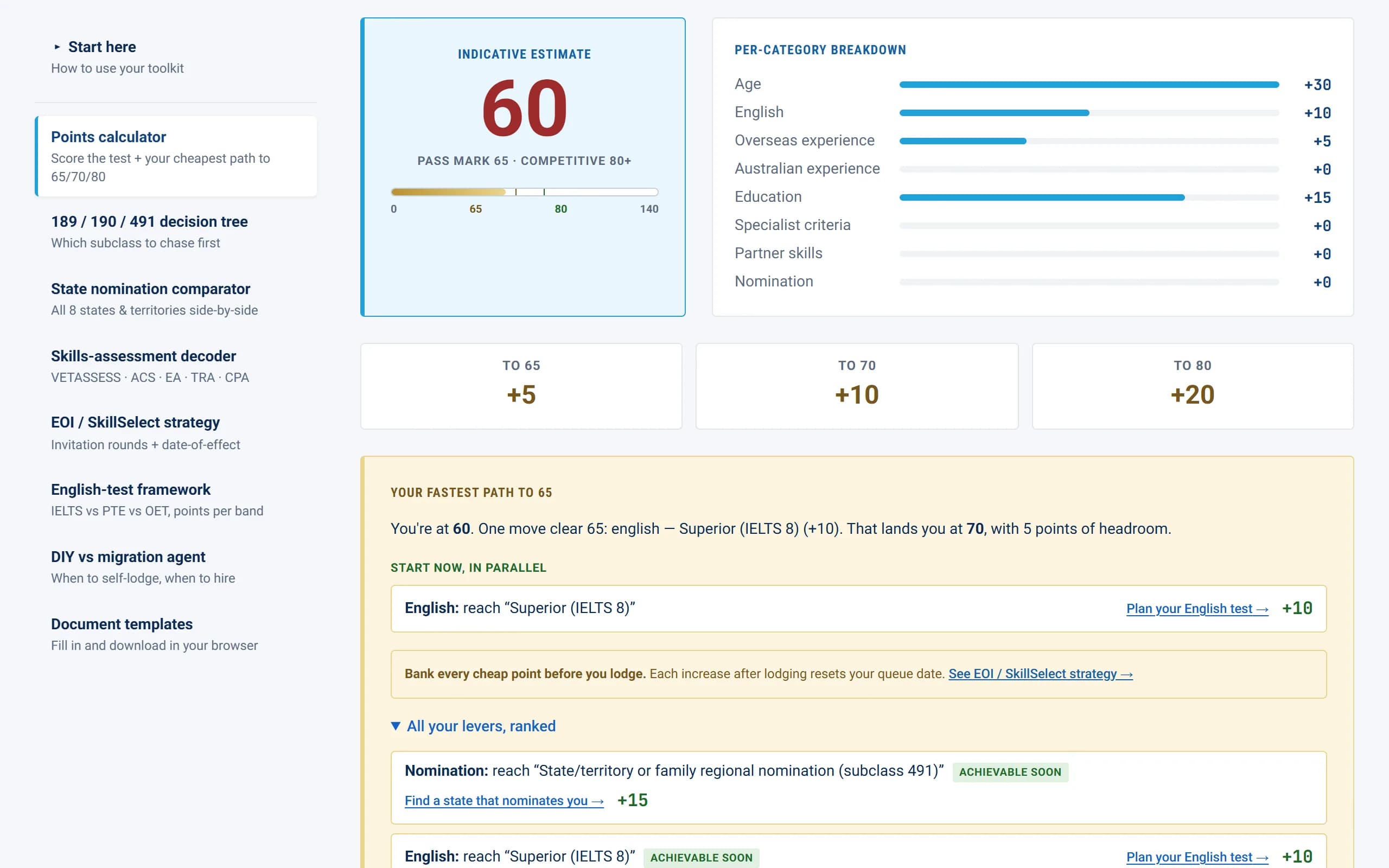
Dog Handler or Trainer is points-tested only through the 190 and 491 routes, since there is no 189 pathway. The standard SkillSelect factors apply.
| Points Factor | Points | Notes |
|---|---|---|
| Age (25-32) | 30 | Maximum bracket |
| Qualification (Diploma/Trade) | 10 | Common for this Skill Level 3 occupation |
| Qualification (Bachelor) | 15 | If held |
| English (Proficient — 7.0) | 10 | Realistic target |
| English (Superior — 8.0+) | 20 | Strong advantage |
| Skilled Employment (overseas) | 5-15 | Based on assessed years |
| State Nomination (190) | 5 | If nominated |
| Regional Nomination (491) | 15 | Largest single boost |
| Partner Skills | 5-10 | If partner has a skilled occupation |
Realistic Scenarios
Scenario 1: Security handler (Certificate IV, 30 years old, Proficient English, 5 years experience). Age 30 + Diploma/Trade 10 + English 10 + Experience 10 = 60 points, then 491 regional nomination adds 15 to reach 75. A regional pathway lifts a modest base score into workable range.
Scenario 2: Assistance-dog trainer (Bachelor in animal behaviour, 33 years old, Superior English, 5 years experience). Age 25 + Bachelor 15 + English 20 + Experience 10 = 70 points, then 190 nomination adds 5 to reach 75. Stronger English and a higher qualification offset the niche occupation.
State Nomination
State demand for Dog Handler or Trainer is genuine but narrow. Security, assistance-dog and behaviour-training sectors drive it, and these are small employment pools. Because state occupation lists for niche animal roles are reviewed annually and differ between jurisdictions, verify 361111 against the current published list for your target state before lodging an expression of interest. The SkillSelect EOI guide explains how nomination affects your expression of interest. For many applicants, employer sponsorship through a 482 is more direct than waiting for a nominated invitation in a thin occupation.
Salary and Employment Outlook
| Role | Typical Salary Range |
|---|---|
| Dog Trainer (entry / pet obedience) | AUD $60,000-$72,000 |
| Dog Handler / Trainer (experienced) | AUD $75,000-$90,000 |
| Security / Detection Handler | AUD $85,000-$100,000+ |
SEEK's 2026 data places the typical range between roughly AUD $80,000 and $90,000, with Jora reporting an average near $90,000 and some security-handler roles passing $100,000. Salaries usually include compulsory superannuation at 11.5 per cent. Security and detection work tends to pay the most, reflecting shift loadings, risk and licensing. Pet obedience and private training sit at the lower end unless the trainer runs their own business.
The strongest employers are security and protection companies, assistance-dog organisations, veterinary behaviour clinics, and established private training schools. Pay varies more by sector than by region, so the choice of specialisation matters more than the city.
Tips for a Successful Application
- Show training work, not animal care. VETASSESS distinguishes active training from general kennel duties. Build references around structured programs, command training and behaviour modification.
- Match the qualification and experience combination exactly. A Certificate III needs three years of relevant employment, while a relevant Certificate IV needs only one. Map your situation to the correct combination before lodging.
- Consider employer sponsorship first. In a thin occupation, a 482 from a security firm or assistance-dog organisation is often faster than chasing a scarce state nomination.
- Sort out licensing for security work. Security dog handling is licensed at state level. Understand the licensing path for your target state, since a job offer may depend on it.
- Lift your English score. Moving from Proficient to Superior adds 10 points, which carries real weight when the occupation offers limited nomination opportunities.
Step-by-Step Migration Roadmap
- Confirm your duties match ANZSCO 361111
- Check 361111 on the Core Skills Occupation List
- Confirm VETASSESS is your assessor on the skills assessment bodies list
- Gather qualification documents and training-focused employment references
- Sit an English test and aim for Proficient or Superior
- Lodge your VETASSESS skills assessment
- Decide between a nominated route (190/491) and employer sponsorship (482)
- Submit an expression of interest in SkillSelect or secure a sponsor
- Apply for nomination, or have your employer nominate you for a 482
- Receive the invitation and lodge the visa
- Complete health, character and any licensing requirements
- Receive the grant and relocate
Frequently Asked Questions
Can a Dog Handler or Trainer apply for the subclass 189 visa?
No. ANZSCO 361111 is on the Core Skills Occupation List but not the MLTSSL, so the points-only independent 189 visa is closed. The available routes are the nominated 190 and 491 visas and the employer-sponsored 482 and 186. The Skilled Occupation List 2026 shows how list status governs visa access.
Does kennel or animal-shelter work count toward the assessment?
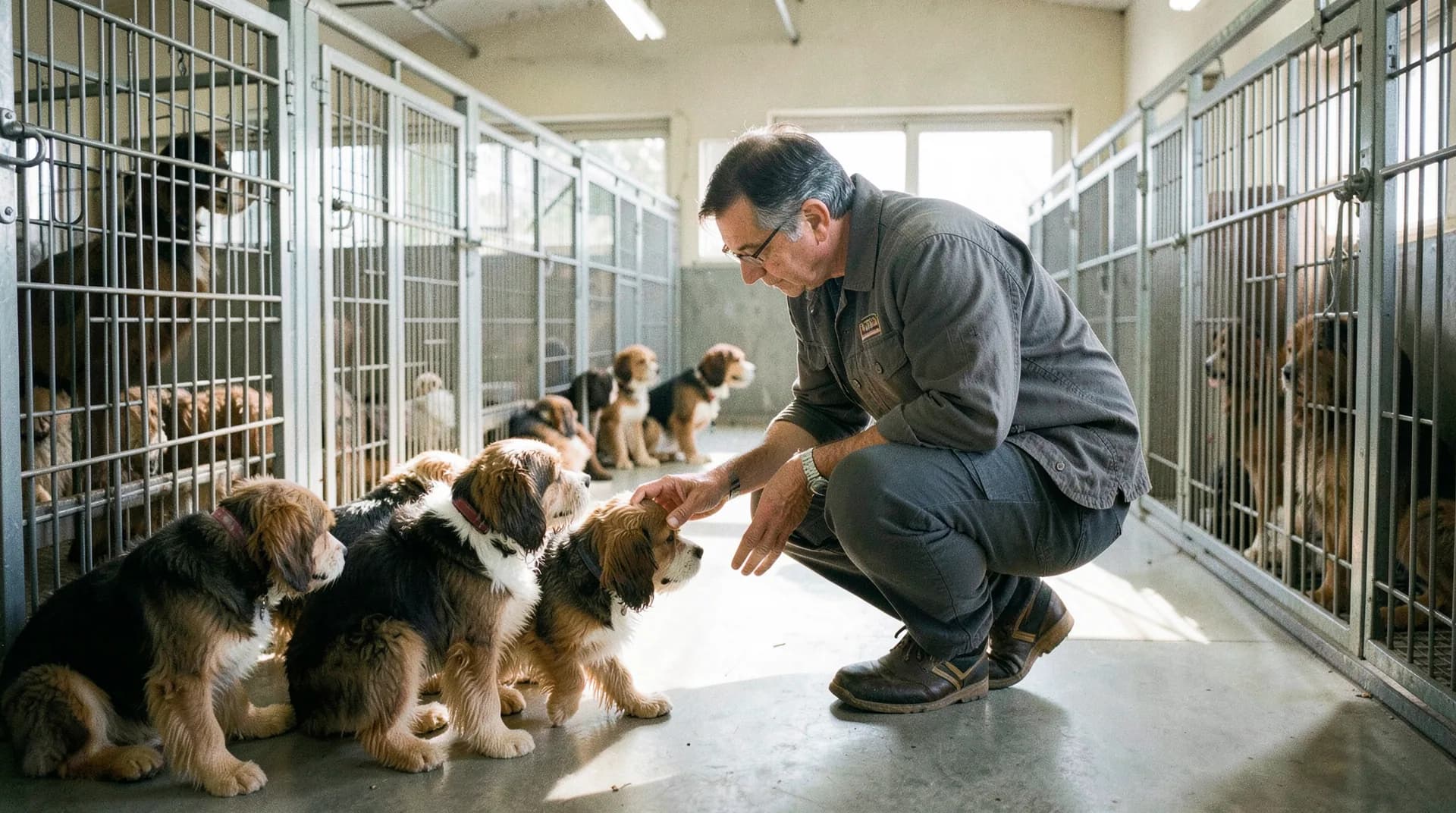
Usually not on its own. VETASSESS looks for active dog training, including obedience, task and behaviour work. General animal attendant duties such as feeding, cleaning and basic care are unlikely to meet the standard unless they sit alongside genuine training responsibilities.
Do I need a licence to work as a security dog handler in Australia?
Often yes. Security dog handling is licensed at state level, and the requirements differ between jurisdictions. Sort out the licensing path for your target state early, since an employer's job offer may depend on you being able to obtain the relevant security licence.
Is employer sponsorship easier than state nomination for this occupation?
Frequently, yes. Because the occupation is niche, state nomination places are scarce and inconsistent. A subclass 482 from an established security firm or assistance-dog organisation is often a more direct route, and it can lead to permanent residency through the 186.
What is the demand outlook for Dog Handlers and Trainers in 2026?
Moderate and stable rather than booming. Security, assistance-dog and behaviour-training sectors provide steady niche demand. For a broader sense of where this sits among Australian skilled occupations, see the most in-demand occupations list.