Naval Architect / Marine Designer Visa Pathway to Australia: Complete 2026 Guide
Updated: 16 August 2026
Australia classifies Naval Architects under ANZSCO 233916. Engineers Australia conducts the skills assessment, typically via a Competency Demonstration Report. The occupation sits on the MLTSSL and the CSOL, unlocking subclasses 189, 190, 491, 482, and 186. Typical 2026 salaries range AUD $95,000-$170,000. The AUKUS submarine programme at Osborne has tightened domestic supply sharply.
Quick Facts: Naval Architect Migration Pathway
| Detail | Information |
|---|---|
| ANZSCO Code | 233916 (Naval Architect / Marine Designer) |
| Skill Level | 1 (Bachelor degree or higher) |
| Skills Assessment | Engineers Australia (EA) |
| Occupation List | MLTSSL and CSOL |
| Visa Options | 189, 190, 491, 482, 186 |
| Demand Level | High — AUKUS, frigate, and patrol-boat programmes outstrip domestic workforce |
| Salary Range | AUD $95,000-$170,000 (SEEK, 2026) |
| Typical 189 Score | 85-90 points (competitive engineering pool) |
| Key Challenge | CDR quality — Engineers Australia is rejecting AI-assisted reports at a high rate in 2026 |
What Naval Architects Do in Australia
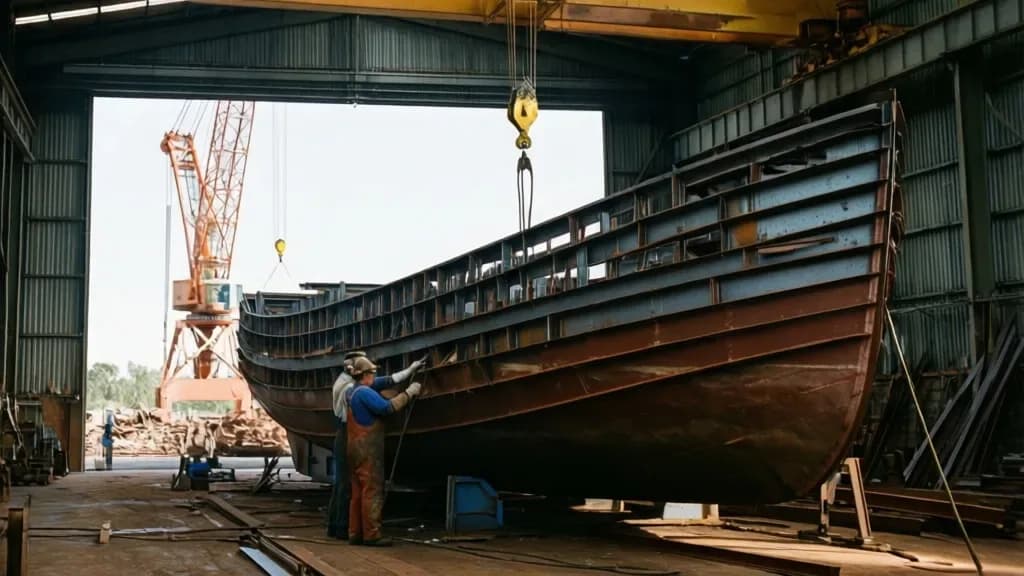
Naval architects design, build, and maintain ships, submarines, offshore platforms, and smaller marine craft. Day-to-day work spans hydrodynamic analysis, structural design, stability calculations, and supervision of construction or refit. In Australia the discipline overlaps with marine engineering, ocean engineering, and offshore renewables, so titles can shift between roles.
Demand is geographically concentrated. Osborne in South Australia hosts the AUKUS submarine yard and the frigate continuous shipbuilding programme. Henderson in Western Australia handles patrol vessels, defence sustainment, and offshore oil and gas. Sydney and Newcastle support commercial maritime, naval architecture consultancies, and superyacht refit. Smaller clusters exist in Cairns, Hobart, and Brisbane around defence sustainment and the recreational marine sector.
The AUKUS programme is the dominant signal in 2026. Australia committed USD 3.9 billion in February 2026 to begin full-scale construction of the submarine yard at Osborne, with peak workforce projections of about 5,500 personnel for submarine production alone. Australian Submarine Agency planning documents acknowledge that the existing naval architecture workforce cannot meet the demand. That tightness has pulled forward sponsorship interest from ASC, BAE Systems Maritime Australia, Civmec, and Austal.
ANZSCO 233916: Code Mapping
ANZSCO 233916 covers Naval Architects in Australia and Marine Designers in New Zealand. The code sits inside unit group 2339 (Other Engineering Professionals), which also captures Aeronautical Engineers (233911), Agricultural Engineers (233912), Biomedical Engineers (233913), Engineering Technologists (233914), and Environmental Engineers (233915).
Typical tasks include preparing ship lines, structural drawings, and specifications; calculating stability, trim, resistance, and propulsion; supervising sea trials; and managing classification society approvals (DNV, Lloyd's, ABS). The role requires a bachelor's degree in naval architecture, marine engineering, or a closely related engineering discipline, often with chartered membership of a professional body such as RINA.
If your duties lean toward propulsion systems, machinery, or shipboard electrical design rather than hull form and structures, Mechanical Engineer (233512) or Electrical Engineer (233311) may map more accurately. Read the ANZSCO description in full before nominating — see how to find your ANZSCO code.
Skills Assessment: Engineers Australia
Engineers Australia is the sole assessing authority for ANZSCO 233916. Three pathways apply.
Washington / Sydney / Dublin Accord pathway — for graduates of engineering programmes accredited under one of the three international accords (US ABET, UK Engineering Council, Indian NBA from 2014, and others). The assessment is faster and cheaper. Naval architecture programmes from RINA-accredited UK universities and ABET-accredited US programmes typically qualify.
Australian-accredited qualification pathway — for graduates of EA-accredited Australian engineering programmes. The lowest fee and fastest turnaround.
Competency Demonstration Report (CDR) pathway — for graduates whose qualification is not covered by an accord. A CDR consists of a continuing professional development list, three career episodes, and a summary statement mapping competencies to the Engineers Australia stage 1 elements for professional engineer.
Requirements:
- Bachelor degree or higher in naval architecture or a closely related engineering field
- English: IELTS 6.0 in each band (or equivalent PTE / TOEFL / OET / Cambridge)
- For CDR, three career episodes documenting engineering work, written in first person
Assessment cost (2025-26 schedule): CDR AUD $1,001; Accord pathway AUD $539; Australian-accredited AUD $335.50; Fast Track surcharge AUD $385. Fees rise 3-4% from 1 July 2026 in line with CPI.
Processing time: Standard CDR 10-16 weeks. Fast Track around 15 working days when documentation is clean.
Common rejection reasons: Plagiarism flags from AI-detection software now applied to CDRs since the 2026 process update; career episodes that describe team activity rather than the applicant's own engineering work; insufficient mapping to stage 1 competencies; and unverifiable employment evidence. Engineers Australia has confirmed that CDRs produced by generative AI tools are being refused at materially higher rates in 2026.
Visa Pathways for Naval Architects
Subclass 482 — Skills in Demand Visa
The 482 is the dominant pathway for naval architects because Australia's primes — ASC, BAE Systems Maritime Australia, Civmec, Austal, Babcock — sponsor experienced overseas engineers directly.
- Visa fee: AUD $3,670 (Core Skills stream primary applicant)
- Salary threshold: Core Skills AUD $76,515; Specialist Skills AUD $141,210
- Processing: Specialist Skills stream 7-51 days. Core Skills stream up to eight months in the 90th percentile as of April 2026
- Quirk: Most naval architect salaries clear the Specialist Skills threshold, which delivers a 7-day decision turnaround on decision-ready files
Subclass 186 — Employer Nomination Scheme
Permanent residency via employer sponsorship. The Direct Entry stream applies when the worker has not held a 482, and the Temporary Residence Transition stream applies after two years on a 482 with the same employer.
- Visa fee: AUD $6,140 (primary applicant)
- Processing: 6-15 months for Direct Entry; faster for TRT
- Quirk: Defence primes routinely sponsor 186 directly for senior naval architects with security-clearance-friendly nationalities
Subclass 189 — Skilled Independent Visa
Permanent residency through the points-based system. Available because Naval Architect is on the MLTSSL.
- Visa fee: AUD $6,135 (primary applicant)
- Realistic invitation score: 85-90 points in 2026
- Processing: 6-12 months
- Quirk: 189 invitations for engineering ANZSCO codes have been thin in 2026 as the federal allocation favours health and construction trades
Subclass 190 — Skilled Nominated Visa
State nomination adds 5 points and grants permanent residency on arrival.
- Visa fee: AUD $6,140
- Best states: South Australia and Western Australia — both have direct defence shipbuilding demand
- Obligation: Two-year residence commitment in the nominating state
Subclass 491 — Skilled Work Regional Visa
Regional nomination adds 15 points. Provisional five-year visa with a pathway to permanent residency via subclass 191.
- Visa fee: AUD $6,140
- Best fit: Henderson (WA) and the Cairns / Townsville defence sustainment cluster
Points Test Strategy
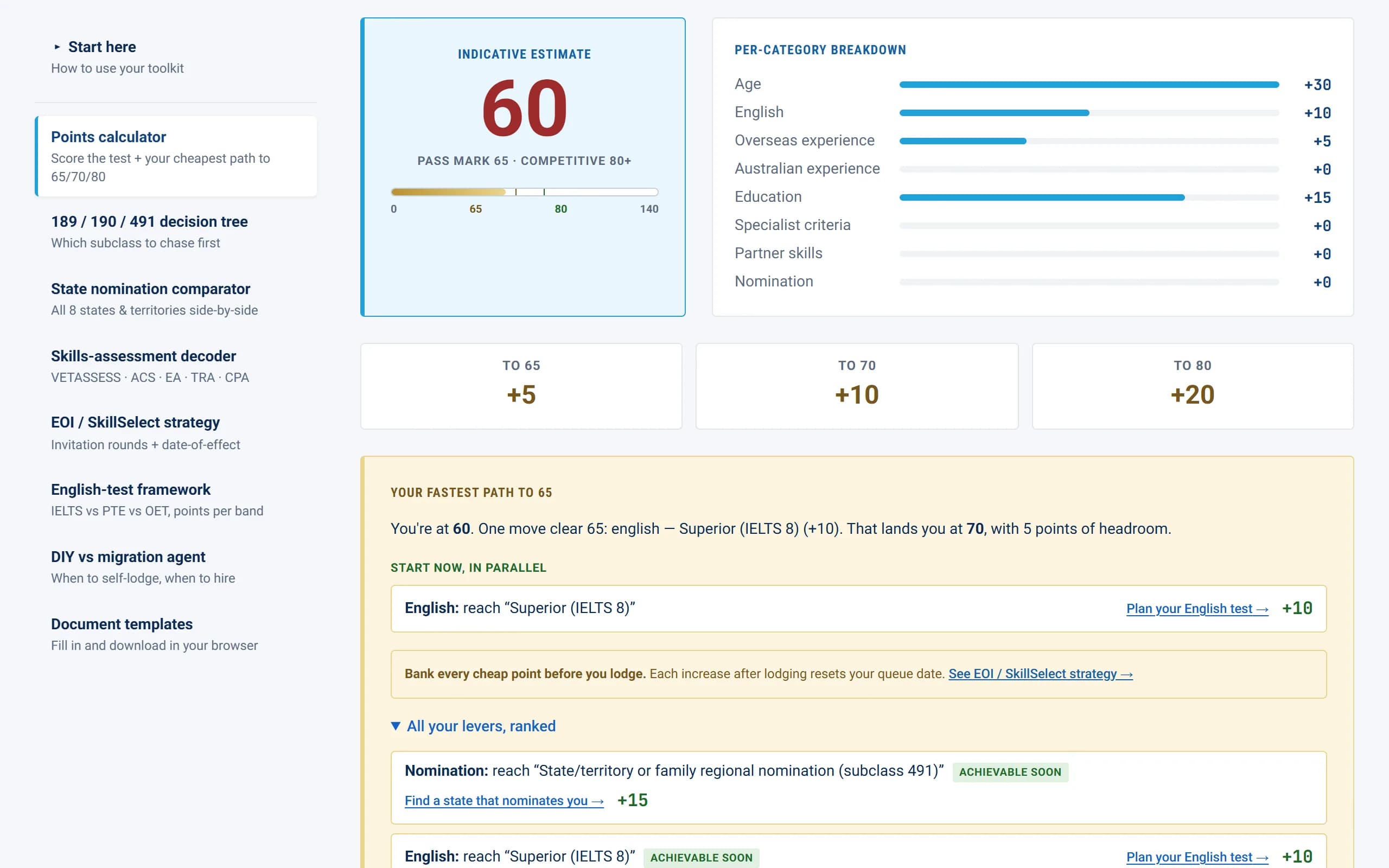
Naval Architect is on the MLTSSL, so 189, 190, and 491 are all in play. Typical scoring:
| Points Factor | Points | Notes |
|---|---|---|
| Age (25-32) | 30 | Maximum bracket |
| Age (33-39) | 25 | Common for mid-career applicants |
| English (Superior, 8.0+) | 20 | Often the swing factor |
| English (Proficient, 7.0) | 10 | More realistic threshold |
| Bachelor degree | 15 | Skill Level 1 minimum |
| Master's degree | 15 | No additional points over Bachelor unless PhD |
| PhD | 20 | Awarded to many academic and R&D naval architects |
| Overseas experience (8+ years) | 15 | Maximum bracket |
| Australian experience (3+ years) | 10 | Strong leverage if you start on 482 |
| State nomination (190) | 5 | |
| Regional nomination (491) | 15 | |
| Partner skills | 10 | If partner has a skilled occupation |
Scenario 1: Mid-career engineer from Korea or India
Aged 31, Master's in Naval Architecture, IELTS 7.5 across bands, 9 years experience including 3 years post-deduction at a tier-1 shipyard.
- Age 30 + Master's 15 + English 10 + Experience 15 = 70 points
- Add 190 nomination = 75 points
- Workable for South Australia 190 nomination given the AUKUS demand signal
Scenario 2: Senior naval architect from the UK
Aged 38, Bachelor's plus Chartered Engineer status, IELTS 8.0+, 12 years experience.
- Age 25 + Bachelor 15 + English 20 + Experience 15 = 75 points
- Add 190 = 80 points
- The cleaner path is direct 482 sponsorship into the AUKUS programme — many UK chartered naval architects move on Specialist Skills with a 7-day decision
State Nomination
South Australia
South Australia is the highest-priority state for naval architects in 2026. The Osborne yard houses ASC, the Future Frigate programme (BAE Systems Maritime Australia, Hunter class), and the AUKUS Submarine Construction Yard. The state's skilled migration programme prioritises occupations supporting the defence industry plan, and Naval Architect appears on the SA Skilled Occupation List for both 190 and 491. Onshore applicants with a current defence-sector role or a job offer are invited first.
Western Australia
WA's Henderson defence precinct supports the Civmec / Luerssen Arafura-class patrol boats and naval sustainment at HMAS Stirling. Naval Architect sits on the WA Skilled Migration Occupation List. The state increasingly invites offshore applicants where the role is in defence shipbuilding or sustainment.
New South Wales
Sydney supports a smaller naval architecture cluster around defence consultancies and commercial maritime. NSW nominates the occupation but invites at higher points than SA or WA. Expect 85+ for 190.
Queensland
Cairns and Townsville support sustainment of patrol craft and offshore vessels. Queensland's 2025-26 programme accepts construction and engineering applicants with at least 9 months onshore experience for 190 or 6 months for 491.
Salary and Employment Outlook
| Role | Typical Salary Range |
|---|---|
| Graduate / Junior Naval Architect (0-2 yrs) | AUD $80,000-$100,000 |
| Naval Architect (3-7 yrs) | AUD $105,000-$140,000 |
| Senior Naval Architect (8+ yrs) | AUD $140,000-$180,000 |
| Principal Naval Architect / Lead Engineer | AUD $170,000-$220,000+ |
| Defence contractor (cleared, AUKUS programme) | AUD $160,000-$240,000 |
| Offshore / consulting daily rate | AUD $1,000-$1,600/day |
Source: SEEK Career Advice (Naval Architect, May 2026), PayScale Australia 2026, plus published salary ranges in AUKUS programme job advertisements. Superannuation (11.5%) sits on top. Defence primes also offer security-clearance allowances and relocation packages of AUD $15,000-$40,000.
Highest-paying employers in 2026: ASC, BAE Systems Maritime Australia, Civmec, Austal, Babcock Australasia, Thales Australia. Consulting firms — DNV, Lloyd's Register, BMT, and Houlder — pay competitive base salaries with project bonuses.
Tips for a Successful Application
-
Write your CDR yourself, not with AI. Engineers Australia rolled out AI-detection across CDR review in 2026 and is rejecting flagged reports at a high rate. Three career episodes, 1,000-2,500 words each, in first person, describing engineering work you performed.
-
Map each career episode to a stage 1 competency. The summary statement is where most CDRs fail. Each claim must reference a specific paragraph in your career episodes and a specific stage 1 element.
-
Lead with the accord pathway if eligible. If your degree is from a Washington Accord, Sydney Accord, or Dublin Accord institution, you skip the CDR entirely. Check the Engineers Australia accord list before assuming you need a CDR.
-
Apply directly to the primes for 482 sponsorship. ASC, BAE Systems Maritime Australia, Civmec, and Austal advertise naval architect roles continually in 2026. The Specialist Skills stream clears in 7 days for decision-ready files.
-
Get security-clearance ready. Australian defence work requires Baseline, NV1, or NV2 clearances. Australian or Five Eyes nationality is preferred. If you're outside that cohort, focus on commercial maritime, consulting, or offshore renewables rather than direct defence roles.
Step-by-Step Migration Roadmap
- Confirm ANZSCO 233916 fits your duties — read the code-finder guide
- Check whether your engineering degree is covered by the Washington, Sydney, or Dublin Accord
- Sit your English test — aim for Proficient (7.0+) minimum, Superior (8.0+) for points leverage
- Apply for Engineers Australia skills assessment — Accord, Australian-accredited, or CDR pathway
- Either: submit EOI in SkillSelect for 189/190/491
- Or: apply directly to ASC / BAE / Civmec / Austal for 482 sponsorship — the faster path in 2026
- If pursuing state nomination, lodge with South Australia or Western Australia first
- Receive invitation and lodge visa within 60 days
- Complete health checks (Bupa Medical Visa Services) and AFP / overseas police clearances
- Apply for or transfer security clearance if working on defence projects
- Receive grant and relocate to Osborne, Henderson, or your nominating region
- Begin work — 482 permits start within days of grant, 189/190 grants are unconditional
Frequently Asked Questions
Is the AUKUS programme actually creating jobs for naval architects in 2026?
Yes, and the gap is widening. Australian Submarine Agency planning has stated explicitly that the maritime workforce is below the level required for SSN-AUKUS construction, with peak demand of around 5,500 people for submarine production alone. ASC and BAE Systems Maritime Australia are actively sponsoring overseas naval architects on 482 visas in 2026.
Do I need a security clearance to work as a naval architect in Australia?
Only for defence work. Commercial maritime, offshore oil and gas, offshore wind, superyacht refit, and classification society work do not require clearances. For defence projects, Baseline clearance is the entry level. NV1 / NV2 are required for submarine and sensitive surface combatant work, and these are restricted to Australian citizens and a narrow set of Five Eyes nationals.
Can I qualify if my degree is in mechanical or marine engineering rather than naval architecture?
Yes, if your work experience is in naval architecture and your duties match ANZSCO 233916. Engineers Australia assesses both the qualification and the duties. A mechanical engineer with 8 years of hull-form, hydrostatics, and stability work can usually be assessed for 233916 via CDR, though the career episodes must demonstrate naval architecture competencies specifically.
Which state offers the best path for naval architects right now?
South Australia by a clear margin in 2026, because the AUKUS programme is funded, contracted, and recruiting at scale. Western Australia is second on the back of Henderson defence sustainment. Queensland and NSW offer fewer roles but lower competition for 190 invitations.
How long does the full pathway take?
For a 482 with a sponsoring employer, 8-12 weeks from job offer to landing in Australia is realistic on the Specialist Skills stream. The full 189 pathway — EA assessment, EOI, invitation, visa grant — runs 12-18 months. State nomination (190) sits in between at roughly 10-14 months.