Natural and Physical Science Professionals nec Visa Pathway to Australia: Complete 2026 Guide
Updated: 16 August 2026
Australia uses ANZSCO 234999 as the catch-all code for natural and physical science professionals not elsewhere classified. VETASSESS conducts the skills assessment. The code sits on the Core Skills Occupation List and the MLTSSL, unlocking subclasses 189, 190, 491, 482 and 186. Typical 2026 salaries range AUD $85,000-$150,000. The code captures astronomers, materials scientists, oceanographers, hydrologists and other specialists without a dedicated ANZSCO entry.
Quick Facts: Natural and Physical Science Professionals nec Migration Pathway
| Detail | Information |
|---|---|
| ANZSCO Code | 234999 (Natural and Physical Science Professionals nec) |
| Skill Level | 1 (Bachelor degree or higher in a relevant natural or physical science) |
| Skills Assessment | VETASSESS (Vocational Education and Training Assessment Services), Group A |
| Occupation List | CSOL and MLTSSL |
| Visa Options | 189, 190, 491, 482, 186 |
| Demand Level | Moderate — varies sharply by specialisation (oceanography, hydrology and materials science in stronger demand than astronomy) |
| Salary Range | AUD $85,000-$150,000 (PayScale and SEEK averages, May 2026) |
| Typical 189 Score | 80-85 points (small invitation pool) |
| Key Challenge | Proving the role doesn't fit a more specific code — VETASSESS will redirect you to 234412, 234914, 234913 etc. if your duties match those codes more closely |
What "nec" Means and Who It Applies To
"Not elsewhere classified" is ANZSCO's catch-all category. The code 234999 sits inside unit group 2349 (Other Natural and Physical Science Professionals), alongside Conservator (234911), Metallurgist (234912), Meteorologist (234913) and Physicist (234914). If your specialisation doesn't fit one of those four — or any other specific science code in the ANZSCO catalogue — you land in 234999.
The code captures, among others:
- Oceanographers — physical, chemical and biological oceanographers working on coastal processes, marine biogeochemistry, ocean modelling
- Hydrologists — surface-water hydrologists doing flood modelling, hydrogeologists in mining and aquifer assessment (where the role doesn't fit 234412 Geophysicist)
- Astronomers and astrophysicists — observational and computational astronomers where the institution categorises the role as astronomy rather than physics
- Materials scientists — synthesis, characterisation and applied materials research where the role doesn't sit cleanly under 234914 Physicist or 234211 Chemist
- Forensic scientists — laboratory forensic specialists in DNA, toxicology and trace analysis
- Soil scientists — agricultural and environmental soil science where 234112 Agricultural Consultant or 234399 Environmental Scientists nec don't apply
- Glaciologists, palaeoclimatologists and Antarctic-program scientists — where the role is broader than 234913 Meteorologist
- Biotechnologists — in non-laboratory leadership or applied-research positions
The unit group description from ABS describes these as professionals who "perform analytical, conceptual and practical tasks in relation to the chemical and physical properties of the universe, life forms including the physiology and biochemistry of humans, animals and plants, environmental factors and agricultural production, disease prevention and the extraction and processing of mineral ores."
The Code-Selection Question
The single most important step is verifying that 234999 is the right code — not a more specific one.
VETASSESS will redirect borderline applications. If you describe duties that match 234913 Meteorologist, 234914 Physicist, 234412 Geophysicist, 234211 Chemist, 234511-234518 Life Scientists, or 234311-234399 Environmental Scientists, the assessment officer will tell you to apply under that code instead. You will lose your application fee and the months of waiting.
A practical decision tree:
- Does your work fit a specific named code? Check the full ANZSCO catalogue. Hydrologists doing groundwater work often fit 234412 Geophysicist. Marine biologists fit 234518 Other Spatial Scientist or one of the life-science codes. Soil scientists fit 234112 Agricultural Consultant if the work is agricultural.
- Is the role academic or applied? Pure-research roles in fields like astrophysics, palaeoclimatology and theoretical materials science map well to 234999. Applied industrial roles often have dedicated codes.
- What does your degree title and major say? VETASSESS reads degree-major alignment carefully. A Master's in Oceanography in an applicant working as an oceanographer maps to 234999. The same applicant working as a coastal engineer maps to a civil-engineering code through Engineers Australia.
Use the how to find your ANZSCO code guide for the formal walk-through.
Skills Assessment — VETASSESS
VETASSESS is the assessing authority and treats 234999 as a Group A professional occupation.
Highly relevant degree fields (varies by specialisation):
- Oceanography or Marine Science (for oceanographers)
- Hydrology, Hydrogeology or Water Resources (for hydrologists)
- Astronomy, Astrophysics (for astronomers)
- Materials Science, Materials Engineering, Applied Physics (for materials scientists)
- Forensic Science (for forensic scientists)
- Soil Science (for soil scientists)
- Climate Science, Polar Science (for glaciologists and palaeoclimatologists)
- Biotechnology with strong research component (for applied biotechnologists)
The pattern that VETASSESS rejects: a generalist BSc with no clear major in any of the above, plus reference letters describing administrative or coordination work in a science adjacent role.
Experience requirements:
- Minimum one year post-qualification at appropriate skill level
- Within the last five years
- 20+ hours per week
- Highly relevant to the ANZSCO task list
Assessment fees (October 2025 schedule):
- Full skills assessment, applicant in Australia: AUD $1,058.20 (incl. GST)
- Full skills assessment, applicant outside Australia: AUD $962.00 (no GST)
- Priority processing: additional AUD $658.30 in Australia / AUD $623.00 offshore
Processing time: 12-20 weeks standard (this code attracts longer review because of code-selection scrutiny), 4-6 weeks priority.
Common rejection reasons: Application would have been better placed under a specific code (most common); generalist BSc with no field specialisation; reference letters that describe project-management duties rather than scientific work; and overseas qualifications where the degree title sounds scientific but the transcript is heavy on policy or business content. The skills assessment bodies complete list covers all the alternatives.
Visa Pathways
Subclass 189 — Skilled Independent visa
Permanent residency through the points system. Strong fit for high-qualified applicants with research output.
- Visa fee: AUD $6,135
- Realistic invitation score: 80-85 points; small invitation pool clears at lower threshold than ICT
- Processing: 8-12 months
- Quirk: Research-active applicants with PhDs commonly clear without state nomination because the pool is small.
Subclass 482 — Skills in Demand visa
- Visa fee: AUD $4,015
- Salary threshold: Core stream AUD $79,423 / Specialist stream AUD $146,576
- Duration: Up to 4 years
- Quirk: Australian Antarctic Division contracts, oceanographic-research positions at CSIRO Oceans and Atmosphere, hydrology positions in state water agencies, and applied-materials roles at CSIRO Manufacturing are the typical sponsorship routes. Universities sponsor research-fellowship hires through this stream.
Subclass 190 — Skilled Nominated visa
- Visa fee: AUD $6,140
- Points bonus: +5
- Quirk: Nomination depends heavily on specialisation. Tasmania nominates for Antarctic-program and oceanographic roles. Queensland nominates for marine science at AIMS. Western Australia nominates for hydrology in mining contexts. Check the live state lists.
Subclass 491 — Skilled Work Regional (Provisional)
- Visa fee: AUD $6,140
- Points bonus: +15
- Quirk: Many of the employers for 234999 specialisations are in regional locations — AIMS in Townsville, the Bureau's Antarctic-program operations through Hobart, regional water authorities, and mining-sector hydrology in the Pilbara, Hunter and Bowen Basin.
Subclass 186 — Employer Nomination Scheme
- Visa fee: AUD $6,140
- Quirk: Usually pursued through the Temporary Residence Transition stream after 482. Direct Entry is granted to senior research scientists with international standing.
Points Test Strategy
| Points Factor | Maximum |
|---|---|
| Age 25-32 | 30 |
| Age 33-39 | 25 |
| English Superior (IELTS 8) | 20 |
| English Proficient (IELTS 7) | 10 |
| Bachelor degree | 15 |
| Masters or Doctorate | 20 |
| Overseas experience 5-7 years | 10 |
| Overseas experience 8+ years | 15 |
| Australian work experience 3+ years | 10 |
| State nomination (190) | 5 |
| Regional nomination (491) | 15 |
| Partner skills | 5-10 |
| Specialist education (research Masters/PhD in STEM) | 10 |
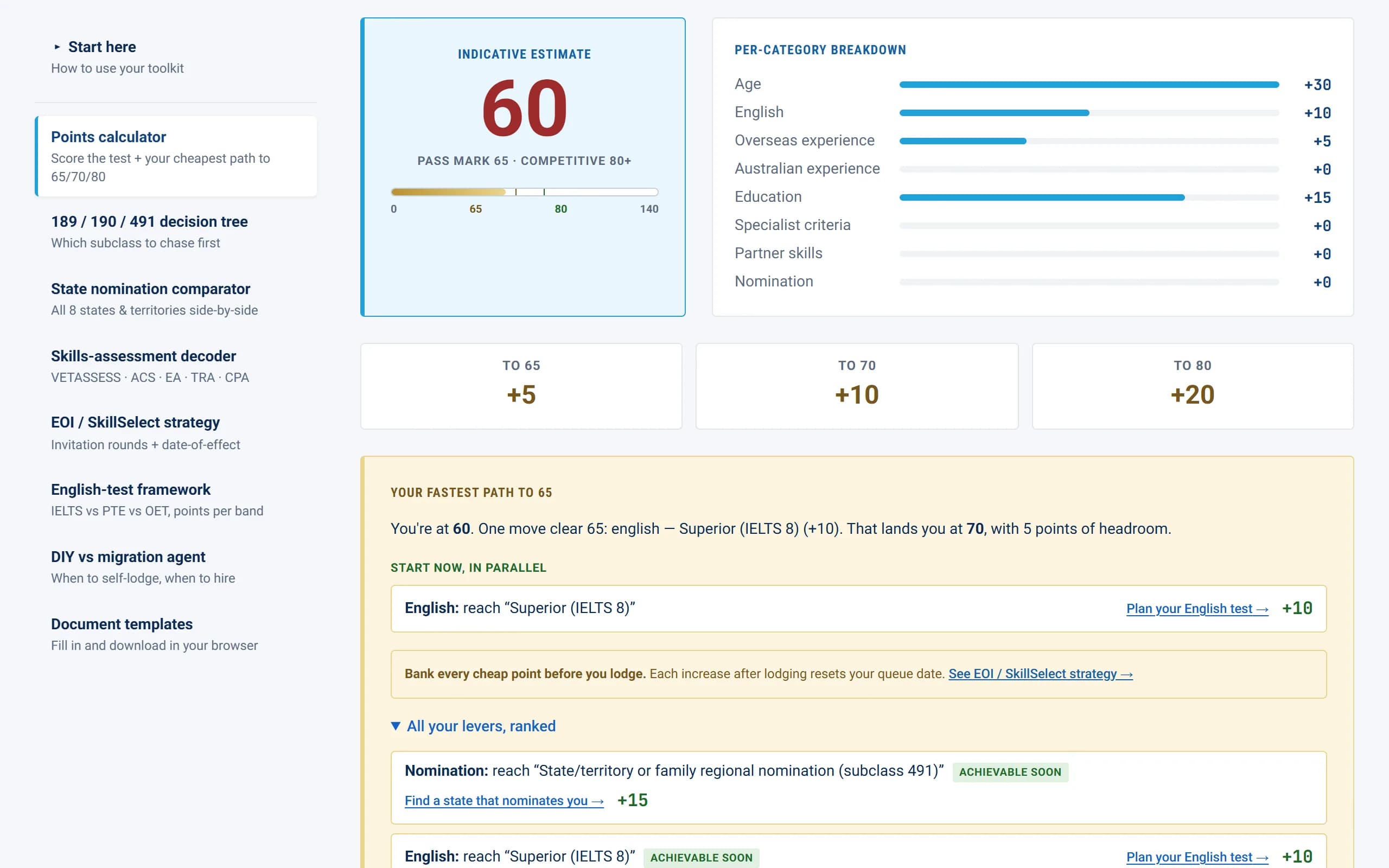
Scenario 1 — Indonesian oceanographer with PhD, 32 years old, four years' post-doc, IELTS 8: 30 (age) + 20 (PhD) + 20 (Superior English) + 5 (experience) + 10 (specialist STEM PhD) = 85 points. Strong 189 candidate.
Scenario 2 — German hydrologist with Master's, 34 years old, seven years' consulting experience, IELTS 7: 25 (age) + 15 (Bachelor) + 10 (English) + 10 (experience) = 60 base. Adds +15 with 491 (regional hydrology role in WA), and +10 with partner-skills claim if partner has a skilled occupation, landing at 85.
State Nomination
Tasmania
Hobart hosts the Australian Antarctic Division, the CSIRO Oceans and Atmosphere site, IMAS (Institute for Marine and Antarctic Studies), and the Bureau's Antarctic program. Tasmania nominates 234999 in most program years for Antarctic, oceanographic and polar-research specialisations.
Queensland
The Australian Institute of Marine Science (AIMS) at Townsville, James Cook University's marine science programs, and the Great Barrier Reef Marine Park Authority make Queensland a strong nominator for marine and reef-science specialisations. Brisbane hosts UQ's astrophysics group and Queensland Bureau forecast offices.
Western Australia
WA's mining-water management workload generates demand for hydrologists and hydrogeologists, particularly in the Pilbara. The state's 190 and 491 programs nominate where there is a regional job offer.
New South Wales
Sydney is the largest research and astronomy cluster — UNSW, Sydney, Macquarie, the Australian Astronomical Observatory's operational arm, and ANSTO's broader materials-science workforce. NSW's 190 program includes 234999 in most rounds.
Australian Capital Territory
ANU's Mount Stromlo and Siding Spring observatories, ANU's Research School of Earth Sciences, Geoscience Australia, and CSIRO's Canberra-based research operations make the ACT a viable nominator for astronomy, geoscience and applied-physics specialisations.
Salary and Employment Outlook
Salaries cluster by specialisation rather than by the umbrella code. Indicative ranges below are drawn from PayScale, SEEK and Hays 2026 data.
| Specialisation | Typical Salary Range (AUD) |
|---|---|
| Post-doctoral Research Fellow (university, any field) | $90,000-$115,000 |
| Oceanographer (CSIRO, IMAS, university) | $95,000-$135,000 |
| Hydrologist (state water agency, consulting) | $90,000-$140,000 |
| Mining Hydrogeologist (Pilbara, FIFO) | $130,000-$200,000 with roster premium |
| Astronomer / Astrophysicist (academic) | $90,000-$140,000 |
| Materials Scientist (CSIRO, industry) | $100,000-$160,000 |
| Forensic Scientist (state forensic services) | $85,000-$130,000 |
| Senior Research Scientist (CSIRO Level 7) | $135,000-$180,000 |
| Principal Research Scientist (CSIRO Level 8) | $175,000-$230,000 |
Federal research organisations (CSIRO, ANSTO, AAD) add 15.4% superannuation, above the standard 11.5% rate. State agencies follow public-service enterprise agreements with similar leave entitlements but lower super. Mining-sector hydrology roles attract roster premiums.
Highest-paying employers and sectors:
- CSIRO — Oceans and Atmosphere, Manufacturing, Mineral Resources, Land and Water divisions
- ANSTO — materials and accelerator-science research
- Australian Antarctic Division — year-long deployment contracts plus headquarters operations
- Mining majors — BHP, Rio, Fortescue and lithium producers hire hydrogeologists and applied geoscientists
- State water authorities — Sydney Water, Melbourne Water, Seqwater, SA Water
- AIMS — Townsville-based marine research
- Universities — Group of Eight and innovative-research universities
Tips for a Successful Application
1. Stress-test the code choice before lodging
The single biggest risk for 234999 applications is being redirected to a more specific code. Walk your CV against the ANZSCO catalogue line by line. If you find a closer match (234412 Geophysicist, 234914 Physicist, 234913 Meteorologist, 234211 Chemist, the life-science codes, the environmental-science codes), apply under that one instead. Use Points Test Advice ($311-$342) for a binding opinion if you're unsure.
2. Write reference letters that name your specialisation
A generic reference letter that says "the applicant worked as a scientist" is not enough. The letter should specify the discipline (oceanographer, hydrologist, astronomer, materials scientist), the technical methods used, and the outputs (papers, models, monitoring programmes, technical reports). VETASSESS uses these to confirm that 234999 is the right home for your duties.
3. Lean on research output and STEM education for points
PhDs in any natural or physical science specialty earn 20 points plus the +10 specialist-education bonus. A research-active applicant with Superior English and a doctorate is one of the simplest profiles to clear 80+ points and qualify for an independent 189.
4. Target the regional research clusters
Tasmania (Antarctic, oceanographic), Queensland (marine science at Townsville, astrophysics at UQ), Western Australia (mining hydrology, geoscience at Curtin), and the ACT (ANU, CSIRO, Geoscience Australia) all sit in or near 491-eligible postcodes for the relevant specialisations. The regional concession (+15) is the cleanest path for borderline points scores.
5. Plan for the longer VETASSESS window
234999 takes 12-20 weeks for standard processing because the assessment officer has to verify both qualification and the code-fit question. If your visa timing matters, pay for priority. The extra AUD $623-$658 buys back 8-14 weeks.
Step-by-Step Migration Roadmap
- Stress-test code choice — does a specific code fit better than 234999? Use the how to find your ANZSCO code guide
- Audit your degree transcript and employment history against the chosen specialisation
- Order specialisation-specific reference letters from past employers and supervisors
- Sit IELTS, PTE or OET (IELTS 8 or PTE 79 for full points)
- Lodge VETASSESS Full Skills Assessment with priority processing if timeline matters; consider Points Test Advice first if the code fit is borderline
- Lodge an Expression of Interest in SkillSelect for 189/190/491
- Lodge state Registration of Interest matched to your specialisation (Tasmania for polar/ocean, Queensland for marine, WA for hydrology, NSW for astronomy)
- For 482 sponsorship, target CSIRO, ANSTO, AAD, AIMS, mining majors and universities
- Receive invitation to apply or 482 grant; lodge visa within 60 days
- Complete health and character checks
- Receive grant and relocate
Frequently Asked Questions
Why use 234999 instead of a specific science code?
Because no specific code matches your duties. Oceanographers, hydrologists, astronomers, materials scientists, forensic scientists, soil scientists, glaciologists and several other specialisations don't have dedicated ANZSCO codes. The "nec" code captures them. If a specific code does match — Physicist (234914), Meteorologist (234913), Geophysicist (234412), Chemist (234211), one of the life-science or environmental-science codes — use that one instead.
Which ANZSCO code gives oceanographers and hydrologists the best migration outcome?
It depends on the work content. Most ocean-research and water-research professionals fit 234999 cleanly. Hydrogeologists in mining contexts can fit 234412 Geophysicist if their work uses geophysical techniques to characterise aquifers. Marine biologists usually fit one of the life-science codes (234518 Other Spatial Scientist for some quantitative roles, or the dedicated life-science codes). Always run the duties past the ANZSCO task lists.
Can astronomers really migrate on 234999?
Yes. Astronomy and astrophysics don't have a dedicated code. Most applicants choose between 234914 Physicist (where the role is heavily theoretical or computational) and 234999 (where the role is observational or institutional astronomy). VETASSESS is comfortable with either provided the degree and references support the choice.
Is 234999 on the MLTSSL?
Yes. The code sits on both the Core Skills Occupation List and the MLTSSL, giving access to all five mainstream skilled visas (189, 190, 491, 482, 186).
What's the safest specialisation under this code for permanent residency?
Hydrogeology and oceanography are the most reliably-sponsored specialisations in 2026 — both have structural shortages and clear employer pipelines (mining sector for hydrogeologists, federal research agencies for oceanographers). Astrophysics is the most academic and the hardest to sponsor outside university roles. Materials science is improving rapidly because of battery, quantum and additive-manufacturing demand.
How do I know whether to use 234999 or one of the life-science codes?
If your work is on plants, animals, microorganisms or biological systems, you're in the life-science family (234511-234518). If your work is on physical, chemical or earth-system phenomena — even when those interact with biology — you're in the natural and physical sciences family (234412-234999). The boundary cases (marine biology, biogeochemistry, biophysics) are best resolved through Points Test Advice before lodging. See the life scientists nec page for the biological-side catch-all and the most in-demand occupations list for broader context.