Flight Attendant Visa Pathway to Australia: Complete 2026 Guide
Updated: 16 August 2026
Australia classifies Flight Attendant under ANZSCO 451711, a Skill Level 3 occupation assessed by VETASSESS. The role appears on the Core Skills Occupation List and on the Regional Occupation List, opening subclasses 491, 494, 482, and 186. Typical 2026 salaries run AUD $50,000 to $105,000 once flying allowances are counted. Its regional eligibility is the standout feature for migrants.
Quick Facts: Flight Attendant Migration Pathway
| Detail | Information |
|---|---|
| ANZSCO Code | 451711 (Flight Attendant) |
| Skill Level | 3 (AQF Certificate IV, or Certificate III with at least two years on-the-job training) |
| Skills Assessment | VETASSESS (Vocational Education and Training Assessment Services) |
| Occupation List | CSOL (Core Skills Occupation List) and Regional Occupation List |
| Visa Options | 491 (regional), 494 (regional employer), 482 (Skills in Demand), 186 (ENS) |
| Demand Level | Moderate — tied to airline fleet growth and route expansion |
| Salary Range | AUD $50,000-$105,000 incl. allowances (SEEK, Glassdoor, 2026) |
| Typical 189 Score | Not applicable — occupation is not on the points-tested SOL for 189 |
| Key Challenge | Most hiring is direct by airlines, with limited offshore sponsorship |
What a Flight Attendant Does in Australia
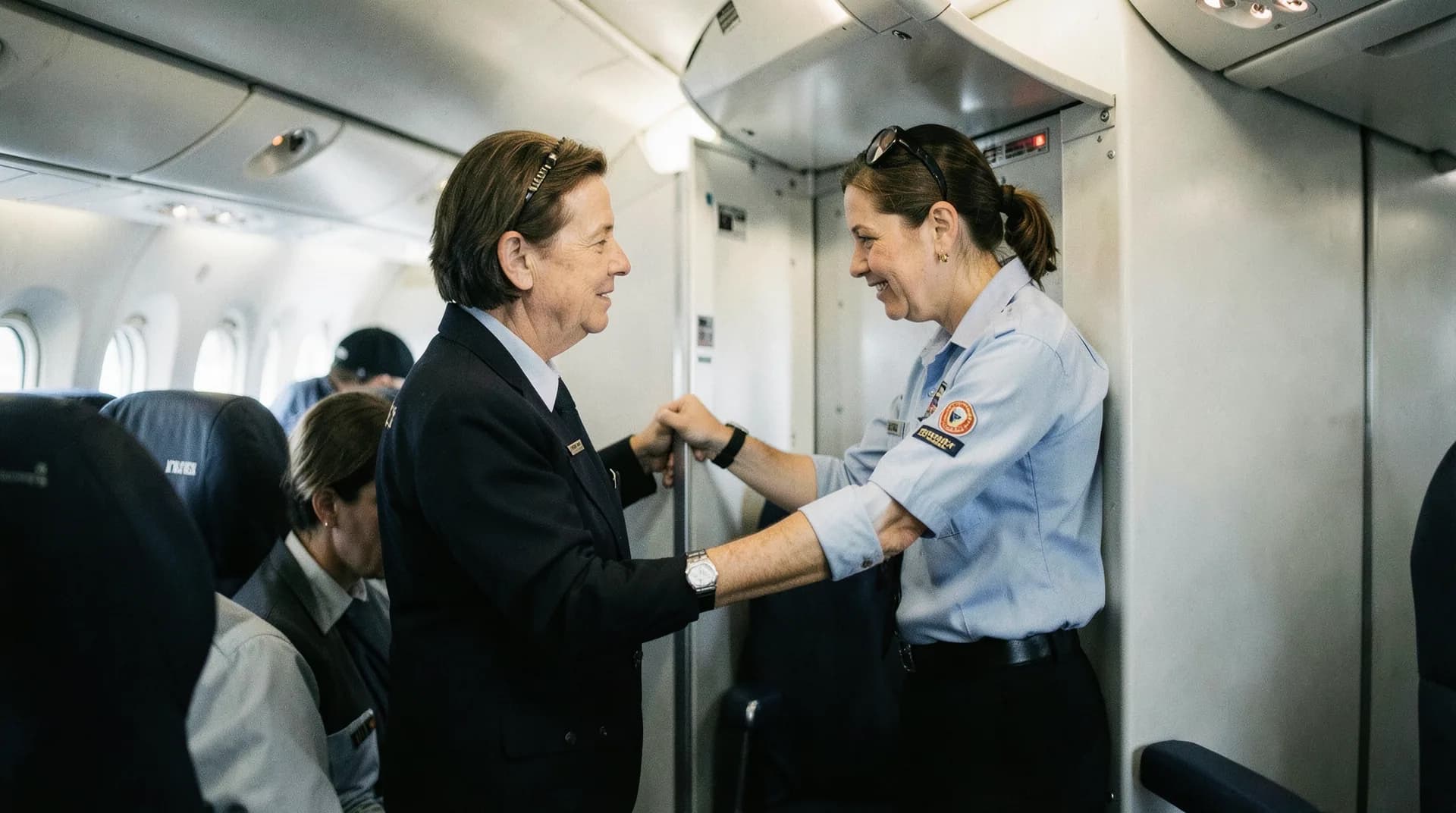
Flight attendants manage cabin safety, deliver in-flight service, and handle emergencies aboard commercial aircraft. The role is far more safety-focused than the service image suggests. Before each flight, crew check emergency equipment, run pre-departure safety demonstrations, and confirm the cabin is secure. In the air, they manage passenger welfare, respond to medical events, and follow strict emergency procedures if needed.
Australia's major employers are Qantas, Jetstar, Virgin Australia, and Rex, along with regional and charter operators. Qantas and Virgin run both domestic and long-haul international fleets, which means crew can work anything from short east-coast hops to ultra-long-haul services to London or Los Angeles. Regional carriers and fly-in-fly-out charter operators serving mining sites create demand outside the capital-city hubs, which matters for the regional visa pathways.
Hiring in this field is unusual. Airlines recruit and train cabin crew directly, often running their own cabin-crew training programs, and most positions are filled domestically. Offshore skilled migration into this occupation is real but narrower than the salary tables alone suggest, because the supply of locally trained crew is strong.
ANZSCO Code 451711 Explained
ANZSCO 451711 covers a Flight Attendant who looks after the safety and comfort of passengers and provides cabin services on aircraft. It sits in unit group 4517, Flight Attendants.
Core tasks summarised from the ANZSCO description include conducting pre-flight safety checks, demonstrating the use of safety equipment, managing emergency procedures and making announcements, checking boarding passes and directing passengers to seats, serving meals and refreshments, selling duty-free goods, and completing post-flight reports. The occupation does not have a separate "nec" fallback within this unit group; if your role is in airline operations management rather than cabin service, a different code applies. Confirm your fit through the ANZSCO code finder.
Skills Assessment with VETASSESS
VETASSESS assesses Flight Attendant. It is a Group D occupation benchmarked at AQF Certificate III or higher.
Requirements. A positive outcome needs a matching qualification and employment combination:
- Certificate IV or higher in a highly relevant field, plus at least one year of post-qualification highly relevant employment in the last five years
- Certificate IV or higher not in a highly relevant field, plus at least two years of post-qualification highly relevant employment
- Certificate III in a highly relevant field, plus at least three years of post-qualification highly relevant employment
Employment must be paid and at least 20 hours per week.
Assessment cost. AUD $1,096 for the standard offshore application. Priority processing adds AUD $825.
Processing time. Roughly 6 to 10 weeks for standard processing, with priority processing returning an outcome in about 10 business days.
Common rejection reasons. Cabin-crew training is often delivered in-house by airlines and may not map cleanly to a formal AQF-comparable qualification, which can push applicants onto a longer experience pathway. References that do not clearly establish the safety and service duties, or that describe ground-handling rather than in-flight roles, also cause problems. A formal cabin-crew certificate plus airline references that detail in-flight responsibilities give the strongest result. See how VETASSESS sits among the other assessors in the skills assessment bodies list.
Visa Pathways for Flight Attendants
Flight Attendant carries an unusual list profile: CSOL plus Regional Occupation List eligibility. That makes the regional subclasses the headline routes.
Subclass 491 — Skilled Work Regional (Provisional)
The 491 is points-tested and requires state or territory nomination or sponsorship by an eligible regional relative. Regional list status is what makes this subclass available for the occupation.
- Visa fee: from AUD $6,140 (primary applicant)
- Eligibility note: regional nomination adds 15 points; you must commit to living and working in a designated regional area
- Processing time: published Home Affairs times apply
- Quirk that matters: flight attendants based at regional airports or flying for regional and charter operators are well placed to satisfy the regional residence requirement
Subclass 494 — Skilled Employer Sponsored Regional (Provisional)
The 494 is employer-sponsored and tied to a designated regional area.
- Visa fee: from AUD $4,910 (primary applicant)
- Eligibility note: needs a regional employer nomination and a positive skills assessment
- Processing time: published Home Affairs times apply
- Quirk that matters: suits crew recruited by regional or FIFO charter operators rather than the major capital-city-based airlines
Subclass 482 — Skills in Demand Visa
The 482 covers non-regional employer sponsorship.
- Visa fee: from AUD $3,210 (Core Skills stream, primary applicant)
- Eligibility note: salary must meet the Core Skills Income Threshold and the market rate
- Processing time: faster for accredited sponsors
- Quirk that matters: because airlines train and hire locally, direct offshore 482 sponsorship into cabin crew is less common than in many other CSOL occupations
Subclass 186 — Employer Nomination Scheme
The 186 provides permanent residency through an employer.
- Visa fee: from AUD $6,140 (primary applicant)
- Eligibility note: Direct Entry needs three years of relevant experience and a positive assessment; the Temporary Residence Transition stream follows time on a 482
- Processing time: published Home Affairs times apply
For the points-tested 491, you lodge an Expression of Interest. Read how that works in the SkillSelect EOI guide.
Points Test Strategy
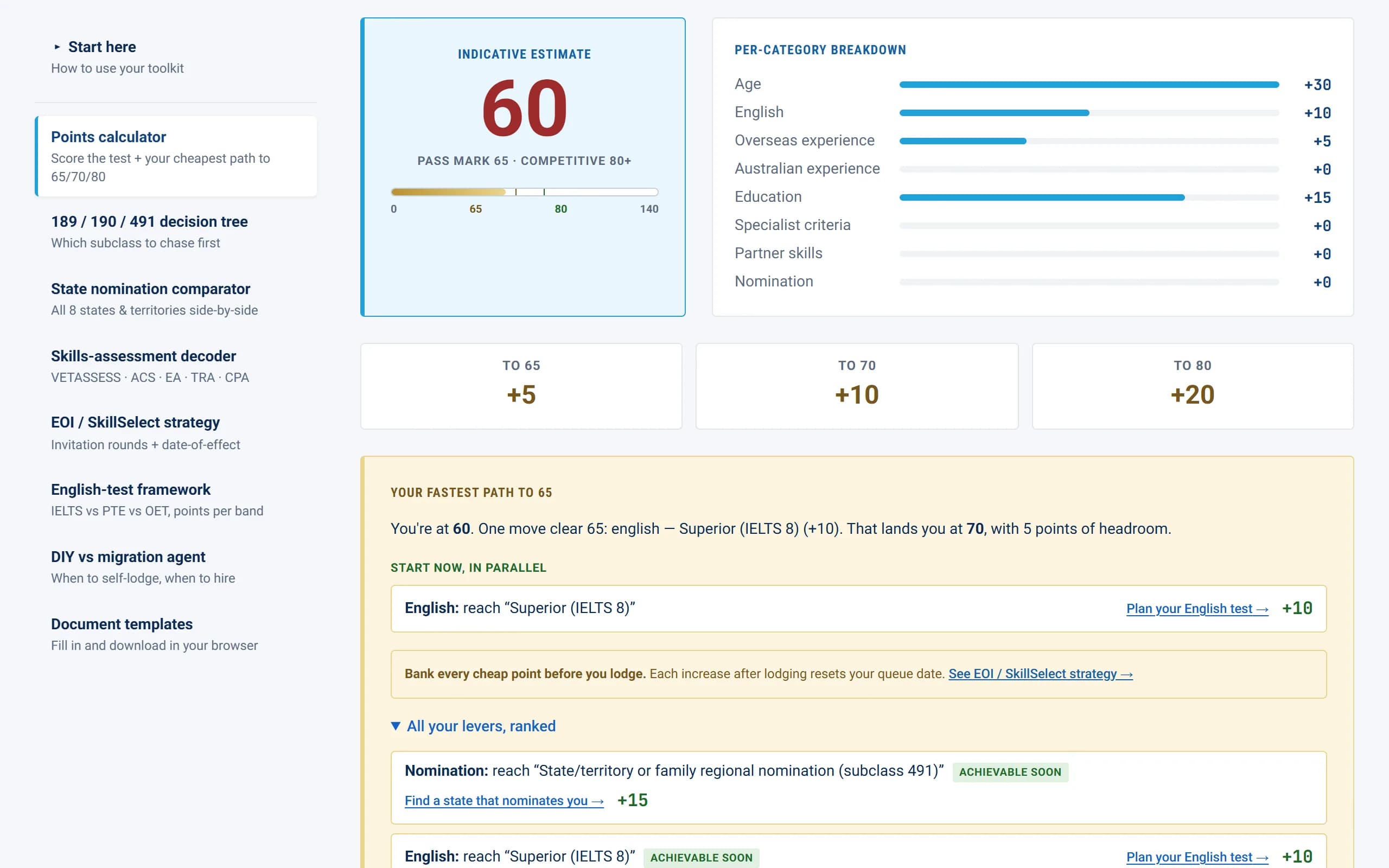
The points-tested route for this occupation is the regional 491. The standard factors apply: age, qualification, English, skilled employment, state or family nomination, and partner skills.
| Points Factor | Points |
|---|---|
| Age (25-32) | 30 |
| Age (33-39) | 25 |
| English (Proficient — 7.0) | 10 |
| English (Superior — 8.0+) | 20 |
| Diploma / trade qualification | 10 |
| Skilled employment (overseas, 3-4 yrs) | 5 |
| Regional nomination or family sponsorship (491) | 15 |
| Partner skills | 5-10 |
Realistic Scenarios
Scenario 1 — Experienced regional candidate. A 30-year-old with a Certificate IV in aviation (cabin crew), five years of experience, and Proficient English: 30 (age) + 10 (English) + 10 (qualification) + 10 (5-8 years overseas experience) = 60, plus 15 for 491 regional nomination = 75 points. That is competitive for a regional invitation in a smaller occupation.
Scenario 2 — Younger candidate, stronger English. A 27-year-old with Superior English and four years of experience: 30 (age) + 20 (English) + 10 (qualification) + 5 (experience) = 65, plus 15 for 491 = 80 points.
The 189 visa is not available because Flight Attendant is not on the relevant points-tested independent list. The 491 regional route is the points-based path that applies.
State Nomination
State and territory programs that nominate Flight Attendant for the 491 change from year to year and target areas with regional aviation activity. Eligibility is verified against each state's published nomination list at the time you apply, so confirm the current list directly with the relevant state before lodging an Expression of Interest. States with active regional airports and charter operations are the most likely to consider the occupation. Because the lists shift, treat any nomination as something to verify rather than assume.
Salary and Employment Outlook
Flight attendant pay combines a modest base salary with flying allowances and duty pay, so headline figures understate total earnings.
| Role | Typical Total Earnings |
|---|---|
| Entry-level cabin crew | AUD $50,000-$70,000 |
| Mid-career cabin crew | AUD $75,000-$85,000 |
| Senior crew / purser / cabin manager | AUD $90,000-$105,000+ |
Figures draw on SEEK, Glassdoor, and Qantas-specific data current to 2026, and include flying allowances and duty pay for the higher bands. Superannuation of 11.5% applies on top. Long-haul international rosters generally pay more than short-haul domestic work because of higher allowances and overnight payments.
The highest-earning segments are long-haul international crew, lead-attendant and purser roles, and premium-cabin service positions with the major carriers. Employment tracks fleet growth and route expansion, so demand rises and falls with airline capacity decisions. Compare earnings against other roles in the salary expectations guide.
Tips for a Successful Application
- Treat the regional pathway as your strongest card. Flight Attendant's place on the Regional Occupation List unlocks the 491 and 494, where competition is lower than in mainstream routes. Build your plan around a regional base.
- Document the safety duties, not just service. VETASSESS and Home Affairs both want to see that your role centred on cabin safety and emergency procedures. References that read as pure hospitality undersell the role.
- Convert airline training into evidence. In-house cabin-crew training is common but does not always look like a formal qualification on paper. Obtain certificates and detailed letters that describe the training hours and competencies.
- Be realistic about direct offshore sponsorship. Airlines hire and train locally, so a 482 sponsored from overseas is harder to secure here than in many occupations. The regional points route is often more achievable.
- Maximise English points. Superior English adds 20 points and can be the difference that lifts a 491 application into invitation range for a small occupation.
Step-by-Step Migration Roadmap
- Confirm your ANZSCO code with the ANZSCO code finder.
- Check list status on the Skilled Occupation List for 2026 and the Core Skills Occupation List.
- Collect your cabin-crew qualification and airline references.
- Lodge the VETASSESS skills assessment (AUD $1,096).
- Sit an English test, aiming for Superior if pursuing the 491.
- For the 491, submit an Expression of Interest through SkillSelect.
- Apply for state or family regional nomination for the 491, or secure a regional employer for the 494.
- Alternatively, secure a sponsoring airline or operator for a 482 or 186.
- Receive the invitation or nomination approval.
- Lodge the visa application.
- Complete health and character checks.
- Receive the visa grant and relocate to the nominated region.
Frequently Asked Questions
Can a flight attendant migrate to Australia on a skilled visa?
Yes. Flight Attendant (ANZSCO 451711) is on the Core Skills Occupation List and the Regional Occupation List, which opens the 491, 494, 482, and 186 visas. The regional subclasses tend to be the most accessible because the occupation is smaller and competition is lower.
Is the 189 visa available for flight attendants?
No. Flight Attendant is not on the points-tested independent list that feeds the subclass 189. The points-tested route for this occupation is the regional 491, which requires state or family nomination and adds 15 points.
Do Australian airlines sponsor cabin crew from overseas?
It happens, but less often than the demand figures imply. Airlines such as Qantas, Virgin Australia, and Jetstar train and recruit cabin crew domestically through their own programs, so direct offshore 482 sponsorship is limited. Regional and charter operators are a more realistic sponsor pool.
How much do flight attendants earn in Australia?
Total earnings range from about AUD $50,000 for entry-level crew to $105,000 or more for senior crew and pursers, once flying allowances and duty pay are included. Long-haul international rosters generally pay more than short-haul domestic work.
What qualification does VETASSESS require for a flight attendant?
VETASSESS benchmarks the occupation at AQF Certificate III or higher. The exact employment requirement depends on the qualification level and relevance, ranging from one to three years of post-qualification work in the role.