Flower Grower Visa Pathway to Australia: Complete 2026 Guide
Updated: 16 August 2026
Australia classifies Flower Grower under ANZSCO 121611, a Skill Level 1 occupation. VETASSESS conducts the skills assessment. The occupation appears on the Core Skills Occupation List (CSOL) but unlocks only the employer-sponsored subclasses 482 and 186, not the points-tested 189, 190 or 491. Typical 2026 salaries run AUD $70,000-$110,000 depending on whether the role is owner-operator or salaried management.
Quick Facts: Flower Grower Migration Pathway
| Detail | Information |
|---|---|
| ANZSCO Code | 121611 (Flower Grower) |
| Skill Level | 1 (bachelor degree or higher, or five years of relevant experience) |
| Skills Assessment | VETASSESS (Vocational Education and Training Assessment Services) |
| Occupation List | CSOL only — not on MLTSSL, STSOL or ROL |
| Visa Options | 482, 186 |
| Demand Level | Niche — small sector, demand tied to commercial cut-flower and nursery operations |
| Salary Range | AUD $70,000-$110,000 (SEEK horticulture data, 2026) |
| Typical Pathway | Employer sponsorship — no points-tested route applies |
| Key Challenge | No 189/190/491 access; the only routes are employer-sponsored |
What a Flower Grower Does in Australia
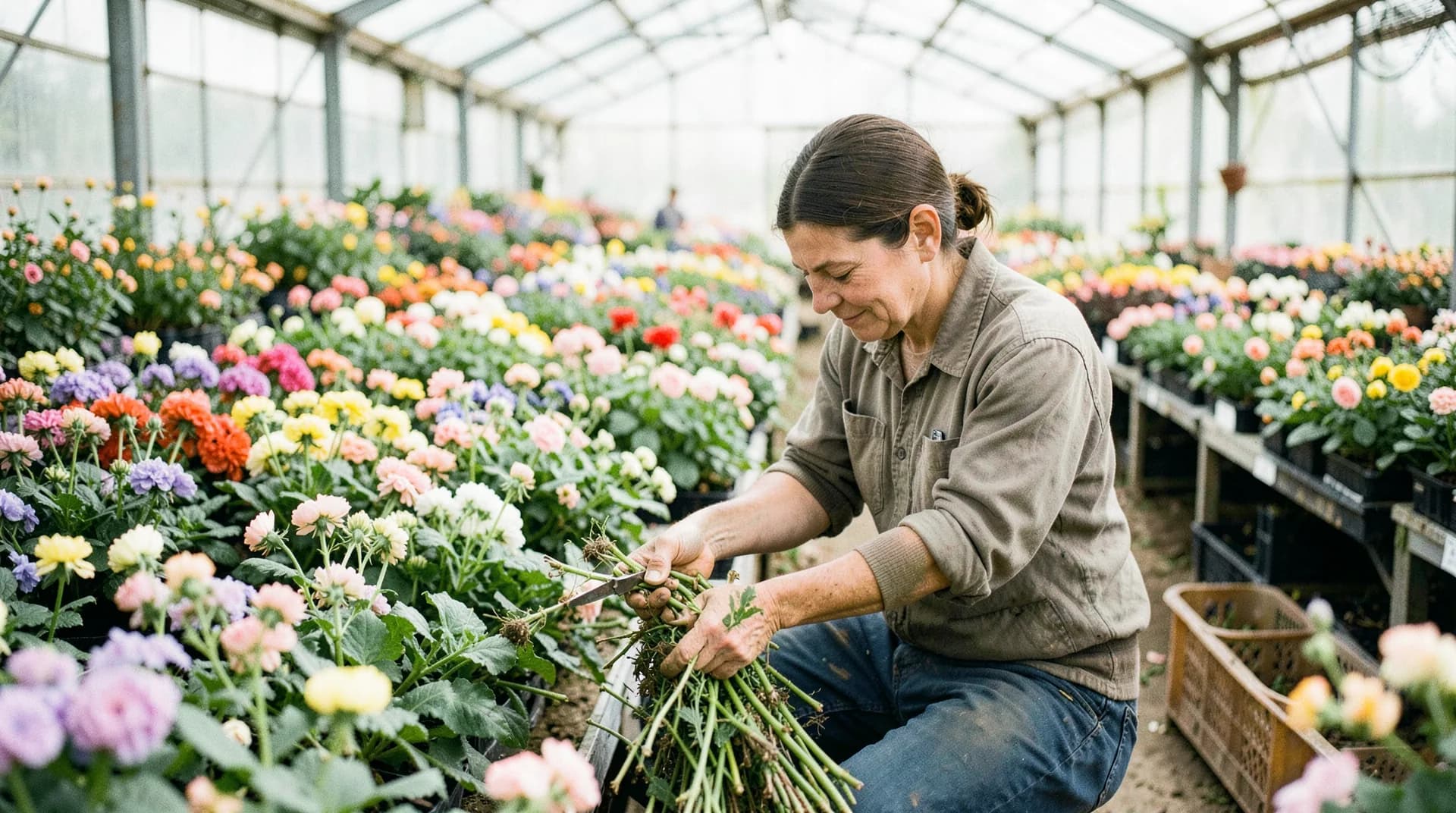
A Flower Grower plans, organises, controls and performs the planting, cultivating and harvesting of flowering and foliage plants grown for sale. The work spans field crops, glasshouse and greenhouse production, and propagation. Daily tasks include managing soil and growing media, scheduling irrigation and feeding, controlling pests and disease, timing harvests to market windows, and overseeing grading, bunching and cool-chain handling so blooms reach wholesalers and florists in good condition.
Australia's commercial flower industry is small but established. Production clusters around the major capitals to stay close to wholesale flower markets, with notable activity in Victoria, New South Wales and Queensland, and specialist growing in cooler areas and the Adelaide Hills. The sector competes with imported flowers, which keeps margins tight and rewards growers who can produce reliable quality and hit seasonal demand peaks around Mother's Day, Valentine's Day and the events calendar. Most operations are family-run or mid-size, so the role mixes horticultural expertise with hands-on business management.
ANZSCO Code 121611 in Detail
The code 121611 sits inside ANZSCO unit group 1216, Horticultural Crop Growers. The official description covers planning, organising, controlling, coordinating and performing planting, cultivating and harvesting activities to grow flowering and foliage plants. The recognised specialisation is Market Gardener (Flower). Core tasks include preparing and treating soil and growing media, sowing and propagating, applying fertiliser and pest control, monitoring crop condition, and organising harvesting, grading and storage.
Related horticulture codes exist in the same group, including Vegetable Grower (121221) and Fruit or Nut Grower. Choose the code that matches what you actually grow and manage. VETASSESS assesses against the duties in your references, so an applicant whose work is mainly nursery propagation rather than cut-flower production should confirm which code best reflects the bulk of their employment before lodging.
Skills Assessment
VETASSESS (Group B)
VETASSESS assesses Flower Grower as a Group B occupation, examining both qualification and employment for relevance.
Requirements:
- A qualification assessed at AQF Bachelor degree level or higher in a highly relevant field, plus at least one year of post-qualification highly relevant employment in the last five years, OR
- A Bachelor degree in any field plus an additional qualification at least at AQF Diploma level in a highly relevant field, plus at least two years of relevant employment, OR
- An assessment under the alternative pathways VETASSESS publishes where formal qualifications are limited but relevant experience is extensive.
Assessment cost: AUD $1,096 for applicants outside Australia (AUD $1,205.60 including GST for online applications within Australia), current after the 22 October 2025 fee increase.
Processing time: Around 7 weeks standard. Priority processing returns an outcome in about 10 business days for an extra AUD $825 (AUD $907.50 including GST).
Common rejection reasons: Employment that reads as general farm or nursery labouring rather than the planning and crop-management duties the code requires; and qualifications in an unrelated discipline with no relevant employment to bridge the gap. From 1 January 2026, Pathway 1 applicants must also lodge a Language, Literacy, Numeracy and Digital Skills assessment with their documents.
Visa Pathways for Flower Growers
This is the part that surprises most applicants. Flower Grower (121611) is on the CSOL only. It is not on the MLTSSL, the STSOL or the Regional Occupation List, which closes off the points-tested subclasses 189, 190 and 491. The only routes are employer-sponsored.
Subclass 482 — Skills in Demand (Temporary)
The primary pathway. An Australian grower or nursery operation sponsors you into the role.
- Visa fee: AUD $1,895 (Core stream) or AUD $3,035 (Specialist stream)
- Eligibility: A sponsoring employer, a positive VETASSESS assessment, and a salary meeting the relevant income threshold
- Duration: Up to four years, depending on stream
- Quirk: Flower growing salaries often sit near the Core stream floor, so confirm the offered package clears the current threshold before the nomination is lodged.
Subclass 186 — Employer Nomination Scheme (Permanent)
Permanent residency through an employer, usually after time on a 482.
- Visa fee: AUD $6,140 (primary applicant)
- Streams: Direct Entry for applicants who already meet the experience and skills test, or the Temporary Residence Transition stream after qualifying 482 service
- Quirk: Because there is no points route, the 186 is the main permanent-residency destination for this occupation, so building a strong relationship with a sponsoring employer matters more here than for occupations with independent options.
Note: there is no Points Test section for this occupation. With no 189, 190 or 491 access, the points test does not determine eligibility. Effort is better spent securing a sponsor and meeting the salary threshold.
State Nomination
State and territory nomination operates through the 190 and 491 visas, neither of which is open to Flower Grower because the occupation is not on the lists those visas draw from. As a result, state nomination is not a pathway for this code in 2026. Applicants should focus entirely on employer sponsorship through the 482 and 186. If your duties also genuinely fit a broader horticulture code that does appear on a state list, that is worth checking, but it must reflect your real work.
Salary and Employment Outlook
| Role | Typical Salary Range |
|---|---|
| Horticultural Worker | AUD $60,000-$75,000 |
| Flower Grower / Horticulturist | AUD $70,000-$85,000 |
| Senior Grower / Production Lead | AUD $85,000-$100,000 |
| Nursery or Farm Manager (horticulture) | AUD $90,000-$110,000 |
SEEK data puts horticulturist roles around AUD $70,000-$80,000 and broader farm management around AUD $90,000-$110,000, with flower-growing roles sitting between the two depending on responsibility. Owner-operators' income varies widely with crop, scale and season. Packages usually add superannuation at 11.5%, and seasonal peaks around major flower-buying events can lift earnings for growers paid on output.
The better-paid roles tend to involve managing a sizeable glasshouse or field operation, running a propagation nursery, or holding production responsibility across multiple sites. Specialist growers who can supply premium or out-of-season blooms reliably hold an advantage against imported product.
Tips for a Successful Application
- Line up a sponsor before anything else. With no points route, the 482 employer offer is the whole pathway. Without it, a positive skills assessment alone does not lead to a visa.
- Confirm the salary clears the 482 threshold in writing. Flower-growing pay can land near the Core stream floor. Check the current income figure against the offered package before the nomination goes in.
- Write references around crop management, not labouring. VETASSESS wants planting schedules, pest control, irrigation and harvest planning. A description that reads like general nursery help is the leading cause of refusal.
- Match the code to what you grow. If most of your work is vegetables or nursery stock rather than cut flowers, a different horticulture code may fit better. Get this right before lodging.
- Prepare your LLND assessment early. From January 2026 it must accompany your VETASSESS documents, so order it at the start rather than after lodgement.
Step-by-Step Migration Roadmap
- Confirm your ANZSCO code using the ANZSCO code finder and check 121611 fits your duties.
- Confirm CSOL status on the Core Skills Occupation List and review the wider Skilled Occupation List for 2026.
- Find a sponsoring employer, since the pathway is employer-sponsored only.
- Gather employment references describing crop-management duties.
- Sit an English test to meet the visa English requirement.
- Lodge your VETASSESS skills assessment with the LLND assessment included.
- Have your employer lodge the 482 nomination and confirm the salary threshold is met.
- Apply for the 482 visa and begin work.
- Transition to the 186 through Direct Entry or Temporary Residence Transition for permanent residency.
- Complete health and character checks at each visa stage.
- Receive the grant and relocate.
Frequently Asked Questions
Why can't a Flower Grower use the points-tested 189, 190 or 491 visas?
Flower Grower (121611) appears only on the Core Skills Occupation List. It is not on the MLTSSL, STSOL or Regional Occupation List, and those are the lists the 189, 190 and 491 visas draw from. The occupation's eligible subclasses are the employer-sponsored 482 and 186, so the route runs through a sponsoring employer rather than a points score.
Do I need a horticulture degree to qualify?
Not strictly. VETASSESS accepts a relevant Bachelor degree plus a year of relevant employment, or a degree in any field combined with a relevant diploma and two years of employment. Where qualifications are limited, alternative pathways can recognise an extended period of relevant work. The duties in your references carry most of the weight.
Is the flower-growing sector large enough to find sponsorship?
The sector is small and competes with imported flowers, so sponsoring employers are fewer than in larger agricultural occupations. Commercial cut-flower growers, glasshouse operations and propagation nurseries are the realistic sponsors. Building a direct relationship with a grower is usually more productive than waiting for advertised roles.
How long does the pathway take?
Allow time to secure a sponsor first, then around seven weeks for a standard VETASSESS assessment, followed by employer nomination and visa processing. Because the 482 leads into the 186 over time, the full journey to permanent residency through Temporary Residence Transition typically spans a few years rather than months.
What can a Flower Grower expect to earn in Australia?
SEEK horticulture data places grower and horticulturist roles around AUD $70,000-$85,000, rising to AUD $90,000-$110,000 for production or farm management. Superannuation at 11.5% is added, and growers paid on output can earn more during the major flower-buying peaks.