Hydrogeologist Visa Pathway to Australia: Complete 2026 Guide
Updated: 16 August 2026
Australia classifies Hydrogeologists under ANZSCO 234413. VETASSESS conducts the skills assessment. The occupation appears on both the MLTSSL and the Core Skills Occupation List (CSOL), unlocking subclasses 189, 190, 491, 482, and 186. Typical 2026 salaries range AUD $90,000-$160,000. The workforce is small (~560 nationally) and demand is structural.
Quick Facts: Hydrogeologist Migration Pathway
| Detail | Information |
|---|---|
| ANZSCO Code | 234413 (Hydrogeologist) |
| Skill Level | 1 (Bachelor degree or higher in a highly relevant geoscience or hydrology field) |
| Skills Assessment | VETASSESS (Vocational Education and Training Assessment Services) |
| Occupation List | MLTSSL and CSOL |
| Visa Options | 189, 190, 491, 482, 186 |
| Demand Level | High — Jobs and Skills Australia classifies geoscience roles as a national shortage; mining-related groundwater work and drought-resilience programmes both pull on the same small workforce |
| Salary Range | AUD $90,000-$160,000 (SEEK 2026, PayScale 2026, JobOutlook) |
| Typical 189 Score | 80-90 points |
| Key Challenge | A small national workforce means employer sponsorship rounds clear quickly, but the EOI pool is also small — strategy depends on whether the candidate has an offer in hand |
What a Hydrogeologist Does in Australia
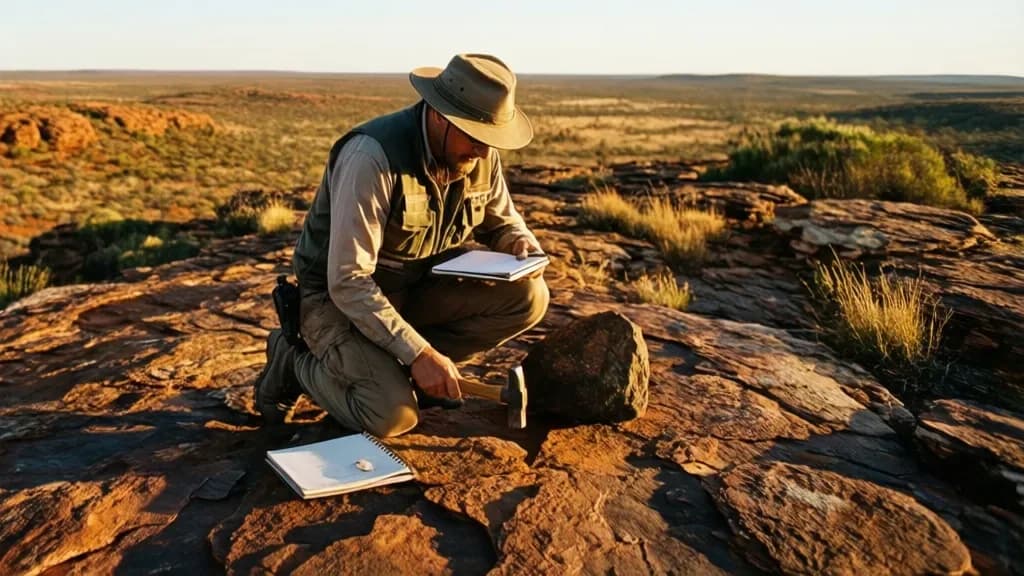
Hydrogeologists assess groundwater resources, design and supervise bore drilling and monitoring programmes, model aquifer behaviour, and advise on water supply, mine dewatering, contamination remediation, and regulatory approvals. The Australian market splits roughly into three streams: mine-water hydrogeologists embedded in resources projects, environmental consultants servicing regulatory approvals and contaminated-land work, and government hydrogeologists in state water departments and the federal Bureau of Meteorology.
JobOutlook reports approximately 560 workers in the occupation nationally, with 82% working full time and an average week of 44 hours. The workforce is small, which means individual moves create real market impact and recruitment is often through professional networks rather than open advertising.
Demand drivers in 2026 include the critical-minerals expansion (every new mine needs hydrogeological characterisation and dewatering design), the Murray-Darling Basin Plan implementation, ongoing groundwater investigations under the Great Artesian Basin Strategic Management Plan, and the federal coal seam gas regulatory regime. State agencies hire continuously to backfill an ageing workforce.
ANZSCO Code 234413
The ANZSCO description for Hydrogeologist covers monitoring, measuring, analysing, and describing the Earth's surface and groundwater resources and many aspects of the water cycle, including human use of water resources. Typical tasks include planning and supervising bore drilling, conducting pumping tests, interpreting aquifer data, developing numerical groundwater models, writing environmental impact assessments, and advising on water licensing and regulatory matters.
The adjacent codes are 234411 Geologist and 234412 Geophysicist. Differentiation matters: VETASSESS will reject a nomination of 234413 by a candidate whose duties are predominantly hard-rock geology or geophysics with only incidental groundwater work. Hydrogeologists who spend the majority of their time on aquifer characterisation, bore design, groundwater modelling, or mine-water management belong under 234413.
Skills Assessment — VETASSESS
VETASSESS is the sole assessing authority for ANZSCO 234413.
Qualification requirement. A qualification assessed as comparable to an AQF Bachelor degree or higher, in a field highly relevant to the nominated occupation. Hydrogeology, Hydrology, Water Resource Engineering, and Geology with hydrogeology majors are accepted directly. Earth Science, Environmental Science, and Civil Engineering qualifications are assessed case by case and succeed when the transcript shows sufficient groundwater, hydraulics, and hydrogeology subjects.
Employment requirement. At least one year of post-qualification employment at the appropriate skill level, in the last five years, working 20 or more hours per week, with duties highly relevant to 234413.
Cost. AUD $1,205.60 for a standard professional assessment (online application; non-residents at AUD $1,096). Priority processing adds approximately AUD $825-$907.50.
Processing time. 12-14 weeks for standard. Priority is 10 business days from confirmation.
Common rejection reasons. Environmental consultants with mixed contaminated-land, soil-and-water, and waste-management duties often fail to demonstrate that groundwater work dominates their day-to-day. Candidates with Civil Engineering or Environmental Science degrees underestimate how strictly VETASSESS reads the "highly relevant" qualification clause — adjacent disciplines need solid hydrogeology coursework on the transcript.
Visa Pathways
Subclass 482 — Skills in Demand
A common pathway because the workforce is small and senior roles are often filled by international recruitment. Major employers — Rio Tinto, BHP, Fortescue, Newmont, AECOM, Jacobs, GHD, SLR, RPS — sponsor offshore hydrogeologists.
- Visa fee: AUD $4,015 primary applicant
- Duration: up to 4 years on the Specialist stream; salary thresholds are easily met
- Processing time: typically 1-3 months for standard processing, faster under accredited sponsorship
- Quirk: the small Australian workforce makes labour market testing relatively straightforward
Subclass 186 — Employer Nomination Scheme
Permanent residency through employer sponsorship via Direct Entry (offshore, with a positive VETASSESS outcome and three years experience) or Temporary Residence Transition (after time on a 482).
- Visa fee: AUD $6,140 primary applicant
- Quirk: mining-sector employers move long-serving 482 holders to the 186 TRT stream once eligibility is met
Subclass 189 — Skilled Independent
Permanent residency through SkillSelect. Available because 234413 is on the MLTSSL.
- Visa fee: AUD $6,135 primary applicant
- Realistic points: 80-90 for invitation in 2026 rounds — lower than ICT, higher than less-competitive trades
- Processing time: 8-14 months on the published global processing-times page
Subclass 190 — Skilled Nominated
State nomination adds 5 points and grants permanent residency. WA, Queensland, SA, and NT are the most receptive states.
- Visa fee: AUD $6,140 primary applicant
- Obligation: two-year commitment to live and work in the nominating state
Subclass 491 — Skilled Work Regional (Provisional)
Adds 15 points. Most Australian hydrogeology work is regional (mine sites, irrigation districts, regional water authorities), which suits this visa.
- Visa fee: AUD $6,140 primary applicant
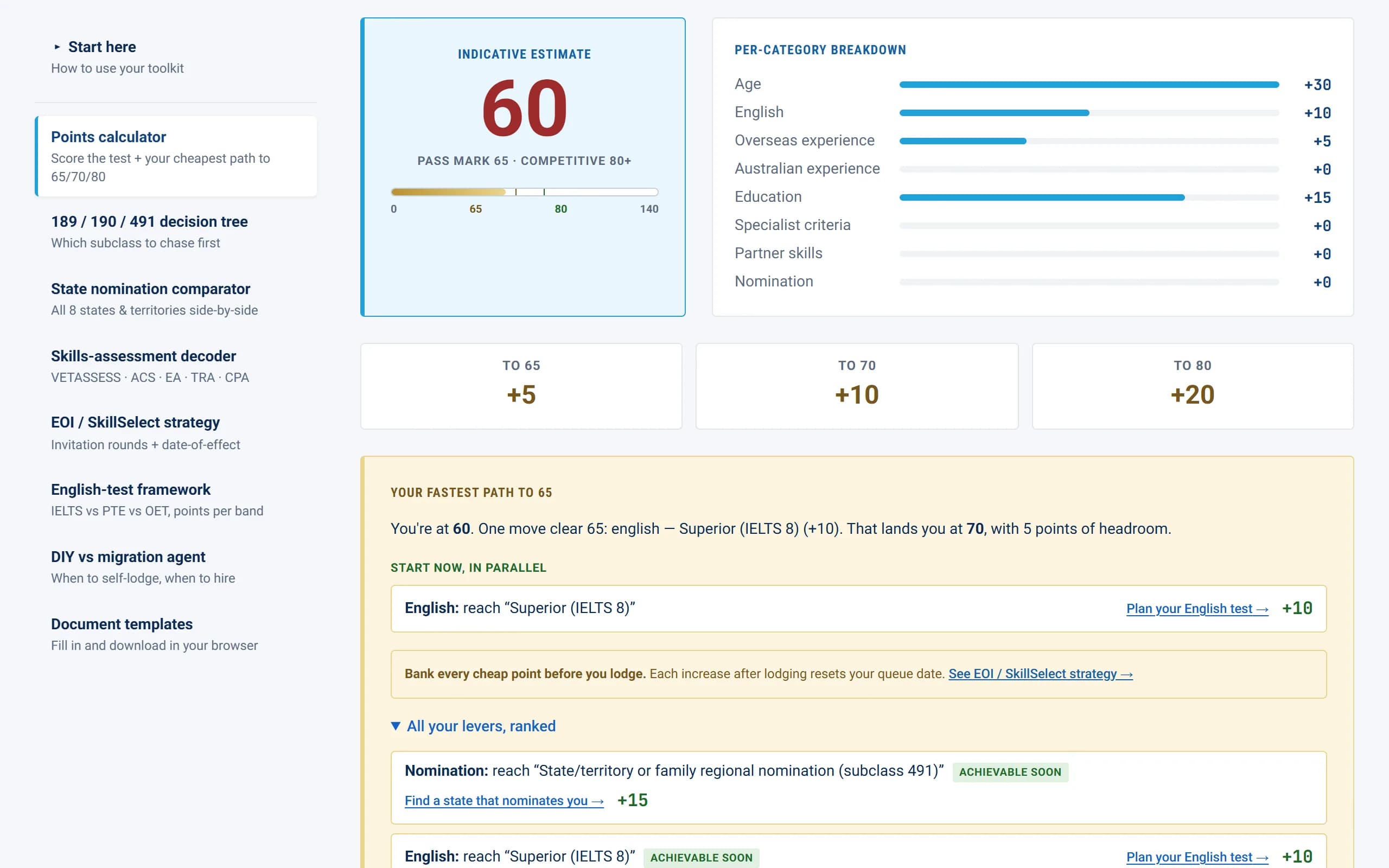
Points Test Strategy
| Points Factor | Points | Notes |
|---|---|---|
| Age (25-32) | 30 | Maximum |
| Age (33-39) | 25 | Common for mid-career |
| English (Superior 8.0+) | 20 | Worth pursuing |
| English (Proficient 7.0) | 10 | Typical for non-native speakers |
| PhD | 20 | More common than in many occupations |
| Master's | 15 | Standard qualification |
| Bachelor | 15 | Minimum |
| Overseas experience (8+ yrs) | 15 | Senior candidates often qualify |
| Australian work experience | 5-20 | Significant boost when present |
| State Nomination (190) | 5 | |
| Regional (491) | 15 | Strong leverage |
| Partner skills | 5-10 | If partner has a skilled occupation |
Scenario 1: 30-year-old mine-water hydrogeologist from Chile
Master's in Hydrogeology, 5 years at Antofagasta and BHP Chile, Proficient English. Age 30 + Master's 15 + English 10 + Experience 10 = 65 points. Add 491 WA = 80 points. Competitive for WA regional rounds. With Superior English, the score moves to 90.
Scenario 2: 36-year-old environmental hydrogeologist from the UK
PhD in Hydrogeology, 11 years at Mott MacDonald and Arup, Superior English. Age 25 + PhD 20 + English 20 + Experience 15 = 80 points. Add 190 NSW or 491 = 85-95. Invitation-grade.
State Nomination for Hydrogeologists
Western Australia
WA is the largest single employer market for hydrogeologists in Australia, primarily through the mining sector. Migration WA lists 234413 in its priority occupation pool with consistent invitations across both 190 and 491. Iron ore dewatering, gold-mine pit hydrogeology, and the lithium boom around Greenbushes, Kathleen Valley, and Mt Holland are all active hiring zones.
Queensland
Queensland nominates Hydrogeologists for 190 and 491, with strong demand around the coal seam gas regulatory regime in the Surat and Bowen basins, the Mt Isa base-metals province, and Great Artesian Basin investigations. The state typically prioritises applicants with confirmed Queensland employment.
South Australia
SA hires hydrogeologists for the Olympic Dam province, the wider far-north uranium and copper projects, and Murray-Darling Basin water-resource work. The state's nomination program includes 234413 across both metropolitan and regional streams.
Northern Territory
NT nominates Hydrogeologists with focus on the McArthur River zinc-lead district, the Tennant Creek base-metals belt, and the federal Government's water-resource investigations across the Northern Australia Strategy. NT runs both 190 and 491 streams with relatively low competition.
NSW and Victoria list 234413 but invite less frequently than the resources states. Tasmania occasionally nominates for environmental-consultancy roles.
Salary and Employment Outlook
| Role | Typical Salary Range (AUD, 2026) |
|---|---|
| Graduate Hydrogeologist | $80,000-$100,000 |
| Hydrogeologist (3-7 yrs) | $100,000-$130,000 |
| Senior Hydrogeologist | $130,000-$165,000 |
| Principal Hydrogeologist | $160,000-$210,000+ |
| Contract Day Rate (FIFO) | $1,000-$1,600/day |
| Government / Academic | $90,000-$140,000 |
Sources: SEEK 2026, PayScale 2026, JobOutlook, Talent.com 2026. JobOutlook reports average weekly pay of approximately AUD $2,192, which annualises near AUD $114,000 across all experience levels. PayScale shows mid-career hydrogeologists at around AUD $100,000 average total compensation. Senior consulting and mining roles, particularly FIFO arrangements in WA, sit well above the median.
Total packages add 11.5% superannuation, FIFO allowances, project-completion bonuses, and continuing-education support. Mining hydrogeologists typically out-earn environmental-consulting hydrogeologists by 15-25% at equivalent experience.
Highest-paying sub-sectors:
- Mining hydrogeology (iron ore, gold, lithium)
- Coal seam gas regulatory work in Queensland
- Senior environmental consulting (AECOM, Jacobs, GHD, SLR)
- Federal and state water agencies (with permanent residency)
- Specialist groundwater modelling (numerical modelling boutiques)
Tips for a Successful Application
- Lead employment references with aquifer-specific duties. "Designed and supervised pumping tests across six bores", "developed a MODFLOW model of the project water-supply aquifer", "drafted the groundwater chapter of the project EIS" — these phrases land cleanly with VETASSESS. Generic "site investigation" wording does not.
- If your degree is Environmental Science or Civil Engineering, attach a course-mapping document. Show explicitly which subjects covered groundwater, well hydraulics, contaminant transport, and hydrogeology. VETASSESS reads the transcript; do not assume the assessor will infer relevance.
- Consider 482 first if you have a job offer. The 482 typically completes in 1-3 months, while the 189 sits in the 8-14 month band. Most senior offshore hydrogeologists enter Australia on a 482 and transition to a 186 after two years.
- WA and Queensland are the strongest state-nomination markets. If the goal is permanent residency without an employer offer, target these states' 491 streams and apply during open rounds.
- Keep a portfolio of redacted technical reports. Pumping-test reports, conceptual hydrogeological models, EIS chapters, and aquifer characterisation reports — VETASSESS occasionally requests samples, and a clean portfolio shortens any clarification round.
Step-by-Step Migration Roadmap
- Confirm duties match the ANZSCO 234413 description over 234411 or 234412 — see the ANZSCO code finder.
- Verify 234413 on the Skilled Occupation List 2026 and the CSOL.
- Gather degree certificates and detailed transcripts; prepare course-mapping if needed.
- Draft employment references that emphasise groundwater-specific duties for the last five years.
- Sit IELTS, PTE, TOEFL, or OET. Aim for Superior to maximise points.
- Lodge the VETASSESS Full Skills Assessment (standard or priority).
- Submit a SkillSelect EOI for 189/190/491.
- Apply for state nomination if pursuing 190 or 491 — WA and Queensland are the strongest options.
- If pursuing 482/186, secure an offer from an approved sponsor — mining majors and environmental consultancies are the most active sponsors.
- Receive invitation and lodge the visa within 60 days.
- Complete health and character checks.
- Receive grant and relocate. Check the Skills Assessment Bodies Complete List and consider membership of the International Association of Hydrogeologists (Australian Chapter).
Frequently Asked Questions
What's the difference between a Hydrogeologist and a Hydrologist for migration purposes?
ANZSCO 234413 covers groundwater specifically — aquifer characterisation, bore design, contamination, and mine dewatering. Surface-water hydrologists working on rivers, dams, and flood modelling typically map to 234413 if their duties include groundwater, or to 233211 Civil Engineer or related codes if their work is purely surface water. VETASSESS reads duties carefully — title alone is not enough.
Is the 482 sponsorship pathway easier than the 189 for hydrogeologists?
Often, yes. The 482 typically completes in 1-3 months and avoids the points competition altogether. With the Specialist-stream salary threshold sitting well below typical senior hydrogeologist packages, sponsorship is administratively straightforward when an Australian employer wants to hire offshore. The 189 sits in the 8-14 month band on the published Home Affairs global processing-times page.
Can my five-year Russian, Indian, or Iranian specialist degree be accepted?
Yes, in most cases. VETASSESS routinely maps five-year specialist degrees in Hydrogeology, Engineering Geology, or Hydrology from Russia, Ukraine, China, India, and Iran to AQF Bachelor Honours or Master's level, depending on curriculum and final-year project. Curricula that include MODFLOW, well hydraulics, and contaminant transport carry the strongest profile.
What's the demand outlook for Hydrogeologists in 2026?
Strong and structural. The workforce is small (~560 nationally), the existing cohort is ageing, the critical-minerals expansion is creating new mining-water demand, and federal and state water programmes continue to hire. Jobs and Skills Australia classifies the geoscience family as in national shortage. See the most in-demand occupations page for context.
Do I need professional registration to work as a Hydrogeologist in Australia?
No statutory licensing is required for the occupation. Voluntary membership of the International Association of Hydrogeologists (Australian Chapter) or the Geological Society of Australia signals professional standing. State water regulators in NSW, Victoria, and Queensland have approved-hydrogeologist schemes for specific licensing work, which is relevant after arrival but does not affect the visa.