Judicial and Other Legal Professionals nec Visa Pathway to Australia: Complete 2026 Guide
Updated: 16 August 2026
Australia classifies these legal professionals under ANZSCO 271299. VETASSESS conducts the skills assessment. The occupation is on the CSOL, opening subclasses 190, 491, 482 and 186, but not the 189. Typical 2026 salaries run AUD $80,000 to $140,000. This is a "not elsewhere classified" code: it covers legal officers and judicial registrars, not solicitors or barristers, who are classified separately.
Quick Facts: Legal Professionals nec Migration Pathway
| Detail | Information |
|---|---|
| ANZSCO Code | 271299 (Judicial and Other Legal Professionals nec) |
| Skill Level | 1 (Bachelor degree or higher) |
| Skills Assessment | VETASSESS (Group A occupation) |
| Occupation List | CSOL (also listed on the STSOL) |
| Visa Options | 190, 491, 482, 186 |
| Demand Level | Moderate — government, courts and policy roles |
| Salary Range | AUD $80,000-$140,000 (SEEK, Indeed 2026) |
| Typical 491 Score | Regional nomination adds 15 points |
| Key Challenge | The nec code excludes solicitors and barristers; your role must match an included title |
What These Legal Professionals Do in Australia
This is a residual code for legal professionals whose roles do not fit the named legal occupations. It covers people such as legal officers, legal researchers, judicial registrars, family court registrars, family law mediators and parliamentary counsel. They interpret and analyse the law, administer legal processes, advise on legal matters and draft legislation. The work sits inside courts, government departments, parliaments, regulators and policy bodies rather than in private legal practice.
Demand is moderate and concentrated in the public sector. Government legal and policy roles open across federal, state and territory agencies, and courts maintain ongoing registrar and administrative-legal positions. These roles are specialised, so volumes are lower than for mainstream professions. Applicants with public-law, policy or court-administration backgrounds find the strongest fit. The role sits alongside other professional occupations on the most in-demand occupations list, though it is a niche rather than a high-volume category.
ANZSCO Code: 271299 Judicial and Other Legal Professionals nec
The code 271299 is the "not elsewhere classified" code within the legal professionals group. It catches legal roles that fall outside the named codes. ANZSCO sets the skill level at 1, a bachelor degree or higher.
The boundary matters here. Solicitor (271311), Barrister (271111), Judge and Magistrate (271211 and similar) are classified under their own codes, and Conveyancer and Legal Executive sit elsewhere again. If you are a practising solicitor, the solicitor pathway is the correct one. The 271299 code is for roles such as legal officer, legal researcher, judicial registrar, family law mediator and parliamentary counsel. Because it is an nec code, VETASSESS assesses each application on a case-by-case basis against the included titles. Read the ANZSCO code finder before nominating, because choosing nec when a named code fits can derail the assessment.
Skills Assessment: VETASSESS
VETASSESS assesses Judicial and Other Legal Professionals nec as a Group A professional occupation. Group A means both your qualification and your employment must assess positively.
Requirements
- A qualification assessed as comparable to an Australian bachelor degree or higher in a highly relevant field, namely Law or Legal Studies
- At least one year of post-qualification employment in the last five years, at least 20 hours a week, highly relevant to the nominated occupation
- For an nec code, evidence that your role matches one of the included job titles rather than a separately classified legal occupation
Assessment cost: VETASSESS publishes professional assessment fees on its fees page; confirm the current figure before lodging.
Processing time: VETASSESS publishes current processing times for professional occupations; Group A assessments typically run a number of weeks.
Common rejection reasons: The main risk is nec mismatch. If your role is actually that of a solicitor or barrister, VETASSESS will point you to the named code rather than assess you under 271299. Roles that sit outside legal practice entirely, such as general administration, also fail the relevance test.
VETASSESS appears on the official assessor list in the skills assessment bodies directory.
Visa Pathways for Legal Professionals nec
Because 271299 is on the CSOL but not the MLTSSL, the 189 is unavailable. The pathways centre on state nomination, regional nomination and employer sponsorship.
Subclass 190 — Skilled Nominated Visa
State nomination adds 5 points and grants permanent residency. You commit to living in the nominating state for two years.
- Visa fee: AUD $6,140
- Points boost: +5
- Eligibility note: Requires a positive VETASSESS assessment and a state that lists the occupation.
Subclass 491 — Skilled Work Regional (Provisional) Visa
Regional nomination adds 15 points. A five-year provisional visa with a permanent residency pathway through the 191.
- Visa fee: AUD $6,140
- Points boost: +15
- Quirk: Regional and territory government bodies sometimes recruit legal and policy staff where capital-city competition is lighter.
Subclass 482 — Skills in Demand Visa
Employer-sponsored temporary visa. A route where a government body, court or organisation offers a qualifying legal role.
- Visa fee: AUD $3,210
- Eligibility note: The employer must meet sponsorship and salary requirements.
- Duration: Up to four years.
Subclass 186 — Employer Nomination Scheme
Permanent residency through employer sponsorship, via the Direct Entry or Temporary Residence Transition streams.
- Visa fee: AUD $6,140
Points Test Strategy
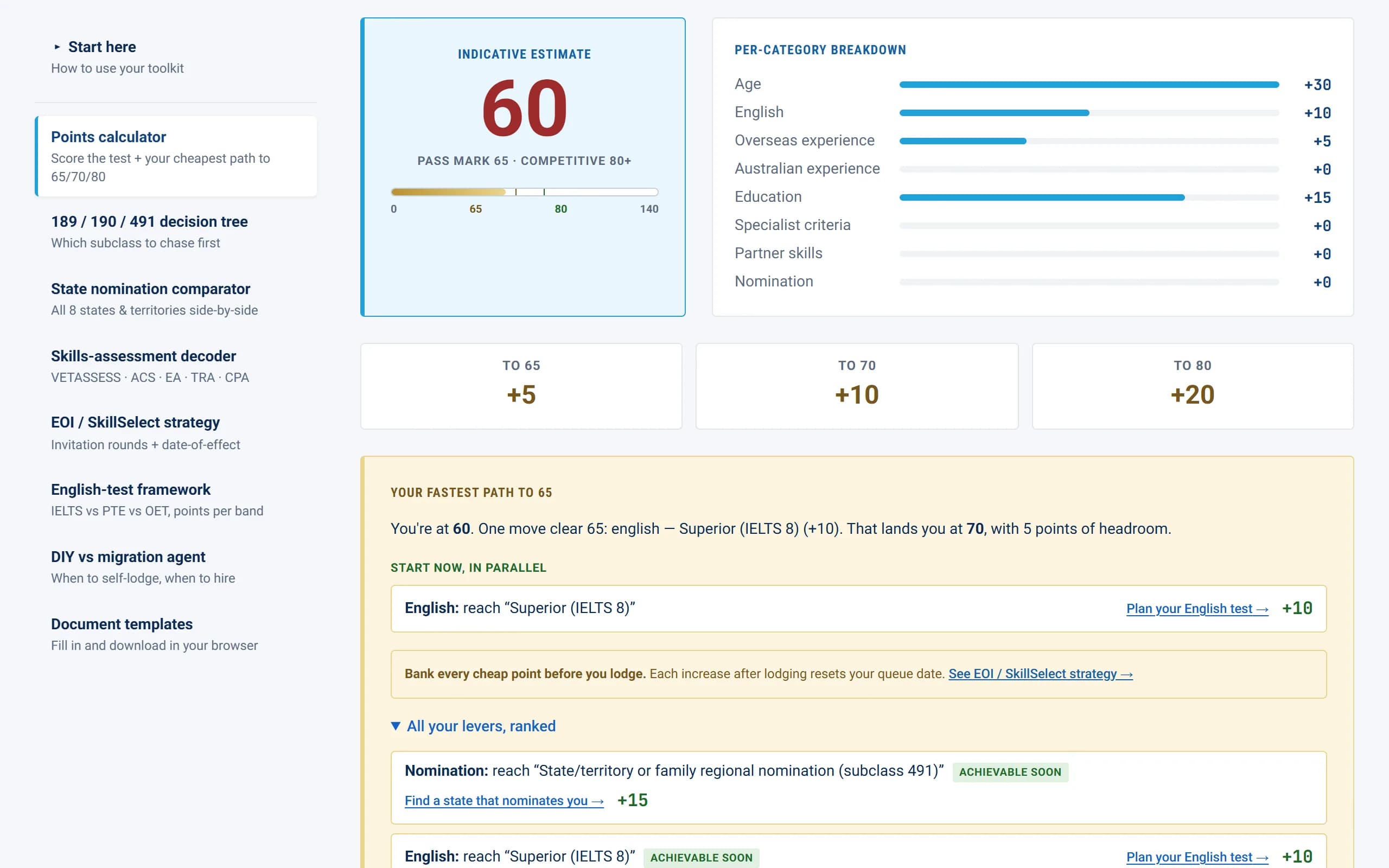
The 190 and 491 are points-tested, so the score matters even without 189 access.
| Points Factor | Points | Notes |
|---|---|---|
| Age (25-32) | 30 | Maximum bracket |
| Age (33-39) | 25 | Still strong |
| English (Superior, 8.0) | 20 | Achievable for legal professionals |
| English (Proficient, 7.0) | 10 | Minimum competitive level |
| Qualification (Master's/LLM) | 15 | Common among legal professionals |
| Qualification (Bachelor's/LLB) | 15 | Minimum for skill level 1 |
| Overseas experience (5-8 years) | 10 | Skilled employment in the occupation |
| State nomination (190) | 5 | Apply where the occupation is listed |
| Regional (491) | 15 | Strongest single boost |
| Partner skills | 5-10 | If your partner has a skilled occupation |
Realistic Scenarios
Scenario 1: LLM holder, 31, Proficient English, 5 years experience Age 30 + Master's 15 + English 10 + Experience 10 = 65 points. A 491 nomination adds 15 to reach 80, a workable regional score.
Scenario 2: LLB holder, 34, Superior English, 5 years experience Age 25 + Bachelor's 15 + English 20 + Experience 10 = 70 points. A 190 nomination lifts this to 75; a 491 lifts it to 85.
State Nomination
State lists change each program year, so confirm the current position against each state's published list and the Skilled Occupation List 2026. Legal nec occupations appear on state lists less consistently than mainstream professions, so check carefully before committing. Where a state nominates 271299, expect a requirement for recent skilled experience in a role that matches an included title, and in some cases a regional job offer. Government and policy roles tied to a specific employer can also support an employer-sponsored pathway.
Salary and Employment Outlook
| Role | Typical Salary Range |
|---|---|
| Legal researcher | AUD $75,000-$90,000 |
| Legal officer | AUD $90,000-$120,000 |
| Judicial or court registrar | AUD $100,000-$130,000 |
| Senior legal/policy officer | AUD $120,000-$140,000+ |
Indeed reports an average legal officer salary around AUD $105,000 to $114,000 for 2026, with experienced officers near AUD $140,000, while legal researchers average closer to AUD $81,000. Superannuation of 11.5% applies. Government roles offer structured classification scales and, in many agencies, salary packaging. Senior policy and registrar positions sit at the upper end of the range.
Government departments, courts, parliaments and regulators are the main employers. Public-law, policy and court-administration experience tends to command the strongest demand within this niche.
Tips for a Successful Application
- Confirm you are not actually a solicitor or barrister. Those roles have their own codes. VETASSESS will redirect you to the named code if your role fits it, so nominate 271299 only where your role matches an included title such as legal officer or judicial registrar.
- Map your duties to a listed nec title. Because this is an nec code, your employment references should clearly describe work that matches legal officer, legal researcher, judicial registrar, family law mediator or parliamentary counsel.
- Hold a Law or Legal Studies qualification. These are the highly relevant fields. A non-law qualification, even in a related discipline, usually does not clear the Group A qualification test.
- Document at least one year of recent, paid work of 20 or more hours a week. Both the qualification and the employment must pass for a Group A outcome.
- Check state lists before you start. This nec code appears less consistently on state lists than mainstream professions, so confirm a nominating state or employer before investing in the assessment.
Step-by-Step Migration Roadmap
- Confirm your ANZSCO code with the ANZSCO code finder — nec versus a named legal code.
- Check list status on the Skilled Occupation List 2026 and the CSOL.
- Confirm your role matches an included nec title.
- Gather your Law or Legal Studies qualification and transcripts.
- Document employment of one year at 20-plus hours a week.
- Sit an English test and aim for Superior where feasible.
- Lodge the VETASSESS Group A assessment.
- Submit an expression of interest in SkillSelect for the 190 or 491.
- Apply for state or regional nomination.
- Alternatively, secure a government or organisational employer for the 482 or 186.
- Receive the invitation, lodge the visa, and complete health and character checks.
- Receive the grant and relocate.
Frequently Asked Questions
Who does the 271299 code actually cover?
It covers legal professionals who do not fit the named legal codes, including legal officers, legal researchers, judicial registrars, family court registrars, family law mediators and parliamentary counsel. It does not cover solicitors, barristers, judges, magistrates, conveyancers or legal executives, all of which are classified under their own codes.
Can a practising solicitor use this nec code?
No. Solicitor has its own code, and VETASSESS will redirect a solicitor to that code rather than assess them under 271299. The nec code is for legal roles that fall outside the named occupations, so nominate it only where your role genuinely matches an included title.
Can I apply for the 189 with this occupation?
No. The occupation is on the CSOL and STSOL, not the MLTSSL, so the 189 is unavailable. The pathways are the 190, 491, 482 and 186, with the 491 carrying the largest points boost for regional applicants.
What qualification do I need?
VETASSESS assesses Law and Legal Studies as the highly relevant fields. You need a qualification comparable to an Australian bachelor degree or higher in one of these, plus at least one year of recent, relevant skilled employment for the Group A outcome.
Will my role be recognised if it is unusual?
Possibly. Because this is an nec code, VETASSESS assesses each application case by case against the included titles. The closer your duties match a listed title such as legal officer or judicial registrar, the stronger your case. Roles that fall outside legal practice altogether are unlikely to succeed.