Mechanical Engineering Draftsperson Visa Pathway to Australia: Complete 2026 Guide
Updated: 16 August 2026
Australia classifies Mechanical Engineering Draftsperson under ANZSCO 312511. Engineers Australia conducts the Migration Skills Assessment. The occupation sits on the Core Skills Occupation List (CSOL) and the Regional Occupation List (ROL), unlocking subclasses 491, 494, 482 and 186. Typical 2026 salaries range AUD $80,000-$95,000 (SEEK 2026). Regional pathways dominate because 312511 is not on the MLTSSL or STSOL.
Quick Facts: Mechanical Engineering Draftsperson Migration Pathway
| Detail | Information |
|---|---|
| ANZSCO Code | 312511 (Mechanical Engineering Draftsperson) |
| Skill Level | 2 (AQF Diploma or higher) |
| Skills Assessment | Engineers Australia (Engineering Associate pathway) |
| Occupation List | CSOL and ROL — not on MLTSSL or STSOL |
| Visa Options | 491, 494, 482, 186 |
| Demand Level | High — manufacturing, defence, resources, infrastructure pipelines |
| Salary Range | AUD $80,000-$95,000 (SEEK 2026); $100,000+ in defence and resources |
| Typical 491 Score | 65-80 with regional nomination |
| Key Challenge | Engineering Associate pathway documentation requires careful preparation |
What Mechanical Engineering Draftspersons Actually Do in Australia
Mechanical engineering draftspersons prepare detailed drawings, plans, and 3D models of mechanical components, assemblies, manufacturing equipment, and mechanical installations. They work under the direction of mechanical engineers and engineering technologists, translating concept designs into production-ready documentation. The toolset has shifted heavily from 2D drafting to 3D CAD platforms: SolidWorks, Autodesk Inventor, PTC Creo, Siemens NX, and increasingly CATIA on defence and aerospace projects.
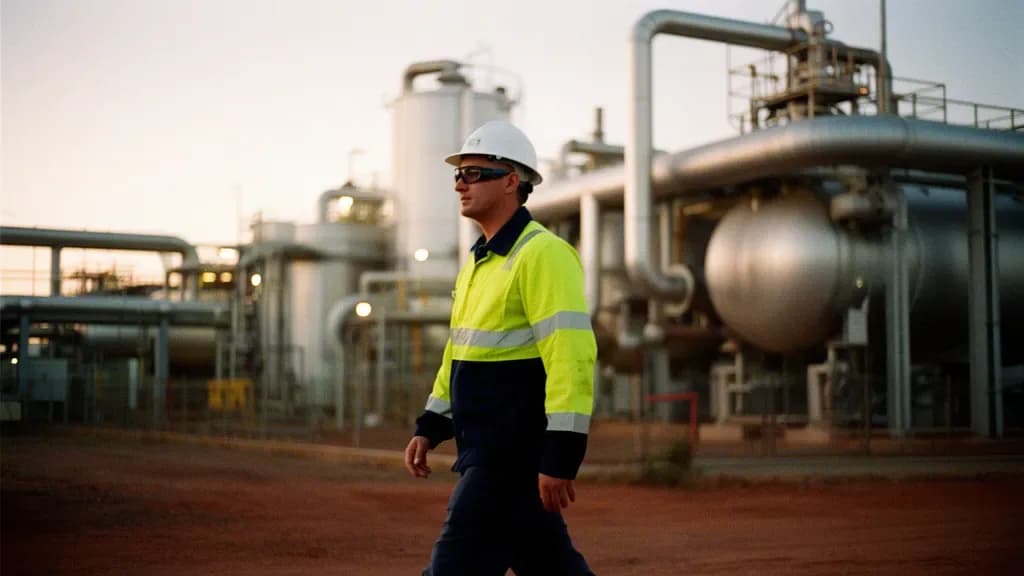
Demand in 2026 stems from four pipelines: defence manufacturing (AUKUS submarines, Hunter-class frigate, missile co-production), resources (mining equipment design, conveyor systems, process plant), infrastructure mechanical systems (HVAC, fire services, hydraulics in major projects), and renewable energy (wind turbine internals, battery thermal management, electrolyser mechanical balance-of-plant).
Sydney, Melbourne, Adelaide, and Perth host most positions. Adelaide is a defence cluster. Perth dominates resources design. Melbourne and Geelong run heavy industrial design teams. Regional demand surfaces in Newcastle (BAE's land systems work), Whyalla (steel and shipbuilding), and the Hunter Valley (mining equipment overhaul).
ANZSCO Code Mapping
ANZSCO 312511 covers technicians who prepare detailed drawings and plans of mechanical engineering work in support of mechanical engineers. The role centres on:
- Component and assembly drawings for manufacture
- 3D parametric modelling for design iteration
- Bill of materials preparation
- Drawing standard compliance (AS1100, ISO 128, ASME Y14.5)
- Drawing release control and revision management
Adjacent codes:
- 233512 Mechanical Engineer — for fully qualified bachelor-level mechanical engineers
- 312512 Mechanical Engineering Technician — for hands-on testing and prototyping (not pure drafting)
- 312611 Safety Inspector — for those whose work focus is safety compliance rather than design
- 312911 Maintenance Planner — for asset-management focused roles
If your role is primarily 3D CAD modelling and detail drawing for mechanical engineers, 312511 is the right code. If you also conduct prototyping, testing, and instrumentation, 312512 may suit better.
Skills Assessment
Engineers Australia — Engineering Associate Pathway
Engineers Australia is the assessing authority for 312511 under the Engineering Associate occupational category. The body offers multiple pathways to a positive outcome.
Pathways:
- Australian accredited qualification — recognised AQF Advanced Diploma or Associate Degree in mechanical engineering
- Sydney Accord qualification — overseas Advanced Diploma / Associate Degree from a Sydney Accord signatory body
- Competency Demonstration Report (CDR) — for applicants whose qualification is not from an accredited or accord-signatory provider
Requirements:
- Qualification at AQF Advanced Diploma / Associate Degree level (typically 2 years of post-secondary education)
- Three Career Episodes describing engineering work, plus a Summary Statement and Continuing Professional Development log for CDR applicants
- English language evidence (IELTS 6.0 in each band, or PTE/OET equivalent)
Assessment Cost: Engineers Australia publishes a fee schedule that varies by pathway. Fees increased 3-4% from 1 July 2026 to align with consumer and wage price indices. Standard Migration Skills Assessment fees range from approximately AUD $270 to AUD $1,575 depending on pathway and additional services. Confirm current rates on the Engineers Australia fees page.
Processing Time: Standard assessments typically finalise in 12-15 weeks. Engineers Australia offers Fast Track processing for an additional fee on eligible applications.
Common rejection reasons: Career Episodes that describe drafting work without engineering analysis or problem-solving content; insufficient evidence of design responsibility versus pure CAD operator work; weak Summary Statements that fail to map competencies to the Engineers Australia stage 1 competencies for Engineering Associate.
Engineers Australia changed its approach to Advanced Diploma and Associate Degree assessments from 1 September 2024. Applicants holding qualifications from Australian RTOs should review the updated requirements before lodging.
For a full list of assessing bodies, see the skills assessment hub.
Visa Pathways for Mechanical Engineering Draftspersons
ANZSCO 312511 sits on the CSOL and ROL. This means 189 and 190 are unavailable, but the regional and employer-sponsored pathways are open.
Subclass 491 — Skilled Work Regional (Provisional) Visa
The dominant points-based pathway. Five-year provisional visa with a route to PR through subclass 191.
- Visa fee: AUD $6,140 (primary applicant)
- Points boost: +15 from regional nomination
- Processing time: 15-28 months at the 90th percentile in 2026
- Occupation quirk: Regional Defence and resources hubs (Whyalla, Newcastle, Geelong, Mackay) actively nominate draftspersons for industrial design teams.
Subclass 494 — Skilled Employer Sponsored Regional (Provisional) Visa
Five-year regional employer-sponsored visa, with a 191 pathway to PR.
- Visa fee: Comparable to 491 — confirm current pricing
- Sponsor: Regional employer in a designated regional area
- Processing time: 6-15 months typical
- Occupation quirk: Mining equipment manufacturers and Defence SMEs use 494 to staff Pilbara, Goldfields, and regional South Australia operations.
Subclass 482 — Skills in Demand Visa
Employer-sponsored temporary visa, valid up to four years.
- Visa fee: AUD $3,210 (primary applicant)
- Salary thresholds: Core Skills Income Threshold AUD $76,515 (rising to AUD $79,499 from 1 July 2026); Specialist Skills stream from AUD $141,210
- Processing time: Core Skills median 51 days; Specialist Skills median 8 days
- Occupation quirk: Mid-level draftsperson salaries usually meet the Core Skills threshold. Senior designers at Defence primes can reach Specialist Skills.
Subclass 186 — Employer Nomination Scheme
Permanent residency through employer sponsorship.
- Visa fee: AUD $6,140 (primary applicant)
- Streams: Direct Entry (3 years relevant experience plus Engineers Australia assessment) or Temporary Residence Transition
- Processing time: Direct Entry median 12 months, 90% within 19 months in 2026
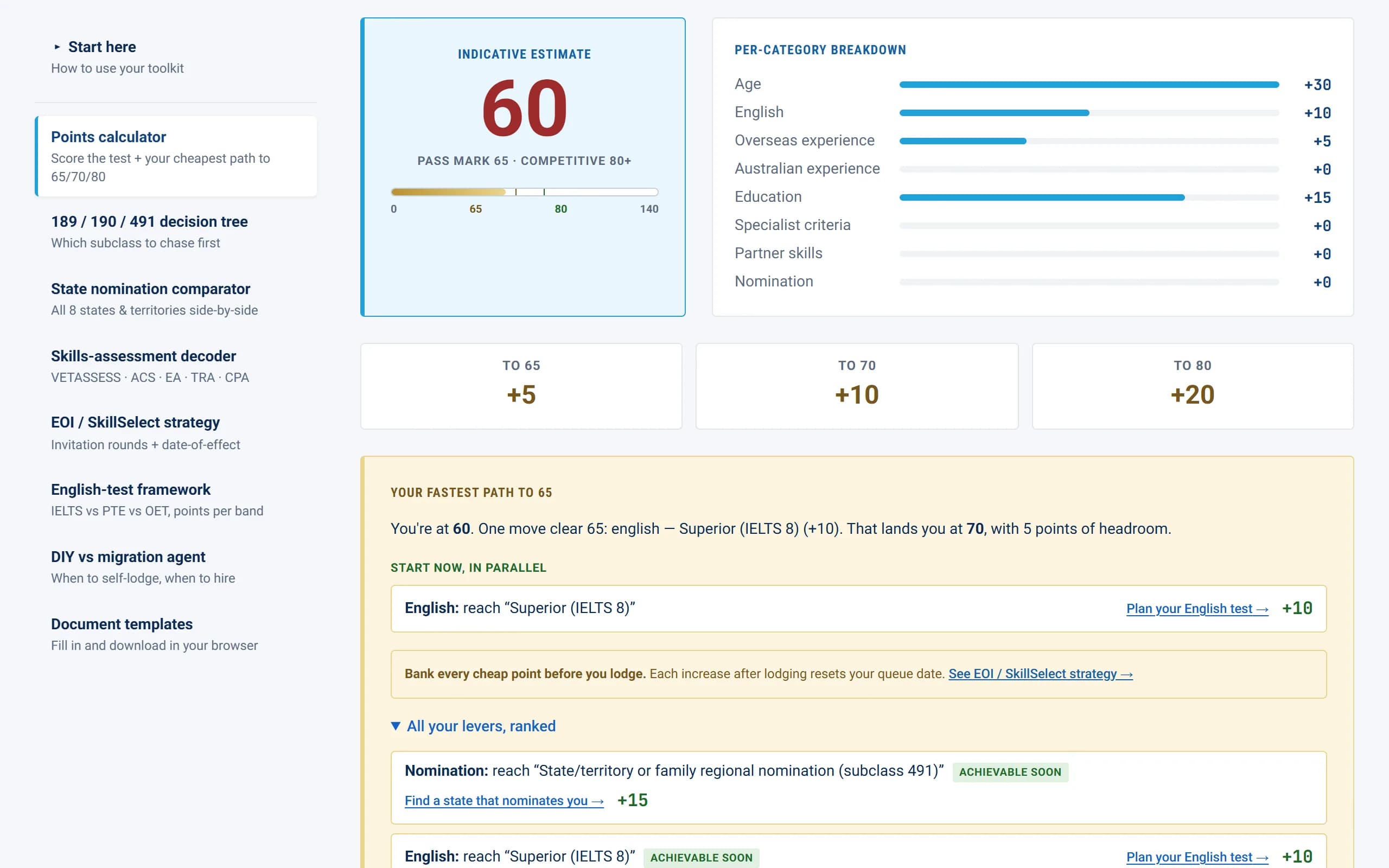
Points Test Strategy
189 invitations are not available. Points still matter for 491 because state nominations are limited and competitive.
| Points Factor | Points | Notes |
|---|---|---|
| Age (25-32) | 30 | Maximum bracket |
| Age (33-39) | 25 | Common for experienced draftspersons |
| English (Superior 8.0+) | 20 | Worth the test prep |
| English (Proficient 7.0) | 10 | Standard target |
| Qualification (Bachelor's) | 15 | Bachelor of Mechanical Engineering |
| Qualification (Diploma) | 10 | AQF Advanced Diploma equivalent |
| Overseas Experience (5-7 years) | 10 | Cap at 15 for 8+ |
| Regional (491) | 15 | Largest single boost |
| Partner Skills | 5-10 | Depends on partner status |
Realistic Scenarios
Scenario 1: 30-year-old applicant from Vietnam, Bachelor of Mechanical Engineering, 6 years CAD design experience, Proficient English
- Age 30 + Bachelor 15 + English 10 + Experience 10 = 65 points
- Add 491 (+15) = 80 points — competitive for regional nomination
Scenario 2: 36-year-old applicant from Egypt, Advanced Diploma in Mechanical Engineering, 12 years experience, Proficient English
- Age 25 + Diploma 10 + English 10 + Experience 15 = 60 points
- Add 491 (+15) = 75 points — sufficient for nomination in shortage regions
State Nomination
South Australia
Adelaide is the strongest market because of Osborne shipbuilding (Hunter-class frigate, Collins-class maintenance, AUKUS submarines) and the broader Defence cluster. Whyalla is rebuilding industrial capability with the GFG Alliance steelworks and renewable hydrogen plans. SA's 491 program regularly nominates mechanical engineering draftspersons.
Western Australia
WA nominates draftspersons for mining equipment design firms in Perth and FIFO maintenance roles in the Pilbara and Goldfields. Major employers include Monadelphous, Civmec, NRW, and resource majors with internal engineering teams. Perth's defence shipbuilding precinct at Henderson is expanding under AUKUS.
Queensland
Queensland's mining (Bowen Basin, North-West Minerals Province) and resources processing (Gladstone, Townsville) sectors drive 491 demand. The Inland Rail project also requires mechanical detailing for rail freight infrastructure.
Tasmania
Tasmania nominates draftspersons for shipbuilding (Incat in Hobart), mining equipment, and industrial fabrication. Lower competition than mainland states.
Northern Territory
The NT runs targeted 491 nominations for defence base infrastructure and mineral processing. Lower volume but accessible thresholds.
State lists refresh annually. Always verify the current state list before paying for skills assessment.
Salary and Employment Outlook
Salary Bands
| Role | Typical Salary Range |
|---|---|
| Junior CAD Draftsperson | AUD $65,000-$78,000 |
| Mechanical Draftsperson (Mid-level) | AUD $80,000-$95,000 |
| Senior Mechanical Designer | AUD $100,000-$120,000 |
| Lead / Principal Designer | AUD $120,000-$145,000 |
| Defence-cleared Mechanical Designer | AUD $110,000-$140,000+ |
| FIFO Mining Equipment Designer | AUD $130,000-$170,000 |
Source: SEEK Salary Hub 2026, supported by SalaryExpert and Glassdoor 2026. Total packages include 11.5% superannuation. Defence and resources roles often add site allowances, security premiums, and contract uplifts.
Highest-Paying Sectors
- Defence shipbuilding and land systems — BAE Systems Australia, ASC, Lockheed Martin, Hanwha Defence Australia
- Mining equipment manufacturers and miners' in-house design — Komatsu, Liebherr, Caterpillar, Rio Tinto, BHP, Fortescue
- Process plant engineering — Worley, Wood, KBR for resources and energy projects
- Industrial fabricators — Civmec, Monadelphous for large modules, pressure vessels, structural mechanical
- Renewable energy mechanical — battery system integration, electrolyser design, wind turbine mechanical balance of plant
CAD platform expertise drives premiums. CATIA experience commands +10-15% on Defence projects. SolidWorks and Inventor remain standard for industrial design. Knowledge of GD&T (Geometric Dimensioning and Tolerancing) and welding symbols per AS1101.3 is increasingly required.
Tips for a Successful Application
1. Treat Career Episodes as Engineering Stories, Not Job Descriptions
Engineers Australia rejects CDRs that read like CVs. Each Career Episode must show an engineering problem, your approach, the analysis you performed, and the outcome. Pure CAD operator work without design responsibility rarely meets the Stage 1 competencies for Engineering Associate. Pick episodes that demonstrate technical judgement.
2. Map Your Software Stack Honestly
Defence and aerospace work demands CATIA, increasingly with PLM systems like Teamcenter or 3DEXPERIENCE. Resources design uses Inventor or SolidWorks. Process plant uses AutoCAD Plant 3D and Navisworks. Tailor your application to the sector you're targeting — generic "AutoCAD experience" does not move the needle for senior roles.
3. Choose Your Pathway Based on Qualification Source
Sydney Accord signatory qualifications skip the CDR requirement and use a lighter Australian Accredited Qualifications pathway. Indian and Filipino three-year Diplomas often fail the Accord recognition test and require a CDR. Check the Engineers Australia accreditation list before deciding which pathway to lodge under.
4. Aim for Regional States with Defence or Resources Demand
Mechanical engineering draftspersons rarely succeed under metropolitan 491 nominations because state lists prioritise ICT and healthcare. Target SA (defence), WA (resources), Queensland (mining and rail), or Tasmania (shipbuilding) for 491 success.
5. Plan for Sponsorship from Day One
Many overseas applicants land permanent residency faster through 482-to-186 than through 491-to-191. Mechanical drafting firms and Defence primes operate established sponsorship pipelines. Reach out to specialist recruiters (Hays Engineering, JTS Recruitment, Aurec) before lodging the skills assessment.
Step-by-Step Migration Roadmap
- Confirm 312511 matches your role — drafting and 3D modelling for mechanical engineers, not pure CAD operator
- Verify CSOL and ROL status — check the skilled occupation list 2026
- Choose your Engineers Australia pathway — Accredited / Sydney Accord / CDR
- Prepare Career Episodes and Summary Statement — engineering content, not CAD output description
- Gather supporting evidence — qualifications, CPD, employer references
- Sit your English test — IELTS Proficient minimum, Superior for points
- Lodge Engineers Australia MSA — pathway-specific fees apply
- Submit EOI in SkillSelect for 491 if pursuing points-based route
- Target a regional state nomination — SA, WA, Queensland, Tasmania, NT
- Alternative: secure 482 or 494 employer sponsorship
- Receive invitation and lodge visa application — within 60 days
- Health, character, biometrics, decision, relocate
Frequently Asked Questions
Can I get a 189 visa as a mechanical engineering draftsperson?
No. ANZSCO 312511 is on the CSOL and ROL, not the MLTSSL. Subclass 189 only accepts MLTSSL occupations. The pathways are 491 (regional state nomination), 494 (regional employer sponsorship), 482 (employer sponsorship), and 186 (employer nomination scheme).
Is the CDR mandatory for everyone?
No. The Competency Demonstration Report is only required if your qualification is not from an Australian accredited provider, a Sydney Accord signatory, or another EA-recognised pathway. Applicants with degrees or Advanced Diplomas from Accord signatory institutions can use the lighter Australian Accredited Qualifications pathway. Confirm your institution's status on the EA website before deciding.
Should I apply as a Mechanical Engineering Draftsperson or Mechanical Engineer (233512)?
The choice depends on your qualification and role. A Bachelor of Mechanical Engineering plus engineering design responsibilities supports a 233512 Mechanical Engineer assessment — which sits on the MLTSSL and opens 189. An Advanced Diploma or Associate Degree plus drafting-focused work supports 312511. Lying about role responsibility leads to assessment rejection.
How does the Engineering Associate pathway differ from Professional Engineer?
Engineers Australia uses Stage 1 Competencies for Engineering Associate (AQF 5/6 equivalent), Engineering Technologist (AQF 7), and Professional Engineer (AQF 7 plus bachelor's degree). Mechanical Engineering Draftsperson maps to Engineering Associate competencies. The CDR structure is similar but the technical depth and analysis expected in Career Episodes is calibrated to the Associate level.
Can I work in Defence as a draftsperson without an Australian security clearance?
Most Defence prime contractors hire overseas-qualified draftspersons and sponsor security clearances after arrival. Baseline and NV1 are the most common levels for design work, with NV2 and PV applying to classified programs. Five Eyes nationals clear faster, but applicants from other backgrounds are routinely cleared given clean records and good documentation.
What's the realistic timeline from Engineers Australia application to PR?
A Sydney Accord pathway typically runs: assessment 3-4 months, EOI and nomination 6-12 months for 491, visa decision 15-24 months, then 3 years of regional work plus 191 transition for PR. Total: roughly 5-7 years. Direct employer sponsorship through 482-to-186 TRT compresses to 3.5-4 years. Direct Entry 186 with strong experience can complete in 18-24 months.