Shipwright Visa Pathway to Australia: Complete 2026 Guide
Updated: 16 August 2026
Australia classifies Shipwright under ANZSCO 399112. Trades Recognition Australia (TRA) conducts the skills assessment, normally through the Job Ready Program. The occupation appears on both the MLTSSL and the Core Skills Occupation List, opening subclasses 189, 190, 491, 482 and 186. SEEK 2026 salaries range AUD $75,000-$90,000 with senior shipwrights and defence-cleared roles substantially higher. Demand is driven by Australia's AUKUS submarine commitment and the multi-decade expansion of the Henderson (WA) and Osborne (SA) defence shipbuilding precincts.
Quick Facts: Shipwright Migration Pathway
| Detail | Information |
|---|---|
| ANZSCO Code | 399112 (Shipwright) |
| Skill Level | 3 (AQF Certificate III with at least two years of on-the-job training, or AQF Certificate IV) |
| Skills Assessment | TRA (Trades Recognition Australia) — Job Ready Program for offshore-trained applicants |
| Occupation List | MLTSSL and CSOL |
| Visa Options | 189, 190, 491, 482, 186 |
| Demand Level | Critical — AUKUS submarine workforce expansion, Henderson and Osborne precincts adding 10,000+ jobs over two decades |
| Salary Range | AUD $75,000-$110,000 (SEEK 2026); defence-cleared roles AUD $100,000-$150,000+ |
| Typical 189 Score | 65-75 (low applicant volume, generous invitation rounds for marine trades) |
| Key Challenge | Defence-precinct roles often require Australian citizenship or PR for security clearance — driving the 482-to-186 pathway as the dominant route |
What Shipwrights Actually Do in Australia
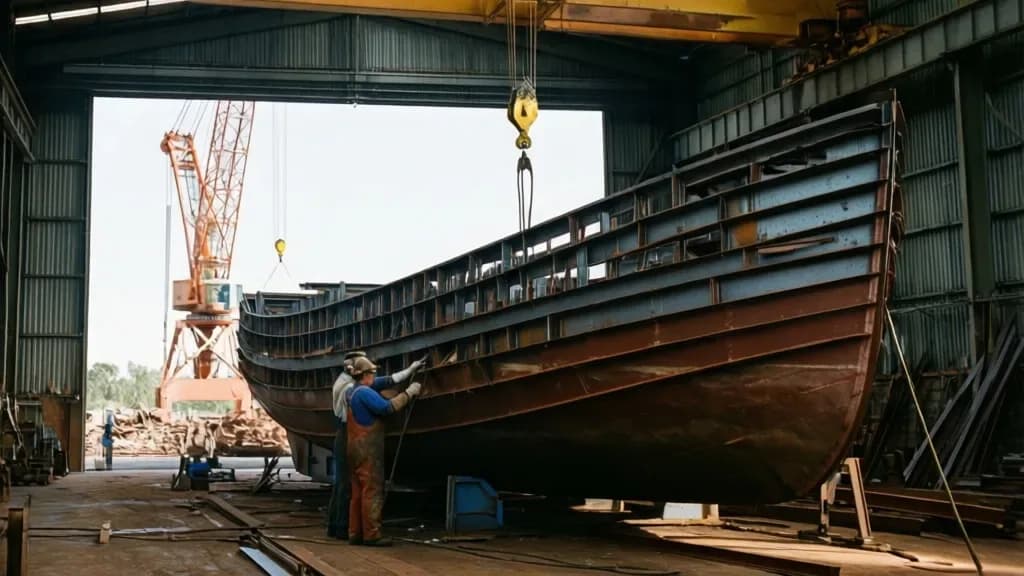
Shipwrights build, modify, repair and maintain commercial vessels, naval ships, large workboats, ferries and the heavy marine craft beyond the recreational sector. The role covers steel and aluminium hull fabrication, structural alignment, dry-docking, frame and bulkhead construction, hull repair and section replacement, slipway and synchrolift operations, and the complex coordination work that vessel construction demands.
The trade is concentrated in defence-adjacent and commercial-marine precincts. The Henderson Defence Precinct in WA hosts Austal, Civmec and the broader Australian Marine Complex. The Osborne Naval Shipyard in Adelaide is where Australia will begin building its first SSN-AUKUS submarines by the end of the decade. Williamstown in Victoria continues as a long-established naval shipbuilding site. Hobart hosts Incat Tasmania, a global leader in aluminium fast-ferry construction. Sydney has Garden Island and Pyrmont, plus the historic shipwright industry around White Bay and Cockatoo Island. The Brisbane River system supports commercial shipwright work at Cairncross Dockyard and the wider Port of Brisbane.
The defining context for shipwright migration in 2026 is the AUKUS submarine programme. Total planned investment under AUKUS Pillar 1 has risen to AUD $71-96 billion. Up to AUD $25 billion will be spent on Henderson over the next decade. These commitments are creating sustained, structural demand for marine trade workers — and the existing Australian workforce cannot satisfy it.
The ANZSCO 399112 Code: What It Covers
ANZSCO 399112 sits inside Unit Group 3991 Boat Builders and Shipwrights alongside 399111 Boat Builder and Repairer. The two codes share an assessing body and visa eligibility but cover different vessel types and skill emphases. Shipwright work focuses on commercial, naval and larger vessels — generally above 24m and frequently above 100m — and emphasises hull integrity, structural alignment, frame and bulkhead work, and the coordination demands of large-vessel construction or refit.
The official ANZSCO description for 399112 covers reading plans and specifications, setting out work to designs, fabricating and assembling structural components, aligning and joining hull sections, dry-docking and slipping vessels, conducting hull repairs, and overseeing the precise tolerances that large marine craft require. Skill level 3 applies.
If your work is predominantly on small recreational craft, yachts, tenders and motor cruisers, 399111 Boat Builder and Repairer is the correct code. If it is predominantly on ferries, naval ships, commercial workboats or vessels typically over 24m, 399112 Shipwright is the better fit.
Skills Assessment Through Trades Recognition Australia
The Job Ready Program (Offshore Applicants)
Most offshore shipwrights complete the four-stage Job Ready Program. The structure mirrors other TRA trades but the workplace assessment is observed against the shipwright competency standard rather than boat building.
Stage 1 — Provisional Skills Assessment (PSA): TRA reviews your overseas qualification and at least three years of post-qualification shipwright experience. Processing typically runs 12-16 weeks.
Stage 2 — Job Ready Employment (JRE): 1,725 hours (approximately 12 months full-time) of paid shipwright work with a TRA-approved Australian employer. Evidence is submitted every three months.
Stage 3 — Job Ready Workplace Assessment (JRWA): An independent TRA-approved assessor observes you working against the relevant Australian competency standard, typically structural fabrication, alignment, dry-docking or hull repair work.
Stage 4 — Job Ready Final Assessment (JRFA): TRA finalises the assessment and issues the skills letter for visa lodgement.
Total program cost: Approximately AUD $3,250 across all four stages, paid in instalments.
Total program duration: 14-20 months from PSA through JRFA. The JRE work-hours stage drives the timeline.
Common rejection reasons: References that describe smaller craft work suitable to 399111 rather than 399112; thin evidence of structural and alignment work as opposed to fit-out only; trying to count yacht-rigging or sailmaking experience as shipwright duties.
Direct MSA Pathway for Australian-Trained Applicants
If you hold the Australian Certificate III in Marine Craft Construction or a related qualification with shipwright endorsement, plus at least one year of Australian post-qualification experience, the direct MSA is available. Fee approximately AUD $1,250; processing approximately 120 days.
Visa Pathways for Shipwrights
Subclass 482 — Skills in Demand Visa
For offshore shipwrights, 482 employer sponsorship is the dominant route. Defence-precinct employers at Henderson and Osborne are actively sponsoring offshore marine trades at scale. Salary thresholds are easily met because shipwright wages in defence precincts comfortably exceed both Core Skills and (for senior roles) Specialist Skills thresholds.
- Visa fee: AUD $4,015 (primary applicant, Core Skills stream)
- Salary threshold: Core Skills AUD $79,423 (from 1 July 2026; previously AUD $76,515); Specialist Skills AUD $146,576 (from 1 July 2026; previously AUD $141,210)
- Processing time: Median 2-3 months for the Core Skills stream
- Quirk that matters: Defence-cleared work at Henderson and Osborne typically requires Australian citizenship for the highest classifications — driving most foreign shipwrights toward the 482-to-186 pathway as a multi-year route to clearance eligibility
Subclass 186 — Employer Nomination Scheme
The TRT stream becomes available after two years on a 482 with the same employer. The defence-precinct employers run well-organised TRT pipelines because their workforce strategy depends on converting 482 holders to permanent residency.
- Visa fee: AUD $6,140 (primary applicant)
- Processing time: Currently extending to 19 months for metro applicants under Ministerial Direction 105; regional applications faster
- Quirk that matters: Henderson sits in a regional postcode under some classifications and Osborne is metropolitan Adelaide — confirm postcode treatment with your migration agent before assuming regional priority applies
Subclass 491 — Skilled Work Regional Visa
Tasmania (Hobart, Incat) and parts of WA outside Perth metro qualify as regional. The 15-point boost can be decisive.
- Visa fee: AUD $6,140 (primary applicant)
- Processing time: 6-12 months following invitation
- Quirk that matters: Hobart's Incat Tasmania is one of the most experienced shipwright employers in the regional system and has hosted many migrant tradespeople
Subclass 190 — State Nominated Visa
WA, SA and TAS all currently nominate Unit Group 3991. The 5-point boost is smaller than the 491's 15 points, but the upside is unrestricted permanent residency.
- Visa fee: AUD $6,140 (primary applicant)
- Processing time: 6-9 months
- Quirk that matters: WA's nomination program is well aligned with the Henderson workforce strategy and has historically been one of the more accessible programs for marine trades
Subclass 189 — Skilled Independent Visa
Shipwright sits on the MLTSSL, so 189 is available. Low applicant volume keeps invitation thresholds in the 65-75 range, well below the 90+ that ICT applicants face.
- Visa fee: AUD $6,135 (primary applicant)
- Processing time: 6-12 months following invitation
- Quirk that matters: The 189 is genuinely competitive for shipwrights — the bottleneck is the JRP timeline, not the points score
Points Test Strategy for Shipwrights
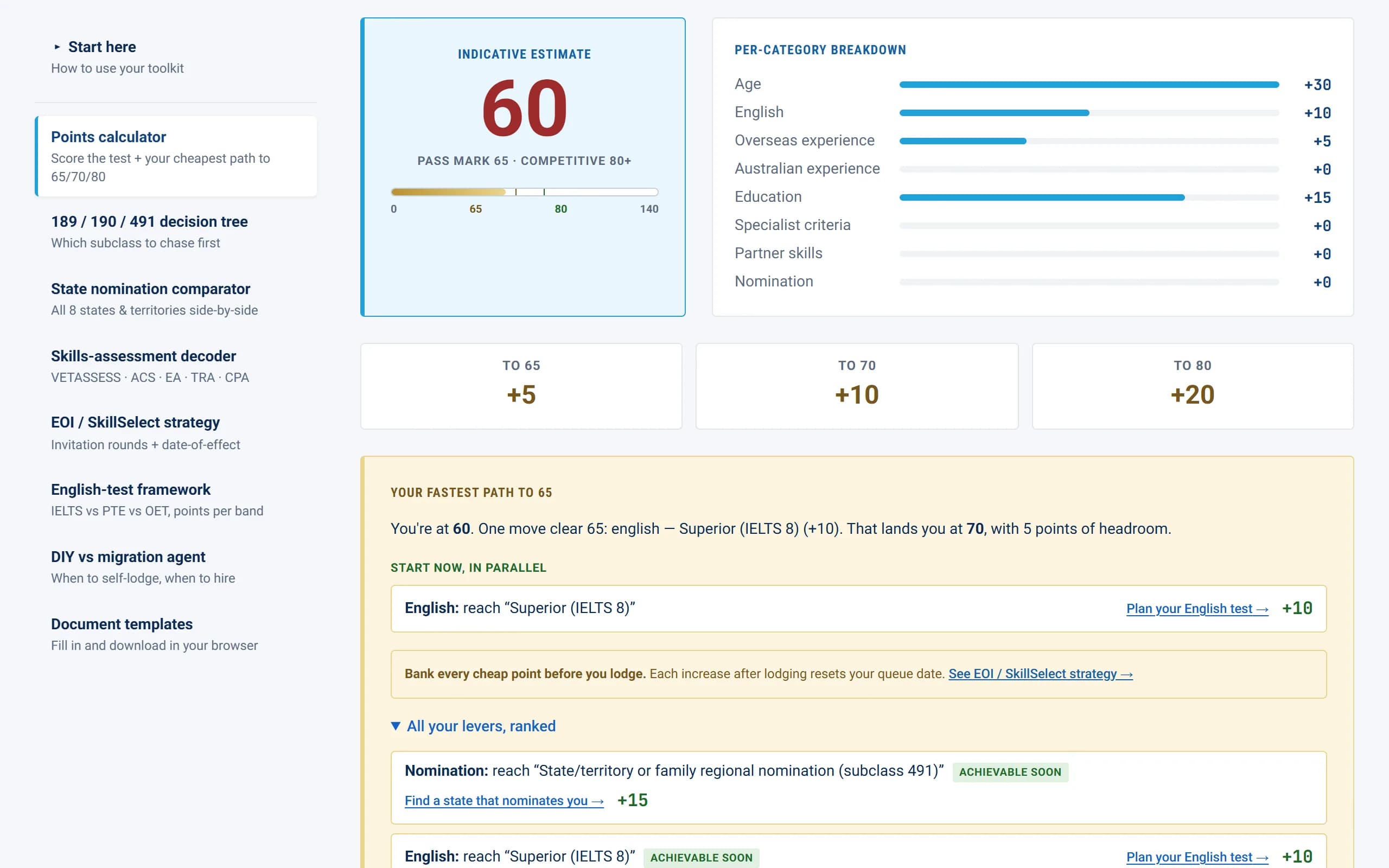
| Points Factor | Points | Notes |
|---|---|---|
| Age (25-32) | 30 | Maximum bracket |
| Age (33-39) | 25 | Strong score |
| English (Superior — IELTS 8/PTE 79) | 20 | Unlocks all state nomination programs |
| English (Proficient — IELTS 7/PTE 65) | 10 | Realistic target for most trade applicants |
| Qualification (AQF Certificate III/IV) | 10 | Trade qualification points |
| Overseas Experience (5-7 years) | 10 | After any TRA-recommended deduction |
| Australian Experience (3+ years) | 10 | Standard for JRP graduates |
| State Nomination (190) | 5 | WA, SA, TAS the strongest nominators |
| Regional Nomination (491) | 15 | Hobart and most non-Perth WA qualify as regional |
| Partner Skills | 5-10 | If partner holds skilled occupation |
Realistic Score Scenarios
Scenario 1: 28-year-old UK-trained shipwright, City & Guilds Level 3, IELTS 7.5, 6 years naval shipyard experience Age 30 + English 10 + Qualification 10 + Experience 10 = 60 points With 491 WA regional nomination (+15) = 75 points — strongly competitive
Scenario 2: 34-year-old Philippines-trained shipwright, JRP-completed, IELTS 6.0, 4 years Australian experience Age 25 + English 0 + Qualification 10 + Australian Experience 10 = 45 points With 491 (+15) and partner skills (+5) = 65 points — would benefit from improving English to Proficient
State Nomination for Shipwrights
Western Australia
WA's Henderson Defence Precinct is the single most significant employer of shipwrights in Australia. The Government has committed up to AUD $25 billion over the next decade to expand Henderson, with initial AUD $12 billion in immediate funding. Henderson is expected to support 10,000 direct jobs over the next two decades. The state's WASMOL Schedule includes Unit Group 3991, and WA received 3,400 nomination places for 2025-26.
South Australia
Adelaide's Osborne Naval Shipyard is the home of the AUKUS submarine programme. Australia will begin building its first SSN-AUKUS by the end of the decade, supported by an expansion of the existing shipyard area. South Australia opened all skilled occupations to its 2025-26 nomination program from 30 September 2025. Construction trades sit in the state's priority sector group, and SA has historically been more flexible on English thresholds than NSW or VIC.
Tasmania
Hobart's Incat Tasmania is a major aluminium fast-ferry builder with a long history of sponsoring overseas shipwrights. The entire state qualifies as regional under the postcode definitions, which makes the 491's 15-point boost available. Tasmania received 1,200 places for 190 and 650 for 491 in 2025-26.
Victoria
Williamstown's long-established naval shipbuilding history continues to generate shipwright demand, with BAE Systems Australia maintaining a workforce there. Victoria received 3,400 places for 2025-26 — the state's 190 list is generally selective but Unit Group 3991 has historically been included.
Salary and Employment Outlook
What Shipwrights Earn in 2026
| Role | Typical Salary Range |
|---|---|
| Apprentice / Trade Assistant | AUD $45,000-$60,000 |
| Qualified Shipwright (PAYG) | AUD $75,000-$95,000 |
| Senior / Lead Shipwright | AUD $95,000-$120,000 |
| Defence-cleared Shipwright (Henderson / Osborne) | AUD $100,000-$150,000+ with clearance premium |
| Project Coordinator / Foreman | AUD $110,000-$140,000+ |
Source: SEEK Career Advice salary data 2026 (AUD $75,000-$90,000 range across all roles), ERI SalaryExpert AUD $81,066 average and AUD $91,379 median, PayScale 2026 hourly rates.
Total package generally includes 11.5% superannuation. Defence-cleared roles command a meaningful premium because security-cleared trade workers are rare. Overtime and shift loadings on dry-dock and slipway work commonly add 15-30% to base salary in peak project periods.
Highest-Demand Sectors
- AUKUS submarine programme — Osborne Naval Shipyard (Adelaide), Henderson Defence Precinct (WA)
- Naval shipbuilding — Austal, Civmec, BAE Systems Australia, ASC Pty Ltd
- Commercial ferry construction — Incat Tasmania (Hobart)
- Vessel refit and dry-docking — Cairncross Dockyard (Brisbane), Garden Island (Sydney), Henderson commercial yards
- Major workboat construction — Birdon (Port Macquarie), Strategic Marine (WA)
Skills Australia Outlook
Jobs and Skills Australia rates marine trades as in shortage. The AUKUS workforce build alone is expected to require thousands of marine trade workers through the 2030s, on top of existing commercial demand. Industry surveys describe time-to-fill for experienced shipwrights as significantly extended through 2026. The defence shipbuilding strategy is among the most aggressive workforce expansion programmes in Australian industrial history, and shipwrights sit at the front of the demand curve.
Tips for a Successful Application
1. Choose Shipwright over Boat Builder if your work is on larger vessels
If your career has been on vessels over 24m — ferries, naval ships, large workboats — choose 399112 Shipwright rather than 399111 Boat Builder. The salary ceilings are higher, the defence-precinct visa pipeline is more developed, and the demand curve is steeper. Your references must consistently describe shipwright duties — structural fabrication, alignment, dry-docking, hull section work.
2. Target Henderson or Osborne for 482 sponsorship
The two defence precincts are the most aggressive sponsors of offshore marine trades in Australia. Austal, Civmec, ASC and BAE Systems Australia have all sponsored 482 workers in the past 24 months. The pay is high, the pathway to 186 is established, and the long-term career upside is the strongest in the trade.
3. Plan around the citizenship pathway if you want defence-cleared work
The highest-level defence work at Henderson and Osborne requires Australian citizenship, which takes four years from PR. Start the 482-to-186-to-citizenship roadmap from day one if your career goal is the cleared roles. Migrants who do not plan for this can spend years on a 482 only to discover the most lucrative positions remain closed to them.
4. Document structural and alignment work specifically
TRA assessors weight evidence of structural fabrication, hull alignment, frame work and major repair much more heavily than evidence of fit-out or surface work. Photographs of structural projects with dates, vessel names where possible, and project captions strengthen the PSA significantly.
5. Push for Proficient English before lodging
The defence-precinct employers prefer applicants with strong English because the work involves reading complex plans, naval drawings and safety documentation. Proficient English (IELTS 7.0 across the board, PTE 65) also unlocks 190 nomination in all the relevant states. The investment in PTE preparation pays back across the assessment, the visa and the workplace.
Step-by-Step Migration Roadmap
- Confirm 399112 is the right code — review the ANZSCO code finder and compare against 399111 Boat Builder and Repairer
- Gather qualification evidence and three years of post-qualification shipwright experience — payslips, contracts, structural-work portfolio
- Submit the TRA Provisional Skills Assessment — through TRA online services
- Sit your English test — aim for Proficient or higher to unlock state nomination and defence-precinct sponsorship
- Apply for a 485 graduate visa or 407 training visa — to enter Australia and start the JRE stage
- Complete 1,725 hours of paid Australian shipwright work — with a TRA-approved employer
- Complete the Job Ready Workplace Assessment — observed competency assessment on-site
- Receive your Job Ready Final Assessment letter — the document you lodge with the visa
- Submit an Expression of Interest in SkillSelect — for 189, 190 or 491
- Apply for state nomination — target WA, SA, TAS based on preferred precinct
- Alternatively, secure 482 employer sponsorship — defence-precinct employers actively sponsoring
- Receive invitation and lodge your visa within 60 days — complete health and character checks
Frequently Asked Questions
How is AUKUS reshaping the shipwright migration pipeline?
AUKUS Pillar 1 commits AUD $71-96 billion to nuclear-powered submarine capability. Up to AUD $25 billion will be spent on Henderson WA over the next decade. Osborne SA is being expanded to build Australia's first SSN-AUKUS submarines. Both precincts have effectively unlimited workforce demand for trade workers through the 2030s. The 482 visa programme is the dominant entry route, with 186 progression after two years standard for sponsored workers.
Can I work on classified defence projects on a temporary visa?
Generally no for the most sensitive work, and partially yes for less sensitive work. Australian Government Security Vetting Agency clearances above Negative Vetting Level 1 typically require Australian citizenship. Workers on a 482 can perform unclassified or low-clearance work but cannot enter classified zones. Most foreign shipwrights start in unclassified roles and progress toward cleared work as they advance through 186 PR and eventual citizenship.
Should I apply as a Shipwright or a Boat Builder?
It depends on the vessels you actually work on. Shipwright covers commercial and naval vessels, usually above 24m, with emphasis on structural and alignment work. Boat Builder and Repairer covers recreational and smaller commercial craft. Your reference letters must match the code you nominate — TRA will not accept a Shipwright nomination if your references describe yacht and tender work.
Which precinct should I target — Henderson or Osborne?
Henderson (WA) is the larger and broader workforce demand, covering surface combatants, amphibious vessels, submarine maintenance and Austal's commercial vessel work. Osborne (SA) is more concentrated on the SSN-AUKUS submarine programme but offers depth in submarine-specific work that does not exist elsewhere in Australia. Henderson has more 482 sponsorship volume because the demand is broader; Osborne has stronger long-term career potential for submarine specialists.
How does Incat Tasmania fit in the shipwright pathway?
Incat is a global leader in aluminium fast-ferry construction and one of Australia's most experienced employers of offshore shipwrights. The entire state of Tasmania qualifies as regional for the 491 visa, which adds 15 points. Incat has a strong track record of sponsoring 482 visa holders and converting them to 186 PR. For applicants drawn to commercial rather than defence work, Hobart is an excellent target. Review the naval architect and marine designer pathway for an adjacent professional route, the skills assessment process, and the broader most in-demand occupations hub.