Multimedia Designer Visa Pathway to Australia: Complete 2026 Guide
Updated: 16 August 2026
Australia classifies the Multimedia Designer occupation under ANZSCO 232413. VETASSESS conducts the skills assessment, not the ICT body ACS. The occupation sits on the Core Skills Occupation List (CSOL) and the regional occupation list, giving access to subclasses 491, 494, 482 and 186. The non-regional 189 and 190 are closed. Typical 2026 salaries run AUD $57,000-$101,000.
Quick Facts: Multimedia Designer Migration Pathway
| Detail | Information |
|---|---|
| ANZSCO Code | 232413 (Multimedia Designer) |
| Skill Level | 1 (Bachelor degree or higher, or five years relevant experience) |
| Skills Assessment | VETASSESS (Vocational Education and Training Assessment Services) |
| Occupation List | CSOL + regional list (ROL) |
| Visa Options | 491, 494, 482, 186 |
| Demand Level | Moderate — concentrated in agencies, gaming and screen media; no national shortage flag |
| Salary Range | AUD $57,000-$101,000 (Indeed + Glassdoor, 2026) |
| Typical 189 Score | Not applicable — regional list status closes 189 and 190 |
| Key Challenge | Regional-only general migration, plus a VETASSESS portfolio and a narrow design major |
What a Multimedia Designer Does in Australia
A Multimedia Designer plans, designs and develops digitally delivered content. The ABS describes the role as producing information, promotional content, instructional material and entertainment through online and recorded digital media, using static and animated text, pictures, video and sound tailored to an audience and purpose. The work covers concept design, storyboarding, motion graphics, animation, and the visual production of websites, apps and interactive media. It is a design occupation, not a software-engineering one.
Demand concentrates in Sydney and Melbourne, where most design and advertising agencies, screen-media companies and digital studios operate. Melbourne carries a notable gaming and screen cluster. Brisbane, Perth and Adelaide hold smaller pools. Employing industries sit largely within professional, scientific and technical services, alongside film, television, gaming and broadcast.
Jobs and Skills Australia does not flag Multimedia Designer as a national shortage occupation. Combined with its regional list status, that means general skilled migration for this code runs through regional pathways rather than the capital-city points race.
ANZSCO 232413 Mapping
The official ANZSCO description for 232413 covers professionals who plan, design and develop digitally delivered information and entertainment. Typical tasks include:
- Determining design-brief objectives by consulting clients and stakeholders
- Researching the communication requirements of the project
- Formulating design concepts and preparing sketches, diagrams, illustrations and layouts
- Selecting and recommending media and materials
- Documenting the design and supervising or carrying out production in the chosen media
A crucial distinction: 232413 Multimedia Designer is a design occupation assessed by VETASSESS. It is different from 261211, which under ANZSCO 2022 is titled Game and Multimedia Developers and is assessed by ACS as an ICT occupation. The 261211 path requires an ICT-major qualification and centres on building games, websites and web applications with significant technical and coding work. If your role is creative production and visual design, 232413 fits. If it is software development for interactive products, 261211 fits. The choice determines your assessing body, so compare the descriptions using the ANZSCO code finder.
Skills Assessment — VETASSESS
VETASSESS is the assessing authority for Multimedia Designer, and it is a Group B occupation. Group B means VETASSESS assesses both your qualification and your employment through one of four pathways. See the skills assessment bodies complete list for context on the assessors.
Qualification requirement: A qualification assessed as comparable to an AQF Bachelor degree or higher, with a major in a highly relevant field. VETASSESS names Multimedia Design, Digital Design or Media, Interactive and Mobile Media, Graphic Design or Visual Communication, Animation, Digital or Learning Design, Games Design, and Screen and Media.
Four assessment pathways:
- Bachelor degree or higher in a highly relevant field, plus at least 1 year of post-qualification highly relevant employment in the past 5 years.
- Bachelor degree or higher in a non-relevant field, plus an additional AQF Diploma-level qualification in a highly relevant field, plus 2 years of employment in the past 5 years.
- Bachelor degree or higher in a non-relevant field, plus 3 years of employment in the past 5 years.
- Bachelor degree or higher in any field, plus 6 years of total employment, including at least 1 year of highly relevant work in the past 5 years.
Employment: All pathways require employment of at least 20 hours per week at an appropriate skill level, in tasks that match the 232413 description.
Portfolio: Mandatory. VETASSESS states you must submit a portfolio, either as a link or as uploaded samples of your design work, with each sample capped at 5MB.
Assessment cost: AUD $1,096 for the standard full skills assessment if you are a non-resident for tax purposes (AUD $1,205.60 including GST for applicants in Australia). Priority processing adds AUD $825.
Processing time: VETASSESS publishes a standard professional-assessment window of roughly 12 to 16 weeks. Priority processing shortens this.
Common rejection reasons: A qualification or portfolio that reads as pure graphic design or ICT development rather than multimedia design; references that describe software engineering or video editing rather than multimedia design and production; and missing or thin portfolio evidence.
Visa Pathways for Multimedia Designers
Because 232413 sits on the regional occupation list rather than the MLTSSL, the general skilled pathways are regional. The order below reflects what is realistic for this code.
Subclass 482 — Skills in Demand
The most direct pathway, since 232413 is on the CSOL and agencies, studios and screen-media companies can sponsor.
- Visa fee: AUD $3,210 (Core Skills stream)
- Salary thresholds: Core Skills Income Threshold AUD $76,515; Specialist threshold AUD $141,210 (1 July 2025 to 30 June 2026)
- Processing time: Core Skills stream around two months for most applications
- Quirk: Junior multimedia salaries can fall below the Core threshold, so a sponsored role must offer at least the CSIT to qualify.
Subclass 491 — Skilled Work Regional
The main general-skilled route for this code. A five-year provisional visa that adds 15 points and leads to permanent residency through subclass 191.
- Visa fee: AUD $6,140
- Points boost: +15
- Quirk: A designated regional area covers everywhere except Sydney, Melbourne and Brisbane, so much of the country counts as regional for nomination purposes.
Subclass 494 — Skilled Employer Sponsored Regional
A five-year provisional, employer-sponsored regional visa with a pathway to permanent residency through subclass 191.
- Visa fee: AUD $4,910
- Quirk: It needs a regional employer willing to sponsor and a positive skills assessment, which suits studios and agencies based outside the three largest cities.
Subclass 186 — Employer Nomination Scheme
Permanent residency through employer sponsorship, via Direct Entry or the Temporary Residence Transition stream after a 482.
- Visa fee: AUD $6,140
- Quirk: Direct Entry requires three years of relevant experience and a positive skills assessment.
Subclasses 189 and 190 are not available for Multimedia Designer, because the code sits on the regional list rather than the MLTSSL.
Points Test Strategy
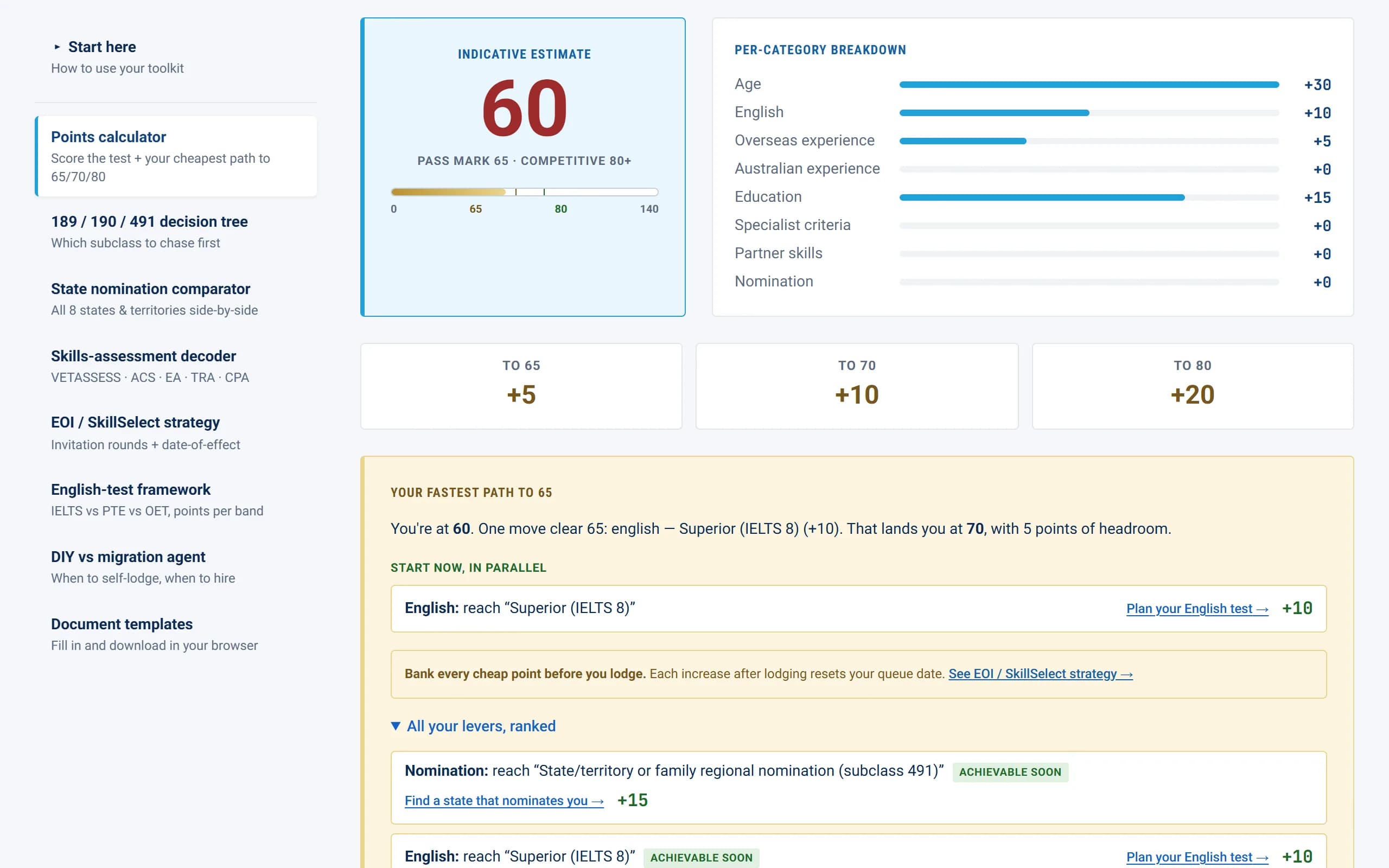
The points test applies to the 491 pathway. Note that without 190 access, regional nomination through 491 is the only way to add nomination points for general skilled migration.
| Points Factor | Maximum | Notes |
|---|---|---|
| Age (25-32) | 30 | Peak band |
| Age (33-39) | 25 | Strong |
| English (Superior 8.0) | 20 | Highest-value single factor |
| English (Proficient 7.0) | 10 | Floor for a competitive score |
| Qualification (Bachelor/Master) | 15 | Typical |
| Skilled experience overseas | 5-15 | Depends on assessed years |
| Skilled experience Australia | 5-20 | If you have worked locally |
| Regional nomination (491) | 15 | The only nomination route for this code |
| Partner skills | 5-10 | |
| Professional Year / NAATI CCL | 5 | Where applicable |
Scenario 1 — Offshore motion designer, 6 years experience
Age 31 (30) + Bachelor in multimedia design (15) + Proficient English (10) + skilled experience (10) = 65. Add 491 regional nomination (15) = 80. Realistic for a regional state listing 232413.
Scenario 2 — Onshore designer with Australian study in a regional area
Age 28 (30) + Master's (15) + Australian study (5) + Superior English (20) + two years local work (5) = 75. Add 491 (15) = 90. Strong for a regional invitation backed by a local job.
State and Regional Nomination for Multimedia Designers
General skilled migration for 232413 runs through regional 491 nomination, since the code is not on the MLTSSL and 190 is not available. State and regional lists change each program year, so verify the current status of 232413 directly on the relevant state's published list before lodging an Expression of Interest.
A current job offer from a regional Australian employer is the strongest asset for this code. Regional programs weight local employment and genuine settlement intent more heavily than raw points, and the 494 employer-sponsored regional route gives studios and agencies outside the three largest cities a direct way to sponsor.
Confirm the code's status on the skilled occupation list for 2026 and the Core Skills Occupation List before committing.
Salary and Employment Outlook
| Role | Typical Salary Range (AUD) |
|---|---|
| Junior Multimedia Designer | $57,000-$61,000 |
| Multimedia Designer (mid-level) | $78,000-$84,000 |
| Senior Multimedia Designer | $95,000-$101,000 |
| Motion Graphics Designer | $80,000-$110,000 |
| Animator | $75,000-$105,000 |
| Contract day rate | $450-$750/day |
Source: Indeed Australia and Glassdoor Australia (June 2026), cross-referenced with SEEK Australia. Indeed reports an average base near AUD $83,000, with a junior average near AUD $61,000. Glassdoor reports an average near AUD $84,500, with entry-level roles around AUD $57,000 and senior roles around AUD $101,000. Superannuation adds 11.5% to base pay.
Highest-paying contexts:
- Gaming and screen media — Melbourne's studio cluster and broadcast media
- Advertising and design agencies in Sydney and Melbourne
- In-house digital teams at larger companies and retailers
- Film and television production — motion graphics and post-production
- E-learning and corporate media — instructional and training content
Mid-point salaries cluster in the low-to-mid AUD $80,000s, and seniors reach around AUD $100,000.
Tips for a Successful Application
-
Plan for regional migration from the start. Because 232413 is on the regional list and not the MLTSSL, the 491 and 494 visas are your general skilled routes. Sydney, Melbourne and Brisbane do not count as regional, so target work and nomination in the rest of the country.
-
Pick the right code before you spend a dollar. The line between 232413 Multimedia Designer (VETASSESS, design) and 261211 Game and Multimedia Developers (ACS, ICT) decides your assessing body and your visa access. If your work is software development, you may be on the wrong code. Read both descriptions carefully.
-
Build a multimedia portfolio, not a graphic-design reel. VETASSESS distinguishes multimedia design from flat graphic design. Show motion graphics, animation, interactive media and digitally delivered content. Keep each sample under 5MB and link out to showreels.
-
Write references that describe design and production. References should describe concept design, storyboarding, motion and media production. References that read like software engineering push you toward an ICT code; references that read like pure layout push you toward graphic design.
-
Maximise English and target regional employers. Superior English is worth 20 points against 10 for Proficient. Combined with a 491 regional nomination, that often clears the invitation threshold. Apply directly to regional studios and agencies for 494 or 482 sponsorship.
Step-by-Step Migration Roadmap
- Decide between 232413 Multimedia Designer and 261211 Game and Multimedia Developers using the ANZSCO code finder
- Check list status on the 2026 skilled occupation list and the CSOL
- Gather employment references and a multimedia portfolio
- Sit your English test, aiming for Superior bands
- Lodge the VETASSESS skills assessment (AUD $1,096 offshore) and wait roughly 12 to 16 weeks
- Calculate your points across age, English, qualification and experience
- Submit an Expression of Interest in SkillSelect for 491 — see how SkillSelect works
- Apply for regional nomination where 232413 is listed
- In parallel, apply to regional Australian studios and agencies for 494 or 482 sponsorship
- Receive your invitation and lodge the visa within 60 days
- Complete health checks and police certificates
- Receive the grant and relocate
Frequently Asked Questions
What is the difference between Multimedia Designer 232413 and Game and Multimedia Developers 261211?
232413 Multimedia Designer is a design occupation assessed by VETASSESS. It centres on visual concept design, motion graphics, animation and the creative production of digital media. 261211, titled Game and Multimedia Developers under ANZSCO 2022, is an ICT occupation assessed by ACS, requiring an ICT-major qualification and focused on building games, websites and web applications with significant coding. Your day-to-day duties decide which one fits, and that choice sets your assessing body.
Can a Multimedia Designer apply for the subclass 189 or 190 visa?
No. 232413 sits on the regional occupation list, not the MLTSSL, so both the independent 189 and the state-nominated 190 are closed. General skilled migration for this code runs through the regional 491 visa, while 494, 482 and 186 cover the employer-sponsored routes. Confirm current list status on the skilled occupation list page.
Does Sydney, Melbourne or Brisbane count as regional for the 491 visa?
No. For skilled migration, designated regional Australia covers everywhere except Sydney, Melbourne and Brisbane. Because Multimedia Designer relies on regional pathways, you would need to live and work outside those three cities to use the 491 or 494 visa. That still leaves most of the country, including Perth, Adelaide, the Gold Coast, Canberra and all of regional Australia.
Is a portfolio required for the VETASSESS assessment?
Yes. VETASSESS requires a portfolio for Multimedia Designer. You provide a link or upload samples of your design work, capped at 5MB per sample. Reviewers look for multimedia work such as motion graphics, animation and interactive media that matches the 232413 task list, rather than flat graphic design or software development.
What is the demand outlook for Multimedia Designers in Australia in 2026?
Moderate and clustered. Jobs and Skills Australia does not flag the occupation as a national shortage, and demand concentrates in agencies, gaming, screen media and corporate digital teams in Sydney and Melbourne. Because the code is regional for general migration, the most reliable path is a regional employer offer combined with 491 or 494 nomination.