Technical Writer Visa Pathway to Australia: Complete 2026 Guide
Updated: 16 August 2026
Australia classifies Technical Writer under ANZSCO 212415, a Skill Level 1 occupation. VETASSESS conducts the skills assessment as a Group B occupation. The role is on the Core Skills Occupation List and the STSOL, opening subclasses 190, 491, 482 and 186. Typical 2026 salaries range AUD $90,000 to $110,000, with Sydney and Perth above the national average. The 189 independent visa is closed because the occupation is off the MLTSSL.
Quick Facts: Technical Writer Migration Pathway
| Detail | Information |
|---|---|
| ANZSCO Code | 212415 (Technical Writer) |
| Skill Level | 1 (Bachelor degree or higher, or five years' relevant experience) |
| Skills Assessment | VETASSESS (Vocational Education and Training Assessment Services) |
| Occupation List | CSOL and STSOL — not on the MLTSSL |
| Visa Options | 190, 491, 482, 186 |
| Demand Level | Moderate to high — software, engineering and regulated industries drive hiring |
| Salary Range | AUD $90,000-$110,000 (SEEK, 2026) |
| Typical 190/491 Score | 65-80 points plus state nomination, where a state nominates the code |
| Key Challenge | No 189 access, so the route runs through employers or state nomination |
What Technical Writers Do in Australia
Technical writers research and produce documentation that explains complex products and processes in plain language. The output covers user manuals, API documentation, knowledge bases, standard operating procedures, online help, training material and regulatory submissions. A technical writer interviews engineers and subject matter experts, structures the information, writes it clearly and keeps it current as products change. Modern roles often involve docs-as-code workflows, version control and publishing tools alongside the writing itself.
Demand in Australia is steadier than in journalism, because the work attaches to industries that are growing or heavily regulated. Software and SaaS companies need product and developer documentation. Engineering, mining, defence and utilities need operating and safety procedures. Banking, insurance and government need compliance and policy documentation. Medical device and pharmaceutical firms need regulatory writing. That spread gives a technical writer more employer options than a journalist has.
Work concentrates in Sydney and Melbourne, the centres of the technology sector. Canberra carries strong government and defence documentation demand. Perth and regional resource centres hire technical writers for mining and energy projects, which lifts pay in those locations. Brisbane and Adelaide add further roles in defence, software and utilities.
ANZSCO Code 212415: Technical Writer
ANZSCO 212415 describes professionals who research and write technical information-based material and documentation for articles, manuals, textbooks, handbooks and multimedia products, usually for educational or corporate purposes. The ABS places it in unit group 2124 (Journalists and Other Writers). The skill level matches a bachelor degree or higher, with five years of relevant experience sometimes substituting for the qualification.
Indicative tasks include researching subject matter, interviewing technical experts, organising information into clear documents, writing and editing technical content, and revising material as products or regulations change.
Choose 212415 when your core work is producing technical documentation. If you write marketing or general copy, that may map elsewhere. If you build interactive or multimedia content rather than write it, look at Multimedia Specialist (261211). News reporting maps to Print Journalist (212413). Confirm the closest match with the ANZSCO code finder.
Skills Assessment: VETASSESS
VETASSESS assesses Technical Writer as a Group B professional occupation. Group B requires a qualification highly relevant to the occupation, plus employment at the appropriate skill level.
Required qualification: An AQF Bachelor degree or higher in a highly relevant field. For technical writing, relevant fields commonly include communication, technical communication, journalism, English or a discipline matching the documentation domain, such as engineering or computer science.
Employment requirement: The standard pathway needs a highly relevant degree plus at least one year of post-qualification employment in the past five years. A non-relevant degree paired with a relevant diploma needs two years; a non-relevant qualification alone needs three years; and a degree in any field can work with six years of employment, including at least one highly relevant year in the past five. All pathways require at least 20 hours per week of paid, highly relevant work.
Assessment cost: AUD $1,205.60 from within Australia (GST inclusive), or AUD $1,096.00 from outside Australia. Priority processing adds AUD $825.
Processing time: A fixed seven-week target for professional occupations applies from 1 December 2025, or 10 business days with priority processing.
Common rejection reasons: Applicants whose documentation work is incidental to another role, such as a developer or analyst who writes some docs, often struggle to show that technical writing was their substantive occupation. References must establish that producing documentation, not coding or analysis, was the primary duty.
Compare VETASSESS with the other authorities on the skills assessment bodies list.
Visa Pathways for Technical Writers
Technical Writer is on the CSOL and STSOL but not the MLTSSL. The 189 independent visa is closed. The realistic routes are employer sponsorship and, where a state lists the code, state nomination.
Subclass 482 — Skills in Demand Visa
A strong primary pathway, since technology and engineering employers regularly sponsor and the code qualifies for the Core Skills stream as a CSOL occupation.
- Base application charge: AUD $3,115 (primary applicant)
- Salary floor: The employer must pay at least the Core Skills Income Threshold of AUD $76,515 (from 1 July 2025), rising to AUD $79,499 from 1 July 2026, or the market rate if higher
- Duration: Up to four years
- Quirk: Technical writer salaries generally clear the income threshold, so the offer rarely fails on pay. Software, defence and resource employers are the most likely sponsors.
Subclass 186 — Employer Nomination Scheme
Permanent residency through an employer, available because the occupation is on the CSOL.
- Base application charge: AUD $3,520 (primary applicant)
- Streams: Direct Entry, or Temporary Residence Transition after a qualifying period on a 482
- Quirk: Direct Entry requires three years of relevant experience and a positive VETASSESS assessment. Experienced technical writers with strong documentation portfolios can sometimes use Direct Entry rather than waiting out a 482.
Subclass 190 — State Nominated Visa
A permanent points-tested visa adding five points, possible because the occupation is on the CSOL. Whether it is usable depends on a state nominating the code in the program year.
- Base application charge: AUD $6,140 (primary applicant)
- Points boost: +5 for state nomination
- Obligation: Live and work in the nominating state, generally for two years
Subclass 491 — Skilled Work Regional (Provisional) Visa
A five-year provisional visa with a permanent pathway through subclass 191. Regional or family nomination adds 15 points.
- Base application charge: AUD $6,140 (primary applicant)
- Points boost: +15 for regional nomination
- Quirk: Remote and hybrid documentation work makes regional living practical, so a 491 can suit technical writers who do not need to be in a capital city office.
Points Test Strategy
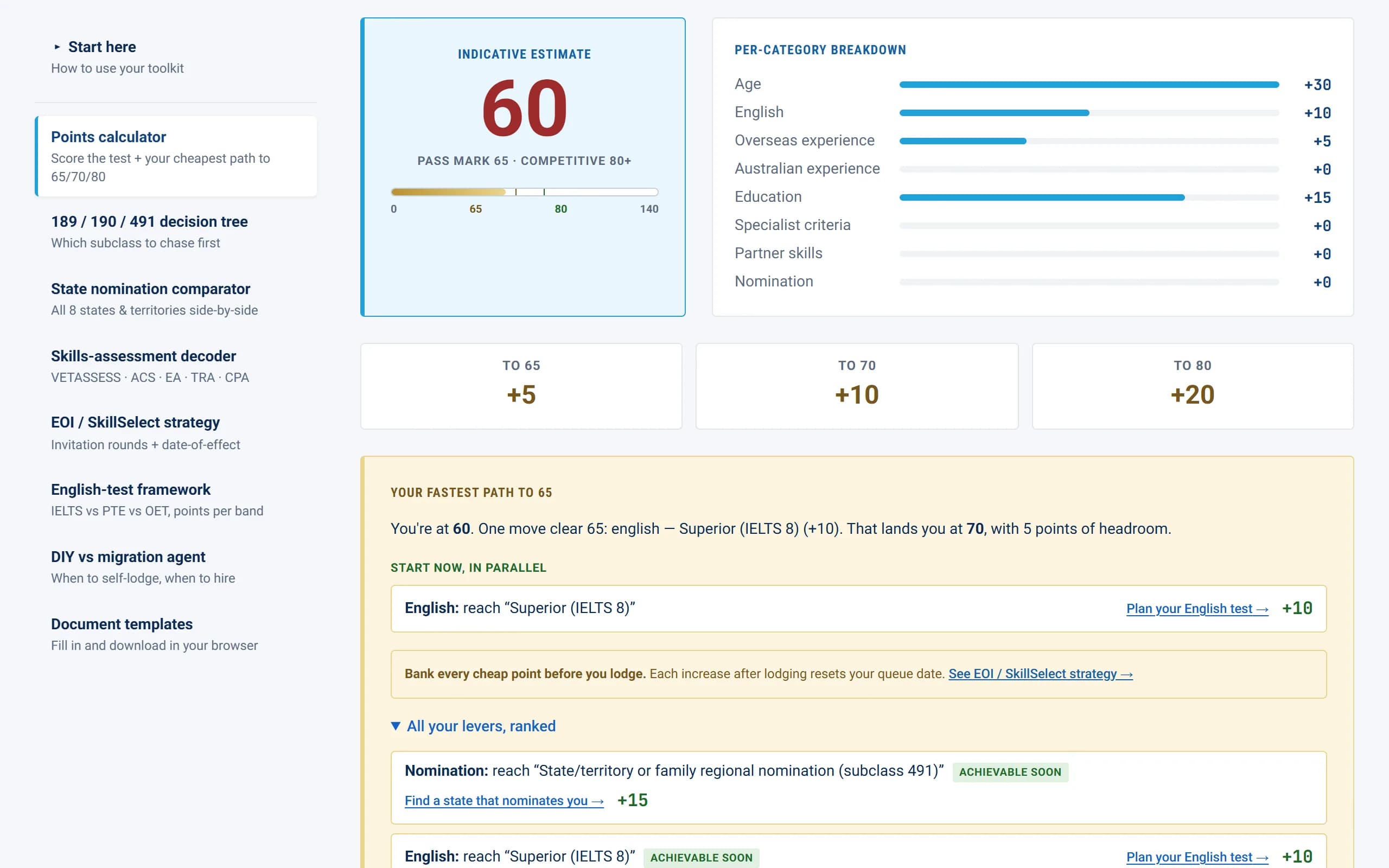
Technical Writer is on the CSOL, not the MLTSSL, so the 189 is unavailable. The points test applies to the 190 and 491, but only where a state nominates the code. Lodge an Expression of Interest through SkillSelect alongside a state nomination application.
| Points Factor | Points | Notes |
|---|---|---|
| Age (25-32) | 30 | Maximum bracket |
| Age (33-39) | 25 | Still competitive |
| English (Superior, IELTS 8/PTE 79) | 20 | A realistic target for technical communicators |
| English (Proficient, IELTS 7/PTE 65) | 10 | The common result |
| Bachelor degree | 15 | Skill Level 1 minimum |
| Skilled employment (8-10 years) | 15 | Overseas and Australian combined |
| State nomination (190) | 5 | Only where a state nominates 212415 |
| Regional nomination (491) | 15 | Only where a state nominates 212415 |
| Partner skills | 5-10 | If your partner has a skilled occupation |
Realistic Scenarios
Scenario 1: Senior technical writer, 31, Superior English, eight years' experience. Age 30 + English 20 + degree 15 + experience 15 = 80 points before nomination. A 491 nomination (+15) reaches 95. Strong written English is an advantage technical writers can usually convert into the full 20 English points.
Scenario 2: Mid-career documentation specialist, 35, Proficient English, six years' experience. Age 25 + English 10 + degree 15 + experience 10 = 60 points. A 491 nomination (+15) lifts this to 75. Where state nomination is uncertain, an employer-sponsored 482 is the more dependable route.
State Nomination
State nomination for Technical Writer varies by program year. State and territory lists weight health, engineering, trades and core ICT most heavily. Technical Writer can appear where a state has documentation demand tied to its technology, defence or resource sectors, but allocations are not guaranteed and conditions differ.
Confirm the occupation on the current nominated occupation list of the state or territory you are targeting before relying on the 190 or 491. Given the strength of the employer-sponsored route for this occupation, treat state nomination as a useful addition rather than the foundation of your plan.
Salary and Employment Outlook
| Role | Typical Salary Range |
|---|---|
| Junior Technical Writer | AUD $70,000-$90,000 |
| Technical Writer (mid-level) | AUD $90,000-$110,000 |
| Senior Technical Writer | AUD $110,000-$135,000 |
| Lead / Documentation Manager | AUD $130,000-$160,000+ |
| Contract Technical Writer | AUD $600-$900/day |
Figures reflect SEEK 2026 advertised salary data, which places the national average between AUD $90,000 and $110,000, with Sydney around AUD $106,000 and Perth notably higher on resource-sector demand. Total packages add superannuation at 11.5 per cent. Contract rates run high in defence and resources, where security clearances and domain knowledge command a premium.
The best-paying sectors are software and SaaS, defence, mining and energy, and financial services. Government and regulated industries provide stable, well-documented roles. Perth pays above the national average because of resource-project demand, while Sydney, Melbourne and Canberra hold the deepest pools of roles.
Tips for a Successful Application
-
Prove technical writing was your main job. VETASSESS needs to see that producing documentation was your substantive duty, not a side task within a developer or analyst role. Frame references around researching, structuring and writing documentation.
-
Build a portfolio you can describe. Much technical documentation is confidential, so you cannot always show samples. Be ready to describe the documents you produced, their audience and your process, since references and a clear account of duties carry the assessment.
-
Convert your English advantage into points. Technical writers write for a living, which makes Superior English (20 points) realistic. For points-tested visas, the gap between Proficient and Superior English is often the difference that lifts a borderline score.
-
Match your domain to the employer. Documentation experience in software, engineering, medical devices or finance maps to specific employers. Targeting sponsors in your domain shortens the path to a 482 and strengthens the reference picture for VETASSESS.
-
Use the 482 as the primary route. Because the 189 is closed and state nomination is uncertain, an employer-sponsored 482 is usually the surest path, with the 186 transition behind it. State nomination is a bonus, not the base plan.
Step-by-Step Migration Roadmap
- Confirm your ANZSCO code using the ANZSCO code finder — verify documentation is your core work.
- Check list status against the Core Skills Occupation List and the skilled occupation list.
- Gather employment evidence showing technical writing as your primary duty at 20+ hours per week.
- Sit an English test — aim for Superior to maximise points.
- Lodge a VETASSESS skills assessment (AUD $1,205.60 in Australia / $1,096 outside).
- Secure an employer sponsor for the 482, or check whether a state nominates 212415.
- Submit an Expression of Interest through SkillSelect for the 190 or 491.
- Apply for state nomination where the occupation is listed.
- Lodge the visa after invitation or employer nomination approval.
- Complete health and character checks.
- Receive the grant and relocate.
Frequently Asked Questions
Can a technical writer apply for a 189 visa in Australia?
No. Technical Writer (212415) is on the Core Skills Occupation List and the STSOL but not the MLTSSL, and the subclass 189 draws only from the MLTSSL. The available pathways are employer sponsorship (482 and 186) and, where a state nominates the code, the points-tested 190 and 491.
Is technical writing in demand in Australia in 2026?
Demand is moderate to high and more stable than journalism, because the work attaches to growing and regulated industries: software, engineering, defence, mining, finance and government. These sectors need ongoing documentation, which sustains hiring and supports sponsorship.
What if my documentation work was part of a developer or analyst role?
You may struggle to assess as a Technical Writer if writing was incidental to coding or analysis. VETASSESS assesses against the primary duties. If documentation was your main job, frame your references around it; if it was a minor part of a technical role, a different ANZSCO code may fit better.
Which locations pay technical writers the most?
Perth often pays above the national average because of resource-sector demand, and Sydney sits a few per cent above the national figure. Canberra offers strong government and defence documentation roles. Melbourne carries a deep pool of software and corporate roles at around the national average.
How long does the migration process take?
The VETASSESS assessment targets seven weeks, or 10 business days with priority processing. An employer-sponsored 482 typically adds a few months, while a state-nominated visa depends on nomination timing and the SkillSelect round. Plan for roughly six to twelve months overall.