Public Relations Professional Visa Pathway to Australia: Complete 2026 Guide
Updated: 16 August 2026
Australia classifies Public Relations Professional under ANZSCO 225311. VETASSESS conducts the skills assessment as a Group B occupation. The occupation sits on the Core Skills Occupation List (CSOL), unlocking subclasses 190, 491, 482 and 186, but not the 189. Typical 2026 salaries run AUD $85,000 to $125,000. There is no points-tested independent route, so state nomination or employer sponsorship does the heavy lifting.
Quick Facts: Public Relations Professional Migration Pathway
| Detail | Information |
|---|---|
| ANZSCO Code | 225311 (Public Relations Professional) |
| Skill Level | 1 (Bachelor degree or higher) |
| Skills Assessment | VETASSESS (Vocational Education and Training Assessment Services), Group B |
| Occupation List | CSOL and STSOL — not on the MLTSSL |
| Visa Options | 190, 491, 482, 186 |
| Demand Level | Moderate — steady corporate and agency demand, concentrated in capital cities |
| Salary Range | AUD $85,000-$125,000 (SEEK, 2026) |
| Typical 189 Score | Not applicable — 225311 is not on the MLTSSL, so the 189 is closed |
| Key Challenge | No 189 route; you need a nominating state or a sponsoring employer |
What Public Relations Professionals Do in Australia
A Public Relations Professional plans and runs campaigns that shape how an organisation is seen by the public, media, investors and staff. Day-to-day work covers media releases, press strategy, crisis communications, stakeholder briefings, event management and reputation monitoring. The role exists across three main settings: in-house corporate communications teams, dedicated PR and communications agencies, and government or not-for-profit bodies.
Demand is steady rather than booming. Most roles cluster in Sydney and Melbourne, where corporate head offices, agencies and the national media sit. Canberra carries a distinct slice of demand because government departments and peak bodies run large communications functions. The profession rewards a strong local network and a portfolio of placed coverage, which means recent arrivals often start in agency roles before moving in-house. VETASSESS specifically asks applicants to supply copies or links to media releases they have produced, so keeping a clean record of published work matters from the first day on the job.
ANZSCO 225311: Code Mapping
ANZSCO 225311 covers a professional who plans, develops, implements and evaluates information and communication strategies that create an understanding and a favourable view of an organisation, its goods and services, and its role in the community. The unit group is 2253 Advertising, Public Relations and Sales Professionals.
Core tasks include planning communication programmes, writing and editing media releases and speeches, arranging interviews and press conferences, advising executives on public image, and assessing the results of campaigns. If your actual work leans toward paid advertising and brand campaigns rather than earned media and reputation, check whether Advertising Specialist (225311's neighbour, 225111) or a managerial code fits better before you commit. The skills assessment turns on whether your documented duties match the code, not on your job title.
If you are unsure which code your duties map to, start with the ANZSCO code finder guide and compare each task list against your reference letters.
Skills Assessment: VETASSESS
Public Relations Professional is assessed by VETASSESS, which handles most non-trade professional and managerial occupations. It is a Group B occupation, the standard professional category.
Requirements
- A qualification assessed as comparable to an Australian Qualifications Framework (AQF) Bachelor degree or higher, in a field highly relevant to public relations or communications.
- At least one year of post-qualification employment at an appropriate skill level within the last five years, highly relevant to the nominated occupation.
- If your degree is not in a highly relevant field, you need an additional qualification at AQF Diploma level or above in a relevant field, plus at least two years of relevant post-qualification employment in the last five years.
- If your employment was not gained after the qualification, five additional years of highly relevant employment are required.
Assessment cost: AUD $1,205.60 for the full skills assessment (fee set after the October 2025 CPI increase).
Processing time: Around 7 weeks for standard processing. Priority processing is available for an extra AUD $907.50 and returns an outcome in roughly 10 business days.
Common rejection reasons: Reference letters that describe general marketing or events work rather than genuine PR duties, and degrees in unrelated fields without the diploma-plus-experience top-up. VETASSESS also looks closely at whether the employer is large enough to justify a dedicated PR role, so sole-trader or micro-agency claims draw scrutiny.
English proficiency is proven separately at the visa stage, not in the VETASSESS assessment itself.
Visa Pathways for Public Relations Professionals
Because 225311 is on the CSOL and STSOL but not the MLTSSL, the 189 is unavailable. The realistic routes are state nomination and employer sponsorship.
Subclass 190 — Skilled Nominated Visa
Permanent residency through state nomination, which adds 5 points.
- Visa fee: AUD $6,140 (primary applicant)
- Eligibility constraint: Only states that currently nominate 225311 can support you, and PR is a smaller nomination category than ICT or health.
- Processing: Several months once invited, subject to state allocation
- Quirk: State PR nominations often carry experience and salary floors above the federal minimum.
Subclass 491 — Skilled Work Regional (Provisional) Visa
A five-year provisional visa with a pathway to permanent residency through the subclass 191. Regional nomination adds 15 points.
- Visa fee: AUD $6,140 (primary applicant)
- Eligibility constraint: You must live and work in a designated regional area, which for PR usually means a regional city with a sizeable employer base.
- Quirk: Regional PR roles are thinner on the ground than metro roles, so a confirmed job offer strengthens an application considerably.
Subclass 482 — Skills in Demand Visa
Employer-sponsored temporary visa, often the most direct route for PR professionals with a job offer.
- Visa fee: AUD $3,210 (Core Skills stream, primary applicant)
- Salary threshold: The Core Skills Income Threshold is AUD $76,515 until 30 June 2026, rising to AUD $79,499 from 1 July 2026. Your salary must meet the threshold and the market rate for the role.
- Duration: Up to four years
- Quirk: Agencies and large corporates that already hold sponsorship accreditation move faster than first-time sponsors.
Subclass 186 — Employer Nomination Scheme
Permanent residency through employer sponsorship, via the Direct Entry stream or the Temporary Residence Transition stream after time on a 482.
- Visa fee: AUD $6,140 (primary applicant)
- Quirk: Direct Entry needs a positive VETASSESS assessment and at least three years of relevant experience, so many PR professionals transition from a 482 instead.
For the full picture of how invitations work, see the SkillSelect EOI guide.
Points Test Strategy
Public Relations Professional cannot use the 189, but the 190 and 491 still run through the points test. You submit an expression of interest, and a state must invite you before you can apply.
| Points Factor | Points | Notes |
|---|---|---|
| Age (25-32) | 30 | Maximum bracket |
| Age (33-39) | 25 | Still strong |
| English (Superior, IELTS 8/PTE 79) | 20 | The largest controllable lever |
| English (Proficient, IELTS 7/PTE 65) | 10 | More common starting point |
| Bachelor degree | 15 | Minimum for Skill Level 1 |
| Master's or PhD | 15-20 | Worth pursuing if close |
| Skilled experience overseas (8+ years) | 15 | Counts after assessment |
| State nomination (190) | 5 | Required for this occupation |
| Regional nomination (491) | 15 | Strongest single boost |
| Partner skills | 5-10 | If partner is skilled or has strong English |
Realistic Score Scenarios
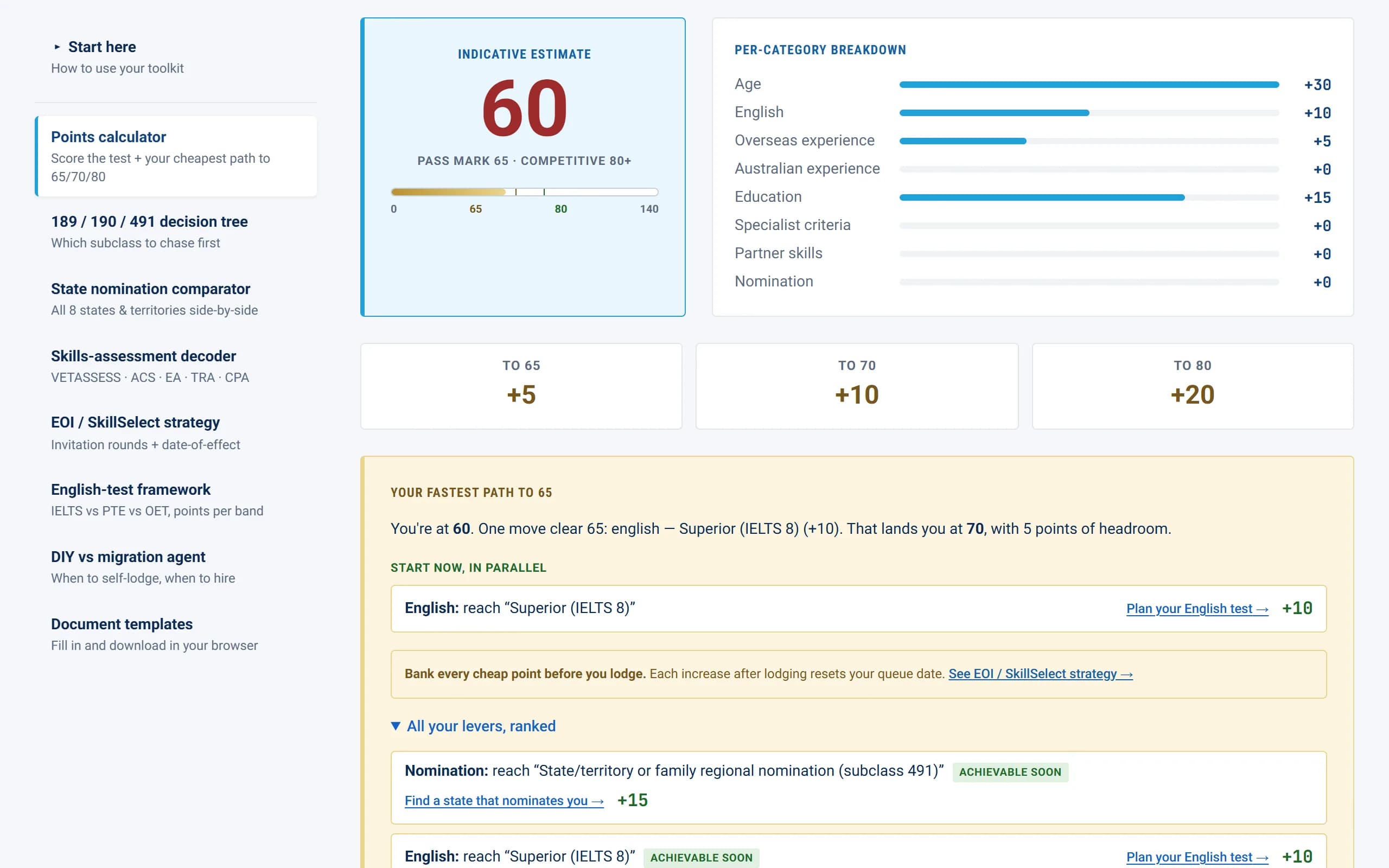
Scenario 1: Agency PR manager, 31, Superior English, 6 years overseas experience. Age 30 + degree 15 + English 20 + experience 10 = 75 points. Adding a 190 nomination lifts the total to 80, which is competitive where a state actively nominates 225311.
Scenario 2: In-house communications lead, 35, Proficient English, 8 years experience. Age 25 + degree 15 + English 10 + experience 15 = 65 points. A 491 regional nomination adds 15 to reach 80, or employer sponsorship through the 482 sidesteps the points test entirely.
State Nomination
State nomination programmes for 225311 change each year and several states do not nominate PR at all. Always check the current state list before lodging an expression of interest.
States with developed economies and large communications sectors, principally New South Wales and Victoria, are the most likely to consider PR nominations, though allocations are small and competitive. Regional pathways through the 491 generally require a genuine connection to the region or a confirmed offer from a regional employer. Because nomination criteria shift, treat any state's published occupation list as the single source of truth and verify it on the day you apply.
Salary and Employment Outlook
| Role | Typical Salary Range (SEEK, 2026) |
|---|---|
| Public Relations Officer | AUD $85,000-$105,000 |
| Public Relations Specialist | AUD $105,000-$125,000 |
| Senior Communications Adviser | AUD $110,000-$135,000 |
| PR / Communications Manager | AUD $120,000-$150,000+ |
Salaries are quoted as base. On top of base, superannuation is paid at 11.5%, and agency roles sometimes add performance bonuses tied to new business. The highest-paying employers are large corporates in financial services and resources, top-tier agencies in Sydney and Melbourne, and government communications functions in Canberra. Pay is noticeably higher in Sydney than in smaller capitals, which matters when you are weighing a regional 491 against a metro 482.
Tips for a Successful Application
- Build a media-release evidence file early. VETASSESS asks for copies or links to releases you have produced. Keep dated samples and outlet links from each role so your portfolio is ready before you lodge.
- Confirm the role is genuinely PR, not marketing. If your reference letters describe campaign buying, social media scheduling or events alone, VETASSESS may decide your duties sit under a different code. Have referees describe earned-media and reputation work explicitly.
- Target the right visa from the start. With no 189 available, decide between chasing a state nomination and securing a sponsoring employer before you spend on the assessment.
- Lift your English score. Superior English is worth 20 points and is the fastest way to make a 190 or 491 expression of interest competitive.
- Check state lists on the day. PR nomination availability moves between programme years. Verify the current CSOL status and the nominating state's published list right before you apply.
Step-by-Step Migration Roadmap
- Confirm your duties map to 225311 using the ANZSCO code finder.
- Check that 225311 remains on the CSOL for 2026.
- Gather degree transcripts, reference letters and a file of published media releases.
- Sit an English test, aiming for Proficient or Superior.
- Lodge the VETASSESS skills assessment (AUD $1,205.60).
- Decide your route: state nomination (190/491) or employer sponsorship (482/186).
- For state nomination, submit an expression of interest in SkillSelect.
- Apply to a state that currently nominates 225311, or secure a job offer from an approved sponsor.
- Receive the invitation or nomination approval.
- Lodge the visa application within the stated window.
- Complete health and character checks.
- Receive the grant and relocate.
Frequently Asked Questions
Can I apply for a 189 visa as a Public Relations Professional?
No. ANZSCO 225311 is on the Core Skills Occupation List and the Short-term Skilled Occupation List, but not on the Medium and Long-term Strategic Skills List that the subclass 189 draws from. The realistic permanent routes are the state-nominated 190 and the employer-sponsored 186. The 491 offers a provisional regional pathway to permanent residency.
Which states nominate Public Relations Professionals in 2026?
Nomination availability for 225311 changes each programme year, and PR is a small category. New South Wales and Victoria, with the largest communications sectors, are the most likely to consider it, but you must check each state's current published occupation list before lodging. Never assume a state nominates the code from one year to the next.
Is employer sponsorship easier than state nomination for PR roles?
Often, yes. The subclass 482 does not require a points test, only a positive VETASSESS assessment and a qualifying job offer that meets the Core Skills Income Threshold. Because PR state nominations are limited and competitive, a sponsoring agency or corporate can be the cleaner path, especially if you are already working in Australia.
What are the most common reasons PR skills assessments fail?
The two recurring problems are reference letters that describe marketing, events or social media work rather than genuine public relations duties, and degrees in unrelated fields without the required diploma-plus-experience top-up. Make sure your referees spell out earned-media, media-release and reputation-management responsibilities, and supply dated samples of your published work.