Workplace Relations Adviser Visa Pathway to Australia: Complete 2026 Guide
Updated: 16 August 2026
Australia classifies Workplace Relations Adviser under ANZSCO 223113. VETASSESS conducts the skills assessment as a Group B professional occupation. The code sits on the Core Skills Occupation List (CSOL) and the Regional Occupation List (ROL), unlocking subclasses 491, 494, 482 and 186, but not the points-tested 189 or 190. Typical 2026 salaries range AUD $95,000 to $120,000. The 2025-26 industrial relations reforms have lifted demand sharply.
Quick Facts: Workplace Relations Adviser Migration Pathway
| Detail | Information |
|---|---|
| ANZSCO Code | 223113 (Workplace Relations Adviser) |
| Skill Level | 1 (Bachelor degree or higher, or equivalent experience) |
| Skills Assessment | VETASSESS (Vocational Education and Training Assessment Services) |
| Occupation List | CSOL and ROL (Core Skills and Regional Occupation Lists) |
| Visa Options | 491, 494, 482, 186 |
| Demand Level | High — driven by the Closing Loopholes reforms and a busy bargaining cycle |
| Salary Range | AUD $95,000-$120,000 (SEEK/Jora, 2026) |
| Typical 491 Score | 70-85 points after regional nomination |
| Key Challenge | No 189 or 190 route — sponsorship or a regional program is mandatory |
The Workplace Relations Adviser Role in Australia
Workplace Relations Advisers help resolve disputes by advising on workplace relations policy and problems, and represent industrial, commercial, union, employer or other parties in negotiations on pay and conditions. The role is also known as Industrial Relations Adviser, Employee Relations Adviser or Employment Relations Consultant. The work centres on the Fair Work Act 2009, enterprise bargaining, modern awards, dispute resolution and representation before the Fair Work Commission.
Demand has risen materially across 2025-26. The Closing Loopholes amendments, the right-to-disconnect provisions, casual conversion rules and a heavy enterprise-bargaining cycle have made employer-side and union-side IR specialists genuinely scarce. The work concentrates in Sydney, Melbourne, Canberra, Brisbane and Perth, with strong demand from large employers in health, retail, mining, construction and the public sector, plus law firms and consultancies that run dedicated workplace relations practices.
This is a specialist code, not a general HR one. Workplace Relations Adviser is distinct from Human Resource Adviser (223111), which covers broader HR administration, and from Human Resource Manager (132311), which owns the function. If your work is mostly recruitment, performance and policy administration, you likely belong under 223111; see the Human Resource Adviser visa pathway.
ANZSCO Code 223113 — What Counts
The 223113 code covers professionals who advise on and represent parties in workplace and industrial relations matters at skill level 1, meaning a Bachelor degree or higher, or relevant experience VETASSESS accepts in lieu. Tasks include advising on industrial relations policy and disputes, interpreting awards and enterprise agreements, conducting or supporting enterprise bargaining, representing parties in negotiations and proceedings, and advising on compliance with the Fair Work framework. Related roles VETASSESS recognises include Industrial Relations Officer, Trade Union Official and Union Organiser.
The boundary that matters is specialisation. A genuine workplace relations role is built around industrial instruments, bargaining and dispute resolution. A role that touches IR occasionally inside a broader HR remit is more likely to be assessed as Human Resource Adviser. Read the official descriptions on the ANZSCO code finder and match your actual duties.
Skills Assessment
VETASSESS (Group B Professional Occupation)
VETASSESS assesses 223113 as a Group B professional occupation. Both qualification and employment are assessed, and both must pass.
Requirements:
- A qualification assessed as comparable to an AQF Bachelor degree or higher in a field highly relevant to workplace relations.
- If the degree is highly relevant, at least one year of highly relevant post-qualification employment in the last five years.
- If the degree is highly relevant plus an additional qualification at least at AQF Diploma level, at least two years of highly relevant employment under an alternative pathway.
- English evidence as required by the visa subclass and any nominating state.
Assessment cost: AUD $1,096 for non-residents, AUD $1,205.60 for Australia-based applicants including GST (VETASSESS professional occupation fee, October 2025).
Processing time: VETASSESS reports around seven weeks on average for professional assessments, with priority processing available for an additional AUD $825 returning an outcome in roughly ten business days.
Common rejection reasons: The most common failure is employment evidence that reads as general HR work rather than specialist industrial relations. The second is a qualification VETASSESS treats as in a field not highly relevant, such as a generalist business degree without IR or employment-law content, which then demands more years of relevant experience.
For how VETASSESS compares to other authorities, see the skills assessment bodies complete list.
Visa Pathways
223113 is on the CSOL and ROL but not the MLTSSL, and it is not eligible for the 190. That removes the independent 189 and the state-nominated 190. The available routes are employer sponsorship and regional nomination.
Subclass 482 — Skills in Demand Visa
Employer-sponsored temporary work visa, the most direct route for an adviser with a job offer.
- Visa fee: from AUD $3,210 (primary applicant).
- Eligibility constraint: the Core Skills Income Threshold is AUD $76,515 until 30 June 2026, rising to AUD $79,499 from 1 July 2026. Most workplace relations salaries clear this comfortably.
- Processing time: varies by stream and nomination; check current Home Affairs published times.
- Quirk: the 482 transitions to permanent residency through the 186 Temporary Residence Transition stream, so it is a real PR pathway for a code that otherwise lacks a points route to PR.
Subclass 186 — Employer Nomination Scheme
Permanent residency through employer sponsorship, available because 223113 is on the CSOL.
- Visa fee: AUD $6,140 (primary applicant, 2026).
- Streams: Direct Entry, or Temporary Residence Transition after holding a 482.
- Quirk: Direct Entry requires at least three years of relevant experience, which most specialist IR advisers can show.
Subclass 494 — Skilled Employer Sponsored Regional (Provisional) Visa
Employer-sponsored regional visa with a five-year term and a pathway to permanent residency through the subclass 191.
- Visa fee: AUD $4,910 (primary applicant, 2026).
- Eligibility constraint: the sponsoring employer must operate in a designated regional area and the role must meet skills and salary requirements.
- Quirk: the ROL listing makes 223113 eligible for the 494, the main employer-sponsored route where the sponsor sits outside the major cities.
Subclass 491 — Skilled Work Regional (Provisional) Visa
Points-tested regional visa, available because 223113 is on the ROL. Regional nomination adds 15 points.
- Visa fee: AUD $6,140 (primary applicant, 2026).
- Points boost: +15 from regional nomination.
- Quirk: the 491 needs both a competitive points score and a regional sponsor or eligible family member, suiting advisers willing to commit to a regional location.
Points Test Strategy
The 491 is the only points-tested route for 223113. Your score sets which regional programs will consider you.
| Points Factor | Points | Notes |
|---|---|---|
| Age (25-32) | 30 | Maximum bracket |
| Qualification (Bachelor) | 15 | Minimum for Skill Level 1 |
| Qualification (Master/PhD) | 15-20 | Higher band if your degree qualifies |
| English (Proficient — 7.0) | 10 | Realistic target |
| English (Superior — 8.0+) | 20 | Strong lift |
| Skilled employment (overseas) | 5-15 | Depends on assessed years |
| Regional nomination (491) | 15 | The largest single boost for this code |
| Partner skills | 5-10 | If your partner has a skilled occupation |
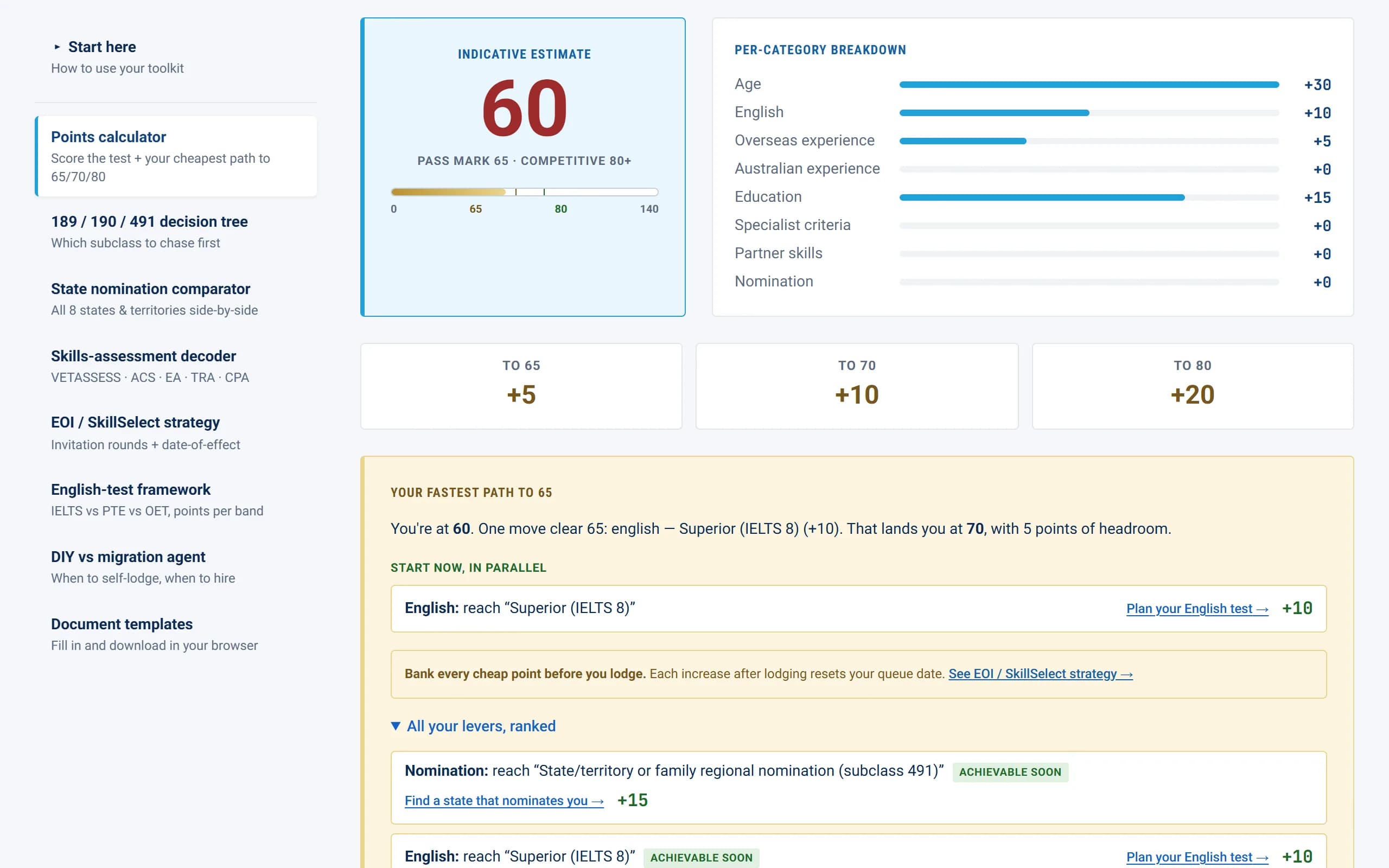
Scenario 1 — Workplace relations adviser, 30, Superior English, 5 assessed years: 30 (age) + 15 (Bachelor) + 20 (English) + 10 (experience) = 75, plus 15 with a 491 regional nomination reaches 90.
Scenario 2 — Workplace relations adviser, 35, Proficient English, 3 assessed years: 25 (age) + 15 (Bachelor) + 10 (English) + 5 (experience) = 55, needing the 491 (+15) to reach 70, or an employer to sponsor a 482 or 494. For how invitations rank, see the SkillSelect EOI guide.
State and Regional Nomination
Because 223113 is excluded from the 190, state nomination applies only through the regional 491. Some regional programs accept professional occupations under broad business or professional categories, and a few employers in regional health, mining and local government run genuine IR roles that suit the 494. The specific availability of 223113 changes by program year and by Designated Area Migration Agreement, so confirm the current status against the relevant state or regional authority's published list before lodging an expression of interest.
Salary and Employment Outlook
| Role | Typical Salary Range |
|---|---|
| Employee Relations Officer | AUD $85,000-$100,000 |
| Workplace / Industrial Relations Adviser | AUD $95,000-$120,000 |
| Senior IR Adviser / Specialist | AUD $120,000-$150,000 |
| IR Manager / Principal Consultant | AUD $140,000-$180,000+ |
Figures draw on SEEK and Jora 2026 salary data, which place the typical Workplace Relations Adviser around AUD $95,000 to $120,000, with New South Wales paying toward the upper end. Total packages add superannuation at 11.5 per cent, and public-sector roles often add salary packaging. The strongest demand sits in large health networks, mining and resources, retail, construction, the public sector, and the law firms and consultancies that advise them. Canberra is notably strong for public-sector and federal IR work.
The outlook is genuinely positive for a management-category code. The 2025-26 reform wave created a structural demand for advisers who can interpret the updated Fair Work provisions and run bargaining, and that demand is not tied to a single hiring cycle the way recruitment is. Specialists with bargaining and Fair Work Commission experience are the most sought after.
Tips for a Successful Application
- Confirm 223113 over 223111. A genuine workplace relations role is built around industrial instruments, bargaining and disputes. If IR is only a slice of a broader HR job, VETASSESS may redirect you to Human Resource Adviser.
- Write references around IR substance. Show enterprise bargaining, award and agreement interpretation, dispute resolution and representation, with concrete matters. Generic "advised on employee matters" wording weakens the case.
- Plan around the absence of a 189 or 190. This code reaches permanent residency through the 186 or the regional 191, so line up an employer or a regional program early.
- Aim for Superior English. IR advisers can usually reach 8.0, and the 20-point lift is decisive for the 491.
- Match your degree to the field. A law, industrial relations or employment-relations qualification is usually treated as highly relevant, cutting the required experience to one year. A generalist business degree may demand more years.
Step-by-Step Migration Roadmap
- Confirm your ANZSCO code against the ANZSCO code finder, ruling out 223111 and 132311.
- Check the list status of 223113 on the Core Skills Occupation List and confirm its ROL listing.
- Prepare references describing specialist workplace relations duties.
- Sit your English test, aiming for Superior where possible.
- Lodge your VETASSESS assessment as a Group B professional occupation.
- Calculate your points with assessed experience factored in.
- Decide your route — employer sponsorship (482, 186, 494) or regional points (491).
- Secure a sponsor or regional nomination as your route requires.
- Submit an expression of interest in SkillSelect if pursuing the 491.
- Receive your invitation and lodge the visa within the allowed period.
- Complete health and character checks.
- Receive the grant and relocate.
Frequently Asked Questions
Why can't a Workplace Relations Adviser apply for the 189 or 190?
ANZSCO 223113 sits on the Core Skills Occupation List and the Regional Occupation List, but not on the Medium and Long-term Strategic Skills List used for the independent 189, and it is not eligible for the state-nominated 190. The available routes are employer-sponsored (482, 186, 494) and the regional points-tested 491.
How is a Workplace Relations Adviser different from a Human Resource Adviser?
The workplace relations code (223113) is a specialist role built around industrial instruments, enterprise bargaining and dispute resolution under the Fair Work framework. The HR adviser code (223111) covers broader HR administration, recruitment support, performance and policy. VETASSESS expects the duties in your references to match the specialist code if you claim it.
Is demand really rising for this occupation in 2026?
Yes. The Closing Loopholes amendments, the right-to-disconnect rules, casual conversion changes and a heavy enterprise-bargaining cycle have made employer-side and union-side IR specialists scarce. Unlike recruitment, this demand is structural rather than tied to a single hiring cycle, which makes it a steadier migration target within the management category.
Can my overseas industrial relations qualification be recognised?
Often, provided VETASSESS assesses it as comparable to an Australian Bachelor degree or higher in a field highly relevant to workplace relations, such as law, industrial relations or employment relations. A highly relevant qualification keeps the required experience to one year. A generalist business degree can still work but usually requires more years of relevant IR employment.
What are the most common reasons these applications fail?
Two reasons dominate. First, employment references that describe general HR work rather than specialist industrial relations, which suggests the wrong code. Second, a qualification VETASSESS judges to be in a field not highly relevant to workplace relations, which then requires more relevant experience than the applicant can show. Careful drafting and honest code selection prevent both.