Renderer (Solid Plaster) Visa Pathway to Australia: Complete 2026 Guide
Updated: 16 August 2026
Australia classifies Solid Plasterer (also called Renderer) under ANZSCO 333212. Trades Recognition Australia (TRA) conducts the skills assessment via the Job Ready Program or the Offshore Skills Assessment Program. The code sits on the Core Skills Occupation List and MLTSSL, unlocking subclasses 189, 190, 491, 482, and 186. Typical 2026 salaries range AUD $80,000-$85,000 for employed roles, with subcontractors earning more per square metre.
Quick Facts: Renderer (Solid Plaster) Migration Pathway
| Detail | Information |
|---|---|
| ANZSCO Code | 333212 (Solid Plasterer / Renderer) |
| Skill Level | 3 (AQF Certificate III or IV, or three years of relevant experience) |
| Skills Assessment | TRA (Trades Recognition Australia) — Job Ready Program or OSAP |
| Occupation List | CSOL and MLTSSL |
| Visa Options | 189, 190, 491, 482, 186 |
| Demand Level | High — solid plasterers are in persistent national shortage according to Jobs and Skills Australia |
| Salary Range | AUD $80,000-$85,000 (SEEK Salary Hub, April 2026) |
| Typical 189 Score | 65-80 points (lower competition than ICT or healthcare) |
| Key Challenge | Distinguishing 333212 (wet trades) from 333211 (plasterboard) in employment references |
What a Solid Plasterer Does in Australia
A 333212 solid plasterer — most often called a renderer in the Australian trade — applies sand-cement, lime-cement, or acrylic render to internal and external walls, sets up texture finishes, and finishes brickwork, blockwork, and concrete substrates. The trade is distinct from 333211 Plasterer (Wall and Ceiling), which works with dry plasterboard. Solid plastering is wet trade work.
Demand for the trade is driven by two streams. First, new residential construction across NSW, Victoria, and South-East Queensland uses external render finishes on the majority of new homes — particularly in the project-builder segment dominated by Metricon, Henley, Simonds, and McDonald Jones. Second, the heritage and renovation market across Sydney, Melbourne, and Adelaide demands traditional lime renders that few tradespeople still execute well. The shortage of skilled renderers has compressed the labour pool and pushed up rates in both segments.
The work concentrates around major capitals but extends into regional growth corridors — Sunshine Coast, Geelong, Newcastle, and the Gold Coast all show sustained renderer demand. Mining-adjacent FIFO work in Western Australia and Queensland also draws solid plasterers for purpose-built accommodation and commercial structures.
ANZSCO Code Mapping
ANZSCO 333212 covers Solid Plasterer, including the alternative title Renderer (Solid Plaster). The code sits beside 333211 Plasterer (Wall and Ceiling), which covers fibrous (plasterboard) work.
Use 333212 when your work history is dominated by:
- Applying sand-cement render to external and internal masonry walls
- Bagging, sponging, and trowel-finishing brickwork
- Setting up scratch coats, float coats, and finish coats
- Applying acrylic render, texture coat, and Modern stuccoes
- Fixing and finishing ornamental moulds and decorative plaster
Use 333211 instead if your day-to-day is plasterboard fixing, jointing, and ceiling installation. The two codes share a unit group (3332 Plasterers) but TRA assesses them as distinct trades with different practical evidence requirements.
The Australian Certificate III equivalent is CPC31020 Certificate III in Solid Plastering. Offshore applicants need a qualification mapped by TRA to this Australian benchmark.
Skills Assessment with TRA
Trades Recognition Australia is the sole assessing body for 333212. The route depends on whether you are onshore or offshore.
Job Ready Program (Onshore Pathway)
For applicants already in Australia — typically on a Temporary Graduate (485) visa after completing CPC31020 or an equivalent Australian qualification. The JRP runs across four stages.
- Stage 1 — Provisional Skills Assessment (PSA): AUD $130. Confirms eligibility and qualification authenticity.
- Stage 2 — Job Ready Employment (JRE): AUD $490. Begin 12 months (minimum 1,725 hours) of paid full-time work in the nominated trade.
- Stage 3 — Job Ready Workplace Assessment (JRWA): AUD $2,845. An approved RTO conducts an on-site workplace assessment of practical rendering skills.
- Stage 4 — Job Ready Final Assessment (JRFA): AUD $75. TRA issues the final outcome letter within approximately 45 days.
Total approximate cost: AUD $3,540. End-to-end timeline: 12-15 months. Solid Plasterer is currently on TRA's prioritised construction-trades list, which can accelerate PSA and JRFA processing where capacity permits.
Offshore Skills Assessment Program (OSAP)
For applicants outside Australia. OSAP combines a documentary review with a practical technical interview conducted by a TRA-approved Registered Training Organisation in your country (or in Australia if you travel). Costs vary by RTO but typically fall in the AUD $1,000-$3,500 range. Processing time is 12-26 weeks once the technical interview is scheduled.
Common rejection reasons across both routes: employment references describing "general construction" rather than specific rendering duties; qualifications that lack the practical wet-trade component; and self-employment evidence without arms-length verification through tax records or third-party contracts.
For broader context on every assessing body, see the skills assessment bodies complete list.
Visa Pathways for Renderers
Subclass 482 — Skills in Demand Visa
Employer-sponsored temporary visa, no points test. The dominant offshore route for renderers with a confirmed job offer.
- Visa fee: AUD $1,895 (Core Skills stream, primary applicant)
- Salary threshold: AUD $76,515 (Core Skills Income Threshold, in force until 30 June 2026; rising to AUD $79,499 from 1 July 2026)
- Duration: Up to 4 years
- Processing time: Around 1-3 months for the Core Skills stream
Most qualified renderer roles in Australian capital cities pay above the CSIT, so the financial threshold rarely binds. Securing a Standard Business Sponsor who has the accreditation and labour market need is the harder step.
Subclass 186 — Employer Nomination Scheme
Permanent residency through employer sponsorship.
- Visa fee: AUD $6,140 (primary applicant)
- Streams: Direct Entry (offshore with 3 years' post-qualification experience) or Temporary Residence Transition (after 2 years on 482)
- Processing time: Around 6-12 months
The Direct Entry stream is realistic for offshore renderers with a positive OSAP outcome, three years of relevant experience, and an Australian sponsoring employer.
Subclass 190 — Skilled Nominated Visa
State-nominated permanent residency. Adds 5 points to the points test.
- Visa fee: AUD $6,140 (primary applicant)
- Obligation: Live and work in the nominating state for 2 years
- Best states: Victoria (which accepts all national SOL occupations), Queensland, and Tasmania have all supported solid plastering trades in 2026 rounds
Subclass 491 — Skilled Work Regional Visa
Regional provisional visa with a pathway to permanent residency via subclass 191.
- Visa fee: AUD $6,140 (primary applicant)
- Points boost: +15 from regional nomination
- Best states: Tasmania has invited 491 applicants at points scores as low as 40 in 2026, Western Australia and regional South Australia are also active
Subclass 189 — Skilled Independent Visa
Points-tested permanent residency, no state or employer sponsorship required.
- Visa fee: AUD $6,135 (primary applicant)
- Minimum points: 65 (typical clearing range for trades 65-80)
- Processing time: 6-12 months
189 invitations for trades are less frequent than for healthcare codes. Most renderer applicants pair a 189 EOI with a 190 or 491 application to maximise chances of receiving an invitation.
Points Test Strategy
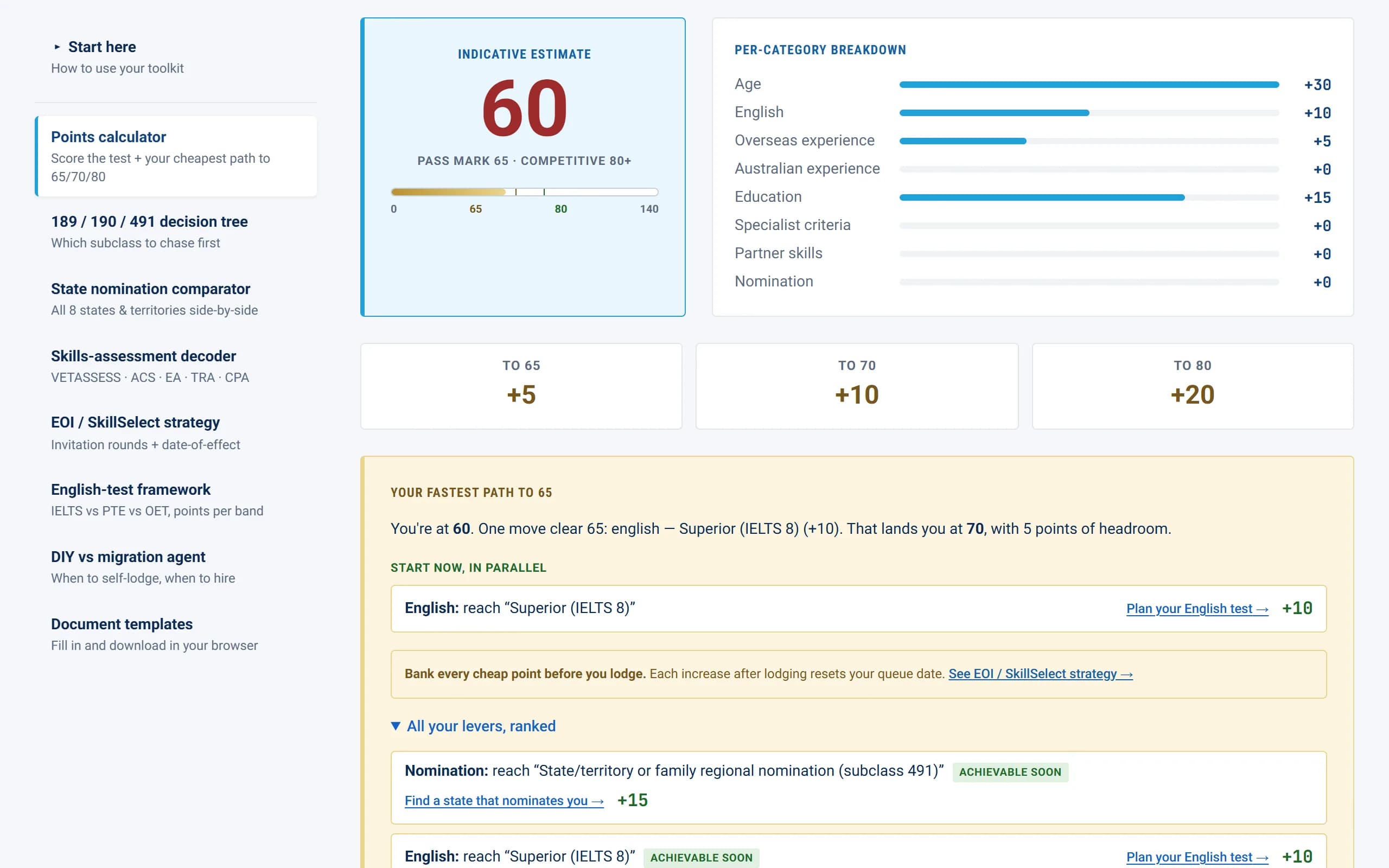
The points test applies to 189, 190, and 491. For 333212, the typical scoring path runs:
| Points Factor | Points | Notes |
|---|---|---|
| Age (25-32) | 30 | Maximum bracket — most trade applicants land here |
| Qualification (Cert III or IV) | 10 | AQF Certificate IV gets 10 points; Cert III alone gets 0 |
| English (Competent, IELTS 6.0) | 0 | Mandatory minimum |
| English (Proficient, IELTS 7.0) | 10 | Achievable with preparation |
| Overseas Experience (5-7 years) | 10 | Most career renderers reach this |
| State Nomination (190) | 5 | Apply where eligible |
| Regional (491) | 15 | The strongest single boost |
| Partner Skills | 5-10 | If partner has a skilled occupation |
Realistic Score Scenarios
Scenario 1: Offshore renderer, 30 years old, Certificate IV in Building, 7 years' experience, Competent English, 491 regional nomination
Age 30 + Qualification 10 + Experience 10 + Regional 15 = 65 points. Competitive for invitation under Tasmania or regional SA.
Scenario 2: Onshore renderer post-485, 28 years old, JRP positive, 4 years onshore experience, Proficient English
Age 30 + Qualification 10 + English 10 + Australian Experience 5 = 55 points. Add 190 (+5) and partner skills (+5) to reach 65 — competitive with state nomination.
State Nomination for Renderers
State nomination programs for trades change each program year. As at the 2025-26 cycle, the most reliable pathways for 333212 sit outside NSW.
Victoria
Victoria does not publish a state-specific list. It accepts all occupations on the national SOL, including 333212. Applicants submit a Registration of Interest through the Live in Melbourne portal and are invited to apply. The 2025-26 allocation is around 2,700 places for subclass 190 and 700 for subclass 491. Solid plastering and renderer roles are routinely supported under Victoria's construction priority.
Queensland
Queensland's 2025-26 program covers building and construction trades on both 190 and 491 pathways, with around 2,600 places allocated. Migration Queensland prioritises offshore applicants with construction trade backgrounds for regional roles outside Brisbane.
Tasmania
Tasmania invited 491 applicants at points scores as low as 40 in early 2026 rounds, making it the most accessible state for trade applicants who otherwise struggle for invitations. Renderers have been supported under Tasmania's broader construction priority.
Western Australia
WA's 2025-26 allocation is 2,000 places for 190 and 1,400 for 491. Construction and skilled trades have been targeted across multiple invitation rounds in 2026.
NSW does not list 333212 specifically on its 2025-26 skills lists — the unit group 3332 (Plasterers) is not currently on the published NSW 190 or 491 lists. See the skilled occupation list SOL 2026 page for any mid-year updates.
Salary and Employment Outlook
What Renderers Earn in 2026
| Role | Typical Salary Range |
|---|---|
| Renderer (Apprentice / Year 4) | AUD $58,000-$68,000 |
| Renderer (Qualified, Employed) | AUD $80,000-$85,000 |
| Renderer (Subcontractor, m² rate) | AUD $95,000-$130,000 |
| Senior / Lead Renderer | AUD $95,000-$115,000 |
| Renderer (FIFO, WA / regional QLD) | AUD $115,000-$150,000 |
Source: SEEK Salary Hub (April 2026), cross-referenced with Talent.com Australia.
Employed renderers typically earn a base salary plus superannuation (11.5% from 1 July 2025) and site allowances. Subcontractor renderers running their own ABN typically earn more by quoting per square metre but carry insurance, vehicle, and material costs. The premium for skilled heritage renderers — those competent in traditional lime renders — sits well above the standard new-build market.
Geography Matters
Sydney and Melbourne offer the highest concentration of work and pay rates. Brisbane and the Gold Coast have grown rapidly post-2024 with strong project-builder activity. Adelaide and Perth pay less in absolute terms but offer lower cost of living. Regional FIFO work in WA and Queensland pays the highest premium but requires remote-site discipline.
Tips for a Successful Application
1. Distinguish 333212 From 333211 Clearly
Solid Plasterer 333212 and Plasterer (Wall and Ceiling) 333211 are different trades for TRA assessment purposes — wet versus dry. If your work is rendering, bagging, and external trowel-finishing, 333212 is correct. If your work is plasterboard fixing and jointing, 333211 is correct. Many failed applications stem from picking the wrong code at the start. Review both ANZSCO descriptions on the how to find ANZSCO code page before lodging.
2. Document Wet Trade Specifics
Employment references should describe sand-cement mixing, scratch coats, float coats, and trowel-finishing — not "plastering" generically. References that say "plastering" without specifying solid or fibrous work will trigger TRA queries and delay your assessment.
3. Show Project-Level Photographic Evidence
Where employment references are thin, supplement with photographs of completed render work — ideally with date stamps and project addresses. TRA accepts this kind of evidence when it corroborates payslips and references, and it makes the workplace assessment smoother.
4. Pair JRP With a Sponsoring Employer Early
Applicants who finish their Australian Certificate III without a job offer waste months looking for work. Industry contacts from your trade school placement are usually the best lead. Many Australian render subcontractors actively sponsor international apprentice graduates given the persistent labour shortage.
5. Choose 491 if Your Points Are Tight
For renderers in the 60-65 points range, the +15 from regional nomination is the difference between sitting in the EOI pool indefinitely and receiving an invitation within a quarter. Tasmania and regional SA have been the most accessible jurisdictions in 2026.
Step-by-Step Migration Roadmap
- Confirm ANZSCO 333212 is the right code — review the how to find ANZSCO code guide and compare against 333211
- Verify list status — confirm 333212 on the skilled occupation list SOL 2026
- Gather qualification and employment evidence — Certificate III equivalent, payslips, tax records, photographs of completed work
- Sit your English test — IELTS or PTE, aim for at least Competent (IELTS 6.0)
- Choose JRP (onshore) or OSAP (offshore) — depending on current location
- Lodge TRA application — pay PSA fee or engage an OSAP-approved RTO
- Complete skills assessment — JRP runs 12-15 months; OSAP 12-26 weeks
- Calculate points and choose pathway — 189, 190, 491, or 482 employer sponsorship
- Submit EOI in SkillSelect — for 189, 190, or 491
- Apply for state nomination — Victoria, Queensland, Tasmania, or WA based on eligibility
- Receive invitation and lodge visa within 60 days
- Complete health and character checks — medicals via Bupa, police clearances
- Receive visa grant and relocate
Frequently Asked Questions
What's the difference between 333211 and 333212 for visa purposes?
Both codes sit on the CSOL and MLTSSL with the same visa eligibility (189, 190, 491, 482, 186) and the same assessing body (TRA). The functional difference is what you do day-to-day — 333211 is plasterboard (dry), 333212 is render (wet). Use the code that genuinely matches your employment history. Submitting the wrong code is the most common reason TRA rejects plastering applications.
Can I count self-employment as a renderer toward the TRA assessment?
Yes, but it requires verifiable evidence. Submit tax returns, business registration, contracts with arms-length clients, and bank statements showing income deposits. TRA scrutinises self-employment more closely than employee work because the applicant controls the evidence. Where possible, supplement with references from clients or contractors who can verify the work.
Are renderers in shortage in Australia in 2026?
Yes. Jobs and Skills Australia identifies solid plasterers in persistent national shortage as of the February 2026 ABS Labour Force Survey reference period. The Federal Government's Housing Accord targets are running materially below required pace, and external render is used on most new project-builder homes — sustaining renderer demand at the national level. Regional shortages are particularly acute.
Which states nominate Renderer (Solid Plaster) 333212 in 2026?
Victoria accepts all national SOL occupations including 333212. Queensland, Tasmania, and Western Australia have supported solid plastering trades through their nomination programs in 2025-26. NSW does not list the unit group 3332 (Plasterers) on its current skills lists.
How much does the full renderer migration pathway cost?
A realistic offshore renderer pathway costs around AUD $11,500 once you add OSAP ($1,500-$3,500), visa fee ($1,895 for 482 Core or $6,135-$6,140 for 189/190/491), IELTS or PTE ($350-$500), medicals ($500-$800), and police clearances. The JRP onshore pathway sits closer to AUD $7,000 including TRA fees and visa application. These numbers exclude migration agent fees if you use one.
Can I switch from 333212 to 333211 mid-application?
Only by withdrawing and lodging a new application — and the TRA fees you've paid are not refundable once assessment has commenced. The best protection is to choose the correct code at the start by comparing your duty list against the ANZSCO descriptions and seeking a preliminary view from a registered migration agent if uncertain.