Vocational Education Teacher Visa Pathway to Australia: Complete 2026 Guide
Updated: 16 August 2026
Australia classifies Vocational Education Teachers (also called TAFE Teachers or, in New Zealand, Polytechnic Teachers) under ANZSCO 242211. VETASSESS conducts the skills assessment. The occupation sits on the CSOL as a Regional Occupation List (ROL) entry, unlocking subclasses 491, 494, 482 and 186. Typical 2026 salaries range AUD $95,000-$135,000. There is no 189 or 190 pathway for 242211 in 2026.
Quick Facts: Vocational Education Teacher Migration Pathway
| Detail | Information |
|---|---|
| ANZSCO Code | 242211 (Vocational Education Teacher / Polytechnic Teacher) |
| Skill Level | 1 (Bachelor degree or higher in a field highly relevant to teaching subject) |
| Skills Assessment | VETASSESS (Group A — full skills assessment) |
| Occupation List | CSOL / ROL only — regional pathways and employer sponsorship |
| Visa Options | 491, 494, 482, 186 |
| Demand Level | High — TAFE sector chronic shortages in trades, IT, health and aged care |
| Salary Range | AUD $95,000-$135,000 (SEEK, 2026; AEU Victoria Agreement 2024) |
| Typical 491 Score | 70-85 points (after +15 regional nomination) |
| Key Challenge | Regional-only pathway — no metropolitan 190 access |
What a Vocational Education Teacher Does in Australia
A Vocational Education Teacher (VET) teaches one or more subjects within a prescribed course of study at a TAFE institute, polytechnic, or registered training organisation (RTO) to tertiary students for vocational education and training purposes. ANZSCO 242211 is specifically the "non-trades" version — a Vocational Education Teacher whose primary teaching is in business, IT, health services, community services, hospitality administration, language training, or similar applied disciplines.
The Australian VET sector is large. TAFE NSW, TAFE Queensland, Melbourne Polytechnic, TAFE SA, TAFE WA, and a network of independent and dual-sector providers train roughly 4.5 million students a year. The Federal Government's Free TAFE and Fee-Free TAFE initiatives have lifted enrolment sharply since 2023, generating sustained teacher demand across multiple state agreements.
VET teaching differs from school teaching in two important ways. First, the student cohort is adult, mixing school-leavers with mid-career upskillers. Second, the qualification standard for the teacher is dual — both subject expertise (a Bachelor degree or equivalent industry-recognised credential in the discipline) and a Certificate IV in Training and Assessment (TAE40122 or its predecessor). Both are non-negotiable for full classroom employment.
ANZSCO 242211 — How the Code Is Defined
ANZSCO 242211 covers VET teachers in the non-trades stream. Trades VET teachers (a chef teaching commercial cookery, a carpenter teaching construction) typically map differently and may go through TRA pathways rather than VETASSESS.
Tasks under 242211 include developing curriculum content aligned to training package units of competency, delivering classroom and workplace-based training, assessing learner competence against national standards, maintaining industry currency, and contributing to course validation and moderation activities.
A common misclassification: applicants from overseas universities try to map a university lecturer career to 242211. That fails. University Lecturer is 242111, assessed by VETASSESS but under a separate occupation code with different evidence requirements. Get this distinction right before lodging.
Skills Assessment — VETASSESS
VETASSESS is the assessing authority for 242211 under its Professional Occupations program (Group A — full skills assessment). The full list of Australian assessing bodies covers VETASSESS scope alongside other professional and trade assessors.
Core requirements:
- A qualification assessed as comparable to an Australian Qualifications Framework (AQF) Bachelor degree or higher, in a field highly relevant to the subject area to be taught.
- At least one year of highly relevant post-qualification employment at an appropriate skill level (Skill Level 1) completed in the last five years, worked at least 20 hours per week.
- Industry teaching, training or assessing experience that aligns with the ANZSCO description.
- Documentation of teaching duties — not just industry practice.
Cost (2026): AUD $1,096.00 outside Australia (GST excluded) or AUD $1,205.60 inside Australia (GST included). Priority Processing adds AUD $825.00 (outside) or AUD $907.50 (inside).
Processing time: Eight to ten weeks from full payment for standard assessment. Priority Processing reduces this to around 10 business days where eligible.
Common rejection reasons: Employment described as pure industry practice without evidence of training or teaching duties; qualification in a field too distant from the subject taught; insufficient evidence of curriculum delivery as opposed to single-session workshop facilitation. VETASSESS expects to see ongoing teaching as the substantive role, not a sideline.
Certificate IV in Training and Assessment (TAE)
A positive VETASSESS outcome does not authorise classroom delivery against accredited Australian training packages. Australian RTOs require the trainer to hold the TAE40122 Certificate IV (or evidence that the qualification is being completed concurrently). Most overseas-trained VET teachers complete the TAE through an Australian RTO either online from offshore or in the first months after arrival. Budget AUD $1,500-$3,500 and four to twelve weeks for the qualification.
Visa Pathways for Vocational Education Teachers
Because 242211 sits on the ROL (regional and employer-sponsored), no 189 or 190 pathway exists in 2026. The route is regional, employer-sponsored, or both.
Subclass 491 — Skilled Work Regional Visa
The dominant points-based pathway. Five-year provisional with a 191 transition to permanent residency after three years of qualifying regional employment.
- Visa fee: AUD $6,140 (primary applicant)
- Points boost: +15 for regional nomination
- Eligibility: State or territory nomination for a designated regional area, plus minimum 65 points
- Processing time: Comparable to 190, typically 6-12 months once nominated
- Quirk: Regional TAFE campuses across NSW, Victoria, Queensland and WA carry persistent vacancies that align well with 491 obligations
Subclass 494 — Skilled Employer Sponsored Regional Visa
Employer-sponsored provisional visa for regional roles. Five-year stay with a pathway to PR via subclass 191.
- Visa fee: AUD $4,910 (primary applicant)
- Eligibility: A nominating regional employer (TAFE institute or RTO in a designated regional area) plus VETASSESS assessment and Regional Certifying Body approval
- Processing time: Variable, generally 4-9 months in 2026
- Quirk: Regional TAFE branches and dual-sector institutions (such as Federation University, CQUniversity, Charles Sturt) are well-versed in sponsoring 494 candidates for VET teaching roles
Subclass 482 — Skills in Demand Visa
Temporary employer-sponsored visa, valid for up to four years. Two relevant streams in 2026 for VET teachers:
- Core Skills stream: Salary threshold AUD $79,423 (from 1 July 2026; previously AUD $76,515). Most VET teacher salaries clear this comfortably.
- Specialist Skills stream: Salary threshold AUD $146,576. Out of reach for almost all VET teaching roles outside senior leadership.
- Visa fee: AUD $4,015 (primary applicant)
- Processing time: Core Skills 90% finalised within roughly eight months; Specialist Skills 7-67 days
- Quirk: TAFE state authorities are typically approved sponsors; smaller RTOs may not be — verify sponsor status before negotiating an offer
Subclass 186 — Employer Nomination Scheme
Permanent residency via employer sponsorship. Either Direct Entry (no prior 482) or TRT (after two years on a 482 with the same employer).
- Visa fee: AUD $6,140 (primary applicant)
- Eligibility: A nominating Australian employer plus VETASSESS assessment
- Processing time: 6-12 months for Direct Entry
Points Test Strategy for 491
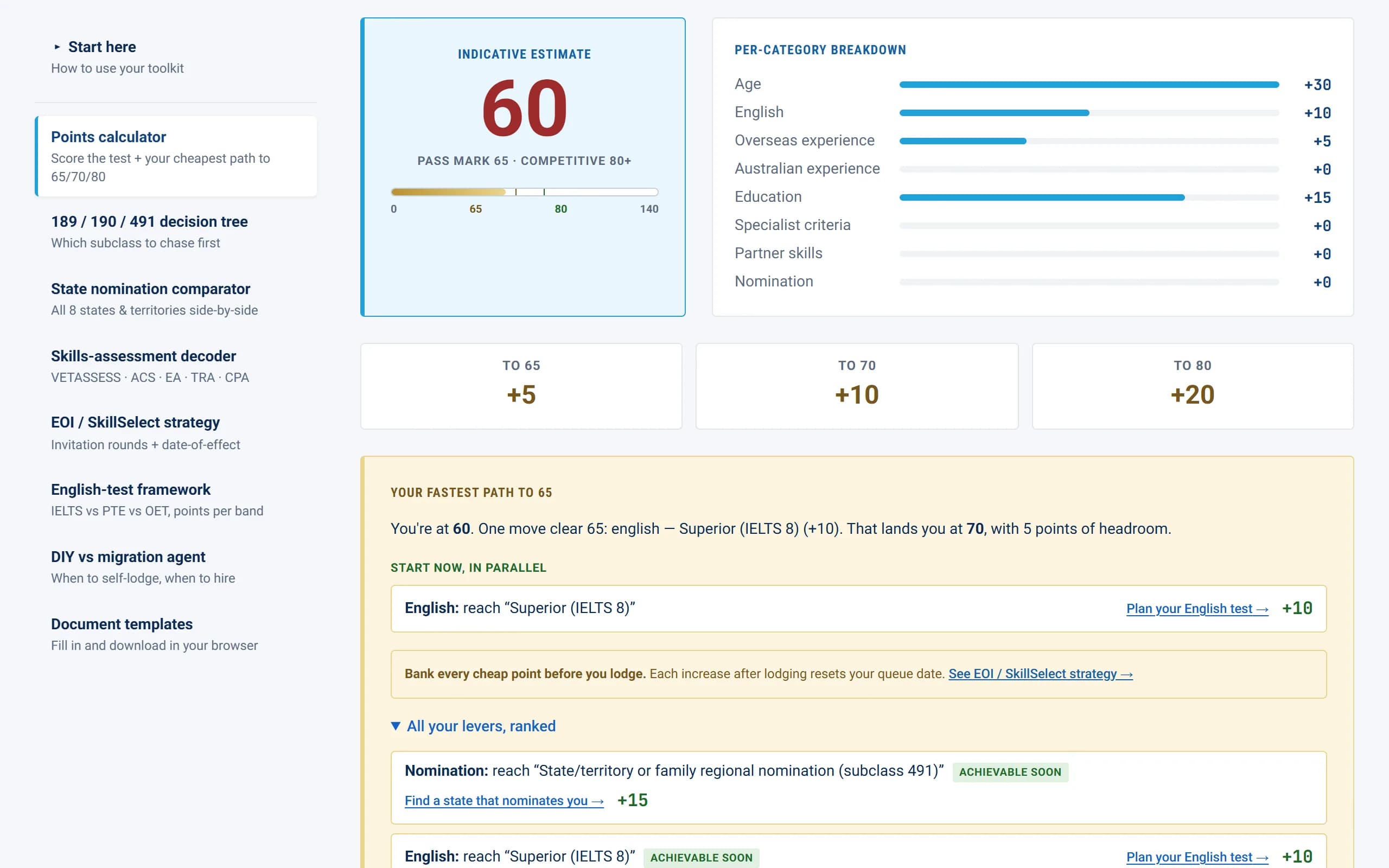
The points framework follows the standard table. Because 491 carries a +15 regional uplift, applicants who would otherwise sit at 60-65 become competitive at 75-80.
| Points Factor | Points | Notes |
|---|---|---|
| Age 25-32 | 30 | Maximum bracket |
| Age 33-39 | 25 | |
| Bachelor degree | 15 | Minimum for Skill Level 1 |
| Master's / PhD | 15 / 20 | Common among senior VET teachers |
| English Superior (IELTS 8.0+) | 20 | |
| English Proficient (IELTS 7.0) | 10 | |
| Overseas experience 5-8 years | 10 | Skilled experience as assessed by VETASSESS |
| Regional nomination (491) | 15 | |
| Partner skills | 5-10 |
Realistic Scenarios
Scenario 1 — South African IT industry trainer, age 33, Bachelor in IT, IELTS 7.5, 7 years industry plus training experience, applying for regional 491:
25 (age) + 15 (bachelor) + 10 (English) + 10 (experience) + 15 (491) = 75 points. Competitive for regional nomination in IT-aligned VET teaching.
Scenario 2 — Indian-trained nursing educator, age 38, M.Ed plus Bachelor of Nursing, IELTS 8.0, 10 years experience including five years teaching, applying for 491:
25 (age) + 15 (bachelor) + 20 (Superior English) + 15 (8+ years experience) + 15 (491) = 90 points. Strong candidate for regional health and community services VET roles.
State Nomination for Vocational Education Teachers
New South Wales
NSW regional pathways under 491 include VET teaching on a discretionary basis where evidence of a confirmed regional TAFE position is provided. NSW Stream 1 and Stream 2 of the 491 program both consider Education and Training occupations as priority.
Victoria
Victoria's regional nomination pathway includes VET teaching for the Free TAFE expansion. Regional Victoria — Ballarat, Bendigo, Shepparton, Wodonga, Warrnambool — covers multiple Federation University and TAFE campuses with documented VET teacher vacancies.
Queensland
Queensland's 491 program includes 242211 for designated regional areas, with TAFE Queensland campuses in Townsville, Cairns, Toowoomba, Mackay and the Wide Bay region consistently advertising VET teacher roles.
South Australia
South Australia routinely opens 491 nominations for teaching occupations and has historically been more accessible to offshore applicants. TAFE SA's regional campuses sit within the eligible nomination zones.
Western Australia
WA's 491 stream covers vocational education teaching with WASMOL listing for regional employment. Pilbara, Mid West and South West WA carry strong VET teacher demand tied to mining, agriculture and tourism training pipelines.
Tasmania and Northern Territory
Both jurisdictions are fully regional for migration purposes. TasTAFE and Charles Darwin University Group (incorporating the NT VET system) both recruit overseas-trained VET teachers and run streamlined 491 nomination pathways. Tasmania favours applicants with documented in-state connections — study, work or family — while the NT actively recruits offshore for remote and Indigenous community delivery.
Salary and Employment Outlook
| Role | Typical Salary Range |
|---|---|
| Entry-Level VET Teacher (Level 1) | AUD $85,000-$95,000 |
| Mid-Career VET Teacher | AUD $100,000-$120,000 |
| Senior Educator / Lead Vocational Teacher | AUD $120,000-$135,000 |
| Education Manager / Department Head | AUD $130,000-$150,000+ |
| Industry-Specialist VET Teacher (construction, nursing, IT) | Premium of $5,000-$15,000 |
Source: SEEK Career Advice (April 2026), Australian Education Union Victorian Branch agreement reporting top classroom rate rising to AUD $134,775 by end-of-agreement, TAFE NSW agreement bands AUD $98,499-$116,813 plus superannuation and leave loading.
Total package includes 11.5% superannuation, leave loading, and (in many TAFE systems) generous personal development and study leave provisions. Regional postings can attract location loadings.
Highest-Demand Subject Areas
- Aged care and disability support training
- Nursing and health services
- Construction and infrastructure (Cert III/IV)
- Information Technology (especially cybersecurity and cloud)
- Hospitality and tourism
- English as an Additional Language (EAL)
- Early Childhood Education and Care
Free TAFE allocations heavily favour these areas, and overseas-trained teachers with industry-current credentials in any of them have access to strong sponsorship and 491 opportunities.
Tips for a Successful Application
1. Document Both Teaching and Industry Experience
VETASSESS wants evidence that you taught, not just that you worked in industry. Reference letters should explicitly describe curriculum delivery, assessment design, learner cohort sizes, and units of competency taught (or the overseas equivalent). Industry-only experience leads to refusal under 242211.
2. Map Your Discipline Tightly
VETASSESS measures the relevance of your qualification to the subject you teach. A B.Com graduate teaching IT will struggle; a B.IT graduate teaching IT clears the relevance test cleanly. If there's a mismatch, get a post-qualification certification that bridges it before lodging.
3. Plan for the Cert IV in TAE
The TAE40122 Certificate IV in Training and Assessment is a separate Australian qualification, not part of the skills assessment. Many candidates complete it online from offshore through an approved RTO so they arrive in Australia ready to teach. Budget AUD $1,500-$3,500.
4. Treat 242211 as a Regional Strategy
There is no 189 or 190 pathway for this code in 2026. Plan for 491 or 494 from day one. Choose a state and a regional area early so EOI, nomination and job-search efforts all align.
5. Apply for Priority Processing if Time-Critical
VETASSESS Priority Processing (additional AUD $825-$907.50) reduces assessment from 8-10 weeks to roughly 10 business days. For candidates with a confirmed job offer where the employer needs the skills outcome quickly, this is usually worth the cost.
Step-by-Step Migration Roadmap
- Confirm 242211 (not 242111 University Lecturer or 241411 Secondary Teacher) matches your role via the ANZSCO code finder.
- Verify ROL status and 491 state eligibility on the 2026 Skilled Occupation List hub.
- Sit IELTS Academic, PTE, or OET — target Proficient (7.0 / 65) at minimum, Superior (8.0 / 79) for full points.
- Gather qualification documents, full employment references, and evidence of teaching duties.
- Lodge the VETASSESS Full Skills Assessment ($1,096 offshore). Use Priority Processing if a job offer is pending.
- Enrol in TAE40122 Certificate IV through an Australian RTO (can run in parallel with VETASSESS).
- Submit an EOI in SkillSelect for subclass 491 (and 494 if employer-sponsored).
- Apply for state or territory regional nomination — most state portals require a separate application.
- On invitation, lodge the visa within 60 days, pay $6,140, supply health and character checks.
- Wait for grant (typically 6-12 months for 491).
- Arrive in regional Australia, complete TAE if not yet finished, and start teaching.
- After three years of qualifying regional work and income, transition to subclass 191 for permanent residency.
Frequently Asked Questions
Why is 242211 only on the ROL and not the CSOL Core Skills list?
The Department of Home Affairs places 242211 in the regional and employer-sponsored band because the underlying shortage is geographically uneven — regional TAFE campuses carry the bulk of vacancies while metropolitan VET sectors are better staffed. Restricting the code to 491, 494, 482 and 186 channels new migrants to where the work actually sits.
Can I switch to a 189 or 190 visa once I'm in Australia on a 491?
Not directly via 242211 — the code's list status doesn't change with location. Once on a 491, the standard pathway is 191 permanent residency after three years of regional work meeting the income threshold. Alternatively, a change to an MLTSSL-listed occupation (with a fresh skills assessment) could open 189 access, but this is rare for VET teachers.
What's the difference between 242211 and Vocational Education Teacher (Trades)?
ANZSCO 242211 (non-trades) is what VETASSESS assesses for migration. The "Trades" stream of vocational teaching — a chef teaching commercial cookery, a carpenter teaching construction, a hairdresser teaching hairdressing — typically returns to the underlying trade ANZSCO code (351311 Chef, 331212 Carpenter, etc.) for migration purposes and is assessed by TRA, not VETASSESS. Get this distinction right before lodging.
Do I need to complete the Certificate IV in TAE before applying for the visa?
No. VETASSESS and the visa decision do not require TAE40122 at the lodgement stage. However, Australian RTOs and TAFEs cannot put you in front of accredited training package learners without it (or current enrolment in it). Most candidates complete the TAE concurrently with the visa wait so they're classroom-ready on arrival.
Which states have the strongest demand for VET teachers in 2026?
Victoria (driven by the Free TAFE expansion), Queensland (regional campuses), Tasmania, the Northern Territory, and regional NSW. WA's mining, hospitality and trades training pipeline also creates sustained demand at TAFE WA's regional campuses. Aged care, nursing, IT and early childhood education trainers are the highest-priority subject specialisms across all states. See the most in-demand occupations hub for the broader 2026 picture, or compare with the Middle School Teacher pathway if school-level teaching also fits your profile. Cross-check placement against the Core Skills Occupation List hub and the 2026 Skilled Occupation List.