Living in Perth as an Immigrant: Mining, Engineering & Lifestyle Guide
Perth is the capital of Western Australia and the operational base for most of Australia's iron ore, lithium and LNG industry. For skilled migrants, the city sits in an unusual position: it is the country's fourth-largest metropolitan area, yet it is classified by the Department of Home Affairs as a designated regional area for skilled visas. That single fact unlocks the subclass 491 visa, an extra 15 points on the skilled migration points test, and a permanent residency pathway via the subclass 191 visa. Median house rent in Perth closed 2025 at $700 a week, and mining engineers in WA command some of the highest salaries paid anywhere in the country.
Quick Stats
- Population (Greater Perth, ABS ERP at 30 June 2024): 2,384,371
- State: Western Australia
- Climate: Hot-summer Mediterranean (Köppen Csa)
- Time zone: AWST (UTC+8), 2 to 3 hours behind the east coast depending on daylight saving
- Distance to airport: about 10 to 17 km east of the CBD, roughly 18 minutes by train from Perth Station to Airport Central
- Key industries: mining, oil and gas, construction, healthcare, education
Why Immigrants Move to Perth
Perth's economy runs on what Western Australia digs out of the ground and ships out of its ports. The Pilbara iron ore basin, the lithium operations in the south-west, and the LNG fields off the north-west coast all run through corporate offices, technical centres and logistics hubs in Perth. BHP, Rio Tinto, Fortescue, Woodside Energy, Chevron Australia and Albemarle all have a major Perth presence. For engineers, geologists, drillers, electricians, project managers, accountants and lawyers serving resources, this is the only Australian city where the sector is the dominant local employer rather than a secondary specialisation.
The second reason migrants move to Perth is the regional visa designation. Since November 2019, Perth has been classified as a designated regional area for the subclass 491 Skilled Work Regional (Provisional) and subclass 494 Skilled Employer Sponsored Regional visas. That status is still in force as of 2026 and is confirmed by Home Affairs' eligible regional areas list. WA state nomination through the State Nominated Migration Program adds 5 points for a subclass 190 nomination or 15 points for a 491. After three years of living and working in a designated regional area, a 491 holder can apply for the subclass 191 permanent residence visa.
Perth has a Mediterranean climate, long stretches of west-facing Indian Ocean coastline, and lower density than Sydney or Melbourne. Beaches such as Cottesloe, Scarborough and Trigg are inside the metropolitan area, not a weekend drive away. House prices and rents are below Sydney levels, although the rental market has tightened sharply since 2022 on the back of resources-led population growth (Greater Perth gained 58,100 residents in 2023-24, with net overseas migration the largest single driver).
The trade-off is isolation. Perth is closer to Jakarta than to Sydney. The east coast is two to three hours ahead, which complicates work with Melbourne, Sydney and Brisbane offices. Some migrants find this isolating; others find it a useful filter against the meeting culture of the eastern capitals.
The salary premium for resources-adjacent skills is real. Senior mining engineers on FIFO rosters routinely earn $270,000 and above according to current Perth-based SEEK listings, well above what equivalent engineers can earn in non-mining states.
Jobs and Economy
The table below covers the main sectors hiring skilled migrants in Perth, with employer examples and indicative annual salary ranges. Salary figures are pulled from SEEK and Hays salary guidance current to 2025 and 2026; FIFO premiums and bonuses are not included unless noted.
| Sector | Major Employers | Indicative Salary | Notes |
|---|---|---|---|
| Mining and resources (engineering) | BHP, Rio Tinto, Fortescue, Mineral Resources | Mining engineer $145k to $165k average; senior FIFO roles $270k+ | FIFO rosters common from Perth to Pilbara |
| Oil and gas, LNG | Woodside Energy, Chevron Australia, Shell, INPEX | Petroleum and process engineers $150k to $220k+ | Concentrated in Perth CBD and FIFO to north-west |
| Construction | Multiplex, BGC, John Holland, Georgiou | Site engineers $100k to $150k; project managers $150k to $220k | WA building and construction trades are a priority occupation category under WASMOL |
| Healthcare | WA Health (East Metropolitan, South Metropolitan, North Metropolitan Health Services), Ramsay, St John of God | Registered nurses around $80k to $90k; mid-career nurses can reach $100k+ | Nursing is on WA's state nomination occupation lists |
| Defence and shipbuilding | Henderson Defence Precinct (Civmec, Austal, Luerssen), ASC | Tradespeople and engineers across naval shipbuilding and AUKUS submarine maintenance | Federal government has committed $12 billion to Henderson, projected to support 10,000 direct jobs over two decades |
| Education | UWA, Curtin, ECU, Murdoch, Notre Dame, WA Department of Education | Academic, professional, teaching scales vary | Universities are major employers in their own right |
| Technology | Resources tech (Woodside FutureLab, Rio Tinto Mine Automation), Atlassian, banking back-office | $110k to $180k for mid-senior software roles | Smaller market than Sydney or Melbourne |
FIFO (fly-in fly-out) is a defining feature of the Perth labour market. Workers fly from Perth Airport's T2 regional terminal on rosters such as 8 days on, 6 days off, or 2 weeks on, 1 week off, and return home between swings. FIFO is offered across mining, oil and gas, construction and some healthcare roles. For migrants, FIFO means a Perth home base with site work in the Pilbara, Goldfields or offshore platforms.
WA's State Nominated Migration Program for 2025-26 is allocated 3,400 places across the subclass 190 and subclass 491. The 2025-26 invitation rounds prioritise occupations in critical-demand sectors, with building and construction trades, healthcare, hospitality and education flagged for preferential ranking. The list is split into General Schedule 1 (mostly health and medical), General Schedule 2 (broader trades, education, professional roles) and a Graduate Occupation List for international students who studied in WA.
Cost of Living Snapshot
| Item | Perth (2025 to early 2026) | Source / note |
|---|---|---|
| Median house rent, weekly | $700 | Perth rental market data, end of 2025 |
| Median unit rent, weekly | $680 | Same |
| 2-bedroom house rent, weekly | $595 | Same |
| 3-bedroom house rent, weekly | $680 | Same |
| Median days on market to lease | About 16 days | Indicates tight market |
| Public transport flat fare | $3.50 "Go Anywhere" SmartRider fare | Introduced 2026 |
| Public transport concession | $1.60 | Concession SmartRider |
| Public transport on Sundays | Free with SmartRider | Statewide |
| Yanchep to Perth CBD train | $4.68 cap | Two-zone fare cap |
For a full breakdown of weekly expenses including groceries, utilities and childcare, see our detailed Perth cost of living guide.
Best Neighbourhoods for New Arrivals
Young professionals. Subiaco sits on the train line three stops west of the CBD with restaurants, the old town hall precinct and easy access to Kings Park. Leederville is younger and louder with bars and small venues. Mount Lawley along Beaufort Street is the inner-northern alternative with terrace houses and a strong cafe strip.
Families. Joondalup in the northern corridor has its own university, hospital, train station and shopping centre, making it close to a self-contained satellite city. Canning Vale to the south offers larger blocks and newer family homes. Kingsley in the north-west is established, leafy and rated highly for schools.
Students. Crawley is immediately adjacent to UWA and the Swan River, with student accommodation, share houses and Matilda Bay. Bentley is the Curtin University suburb with cheaper rent and direct bus links to the CBD.
Budget-conscious. Armadale sits at the southern end of the Armadale line with the lowest median rents inside the metro rail network. Midland to the east is a transport hub with the newest METRONET upgrades and lower entry prices. Kwinana to the south is industrial-adjacent and one of the cheapest suburbs with rail access.
Transport
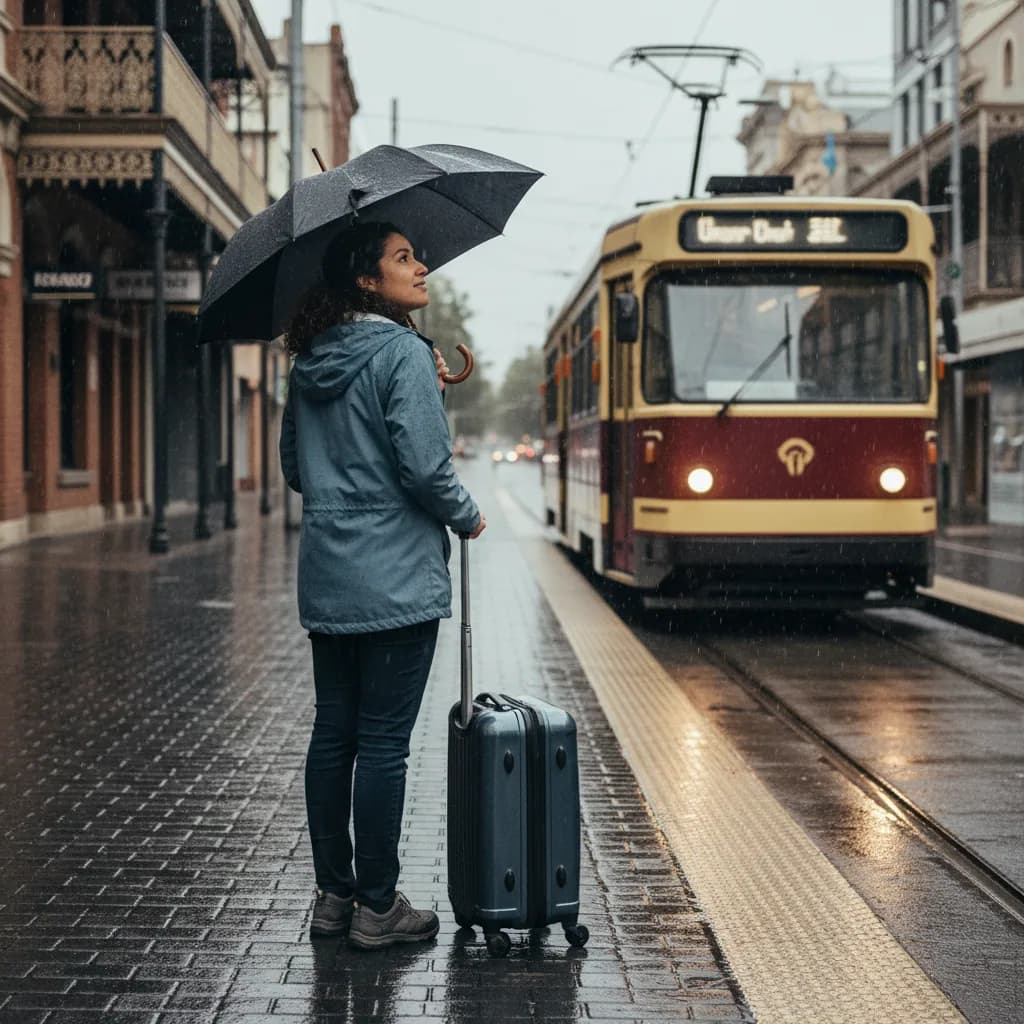
Public transport in Perth is run by Transperth and covers train, bus and ferry services using a single SmartRider smartcard. As of 2026, the system uses a flat $3.50 "Go Anywhere" fare for full price and $1.60 for concession, replacing the previous zone-based system. SmartRider users get a 10% discount over paper tickets, or 20% with Autoload. Travel is free for students Monday to Friday and free for everyone on Sundays. SmartRider readers also accept contactless Mastercard and Visa, including digital wallets, from December 2025 onward.
METRONET is the state's rail expansion program. The Yanchep Rail Extension (Joondalup line extended 14.5 km north with three new stations) opened in 2024, the Morley-Ellenbrook Line (21 km, five new stations) opened on 8 December 2024, and the upgraded Midland Station opened on 22 February 2026 as the final new station in the METRONET program. The full program adds about 72 km of new passenger rail and 18 stations across the Perth network.
Perth is a car city. Outside the rail spine and core bus routes, you will need a car for most family suburbs, beach access and weekend travel. Free CAT bus routes circulate within the CBD.
Perth Airport has four terminals. T1 handles international flights and Virgin domestic. T2 handles regional and FIFO turboprops (Alliance, Rex). T3 and T4 sit on the opposite side of the runway and handle Qantas and Jetstar domestic services, with a free shuttle bus between the two precincts. The Airport Central station on the Airport Line links Perth Station to T1 and T2 in about 18 minutes.
Education
Perth has five universities. By 2023 to 2024 headcount, Curtin University is the largest with 52,137 students, followed by Edith Cowan University at around 29,718, UWA at 27,081, Murdoch at 24,105 and the University of Notre Dame Australia (Fremantle campus) at 11,381. UWA is the only Group of Eight university in Western Australia and sits in Crawley on the river. Curtin is in Bentley with major engineering, business and mining schools. ECU has campuses in Joondalup, Mount Lawley and Bunbury. Murdoch is in the southern suburbs near Fiona Stanley Hospital. Notre Dame is centred on Fremantle.
School-age children attend WA public schools, Catholic schools or independent schools. Public school enrolment is administered by the WA Department of Education and is generally based on the catchment of your residential address. Migrant families on temporary visas should check enrolment fees and eligibility, which differ by visa subclass. Our school enrollment guide for visa holders covers state-by-state rules.
Healthcare
Perth's major public hospitals are:
- Royal Perth Hospital (RPH), a 450-bed adult teaching hospital on the north-eastern edge of the CBD with over 6,000 staff and around 70,000 patients a year
- Fiona Stanley Hospital (FSH) in Murdoch, a 783-bed tertiary hospital opened in 2014, the largest single building project ever undertaken by the WA government, with the State Rehabilitation Service, State Burns Service and a 30-bed mental health unit
- Sir Charles Gairdner Hospital in Nedlands, a major tertiary teaching hospital and home to the WA neurological intervention service
- Perth Children's Hospital in Nedlands, WA's specialist paediatric hospital and trauma centre for children up to 16
Medicare eligibility depends on your visa subclass. Permanent residents, New Zealand citizens and some bridging visa holders qualify; most temporary visa holders do not and need private health insurance. See our Medicare for visa holders guide for details. Bulk billing is available at some GP clinics but is less common than it was a decade ago; expect out-of-pocket fees of around $40 to $50 for a standard GP visit when not bulk billed.
Climate
Perth has hot dry summers and mild wet winters. The Bureau of Meteorology Perth Metro station records the following averages:
| Season | Months | Avg High °C | Avg Low °C | Rainfall mm (monthly) |
|---|---|---|---|---|
| Summer | December to February | 29.6 to 31.7 | 16.6 to 18.4 | 9.4 to 16.7 |
| Autumn | March to May | 22.4 to 29.7 | 10.5 to 16.9 | 20.0 to 86.2 |
| Winter | June to August | 18.5 to 19.5 | 8.1 to 8.7 | 122.7 to 147.0 |
| Spring | September to November | 20.6 to 26.8 | 9.7 to 14.4 | 24.2 to 79.3 |
February is the hottest month with an average high of 31.7°C. July is both the coldest (average low 8.1°C) and the wettest (147.0 mm). Most of Perth's rainfall falls between June and August.
Two local features to know about. The "Fremantle Doctor" is a strong south-westerly sea breeze that arrives most summer afternoons and drops temperatures sharply along the coast. UV is high year-round and extreme for much of summer. Winters are mild compared with Melbourne or Adelaide but can feel cold indoors because most older Perth homes are poorly insulated.
Culture and Lifestyle
Northbridge, immediately north of the CBD, is Perth's main inner-city food and nightlife district with Vietnamese, Cantonese, Korean, Italian and African options. Fremantle to the south-west has the Cappuccino Strip, the Fremantle Markets and a strong independent food and bar scene. The Swan Valley is Perth's wine region, about 25 minutes north-east of the CBD, with cellar doors, breweries and produce.
Beach life is central to how Perth works. Cottesloe is the most photographed beach with its pylon and Norfolk Island pines. Scarborough and Trigg are the surf and lifestyle beaches further north. Hillarys to the north and South Beach in Fremantle suit families.
Sport is split mostly between AFL (the West Coast Eagles and the Fremantle Dockers, both based at Optus Stadium and Mineral Resources Park / Cockburn ARC respectively) and the Perth Wildcats (NBL) and Perth Scorchers (Big Bash League cricket). Rottnest Island, a 25-minute ferry from Fremantle, is a low-traffic island known for its beaches and quokkas.
Immigration Pathways to Perth
Two visa subclasses do most of the work for skilled migrants choosing Perth.
Subclass 190 Skilled Nominated visa. Permanent residence on grant. Requires nomination by the WA government through the State Nominated Migration Program. WA nomination adds 5 points to your points test score. Your occupation must be on WASMOL Schedule 1 or 2, or the Graduate Occupation List if you studied in WA.
Subclass 491 Skilled Work Regional (Provisional) visa. Five-year provisional visa. Requires nomination by a state government or sponsorship by an eligible relative living in a designated regional area. WA state nomination for 491 adds 15 points. After three years of living and working in a designated regional area (which includes all of Perth metro), 491 holders can apply for the subclass 191 Permanent Residence (Skilled Regional) visa.
Perth's regional designation is the critical lever. Since 16 November 2019, Perth has been classified as a designated regional area for skilled visas, alongside the Gold Coast, Newcastle, Wollongong, Geelong, Hobart, Adelaide and Canberra. This status is confirmed on the current Home Affairs eligible regional areas list and remains in effect as of 2026. Sydney, Melbourne and Brisbane are not designated regional areas. The practical effect: a candidate who would not qualify for a 190 in Sydney because their points are too low can move to Perth, qualify for a 491 with WA state nomination, work in Perth for three years, and then transition to PR through the 191. The 491 still lives and works in a major capital city, not an isolated regional town.
The WA SNMP for 2025-26 is allocated 3,400 places. In the March 2026 round, places were distributed across General WASMOL Schedule 1 (464 invitations), General WASMOL Schedule 2 (1,145), Graduate Higher Education (500) and Graduate VET (91). Priority sectors for preferential ranking include building and construction trades, healthcare and social assistance, hospitality and tourism, and education and training.
For broader context on what each visa lets you do at work, see our working rights by visa type guide.
Pros and Cons
| Pros | Cons |
|---|---|
| Designated regional area for skilled visas (491 and 191 pathway) | Geographically isolated, 3-hour flight to east coast |
| Extra 15 points for 491 with WA state nomination | Time zone 2 to 3 hours behind east coast affects east-coast remote work |
| Resources sector salary premium for engineers and trades | Rental market is tight: 16-day median days-to-lease at end of 2025 |
| Lower median rent than Sydney; more space than Melbourne | Smaller tech and finance sectors than Sydney or Melbourne |
| Beaches inside the metropolitan area | Older housing stock is poorly insulated for winter |
| Sunshine: dry summers, mild winters | UV is high to extreme much of the year |
| METRONET expansion is opening up new commuter corridors | Car dependency outside the rail spine |
| Henderson Defence Precinct creating thousands of long-term jobs | Pilbara FIFO can mean weeks away from family at a time |
FAQ
Is Perth really classified as regional for visa purposes? Yes. Perth has been a designated regional area since 16 November 2019. The Department of Home Affairs eligible regional areas list confirms the status is still in effect, which makes Perth eligible for the subclass 491 visa, the subclass 494 visa, the 15-point regional points bonus, and the subclass 191 PR pathway after three years.
How does the cost of living compare with the east coast? Median house rents in Perth ($700/week at end of 2025) sit below Sydney but have risen sharply since 2022. Public transport is among the cheapest in any Australian capital with the flat $3.50 Go Anywhere fare. Detailed numbers are in our Perth cost of living guide.
How do I get into a FIFO mining job from Perth? Most FIFO roles are recruited through Perth-based offices of the major miners (BHP, Rio Tinto, Fortescue, Mineral Resources) and labour-hire firms (Programmed, WorkPac, Mader). Entry-level roles such as cleaners, kitchen hands, drillers' offsiders and trainee plant operators are routinely advertised. Trades and engineering roles usually require recognised qualifications and, for visa holders, the right working rights on your visa.
How long does it take to find work in mining? For trades and engineers with recent resources-sector experience, weeks rather than months once you have the right tickets (white card, working at heights, confined space) and a Perth-based phone number. For graduates and migrants without local experience, expect a longer ramp through labour-hire and entry-level FIFO roles.
What are the cheapest suburbs with rail access? Armadale (southern end of Armadale line), Midland (eastern end of Midland line, recently upgraded under METRONET) and Kwinana (Mandurah line) are the cheapest mainstream suburbs on the metro rail network. Median rents in these areas sit below the metro median.
Can I live in Perth without a car? You can if you live close to the train network and commute into the CBD. Outside the rail spine and the high-frequency bus corridors, life is hard without a car: school runs, beach trips, weekend visits to the Swan Valley or Rottnest, and major grocery shops all assume car ownership.
How do I cope with the isolation and time zone? The 2 to 3 hour gap to the east coast is real and matters for work. East-coast 9am meetings start at 6am or 7am Perth time. Most migrants adjust by shifting work to mid-morning to evening (overlapping with both east coast and South-East Asia) and treating the isolation as a feature rather than a bug. Perth is closer to Bali, Singapore and Jakarta than to Sydney, which makes regional travel easier than the east coast.
How do I open a bank account and get a tax file number after I arrive? You can open a bank account online from offshore with the big four banks before you fly out, and apply for a tax file number within days of arrival. See our TFN guide and bank account guide.
Sources
- ABS Regional population 2023-24, Greater Perth ERP — Greater Perth population 2,384,371 at 30 June 2024 and growth components
- Home Affairs eligible regional areas — Perth's designated regional area status
- Home Affairs subclass 491 visa — 491 program rules and 191 PR pathway
- Migration WA State Nominated Migration Program — WASMOL Schedules 1 and 2, Graduate Occupation List, 2025-26 allocation of 3,400 places
- Bureau of Meteorology Perth Metro climate averages — monthly temperature and rainfall
- Wikipedia: Climate of Perth — Köppen Csa classification and monthly BOM data summary
- Transperth fares — $3.50 Go Anywhere fare and SmartRider discounts
- METRONET Yanchep Rail Extension — opening details and fare cap
- Wikipedia: METRONET — Morley-Ellenbrook Line opening 8 December 2024, Midland Station 22 February 2026, 72 km of new rail
- Defence: Henderson Defence Precinct — $12 billion commitment and 10,000 direct jobs over two decades
- SEEK Mining Engineer salary in Perth — Perth FIFO senior mining engineer roles at $270k+
- Hays Australia Salary Guide FY25/26 — salary ranges across construction, engineering, healthcare and resources
- Wikipedia: Royal Perth Hospital — 450-bed adult teaching hospital
- Wikipedia: Fiona Stanley Hospital — 783-bed hospital opened December 2013, State Rehabilitation and Burns Services
- Wikipedia: Perth Children's Hospital — paediatric hospital and trauma centre
- Curtin University student statistics — 52,137 enrolled students
- Wikipedia: University of Western Australia — 27,081 students
- Wikipedia: Perth Airport — four-terminal structure and Airport Line travel time
- HERE Property Perth Rental Trends Nov 2025 — median weekly rents and days-to-lease