Journalists and Other Writers (nec) Visa Pathway to Australia: Complete 2026 Guide
Updated: 16 August 2026
Australia classifies this occupation under ANZSCO 212499, Journalists and Other Writers (not elsewhere classified). VETASSESS conducts the skills assessment as a Group B professional occupation. The code sits on the Core Skills Occupation List (CSOL), unlocking subclasses 190, 491, 482 and 186, but not the independent 189. Typical 2026 salaries range AUD $70,000 to $120,000 depending on the writing discipline. It is a catch-all code, which is its main complication.
Quick Facts: Journalists and Other Writers (nec) Migration Pathway
| Detail | Information |
|---|---|
| ANZSCO Code | 212499 (Journalists and Other Writers nec) |
| Skill Level | 1 (Bachelor degree or higher, or equivalent experience) |
| Skills Assessment | VETASSESS (Vocational Education and Training Assessment Services) |
| Occupation List | CSOL (Core Skills Occupation List) |
| Visa Options | 190, 491, 482, 186 |
| Demand Level | Moderate — concentrated in major-city media, corporate communications and digital publishing |
| Salary Range | AUD $70,000-$120,000 (SEEK, 2026; varies by role) |
| Typical 190 Score | 75-85 points after state nomination |
| Key Challenge | A "nec" catch-all code — VETASSESS must agree your role doesn't fit a more specific writing code |
What "Journalists and Other Writers (nec)" Covers in Australia
The "nec" suffix means not elsewhere classified. ANZSCO already has dedicated codes for Print Journalists (212412), Technical Writers (212415), Copywriters (212411) and Editors (212412 sits separately). The 212499 code captures professional writers whose work does not fit any of those tighter definitions. Think bloggers working at a professional standard, critics, photojournalists, editorial assistants who have moved into commissioning, and writers producing commentary or feature work across mixed media.
The day-to-day work involves researching, composing, editing and presenting stories, feature articles, commentaries and opinion pieces across print, digital, online, radio and television. In practice, Australian demand for this code clusters in three places: metropolitan newsrooms in Sydney and Melbourne, the corporate communications teams of large employers and government departments, and the digital content studios that service them. Regional and rural newspapers also hire, though the sector has contracted over the past decade as advertising revenue moved to platforms.
Pay sits across a wide band. A staff journalist on a metropolitan masthead earns less than a senior content writer embedded in a bank's communications team. SEEK reports journalist salaries between AUD $70,000 and $85,000, while broader "writer" roles report AUD $100,000 to $120,000. The role you actually perform determines both your salary and, more importantly, your skills assessment outcome.
ANZSCO Code 212499 — When This Code Applies
Use 212499 only when your role genuinely does not match a more specific ANZSCO writing or journalism code. This is the single most important judgement on the page. VETASSESS reads your duties first and your job title second. If your references describe a print reporter, you belong under 212412; if they describe technical documentation, you belong under 212415. The 212499 code is for the writers who fall between those definitions.
The indicative roles VETASSESS accepts under 212499 include blogger, critic, editorial assistant and photo journalist working at a professional skill level. The code requires a qualification comparable to an Australian Qualifications Framework (AQF) Bachelor degree or higher. If you are unsure whether your work fits 212499 or a tighter code, read the official descriptions on the ANZSCO code finder before you lodge anything.
Skills Assessment
VETASSESS (Group B Professional Occupation)
VETASSESS is the assessing authority for 212499. It treats the occupation as a Group B professional occupation, which means both your qualification and your employment are assessed, and both must pass for a positive outcome.
Requirements:
- A qualification assessed as comparable to an AQF Bachelor degree or higher.
- If your degree is in a highly relevant field, at least one year of highly relevant post-qualification employment in the last five years.
- If your degree is not in a highly relevant field, VETASSESS requires more relevant employment to compensate.
- English evidence as required by the visa subclass and any state nominating you.
Assessment cost: AUD $1,096 for non-residents, AUD $1,205.60 for Australia-based applicants including GST (VETASSESS professional occupation fee, increased October 2025).
Processing time: VETASSESS reports an average of around seven weeks for professional assessments, with priority processing available for an additional AUD $825 (non-resident) delivering an outcome in roughly ten business days.
Common rejection reasons: The most frequent failure is a mismatch between the duties in your employment references and the ANZSCO 212499 description, often because the work actually fits a more specific code. The second is a qualification that VETASSESS assesses as below Bachelor level or in a field it considers not highly relevant to professional writing.
For a side-by-side view of every authority and what each assesses, see the skills assessment bodies complete list.
Visa Pathways
The 212499 code is on the CSOL but not the MLTSSL, so the points-tested independent 189 is not available. Employer sponsorship and state-nominated routes carry the most weight.
Subclass 482 — Skills in Demand Visa
Employer-sponsored temporary work visa, the most direct route for writers with an Australian job offer.
- Visa fee: from AUD $3,210 (primary applicant).
- Eligibility constraint: the Core Skills Income Threshold is AUD $76,515 until 30 June 2026, rising to AUD $79,499 from 1 July 2026. Many senior content and communications roles clear this; junior newsroom roles may not.
- Processing time: varies by stream and nomination; check current Home Affairs published times.
- Quirk: corporate communications and in-house content roles tend to meet the salary threshold more easily than editorial newsroom positions, so the sponsoring employer matters as much as the job title.
Subclass 190 — Skilled Nominated Visa
Permanent residency through state nomination, which adds five points.
- Visa fee: AUD $6,140 (primary applicant, 2026).
- Points boost: +5 from state nomination.
- Obligation: commit to living and working in the nominating state, usually for two years.
- Quirk: state nomination of 212499 is selective. You generally need a genuine local employment connection or strong demand evidence, because media and writing roles are not flagged as national shortages.
Subclass 491 — Skilled Work Regional (Provisional) Visa
Regional nomination adds 15 points and provides a five-year provisional visa with a pathway to permanent residency through the subclass 191.
- Visa fee: AUD $6,140 (primary applicant, 2026).
- Points boost: +15 from regional nomination.
- Quirk: regional mastheads and regional council communications teams occasionally nominate writers where city programs will not. The trade-off is a binding regional residence commitment.
Subclass 186 — Employer Nomination Scheme
Permanent residency through employer sponsorship, available because 212499 is on the CSOL.
- Visa fee: AUD $6,140 (primary applicant, 2026).
- Streams: Direct Entry, or Temporary Residence Transition after holding a 482 with the same employer.
- Quirk: the Direct Entry stream requires at least three years of relevant work experience, which suits established writers more than recent graduates.
Points Test Strategy
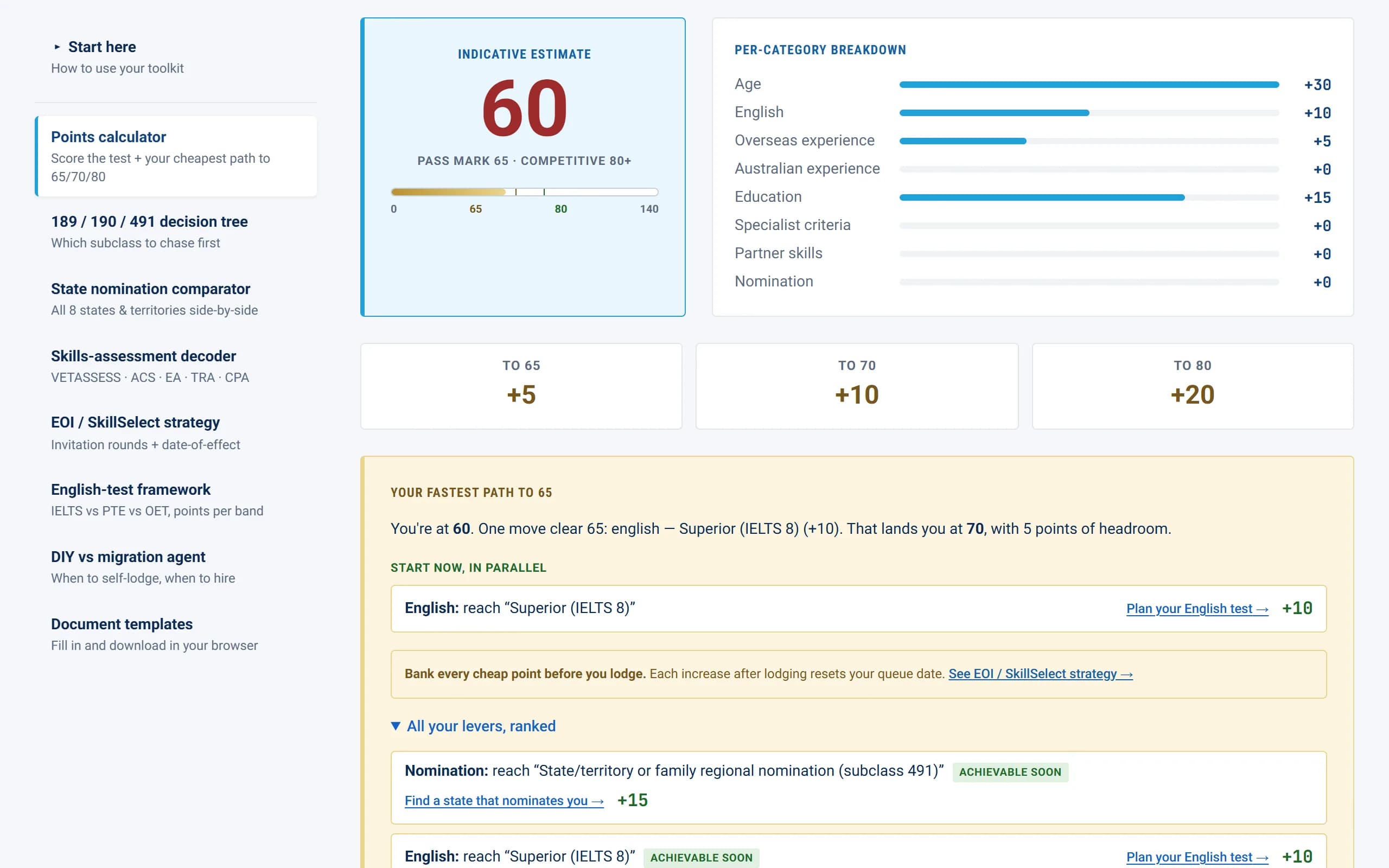
Because 212499 reaches permanent residency mainly through the 190 and 491, your points score determines which states will consider you. The standard factors apply: age, qualification, English, skilled employment, state or regional nomination, and partner skills.
| Points Factor | Points | Notes |
|---|---|---|
| Age (25-32) | 30 | Maximum bracket |
| Qualification (Bachelor) | 15 | Minimum for Skill Level 1 |
| Qualification (Master/PhD) | 15-20 | Higher band if your degree qualifies |
| English (Proficient — 7.0) | 10 | Realistic target |
| English (Superior — 8.0+) | 20 | Strong lift, often decisive |
| Skilled employment (overseas) | 5-15 | Depends on assessed years |
| State nomination (190) | 5 | Apply where eligible |
| Regional nomination (491) | 15 | The largest single boost |
| Partner skills | 5-10 | If your partner has a skilled occupation |
Scenario 1 — Senior content writer, 30, Superior English, 5 assessed years: 30 (age) + 15 (Bachelor) + 20 (English) + 10 (experience) = 75, plus 15 with a 491 regional nomination reaches 90. Competitive in a regional program.
Scenario 2 — Journalist, 34, Proficient English, 3 assessed years: 25 (age) + 15 (Bachelor) + 10 (English) + 5 (experience) = 55, needing a 491 (+15) to reach 70, or an employer willing to sponsor a 482. For more detail on how invitations work, see the SkillSelect EOI guide.
State Nomination
State nomination of 212499 is limited and changes between program years. Writing and media occupations rarely appear as open invitations the way ICT and healthcare codes do. In practice, candidates secure nomination through one of two routes: a genuine job offer with a local employer, or a regional program that accepts the code under a broad professional category. Always confirm the current status against the nominating state's published occupation list before lodging an expression of interest, because a code that was open last year can close without notice. Treat any blanket claim that a particular state "nominates journalists" with caution and verify it directly.
Salary and Employment Outlook
| Role | Typical Salary Range |
|---|---|
| Editorial assistant | AUD $60,000-$75,000 |
| Staff journalist / reporter | AUD $70,000-$85,000 |
| Content writer (corporate) | AUD $80,000-$110,000 |
| Senior writer / commentator | AUD $100,000-$130,000 |
| Communications lead with writing focus | AUD $120,000-$150,000+ |
Figures draw on SEEK 2026 salary data for journalist and writer roles. Total packages add superannuation at 11.5 per cent, and corporate communications roles often pay above editorial roles for equivalent seniority. The highest pay sits in financial services communications, government departments, large consultancies and technology companies, all of which need professional writers for internal and external content. Sydney and Melbourne carry the deepest markets, with Canberra strong for government and public-sector writing.
The structural reality is honest to state. Traditional newsroom employment has contracted, while corporate content, digital publishing and communications roles have grown. A migrant whose experience leans toward corporate and digital writing has a stronger demand profile than one whose experience is purely print newsroom.
Tips for a Successful Application
- Confirm 212499 is genuinely your code. If your work fits Print Journalist, Copywriter, Technical Writer or Editor, use that specific code instead. The "nec" code only fits writers who fall outside those definitions, and VETASSESS will redirect a misfiled application.
- Write references in ANZSCO language. Ask referees to describe researching, composing, editing and presenting written work, with concrete examples of published or commissioned output. Vague "communications duties" wording weakens the employment assessment.
- Keep a portfolio of published work. Bylines, mastheads, datelines and links demonstrate the professional skill level VETASSESS looks for, especially for bloggers and critics whose work is online.
- Aim for Superior English. Writing occupations attract applicants who can realistically reach 8.0 across all bands, and the 20-point lift often decides whether a state will nominate.
- Target the employer route first. Because the code is CSOL-only, a 482 or 186 with a sponsoring employer is frequently more reliable than waiting for a points invitation in a low-demand occupation.
Step-by-Step Migration Roadmap
- Confirm your ANZSCO code against the ANZSCO code finder, ruling out the specific journalism and writing codes first.
- Check the list status of 212499 on the Core Skills Occupation List.
- Gather your portfolio and references describing duties that match 212499.
- Sit your English test, aiming for Superior (8.0+) where possible.
- Lodge your VETASSESS assessment as a Group B professional occupation.
- Calculate your points with assessed experience factored in.
- Submit an expression of interest in SkillSelect for the 190 or 491.
- Apply for state or regional nomination where the code is open.
- Alternatively, secure an employer willing to sponsor a 482 or 186.
- Receive your invitation and lodge the visa within the allowed period.
- Complete health and character checks.
- Receive the grant and relocate.
Frequently Asked Questions
Why is this occupation classified as "nec" rather than having its own code?
ANZSCO already has dedicated codes for print journalists, copywriters, technical writers and editors. The "nec" code 212499 exists to capture professional writers whose work does not fit any of those tighter definitions, such as bloggers, critics and photojournalists working at a Bachelor-degree skill level. It is a residual category by design.
Which writing roles should use a more specific code instead?
If you primarily report news for a print or online masthead, you likely fit Print Journalist. If you write advertising and marketing copy, Copywriter fits better. If you produce manuals and technical documentation, Technical Writer applies. Using 212499 when a specific code fits your duties is the most common reason these assessments are knocked back.
Can I get permanent residency directly as a writer?
Yes, through the subclass 186 Employer Nomination Scheme, because 212499 sits on the CSOL. The 189 independent visa is not available because the code is not on the MLTSSL. The 190 and 491 reach permanent residency but depend on a state or region nominating the code, which is selective for writing occupations.
What is the demand outlook for writers in Australia in 2026?
Mixed but shifting. Traditional newsroom employment has contracted, while corporate communications, digital content and in-house publishing roles have grown. Candidates with experience in corporate and digital writing have a stronger demand profile than those with purely print newsroom backgrounds. For where writing sits against higher-demand fields, see the most in-demand occupations list.
How long does the whole process take?
Budget around seven weeks for a standard VETASSESS assessment, plus English testing beforehand and the expression-of-interest and nomination wait afterward. Employer-sponsored routes can move faster once a sponsor is in place, while state-nominated routes depend on program timing. The full journey from decision to grant commonly runs nine to eighteen months.