Architectural, Building and Surveying Technicians nec Visa Pathway to Australia: Complete 2026 Guide
Updated: 16 August 2026
Australia classifies Architectural, Building and Surveying Technicians not elsewhere classified under ANZSCO 312199. VETASSESS conducts the skills assessment as a Group C occupation. The code is on the Core Skills Occupation List (CSOL) and the Short-Term Skilled Occupation List (STSOL), making subclasses 190, 491, 482 and 186 available. The 189 is closed. Typical 2026 salaries range AUD $70,000-$110,000 depending on the technical specialisation.
Quick Facts: Architectural, Building and Surveying Technicians nec Migration Pathway
| Detail | Information |
|---|---|
| ANZSCO Code | 312199 (Architectural, Building and Surveying Technicians nec) |
| Skill Level | 2 (AQF Diploma or higher) |
| Skill Group | Group C — VETASSESS professional assessment |
| Skills Assessment | VETASSESS |
| Occupation List | CSOL + STSOL (no MLTSSL — 189 unavailable) |
| Visa Options | 190, 491, 482, 186 |
| Demand Level | Moderate — concentrated in niche technical fields adjacent to surveying and construction |
| Salary Range | AUD $70,000-$110,000 (SEEK construction/surveying technician 2026 data) |
| Typical 482 Salary | Most roles sit in Core Skills band |
| Key Challenge | "nec" residual status — applicants must prove their role does not fit one of the named codes |
What "nec" Means and Who Falls Under 312199
ANZSCO 312199 is a "not elsewhere classified" residual code. It captures technician roles that perform architectural, building or surveying support functions but do not fit cleanly into the named codes in the 3121 unit group — Architectural Draftsperson (312111), Building Associate (312112), Building Inspector (312113), Construction Estimator (312114), Clerk of Works (312115) or Plumbing Inspector (312116).
In practice, the migrants who use 312199 typically fall into one of these categories:
- Geographic Information System (GIS) technicians performing spatial-data work that supports surveyors and town planners
- Cartographic or mapping technicians
- Hydrographic survey support technicians
- Photogrammetric technicians
- BIM/digital-construction coordinators whose role spans more than one named code
- Building services coordinators
- Drone-survey or LiDAR technicians supporting construction and surveying teams
- Technical officers in council planning departments performing site inspections and approvals support work that does not fit Building Inspector cleanly
If your role does fit one of the named codes, you should use the named code — VETASSESS will reject 312199 applications where the role clearly maps to a more specific occupation.
What Architectural, Building and Surveying Technicians Do in Australia
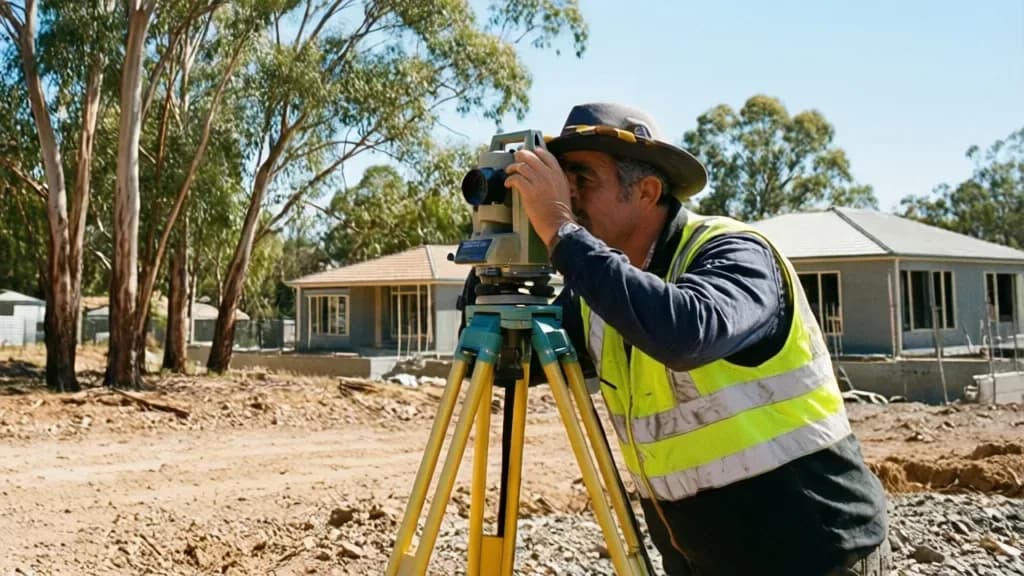
The work sits in the technical support layer of construction, surveying and built-environment professions. On the surveying side, the role often involves spatial-data capture and processing — fieldwork with total stations, GNSS receivers, LiDAR, drones, and photogrammetric platforms, followed by office processing in software like Civil 3D, Trimble Business Center, Leica Cyclone, Pix4D, or ArcGIS. On the construction side, the role can mean building-services coordination, BIM model management, or council-side technical assessment of development applications.
Employers include surveying consultancies (Veris, Geomatics, AAM, JBA, RPS), spatial-services arms of engineering consultancies (Aurecon, GHD, Cardno, SMEC, Beca), architectural and BIM consultancies, local government planning departments, and the spatial-data teams of utilities and transport agencies (Sydney Water, Melbourne Water, Transport for NSW, V/Line).
Geographically, demand follows the infrastructure pipeline. NSW and Victoria dominate by volume. Queensland's Olympic-linked infrastructure has driven a step-up in spatial demand. WA and SA have substantial demand tied to mining and defence. Tasmania and NT have smaller but consistent demand.
ANZSCO 312199 — The Code in Detail
The ABS description: This residual occupation includes technicians performing architectural, building or surveying support functions not elsewhere classified.
Typical tasks across the technicians captured by this code:
- Operating survey instruments and processing field data
- Producing spatial datasets, maps and survey plans
- Supporting BIM model coordination across consultants
- Performing technical inspections and supporting approvals processes
- Managing geographic information systems and spatial databases
- Producing visualisations from drone, LiDAR or photogrammetric capture
- Assisting registered surveyors, architects or building inspectors with technical content
The adjacent named codes — 312111 (Architectural Draftsperson), 312112 (Building Associate), 312113 (Building Inspector), 312114 (Construction Estimator) — should be used in preference where the role fits. The Surveying Technician role (no separate ANZSCO code; falls under 312199 or sometimes 312911 Maintenance Planner depending on duties) is the most common true-fit case for 312199.
Skills Assessment — VETASSESS
VETASSESS assesses 312199 as a Group C occupation. The assessment is two-part: confirming the role genuinely does not fit a named code, and assessing qualification and employment under the standard Group C criteria.
Assessment fees (current schedule from October 2025):
- Full skills assessment (offshore): AUD $1,096
- Full skills assessment (onshore, GST inclusive): AUD $1,205.60
- Priority Processing (additional): AUD $825 (offshore) / $907.50 (onshore)
Processing time: VETASSESS publishes 12-14 weeks standard processing. Priority Processing reduces this to approximately 10 business days.
Group C qualification + employment pathways:
- AQF Diploma level qualification in a highly relevant field + 1 year post-qualification highly relevant employment in the last 5 years
- AQF Diploma in a highly relevant field + Certificate IV in a highly relevant field + 1 year employment
- AQF Diploma in a less relevant field + 2 years post-qualification highly relevant employment in the last 5 years
- No relevant qualification + 4 years employment including 1 year in the last 5 years
For 312199, "highly relevant" qualifications include surveying, spatial information, geomatics, geographic information systems, photogrammetry, hydrography, construction management, building surveying, and architectural technology — depending on the specific technician variant being claimed.
Common rejection reasons. The biggest issue is duty mismatch with a more specific named code. If your work is genuinely 80% architectural drafting, VETASSESS will reject 312199 and suggest 312111. The second common issue: applicants whose work is predominantly survey-instrument operation without office-side spatial processing or technical-support content — VETASSESS may read these cases as below the AQF Diploma skill level.
Visa Pathways for 312199
With placement on CSOL and STSOL but not MLTSSL, available routes are 190, 491, 482 and 186.
Subclass 190 — State Nominated Visa
Permanent residency through state nomination. Adds 5 points.
- Visa application fee: AUD $6,140
- Commitment: 2 years in the nominating state
- Reality for 312199: State activity is narrow for this residual code. Tasmania, ACT and NT have been the most consistent for niche technician roles.
Subclass 491 — Skilled Work Regional (Provisional)
5-year provisional visa with PR pathway through subclass 191. Adds 15 points.
- Visa application fee: AUD $6,140
- Best states: Tasmania, SA, NT, ACT, regional QLD, regional WA
Subclass 482 — Skills in Demand Visa
Employer-sponsored temporary visa, up to 4 years.
- Visa application fee (primary): AUD $4,015
- Salary thresholds: Core Skills $79,423; Specialist Skills $146,576 from 1 July 2026 (previously $76,515 and $141,210).
- Reality for 312199: Most technician roles sit in the Core band. Senior BIM coordinators and GIS specialists can clear Specialist Skills.
Subclass 186 — Employer Nomination Scheme
Permanent residency through employer sponsorship.
- Visa application fee: AUD $6,140
- Streams: Direct Entry (3+ years experience + skills assessment) or Temporary Residence Transition (after time on a 482)
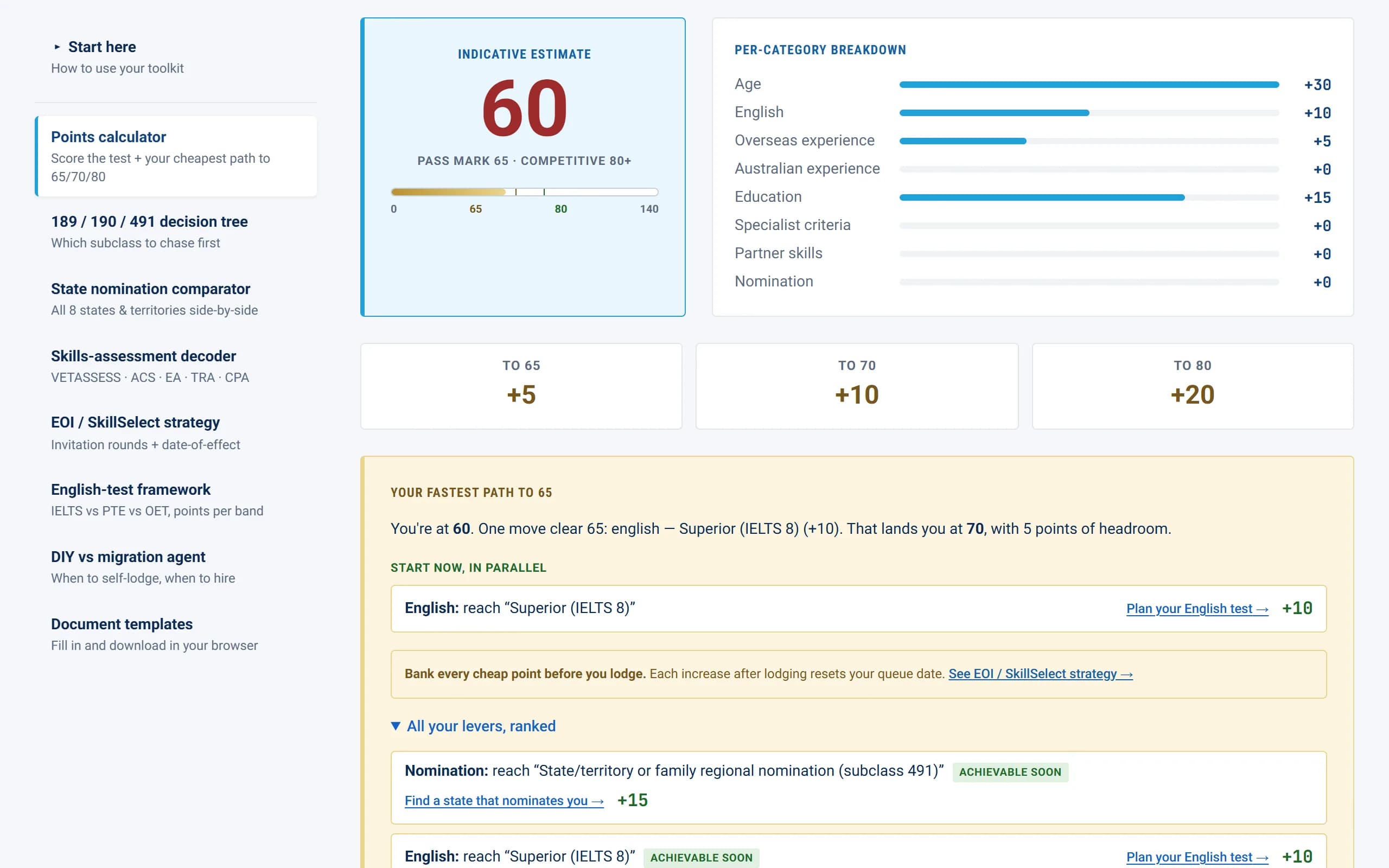
Points Test Strategy (for 190/491)
| Points Factor | Points | Notes |
|---|---|---|
| Age 25-32 | 30 | Maximum |
| Age 33-39 | 25 | |
| AQF Diploma | 10 | Minimum for code |
| Bachelor degree | 15 | Common for spatial and BIM roles |
| Master's | 15 | |
| English Proficient (IELTS 7) | 10 | |
| English Superior (IELTS 8) | 20 | |
| Overseas experience 3-5 years | 5 | |
| 5-8 years | 10 | |
| 8+ years | 15 | |
| Australian study | 5 | |
| State nomination 190 | 5 | |
| Regional 491 | 15 | |
| Partner skills | 5-10 |
Realistic Scenarios
Scenario A — Indian GIS technician, 29, bachelor in geography/GIS, 6 years experience, IELTS 7: 30 + 15 + 10 + 10 = 65. With 491 regional (+15) reaches 80, competitive for Tasmania, SA and NT.
Scenario B — UK BIM technician, 33, advanced diploma + Certificate IV in CAD, 9 years experience, IELTS 8: 25 + 10 + 20 + 15 = 70. With 190 (+5) reaches 75, marginal — adding 491 (+15) reaches 85 for stronger competitiveness.
State Nomination
Activity for 312199 is narrow. Verify each state's current list before lodging.
Tasmania
Tasmania's Skilled Migration Program has historically nominated 312199 under both 190 and 491 streams when the role aligns with the state's spatial-services or surveying demand. Hobart's surveying consultancies and government spatial-data teams provide consistent demand for technicians.
Australian Capital Territory
The ACT's Critical Skills List includes spatial and GIS technician roles intermittently, tied to federal-government spatial-data work (Geoscience Australia, the Department of Defence, the Bureau of Meteorology). Onshore candidates already working in Canberra have a meaningful edge.
Northern Territory
The NT program includes survey and spatial-technician roles when defence-linked and resources-linked demand justifies it. Darwin's infrastructure pipeline tied to AUKUS and resources keeps activity steady.
South Australia
SA's program intermittently includes spatial and survey-technician roles, particularly tied to the defence pipeline and the Hospital Network expansion.
Salary and Employment Outlook
| Role | Typical Range (AUD) |
|---|---|
| Junior Survey/GIS Technician (0-3 yrs) | $60,000-$80,000 |
| Survey/Spatial Technician (3-7 yrs) | $80,000-$100,000 |
| Senior Spatial / GIS Specialist | $95,000-$120,000 |
| BIM Coordinator | $95,000-$130,000 |
| Senior BIM / Digital Engineering Specialist | $115,000-$145,000 |
| Drone / LiDAR Specialist | $90,000-$130,000 |
| Contract technician (day rate) | $500-$900/day |
Sources: SEEK Career Advice (Apr-May 2026) for spatial, surveying and BIM technician roles; PayScale Australia 2026 data; cross-checked against current job-ad disclosures from major spatial consultancies and engineering firms.
Superannuation is 11.5% on top of base. Engineering consultancies and tier-one builders pay premiums for BIM and digital-engineering specialists — the role has moved from a CAD-adjacent niche to a critical-path delivery function on major infrastructure tenders. Mining-services consultancies pay above-average rates for drone-survey and spatial specialists working on resource-extraction projects.
Highest-paying domains: digital engineering and BIM coordination on major infrastructure programs, defence spatial-services, mining-services spatial, and government spatial-data roles. Local-government technical-officer roles pay below the private-sector median but with strong work-life-balance trade-offs.
Tips for a Successful Application
1. Justify why your role doesn't fit a named code
VETASSESS reads "nec" applications carefully. If your role is 70% drafting, the body will redirect you to 312111. If it's 70% site supervision, to 312112. Be ready to demonstrate that your actual duty mix spans multiple named codes without dominating any one — or that you sit in a recognised technician variant (GIS, BIM, drone-survey) that genuinely does not fit elsewhere.
2. Quantify the spatial or digital-engineering content
The strongest 312199 applications come from candidates with substantive spatial, GIS, BIM or digital-engineering content in their role. Reference letters should name specific software (ArcGIS, QGIS, Civil 3D, Revit, Navisworks, Pix4D, Leica Cyclone), project deliverables, and the dataset volumes processed.
3. Don't pad your qualification
The most common rejection failure is qualifications assessed as not highly relevant. A Bachelor of Geography without GIS or spatial content does not pass for a GIS-technician application. A general construction diploma without surveying or digital-engineering subjects does not pass for a survey-technician application. Lead with the spatial, surveying or BIM subjects in your transcript when lodging.
4. Onshore experience materially improves your case
Surveying and spatial work in Australia is heavily regulated by state-based surveyor registration boards. Even though 312199 itself does not require registration, sponsoring employers and state nomination panels look for evidence of familiarity with Australian standards (the AS series, the Surveying and Spatial Information Acts, the National BIM Initiative). A 6-12 month onshore stint on a graduate or partner visa, or completed Australian study, strengthens applications materially.
5. Move toward a named code as your career develops
312199 is a viable entry code but the long-term migration outcomes are better under a named code. Many technicians enter on a 482 under 312199, then re-assess under a named code (312111, 312112 or even 232212 Surveyor for those who complete the registration pathway) as their role specialises.
Step-by-Step Migration Roadmap
- Confirm your role does not fit a named code — see how to find your ANZSCO code
- Gather qualification documents (diploma/degree, transcripts, syllabus content)
- Prepare detailed employment references quantifying technical software use, deliverables and supervision
- Sit IELTS, PTE or OET — Superior English is the biggest single points lever
- Lodge VETASSESS Group C assessment (AUD $1,096 offshore; 12-14 weeks)
- Calculate points
- Choose route: 190 nomination, 491 regional, or 482 sponsorship
- For nomination, identify a state where your specialisation is on the active list (Tasmania, ACT, NT, SA most common)
- Lodge EOI (190/491) or have employer lodge nomination (482)
- Receive invitation and lodge visa application within 60 days
- Complete medicals and police checks
- Receive grant and relocate
Internal references: skills assessment bodies complete list, CSOL hub, architectural draftsperson pathway, building associate pathway, SOL 2026.
Frequently Asked Questions
Should I apply under 312199 or one of the named codes in 3121?
Always apply under a named code if your role genuinely fits. VETASSESS rejects 312199 applications where the duty profile clearly maps to 312111, 312112, 312113 or 312114. The "nec" code is reserved for residual technician roles — GIS, spatial, BIM, drone-survey, photogrammetric — that do not fit one of the named codes. If you're unsure, look at how more than 50% of your time is spent and apply under the closest named code if there is a dominant activity.
Why does the salary range vary so widely for this code?
Because 312199 captures multiple distinct technician roles with different market values. A council building-inspection technical officer sits in the $70k-$90k band; a senior BIM coordinator on a major infrastructure tender sits at $130k+; a GIS specialist with mining-industry experience sits between the two. Your specific specialisation determines where in the range you'll land.
Is registration as a surveyor required for 312199?
No. ANZSCO 312199 is a technician role and does not require state-level surveyor registration. If you want to practise as a registered Surveyor (ANZSCO 232212), that's a separate professional pathway managed by state Surveyors Boards (NSW Board of Surveying and Spatial Information, the Surveyors Registration Board of Victoria, etc.) and assessed by the Spatial Sciences Institute or the equivalent state body.
Do I need a BIM or GIS certification before applying?
Not formally — neither VETASSESS nor the Department of Home Affairs require a vendor certification. But sponsoring employers and state nomination panels weight Autodesk Certified Professional (Revit), Esri Technical Certification (ArcGIS), and similar credentials heavily. They add credibility and reduce the perceived ramp time.
Will my Surveying Technician role pass under 312199?
Yes, in most cases. The Surveying Technician role is the most common true-fit case for 312199 — it doesn't have its own ANZSCO code, but it clearly fits the unit group 3121 unit description. VETASSESS routinely assesses surveying technicians positively under 312199 where the qualification and employment criteria are met.
Is there a faster route than 491 regional for this code?
For non-sponsored migration, no — the 491 is the fastest realistic skilled-migration route given the absence of 189 eligibility. For sponsored migration, the 482 (or 494 for regional sponsors) into 186 TRT is faster end-to-end than waiting for a 190 invitation. Sponsorship is the preferred route for senior BIM and spatial specialists; the points-based 491 is preferred for mid-career technicians without a confirmed employer.