Electrical Engineering Technician Visa Pathway to Australia: Complete 2026 Guide
Updated: 16 August 2026
Australia classifies Electrical Engineering Technician under ANZSCO 312312. Trades Recognition Australia (TRA) conducts the skills assessment via the Migration Skills Assessment (MSA) program. The occupation sits on the MLTSSL and CSOL, unlocking subclasses 189, 190, 491, 482 and 186. Typical 2026 salaries range AUD $85,000-$120,000. The occupation is in active demand across the renewables, defence, infrastructure and resources sectors.
Quick Facts: Electrical Engineering Technician Migration Pathway
| Detail | Information |
|---|---|
| ANZSCO Code | 312312 (Electrical Engineering Technician) |
| Skill Level | 2 (Associate Degree, Advanced Diploma, Diploma — or AQF Cert IV + 2 yrs experience) |
| Skills Assessment | TRA (Trades Recognition Australia) — Migration Skills Assessment |
| Occupation List | MLTSSL and CSOL |
| Visa Options | 189, 190, 491, 482, 186 |
| Demand Level | High — renewables build-out, defence projects and grid upgrades driving sustained hiring |
| Salary Range | AUD $85,000-$120,000 (SEEK Salary Hub, 2026) |
| Typical 189 Score | 75-85 points |
| Key Challenge | TRA documentation is heavier than engineering body assessments — payslips, tax records and photos of workplaces all expected |
What an Electrical Engineering Technician Does in Australia
The role sits between the tradesperson electrician and the fully qualified electrical engineer. Electrical Engineering Technicians design, build, test, install and commission electrical and electronic systems under the direction of professional engineers. The work is technical and specification-driven rather than installation-only.
In Australia the role is concentrated in five sectors: renewable energy (utility-scale solar farms, battery storage, transmission upgrades for AEMO's Integrated System Plan), defence (AUKUS submarine and frigate programs, Hanwha land systems), resources (BHP, Rio Tinto, Fortescue mine electrification programs), infrastructure (Snowy 2.0, Marinus Link, state grid operators) and manufacturing. Employers range from large EPCs (UGL, Downer, John Holland, Acciona) through OEM equipment vendors (ABB, Schneider Electric, Siemens) to specialist substation and protection consultancies.
Jobs and Skills Australia reports electrical technician shortages across multiple states, and the renewables build-out alone is forecast to require thousands of additional electrical technicians through 2030 to deliver the AEMO transmission plan.
ANZSCO 312312 — Code Mapping
The ABS describes Electrical Engineering Technician as conducting tests of electrical systems, preparing charts and tabulations, and assisting in cost estimation, in support of Electrical Engineers and Engineering Technologists. Indicative tasks paraphrased from ANZSCO:
- Assisting in the preparation of electrical drawings, plans and specifications
- Conducting tests of electrical systems and recording results
- Diagnosing complex problems and replacing faulty components
- Installing, maintaining and repairing electrical equipment
- Estimating labour, material and construction costs
- Preparing technical reports
If you are a hands-on licensed electrician installing wiring on construction sites, ANZSCO 341111 Electrician (General) is the correct code — not 312312. If you hold a four-year bachelor's degree in electrical engineering and work in design and analysis, ANZSCO 233311 Electrical Engineer is the right code and Engineers Australia is the assessing body. The technician code applies to diploma- or associate-degree-qualified specialists working in engineering support roles.
For an adjacent occupation, see Civil Engineering Technician which uses an identical assessment framework but covers civil work.
Skills Assessment — Trades Recognition Australia
TRA's Migration Skills Assessment (MSA) program covers Electrical Engineering Technician under the trades and technical occupations stream.
Requirements
- AQF Certificate III, IV, Diploma, Advanced Diploma or Associate Degree (or equivalent) closely related to the nominated occupation
- Sufficient post-qualification employment — typically 3+ years in the nominated occupation at the appropriate skill level
- Detailed employment evidence: payslips, tax records, employment contracts, references with task descriptions, organisational charts and dated photographs of workplaces
Assessment cost (2026): AUD $1,070 for a standard MSA application
Processing time: TRA aims to finalise applications within 120 days of payment, though documentation-complete files often clear faster.
Common rejection reasons
TRA refusals are usually documentation-driven rather than substantive. The pattern is: thin or undated employer references, missing payslips for claimed employment periods, qualification documents that cannot be verified against the institution's records, or task descriptions in references that mirror the ANZSCO description too closely (TRA reads this as coached and discounts the evidence). Get original payslips for every month of claimed experience before you lodge.
Visa Pathways for Electrical Engineering Technician
Subclass 482 — Skills in Demand (Core Skills Stream)
Employer sponsorship is the dominant route for many technicians. Major EPCs and OEMs sponsor offshore technicians regularly for projects on tight build schedules.
- Visa fee: AUD $4,015 (Core Skills primary)
- Core Skills Income Threshold: AUD $79,423 — most technician roles in renewables and defence clear this
- Duration: Up to 4 years
- Processing: Median 21-47 days for the Core Skills stream
- Quirk: Specialist Skills stream (salary above AUD $146,576) is faster but most technician roles fall under Core Skills
Subclass 186 — Employer Nomination Scheme
Permanent residency via employer sponsorship. The natural step after 2+ years on a 482 under the TRT stream, or via Direct Entry if you hold three years of post-qualification experience.
- Visa fee: AUD $6,140
- Streams: Direct Entry or Temporary Residence Transition
- Processing: 12-20+ months (backlog persists)
Subclass 189 — Skilled Independent
Permanent residency through the points test. Available because 312312 sits on the MLTSSL.
- Visa fee: AUD $6,135
- Realistic invitation score: 75-85 points
- Processing: 8-14 months
Subclass 190 — State Nominated
State nomination adds 5 points and grants permanent residency.
- Visa fee: AUD $6,140
- Strongest states for 312312: New South Wales (transmission and rail), Victoria (renewables), Western Australia (resources), South Australia (defence)
- Processing: 9-19 months (after state approval)
Subclass 491 — Skilled Work Regional
Five-year provisional visa with PR pathway via subclass 191.
- Visa fee: AUD $6,140
- Points boost: +15 from regional nomination
- Processing: 12-15 months
- Quirk: Regional renewables projects (Western Downs, Murray River, Gippsland) routinely sponsor and nominate offshore technicians
Points Test Strategy
| Points Factor | Points | Notes |
|---|---|---|
| Age 25-32 | 30 | Maximum bracket |
| Diploma / Advanced Diploma / Associate Degree | 10 | Skill Level 2 baseline |
| Bachelor's | 15 | If your qualification sits at AQF 7 |
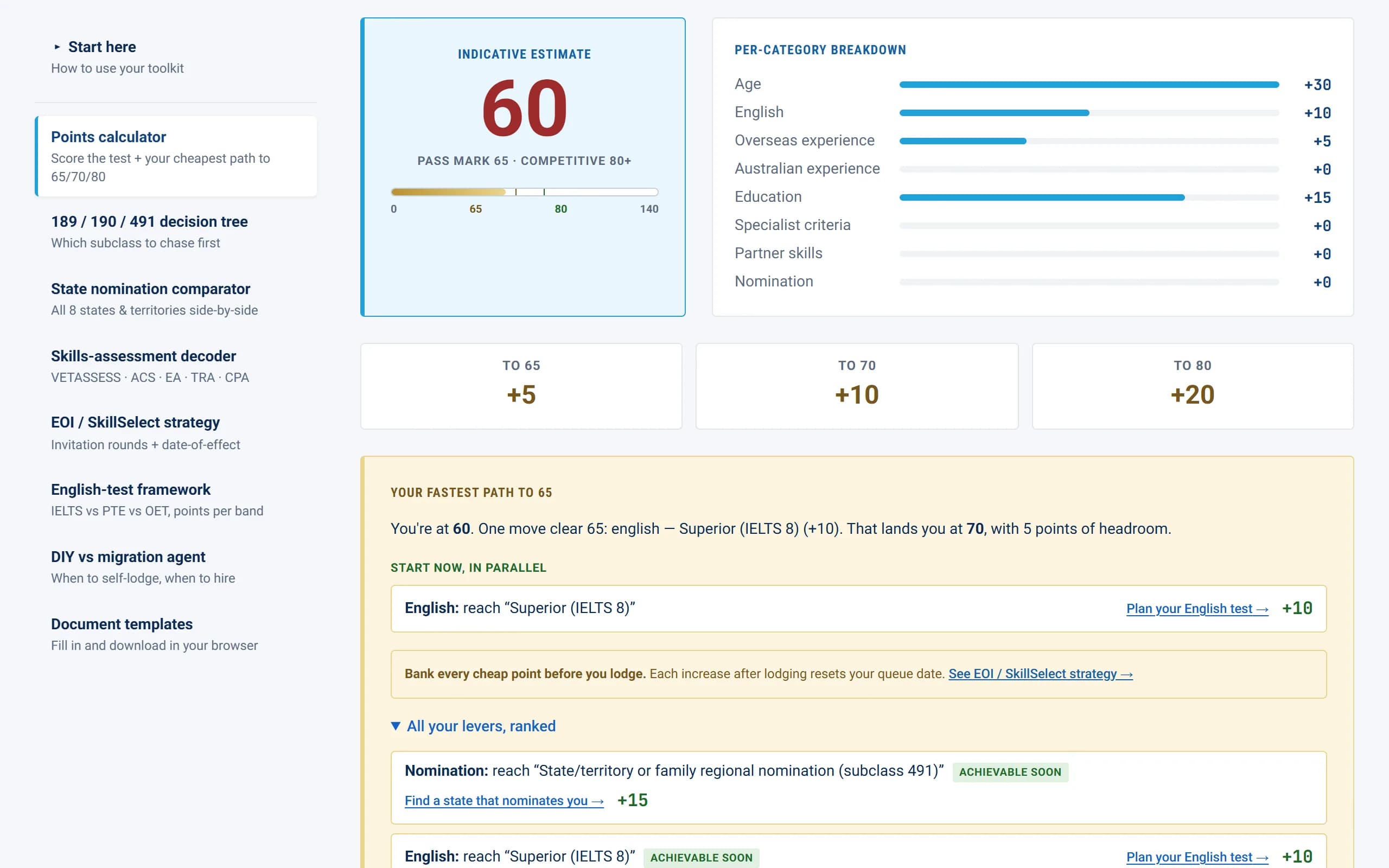
| English Superior (IELTS 8.0) | 20 | Difficult but achievable with prep |
| English Proficient (IELTS 7.0) | 10 | Realistic benchmark |
| Overseas experience 5-8 years | 10 | Standard for mid-career technicians |
| State nomination (190) | 5 | NSW, VIC, SA, WA all nominate 312312 |
| Regional nomination (491) | 15 | Strong renewables pipeline in regional VIC, NSW, QLD |
| Partner skills | 5-10 | If partner has a skilled occupation |
Realistic Scenarios
Scenario 1: Mid-career technician, India
Age 30 (30) + Advanced Diploma (10) + IELTS 7.0 / Proficient (10) + 6 years experience (10) = 60 points. Add 491 regional nomination (+15) = 75 points. Competitive.
Scenario 2: Senior technician, Europe, renewables specialism
Age 34 (25) + Bachelor's (15) + IELTS 7.5 / Proficient (10) + 8+ years experience (15) + 190 nomination (+5) = 70 points. Plus partner skilled (+10) = 80. Strong invitation profile.
State Nomination
New South Wales
NSW prioritises occupations supporting the energy transition, rail electrification and major infrastructure. Electrical Engineering Technician features on the NSW 2025-26 skilled list under both 190 and 491. The NSW renewables pipeline is large, and Transgrid's transmission build-out is an active source of demand.
Victoria
Victoria's 2025-26 program (3,400 places) is heavily weighted toward renewables, manufacturing and digital sectors. Electrical Engineering Technician is on the eligible occupations under both 190 and 491. Submit a Registration of Interest through the Live in Melbourne portal.
South Australia
South Australia is investing heavily in defence (Hunter-class frigates, AUKUS submarine pillar) and renewables. The state's 2025-26 list (3,800 places) includes engineering technician occupations. South Australia historically accepts applicants with shorter local experience than NSW or Victoria.
Western Australia
WA's resources sector creates continuous demand. The state nominates 312312 with conditions favouring applicants with industrial or resources-sector experience, particularly in instrumentation, protection and high-voltage systems.
Queensland
Queensland's regional renewables pipeline (Western Downs, Genex, CopperString 2032) creates strong 491 opportunities. The state's 190 list is more competitive but accessible to applicants with Queensland job offers.
Salary and Employment Outlook
Typical 2026 Earnings
| Role | Salary Range (AUD) |
|---|---|
| Junior Electrical Technician (1-3 yrs) | $75,000-$90,000 |
| Electrical Engineering Technician (mid) | $90,000-$110,000 |
| Senior Technician / Specialist | $110,000-$130,000 |
| Protection & Control Technician (utilities) | $115,000-$140,000 |
| Instrumentation Technician (resources / FIFO) | $130,000-$170,000 + LAFHA |
| Defence-cleared Technician | $115,000-$150,000 |
| Contracting day rates (renewables EPC) | $700-$1,100/day |
Figures reflect SEEK Salary Hub 2026 averages for electrical technician roles, with sector and seniority spreads. FIFO mining roles add 25-40% loading plus accommodation, food and transport. Defence-cleared roles attract security clearance allowances. All figures sit above the AUD $79,423 482 Core Skills Income Threshold.
Highest-Paying Sectors
- Resources (BHP, Rio Tinto, Fortescue, Roy Hill) — highest base plus FIFO loadings
- Defence (BAE Systems, ASC, Hanwha) — security clearance premiums
- Renewables EPCs (Acciona, Vestas, GE Vernova, Goldwind) — strong base plus completion bonuses
- Utilities (Transgrid, AusNet, Powerlink, AEMO) — stable, structured pay scales
- Industrial automation (ABB, Siemens, Rockwell) — strong base plus equity for senior roles
Tips for a Successful Application
1. Build a TRA evidence file before you start the application
TRA documentation is the single biggest cause of refusal. For each claimed employment period gather: contract or appointment letter, every monthly payslip, tax statement (Form 16 in India, BIR 2316 in the Philippines, equivalent elsewhere), an itemised reference signed by a verifiable supervisor on official letterhead with their direct phone number, and 5-10 dated photographs of you at the workplace with equipment. Assume TRA will call your supervisor — they often do.
2. Match your qualification cleanly to AQF Cert IV or above
If your technical diploma sits below AQF Certificate IV equivalent, you may need a top-up qualification or additional verifiable experience. Run a TRA pre-assessment if there is any doubt — it costs less than a failed full assessment.
3. Consider 482 first if your points are tight
For technicians with 60-65 points, employer sponsorship is often faster and more certain than waiting for an invitation. Major EPCs working on renewables, defence and infrastructure are actively sponsoring offshore technicians. A 482 also builds Australian experience that boosts your points score for a later 189 or 190.
4. Specialise — generalists struggle
Australia hires technicians by specialism. Protection and control, instrumentation, high-voltage, renewables-specific (BESS, inverter commissioning, transformer testing), rail traction, or defence systems — pick one and make it visible on your CV. Generalist "electrical technician" applications attract fewer interviews than specialist profiles.
5. Get your English higher than the minimum
IELTS 7.0 / Proficient is the realistic baseline. Pushing to Superior (IELTS 8.0) adds 10 points and moves most candidates from waiting on a 491 to a competitive 189 or 190 profile. The OET is not appropriate for engineering occupations — book IELTS Academic.
Step-by-Step Migration Roadmap
- Confirm ANZSCO 312312 is the right code — review how to find your ANZSCO code
- Check the Skilled Occupation List 2026 for current status
- Assemble TRA evidence — qualifications, every payslip, tax records, photographs, references
- Sit IELTS Academic — aim for 7.0+ in every band; 8.0 is materially better
- Lodge TRA Migration Skills Assessment — AUD $1,070, allow up to 120 days
- Build a target list of employers — EPCs, OEMs, utilities, defence primes
- Submit Expression of Interest in SkillSelect for 189, 190 or 491
- Apply for state nomination — NSW, VIC, SA, WA, QLD per your specialism
- Pursue 482 in parallel if you have or can secure a job offer
- Receive invitation — lodge visa within 60 days
- Complete health and character checks — police clearances from each country lived in for 12 months
- Receive visa grant and finalise relocation
Frequently Asked Questions
Is Electrical Engineering Technician the same as Electrician?
No. Electrician (General) ANZSCO 341111 is a hands-on licensed trade focused on installation, maintenance and compliance of electrical wiring. Electrical Engineering Technician 312312 is an engineering-support role focused on testing, design assistance, commissioning and technical reporting under the direction of a qualified engineer. The two codes have different assessing bodies (CPC for Electrician, TRA for Technician) and different qualification expectations. Choose based on what you actually do at work.
Can I lodge a 189 visa or do I have to go employer-sponsored?
You can lodge a 189. Electrical Engineering Technician is on the MLTSSL, which makes the 189 available. The realistic invitation threshold sits at 75-85 points for 312312 in 2026 — achievable with a Bachelor's, Superior English, mid-career experience and partner-skills points. If your score is below that, look at 491 regional (+15) or 482 employer-sponsored as the faster route.
Will my Indian, Filipino or Egyptian diploma be recognised by TRA?
TRA assesses qualifications case-by-case against AQF equivalence. Three-year diplomas from polytechnics in India (Diploma of Engineering), TESDA NC IV qualifications in the Philippines, and equivalent qualifications from Egyptian, Pakistani and Sri Lankan technical institutes are commonly accepted, provided they map cleanly to the ANZSCO description and you have sufficient post-qualification employment. Hospital-based or short-course qualifications often need a top-up.
What state offers the strongest pathway for renewables technicians?
Victoria for solar and BESS, NSW for transmission and high-voltage, Queensland for grid expansion and wind, South Australia for defence-adjacent electrical work, and Western Australia for resources sector electrification. Match your specialism to the state's pipeline rather than chasing the largest absolute allocation.
What are the most common reasons 312312 applications fail?
In order: incomplete TRA documentation (especially missing payslips for claimed experience periods); qualification that does not map cleanly to AQF Certificate IV equivalent; English below 7.0 in any single band; and references that are too generic to satisfy TRA's expectation of detailed task evidence. Each is fixable before lodging — none are reasons to refuse application after the fact.