Electronic Equipment Trades Worker Visa Pathway to Australia: Complete 2026 Guide
Updated: 16 August 2026
Australia classifies Electronic Equipment Trades Worker under ANZSCO 342313. Trades Recognition Australia (TRA) is the assessing authority. The occupation sits on the MLTSSL and CSOL, opening subclasses 189, 190, 491, 482 and 186. Typical 2026 salaries range AUD $70,000-$95,000. Offshore applicants without recognised Australian qualifications typically complete the TRA Job Ready Program, which takes 12+ months.
Quick Facts: Electronic Equipment Trades Worker Migration Pathway
| Detail | Information |
|---|---|
| ANZSCO Code | 342313 (Electronic Equipment Trades Worker) |
| Skill Level | 3 (AQF Certificate III or IV — trade qualification) |
| Skills Assessment | TRA (Trades Recognition Australia) — Offshore Skills Assessment or Job Ready Program |
| Occupation List | MLTSSL and CSOL |
| Visa Options | 189, 190, 491, 482, 186 |
| Demand Level | Moderate to high — defence electronics, security systems and broadcast infrastructure all hiring |
| Salary Range | AUD $70,000-$95,000 (SEEK Salary Hub, 2026; Talent.com Australia confirms median $75k) |
| Typical 189 Score | 75-90 points |
| Key Challenge | The Job Ready Program is a 12-18 month gating process for offshore-qualified applicants |
What an Electronic Equipment Trades Worker Does in Australia
The role covers installation, fault diagnosis, repair and maintenance of electronic equipment. The ABS description includes audio-visual reproduction equipment, home entertainment systems, computer hardware, and electronic security systems. In practice the Australian labour market for 342313 spans five active sectors:
- Electronic security — alarm systems, CCTV, access control and integrated building security for ADT, Chubb, Securitas, Wilson Security and a long tail of integrators
- Broadcast and AV — live event AV, sports broadcasting infrastructure, corporate AV (e.g. Foxtel, Stan Sport, AV1, Pro AV)
- Defence electronics — service and repair of avionics, communications, and electronic warfare equipment for BAE Systems, Thales, Raytheon Australia, Lockheed Martin
- Industrial electronics — automation, instrumentation and control system service for manufacturing
- Service technicians — for OEMs servicing copiers, medical imaging, ATMs, point-of-sale, and gaming machines
The occupation is on the Jobs and Skills Australia shortage tracker for several states, particularly in regional areas where qualified service technicians are scarce. Defence growth under AUKUS and the broader Integrated Investment Program is widening the gap further.
ANZSCO 342313 — Code Mapping
The ABS describes Electronic Equipment Trades Worker as installing, maintaining and repairing electronic equipment and systems. Indicative tasks paraphrased:
- Installing and connecting electronic equipment
- Diagnosing electronic faults using test equipment and schematics
- Repairing or replacing faulty components, modules and assemblies
- Performing routine preventative maintenance
- Programming, configuring and testing equipment
- Documenting service work and reporting recurring faults
If your day-to-day work is on electrical wiring and installation for buildings, Electrician (General) ANZSCO 341111 is the right code. If you primarily install and maintain telecommunications cabling and transmission equipment, ANZSCO 342411 Cabler (Data and Telecommunications) or 342314 Telecommunications Cable Jointer may be more accurate. For instrumentation work in industrial settings, ANZSCO 342314 Electronic Instrument Trades Worker (General) often fits better than 342313.
Skills Assessment — Trades Recognition Australia
TRA offers two paths for 342313 depending on where you trained.
Offshore Skills Assessment (OSA)
For applicants whose qualifications and experience were gained outside Australia.
Requirements
- AQF Certificate III equivalent qualification in electronic equipment trades, plus three years of recent post-qualification employment
- Original payslips, tax records, employment contracts, dated workplace photographs, organisation charts, and detailed references for each claimed period
Cost (2026): approximately AUD $1,070 for the standard OSA application
Processing time: TRA aims to finalise within 120 days of payment
Critical detail: A successful OSA is not enough to lodge most skilled visas. Offshore-qualified applicants typically also need to complete the TRA Job Ready Program before a positive skills assessment can be issued for visa purposes.
Job Ready Program (JRP)
The JRP is a four-step employment-based assessment program for trade occupations.
- Provisional Skills Assessment (PSA) — TRA confirms your offshore qualifications and experience are sufficient to enter the program. Cost: AUD $370.
- Job Ready Employment — register a qualifying Australian employer with TRA and begin paid work in the nominated occupation. You must complete 1,725 hours over a minimum of 6 months.
- Job Ready Workplace Assessment (JRWA) — after 863 paid hours an external assessor visits your workplace to assess competence. Cost: AUD $2,510.
- Job Ready Final Assessment (JRFA) — after 1,725 hours TRA issues the migration skills assessment. Cost: AUD $400.
Total JRP cost: approximately AUD $3,650 across all four stages. Total elapsed time: typically 12-18 months from PSA to final assessment.
Common rejection reasons
OSA refusals usually stem from documentation gaps — missing payslips, references that are too vague, or qualifications that do not map cleanly to AQF Certificate III in electronic trades. JRP failures generally come at the workplace assessment stage when the assessor finds the applicant lacks practical competence in core tasks (soldering to standard, fault-finding methodology, calibration procedures). The JRP is rigorous and reflects what TRA expects an Australian-trained tradesperson to do unsupervised.
Visa Pathways for Electronic Equipment Trades Worker
Subclass 482 — Skills in Demand (Core Skills Stream)
Employer sponsorship is the most practical first step for many offshore tradespeople, particularly because the 482 can be lodged with a TRA Provisional Skills Assessment for the Job Ready Program — you do not have to wait for the final assessment.
- Visa fee: AUD $4,015 (Core Skills, primary)
- Core Skills Income Threshold: AUD $79,423 — service-technician roles can be just at or above this depending on employer
- Duration: Up to 4 years
- Processing: Median 21-47 days
- Quirk: Defence integrators and large security companies sponsor 342313 regularly
Subclass 186 — Employer Nomination Scheme
Permanent residency via employer sponsorship. Direct Entry stream requires a positive TRA skills assessment plus three years of post-qualification experience.
- Visa fee: AUD $6,140
- Streams: Direct Entry or Temporary Residence Transition
- Processing: 12-20+ months
Subclass 189 — Skilled Independent
PR through the points test. Available because 342313 is on the MLTSSL.
- Visa fee: AUD $6,135
- Realistic invitation score: 75-90 points
- Processing: 8-14 months
- Reality: Trade occupations rarely clear at the lowest invitation thresholds — plan for 80+ points
Subclass 190 — State Nominated
Adds 5 points and grants PR conditional on state residence.
- Visa fee: AUD $6,140
- Strongest states: South Australia (defence), Victoria (security), Western Australia (resources electronics)
- Processing: 9-19 months
Subclass 491 — Skilled Work Regional
Five-year provisional visa with PR pathway via subclass 191.
- Visa fee: AUD $6,140
- Points boost: +15 regional
- Processing: 12-15 months
- Reality: Regional employers in security and broadcast electronics often sponsor and nominate offshore tradespeople
Points Test Strategy
Skill Level 3 trade occupations rarely reach the lowest invitation thresholds without state or regional nomination. The realistic profile:
| Points Factor | Points | Notes |
|---|---|---|
| Age 25-32 | 30 | Maximum bracket |
| AQF Certificate III/IV qualification | 10 | Trade qualification baseline |
| Diploma or higher | 15 | If you also hold a diploma in electronics engineering |
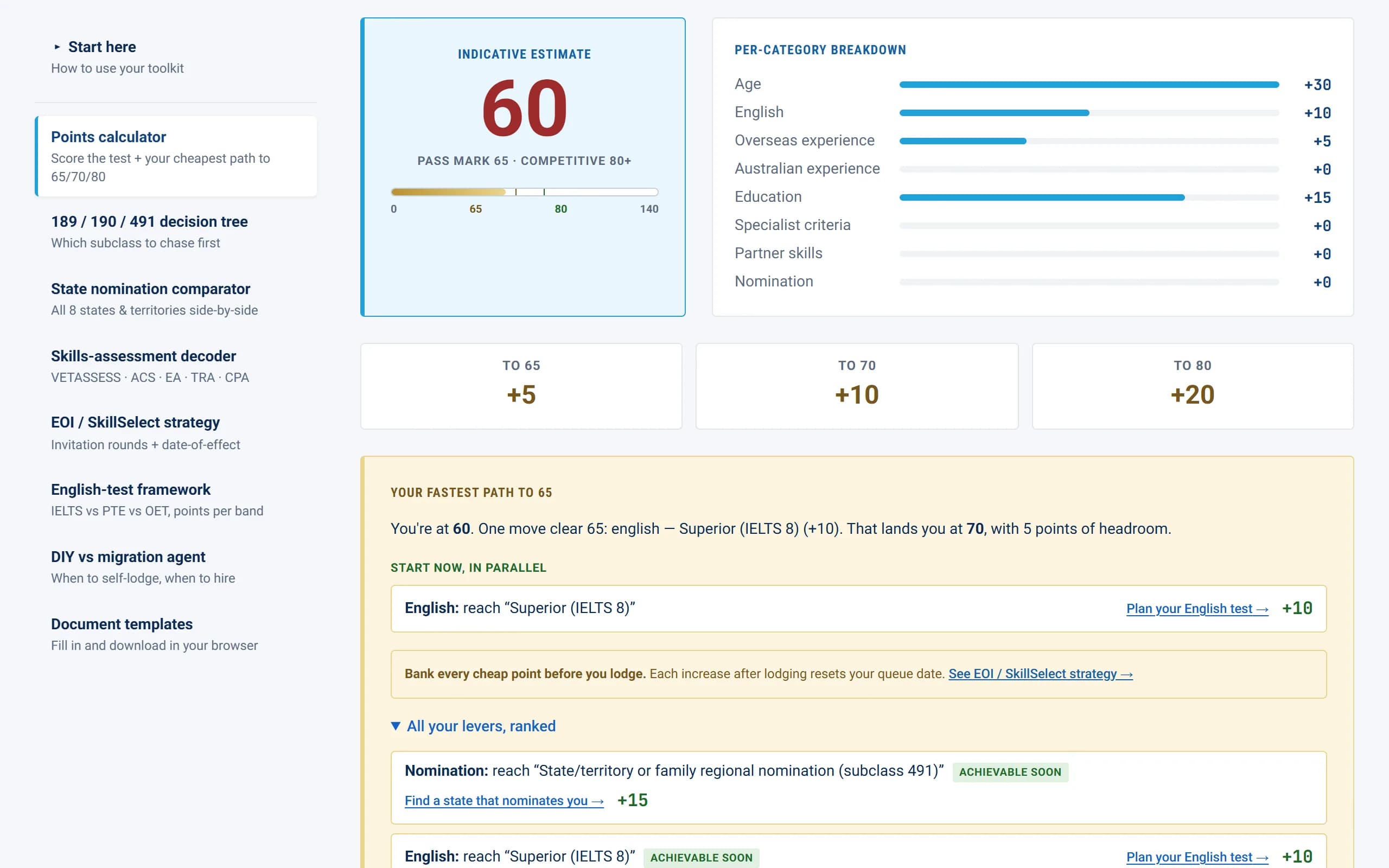
| English Superior (IELTS 8.0) | 20 | Difficult but materially valuable |
| English Proficient (IELTS 7.0) | 10 | Realistic benchmark |
| Overseas experience 5-8 years | 10 | Standard for mid-career service techs |
| Australian experience 1 year+ | 5 | Common if you complete the JRP |
| State nomination (190) | 5 | Several states nominate |
| Regional nomination (491) | 15 | Strongest lever for trade occupations |
| Partner skills | 5-10 | If partner has a skilled occupation |
Realistic Scenarios
Scenario 1: Offshore tradesperson via JRP and 491
Age 30 (30) + Cert III/IV (10) + IELTS 7.0 / Proficient (10) + 6 years experience (10) + 1 year Australian experience from JRP (5) + 491 nomination (15) = 80 points. Strong invitation profile.
Scenario 2: Employer sponsorship route
Skip the points test entirely. Secure a 482 job offer with a defence integrator, security company or broadcast employer; lodge 482 against a TRA Provisional Skills Assessment; complete the JRP while on the 482; transition to 186 TRT after two years.
State Nomination
South Australia
South Australia is the strongest state for 342313 because of the concentration of defence work — the Hunter-class frigate program, Collins-class submarine sustainment, and AUKUS pillar one work all need electronic technicians. South Australia's 2025-26 skilled program (3,800 nomination places) includes trade electronics occupations.
Victoria
Victoria's 2025-26 program covers electronic trade roles tied to defence (Hanwha land systems, BAE Williamstown), broadcast and security integration. The 491 stream is the realistic entry point for offshore applicants.
Western Australia
WA's resources sector demand drives steady hiring for industrial-electronics service roles, particularly on FIFO rotations for BHP, Rio Tinto and Woodside. The state nominates 342313 under conditions favouring applicants with prior industrial or instrumentation experience.
Queensland
Queensland's 2025-26 list includes electronic equipment trade roles, particularly for regional 491 placements. Strong demand exists for security and AV technicians in Brisbane, the Gold Coast and Cairns.
Salary and Employment Outlook
Typical 2026 Earnings
| Role | Salary Range (AUD) |
|---|---|
| Apprentice / Trainee Electronic Tech | $50,000-$65,000 |
| Electronic Equipment Trades Worker (3-5 yrs) | $70,000-$85,000 |
| Senior Service Technician | $85,000-$100,000 |
| Security Systems Integrator | $80,000-$105,000 |
| Broadcast / AV Engineer | $90,000-$120,000 |
| Defence Electronics Technician (cleared) | $95,000-$130,000 |
| Industrial Electronics (FIFO) | $110,000-$150,000 + LAFHA |
| Contracting day rates | $500-$900/day |
Figures reflect SEEK Salary Hub 2026 averages cross-checked against Talent.com Australia (which reports median Electronic Equipment Trades Worker salary near AUD $75,000). FIFO mining roles add 25-40% loading plus accommodation, food and transport. Defence-cleared work attracts a security clearance allowance.
Highest-Paying Sectors
- Defence (BAE, Thales, Raytheon, Lockheed, ASC) — security clearance premiums and structured career paths
- Resources / industrial (BHP, Rio Tinto, Woodside) — FIFO loading plus rotation allowances
- Broadcast and live events — penalty rates for sports, news and major events
- OEM service contracts (Cisco, Konica Minolta, Diebold Nixdorf, medical imaging) — base plus on-call allowances and vehicle
- Specialist security integrators — strong base for senior commissioning roles
Tips for a Successful Application
1. Budget time and money for the Job Ready Program
Offshore applicants almost always need the JRP. Plan for 12-18 months of Australian paid work between Provisional Skills Assessment and final assessment, plus around AUD $3,650 in TRA fees across the four stages. The JRP cannot be rushed and the workplace assessment is genuinely rigorous.
2. Pursue 482 employer sponsorship as the entry vehicle
The 482 can be lodged on a TRA Provisional Skills Assessment alone — you do not need the final assessment yet. This is the smartest sequencing: 482 to enter Australia, JRP completed while working on the 482, then 186 TRT or 189 / 190 once the final assessment is issued.
3. Document every workplace photograph and reference letter early
The single most common refusal driver across TRA assessments is thin documentation. Before you leave your home country, get itemised references on letterhead, original payslips for every claimed month, tax filings, and 5-10 dated workplace photos with equipment. Replicating this evidence later, with previous employers, can be impossible.
4. Specialise — defence, security, broadcast or industrial
Australia hires service technicians by sector. Defence requires security clearances (and Australian or Five Eyes citizenship for higher clearances), which limits eligibility but commands premium pay. Security integration is open to most applicants. Broadcast is small but well-paid. Industrial electronics is the broadest and easiest entry point. Choose one and tailor your CV and references to it.
5. Match your English to the role tier
IELTS Academic 7.0 / Proficient is the realistic floor. Defence and broadcast roles often expect stronger English than security or industrial service work. If your written and verbal English is below Proficient level, factor in 3-6 months of preparation before sitting the test.
Step-by-Step Migration Roadmap
- Confirm ANZSCO 342313 is the right code — review how to find your ANZSCO code
- Check the Skilled Occupation List 2026 for current status
- Assemble pre-departure evidence — qualifications, every payslip, tax records, workplace photographs, references
- Sit IELTS Academic — aim for 7.0 in every band
- Lodge TRA Provisional Skills Assessment — AUD $370
- Secure 482 employer sponsorship — defence integrators, security companies, broadcast employers
- Enter Australia on 482, begin Job Ready Employment — 1,725 hours required
- Complete Workplace Assessment at 863 hours — AUD $2,510
- Complete Final Assessment at 1,725 hours — AUD $400, full TRA outcome issued
- Lodge 186 TRT (if staying with sponsoring employer) or 189 / 190 EOI
- Receive invitation or 186 nomination — lodge visa within deadlines
- Receive visa grant — relocation and full work rights
Frequently Asked Questions
What is the difference between Electronic Equipment Trades Worker and Electronic Instrument Trades Worker?
342313 Electronic Equipment Trades Worker covers consumer, security, broadcast and general electronic equipment. 342314 Electronic Instrument Trades Worker (General) covers industrial instrumentation — process control, flow, pressure, level and analytical instruments used in mining, oil and gas, power generation and water utilities. Many candidates fit either code; pick the one that matches the dominant content of your work and references.
Can I skip the Job Ready Program?
Only if you completed your qualifications and post-qualification experience in Australia. Offshore-qualified applicants typically require the JRP for a TRA migration skills assessment to be issued. The JRP exists precisely because offshore qualifications and offshore experience cannot be verified to the same standard as Australian apprenticeship completion.
Is employer sponsorship easier than the points test for trade occupations?
For 342313, yes — significantly so. Trade occupations rarely clear the lowest 189 invitation thresholds, so a points-test profile typically needs to reach 80+ to be competitive. By contrast, defence integrators, security companies and broadcast employers actively sponsor offshore tradespeople. Combining a 482 with the JRP is the standard sequencing for offshore applicants in this occupation.
Will my qualification from India, the Philippines or Pakistan be recognised by TRA?
TRA assesses against AQF Certificate III equivalence. A formal ITI Diploma in Electronics (India), a TESDA NC III in Consumer Electronics (Philippines), or an equivalent technical college qualification from Pakistan, Sri Lanka or Egypt is commonly accepted, provided you can demonstrate three years of relevant post-qualification employment. Short courses and unaccredited certifications generally do not satisfy the AQF benchmark.
What are the most common reasons 342313 applications fail?
Three recurring patterns: documentation gaps in the Provisional Skills Assessment (missing payslips, vague references); failing the Job Ready Workplace Assessment because the applicant cannot demonstrate fault-finding methodology and soldering competence under observation; and English scores below 7.0 in any single band. All three are preventable. The Workplace Assessment in particular rewards applicants who have been doing the actual work — not those who have been supervising or managing.