Building Inspector Visa Pathway to Australia: Complete 2026 Guide
Updated: 16 August 2026
Australia classifies Building Inspector under ANZSCO 312113. VETASSESS conducts the skills assessment. The occupation sits on the Core Skills Occupation List (CSOL), which unlocks subclasses 190, 491, 482 and 186. Typical 2026 salaries range AUD $95,000-$115,000 (SEEK 2026). State nomination is the dominant pathway because 312113 is not on the MLTSSL.
Quick Facts: Building Inspector Migration Pathway
| Detail | Information |
|---|---|
| ANZSCO Code | 312113 (Building Inspector) |
| Skill Level | 2 (AQF Diploma or higher, plus relevant experience) |
| Skills Assessment | VETASSESS (Vocational Education and Training Assessment Services) |
| Occupation List | CSOL and STSOL — not on MLTSSL |
| Visa Options | 190, 491, 482, 186 |
| Demand Level | High — driven by housing approvals, infrastructure pipeline, and post-Grenfell compliance focus |
| Salary Range | AUD $95,000-$115,000 (SEEK 2026) |
| Typical 190/491 Score | 70-85 points including state nomination |
| Key Challenge | No 189 access — applicants must secure state nomination or employer sponsorship |
What Building Inspectors Actually Do in Australia
Building Inspectors verify that building work complies with the National Construction Code (NCC), state-based building Acts, and Australian Standards. The role covers structural elements, fire safety, accessibility, energy efficiency, plumbing rough-ins, and final occupancy certificates. Inspectors work for local councils, private certifying firms, government departments, and increasingly for property buyers commissioning pre-purchase reports.
Demand concentrates around the four largest residential markets: Sydney, Melbourne, South-East Queensland, and Perth. Sydney and Melbourne carry the heaviest load because of dense apartment pipelines and the regulatory tightening that followed the Opal Tower and Mascot Towers disputes. Regional Victoria, the NSW Hunter, and the Gold Coast also run persistent vacancies because local registration regimes restrict who can sign off on work.
The Australian Building Codes Board and state regulators have raised the bar on private certifiers since 2022. Inspectors entering Australia now face stricter local registration on top of the federal skills assessment, and a positive VETASSESS outcome does not automatically permit signing off on Australian work — that requires separate state-level licensing through bodies like the NSW Building Commission, the Victorian Building Authority, or the Queensland Building and Construction Commission.
ANZSCO Code Mapping
ANZSCO 312113 covers professionals who inspect building work and materials to ensure compliance with specifications, building codes, and other regulations. The code captures three career patterns:
- Council and government building surveyors who issue statutory approvals
- Private certifiers who provide pre-purchase and progress inspections
- Quality assurance inspectors employed by construction firms or developers
Adjacent codes that some applicants consider:
- 312111 Architectural Draftsperson — only if the bulk of work is design documentation rather than inspection
- 312112 Building Associate — closer fit for those running site supervision rather than compliance inspection
- 133111 Construction Project Manager — applicable only for senior PMs, not inspectors
Choose 312113 only if your day-to-day duties match inspection and compliance verification. Misalignment between your role and the chosen code is the single most common cause of negative VETASSESS outcomes.
Skills Assessment
VETASSESS Assessment
VETASSESS is the sole assessing authority for Building Inspector. The body classifies the occupation as Group C, which means both qualification level and employment history are weighed.
Requirements:
- Qualification assessed at AQF Diploma level or higher in a highly relevant field (typically building surveying, construction management, civil engineering, or architecture)
- At least one year of post-qualification, highly relevant employment in the last five years
- Alternative pathways available for applicants with Certificate IV qualifications combined with longer experience (Pathway B), or non-relevant fields of study with extended experience (Pathway C, four years employment)
Assessment Cost: AUD $1,096 (standard, non-Australian tax resident) or AUD $1,205.60 (in-Australia, GST inclusive), with priority processing adding AUD $825-$907.50. Fees were updated 22 October 2025.
Processing Time: 7 weeks standard; 10 business days with priority processing once eligibility is confirmed.
Common rejection reasons: Qualifications in unrelated fields (general construction management without a building surveying focus), and employment evidence that describes site supervision rather than inspection and compliance work. VETASSESS expects employer references to use task language that mirrors the ANZSCO description.
For a complete list of assessing bodies, see the skills assessment bodies hub.
State Registration (Separate Process)
VETASSESS confirms qualification and experience for migration only. To sign off on Australian building work after arrival, an inspector must register separately with the relevant state body. NSW issues registration through the NSW Building Commission, Victoria through the VBA, and Queensland through the QBCC. Each state runs its own technical exams and CPD requirements. Treat state registration as a separate post-arrival workstream — do not assume the VETASSESS letter unlocks practice rights.
Visa Pathways for Building Inspectors
Because 312113 sits on the CSOL but not the MLTSSL, subclass 189 is not available. The realistic options are state-sponsored or employer-sponsored.
Subclass 190 — Skilled Nominated Visa
Permanent residency via state nomination. The most common pathway for building inspectors who already meet the points threshold.
- Visa fee: AUD $6,140 (primary applicant)
- Points boost: +5 from state nomination
- Processing time: 6-19 months (50th-90th percentile, 2026)
- Occupation quirk: State lists change annually. Confirm 312113 status with the nominating state before submitting an Expression of Interest.
Subclass 491 — Skilled Work Regional (Provisional) Visa
Regional state or family nomination, valid five years with a pathway to permanent residency via subclass 191.
- Visa fee: AUD $6,140 (primary applicant)
- Points boost: +15 from regional nomination
- Processing time: 15-28 months at the 90th percentile in 2026; faster for decision-ready onshore files
- Occupation quirk: Regional councils across NSW, Victoria, and Queensland actively recruit building inspectors. Local government employment often counts toward the residence requirement for 191.
Subclass 482 — Skills in Demand Visa
Employer-sponsored temporary visa, valid up to four years.
- Visa fee: AUD $3,210 (primary applicant)
- Salary thresholds: Core Skills Income Threshold AUD $76,515 (rising to AUD $79,499 from 1 July 2026); Specialist Skills stream from AUD $141,210
- Processing time: Core Skills median 51 days, 90% within roughly three months; Specialist Skills median 8 days
- Occupation quirk: Most council and private-firm salaries clear the Core Skills threshold. Senior compliance roles can reach the Specialist Skills stream.
Subclass 186 — Employer Nomination Scheme
Permanent residency via employer sponsorship.
- Visa fee: AUD $6,140 (primary applicant)
- Streams: Direct Entry (3 years relevant experience) or Temporary Residence Transition (after 2+ years on 482)
- Processing time: Direct Entry median 12 months, 90% within 19 months in 2026
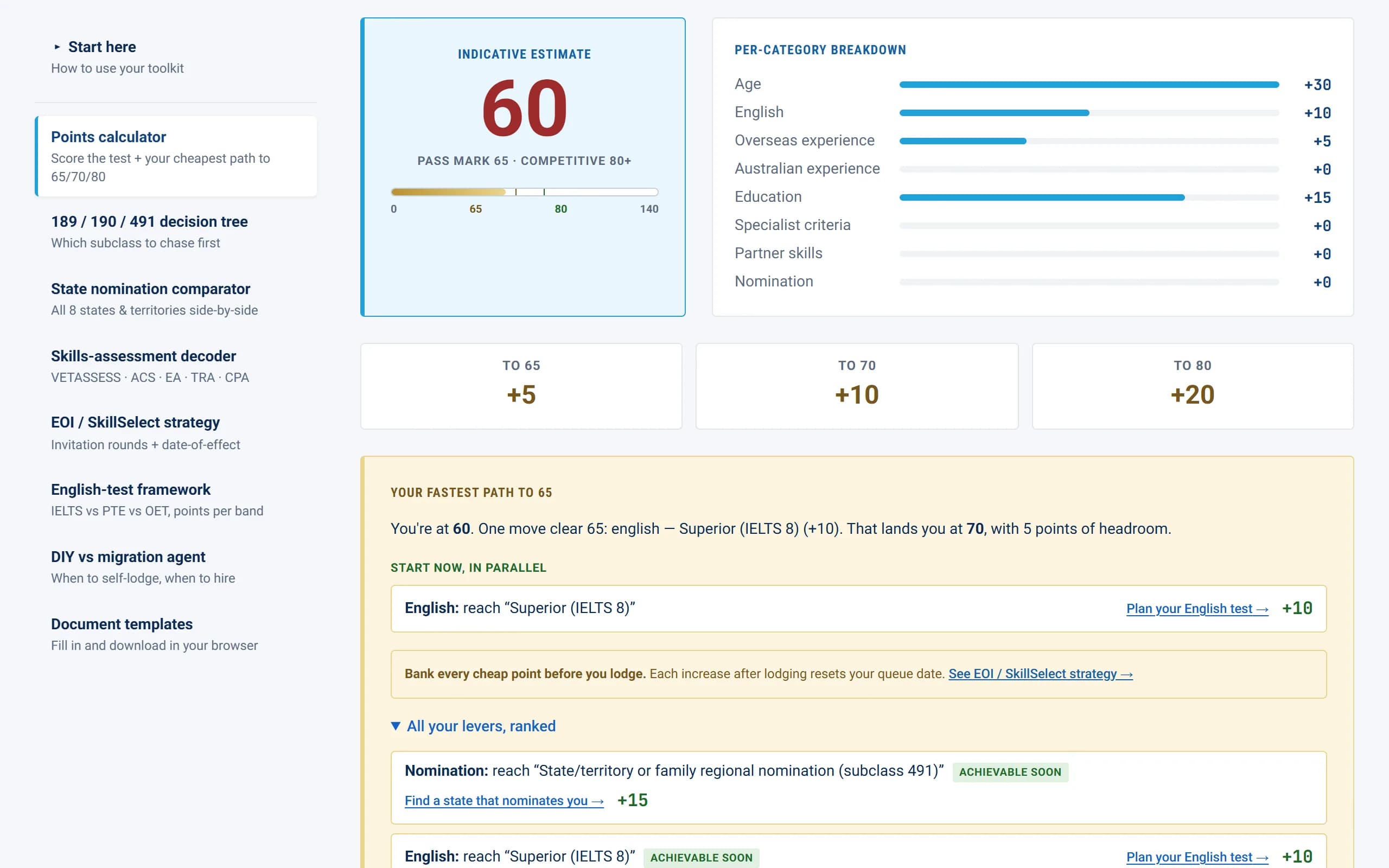
Points Test Strategy
| Points Factor | Points | Notes |
|---|---|---|
| Age (25-32) | 30 | Maximum bracket |
| Age (33-39) | 25 | Common for experienced inspectors |
| English (Superior 8.0+) | 20 | High return on investment |
| English (Proficient 7.0) | 10 | More common |
| Qualification (Bachelor's) | 15 | Construction management, building surveying |
| Qualification (Diploma) | 10 | AQF Diploma minimum for VETASSESS |
| Overseas Experience (8+ years) | 15 | Capped at 15 |
| Australian Experience (3+ years) | 10 | If applicable |
| State Nomination (190) | 5 | Adds list access plus 5 points |
| Regional (491) | 15 | Highest single boost |
| Partner Skills | 10 | Skilled partner on a relevant list |
Realistic Scenarios
Scenario 1: Mid-career UK building surveyor, 34 years old, Diploma + 8 years experience, Proficient English
- Age 25 + Diploma 10 + English 10 + Experience 15 = 60 points
- Add 491 (+15) = 75 points — competitive for regional nomination
- Add Superior English (+10 swing) = 85 points
Scenario 2: 30-year-old applicant from India with Bachelor of Building Surveying, 5 years experience, Proficient English
- Age 30 + Bachelor 15 + English 10 + Experience 10 = 65 points
- Add 190 (+5) = 70 points — sufficient in most state ceilings for non-MLTSSL CSOL roles
State Nomination
New South Wales
NSW lists 312113 for both 190 and 491 in selected program years, particularly for regional postcodes outside Greater Sydney. Demand is strongest in Newcastle, the Central Coast, and Wollongong, where multi-storey residential pipelines outpace local certifier supply. NSW typically expects an EOI score of 70+ plus a commitment to live in the nominating region for two years.
Victoria
Victoria includes Building Inspector in its skilled program when regional shortages are confirmed. The state focuses on Geelong, Ballarat, Bendigo, and Greater Shepparton for 491 nominations. Victorian nominations often require evidence of recent work experience and a written commitment to settle outside Metro Melbourne for the visa term.
Queensland
Queensland nominates building inspectors for 491 across regional zones including the Sunshine Coast, Townsville, and Cairns. The QBCC's separate registration regime means inspectors should budget time after arrival for the local Building Inspection Licence pathway.
South Australia
South Australia has historically included 312113 on its supplementary skilled list to fill regional council vacancies. Applicants typically need 3+ years of relevant experience and a willingness to live in regional SA.
State lists update annually around July. Always verify against the official state nomination page before lodging.
Salary and Employment Outlook
Salary Bands
| Role | Typical Salary Range |
|---|---|
| Junior Building Inspector | AUD $75,000-$90,000 |
| Building Inspector (Mid-level) | AUD $95,000-$115,000 |
| Senior Building Surveyor / Certifier | AUD $120,000-$150,000 |
| Principal Certifier / Statutory Authority | AUD $140,000-$170,000+ |
| Private Pre-purchase Inspector (self-employed) | AUD $300-$600 per inspection, 4-8 inspections/day capacity |
Source: SEEK Salary Hub 2026 plus SalaryExpert 2026. Total packages typically add 11.5% superannuation. Council roles include defined-benefit super in some jurisdictions. Private firm certifiers often receive vehicle allowances of $12,000-$18,000.
Highest-Paying Sectors
- Private certification firms — particularly in Sydney and Melbourne where multi-storey signoffs command premium fees
- Tier-1 builders — internal QA roles at firms like Multiplex, Lendlease, Hutchinson
- State and federal government — Defence estate, social housing programs, infrastructure agencies
- Insurance assessors — for structural defect claims and post-disaster assessments
Geographic variation is significant. Sydney CBD certifiers earn 15-25% more than Brisbane or Perth peers. Regional council inspectors earn less in base salary but often gain remote-area allowances and housing assistance.
Tips for a Successful Application
1. Document Your Inspection Workload in Hours and Numbers
VETASSESS reads employer references closely. Quantify inspections per month, types of buildings (Class 1, 2, 9b under the NCC equivalent in your country), and the regulations you enforce. Generic letters that describe "building inspections" without volume or compliance framework data routinely receive requests for further information.
2. Map Your Qualification to AQF Diploma Carefully
Many overseas building surveying qualifications sit at certificate or diploma level on national frameworks but get assessed lower against AQF. If your degree is older than 10 years or from an institution not commonly assessed, request a comparative qualification report from your university before submitting to VETASSESS.
3. Begin State Registration Research Before You Land
The VETASSESS positive outcome does not let you sign off on Australian work. Each state runs its own technical exam, CPD requirement, and supervised practice period. NSW and Victoria are the strictest. Budget 6-18 months after arrival for full local registration.
4. Target States that Currently List 312113
State lists for non-MLTSSL CSOL occupations swing year to year. Do not commit to a state without verifying 312113 sits on its current 190 or 491 list. Cross-check the skilled occupation list page and the CSOL hub before lodging an EOI.
5. Build Tier-1 Employer Relationships Before Lodging
Subclass 482 sponsorship is faster than the points-based route for inspectors with the right networks. Multiplex, Lendlease, JLL, CBRE, and the Big 4 audit firms run quality assurance teams that sponsor regularly. Reach out before lodging skills assessment, not after.
Step-by-Step Migration Roadmap
- Confirm your role matches 312113 — review the ANZSCO description and the VETASSESS occupation page
- Check current CSOL/STSOL status — verify on the skilled occupation list 2026 page
- Gather qualification evidence — degree certificates, transcripts, professional registration
- Prepare employment references — quantified, task-aligned to ANZSCO 312113
- Sit your English test — IELTS, PTE, OET, or TOEFL; aim for Superior if points are tight
- Lodge VETASSESS application — AUD $1,096-$1,205.60
- Submit Expression of Interest in SkillSelect for 190 or 491
- Apply for state nomination — confirm 312113 on the current state list
- Alternative: pursue 482 sponsorship with a building or certification firm
- Receive invitation — lodge visa application within 60 days
- Complete health, character, and biometrics
- Begin state inspector registration in parallel with relocation
Frequently Asked Questions
Is Building Inspector eligible for the 189 Skilled Independent visa?
No. ANZSCO 312113 is on the Core Skills Occupation List (CSOL) and the STSOL, but it is not on the MLTSSL. Subclass 189 only accepts MLTSSL occupations. Building inspectors must use 190, 491, 482, or 186.
Does a VETASSESS positive outcome let me work as an inspector in Australia immediately?
The VETASSESS assessment is for migration purposes. Signing off on Australian building work requires separate registration with the state regulator — the NSW Building Commission, Victorian Building Authority, Queensland Building and Construction Commission, or equivalent. These processes typically take 6-18 months and involve local exams plus supervised practice.
Which Australian state has the most demand for building inspectors in 2026?
New South Wales and Victoria carry the largest backlog of certification work, driven by apartment construction and the regulatory tightening that followed the Opal Tower issues. Queensland is rising fast due to South-East Queensland population growth. Regional councils across all three states report persistent vacancies.
Can I work as a private pre-purchase inspector on a 482 visa?
The 482 visa requires an approved sponsor with a nominated full-time role at the Annual Market Salary Rate. Self-employed pre-purchase inspection work is not a permitted 482 activity unless you operate through a corporate structure that meets sponsorship and salary obligations. Most building inspectors enter on 482 with a private certifier or builder, then move to self-employment after gaining PR through 186 or 191.
What's the demand outlook for building inspectors in Australia from 2026?
Jobs and Skills Australia categorises the broader building surveying workforce as in persistent regional shortage. The national housing target of 1.2 million homes by 2029 plus infrastructure pipeline (rail, hospitals, defence estate) keeps inspector demand well above local graduate supply. Private certification firms report multi-month vacancy fill times for senior roles in Sydney and Melbourne.
Why is 312113 not on the MLTSSL?
The MLTSSL prioritises occupations with national-scale shortages and limited substitution risk. Building inspection is heavily state-regulated, with local councils able to insource if private supply tightens. The federal classification keeps the role on the CSOL — sufficient for state nomination and employer sponsorship, but not for points-only independent visas. The CSOL hub explains the policy logic in detail.