Diving Instructor (Open Water) Visa Pathway to Australia: Complete 2026 Guide
Updated: 16 August 2026
Australia classifies Diving Instructor (Open Water) under ANZSCO 452311, a Skill Level 3 occupation assessed by VETASSESS. The role sits on the Core Skills Occupation List and the Short-Term Skilled Occupation List, opening subclasses 190, 491, 482, and 186. Typical 2026 salaries run AUD $60,000 to $80,000. Registration or licensing through a recognised diver-training agency is mandatory.
Quick Facts: Diving Instructor Migration Pathway
| Detail | Information |
|---|---|
| ANZSCO Code | 452311 (Diving Instructor — Open Water) |
| Skill Level | 3 (AQF Certificate IV, or Certificate III with at least two years on-the-job training) |
| Skills Assessment | VETASSESS (Vocational Education and Training Assessment Services) |
| Occupation List | CSOL and STSOL (Short-Term Skilled Occupation List) |
| Visa Options | 190 (state nominated), 491 (regional), 482 (Skills in Demand), 186 (ENS) |
| Demand Level | Moderate — concentrated in Queensland and other coastal tourism regions |
| Salary Range | AUD $60,000-$80,000 (Indeed, Jora, SalaryExpert, 2026) |
| Typical 189 Score | Not applicable — occupation is not on the 189 independent list |
| Key Challenge | Holding current instructor-level certification from a recognised agency |
What a Diving Instructor Does in Australia
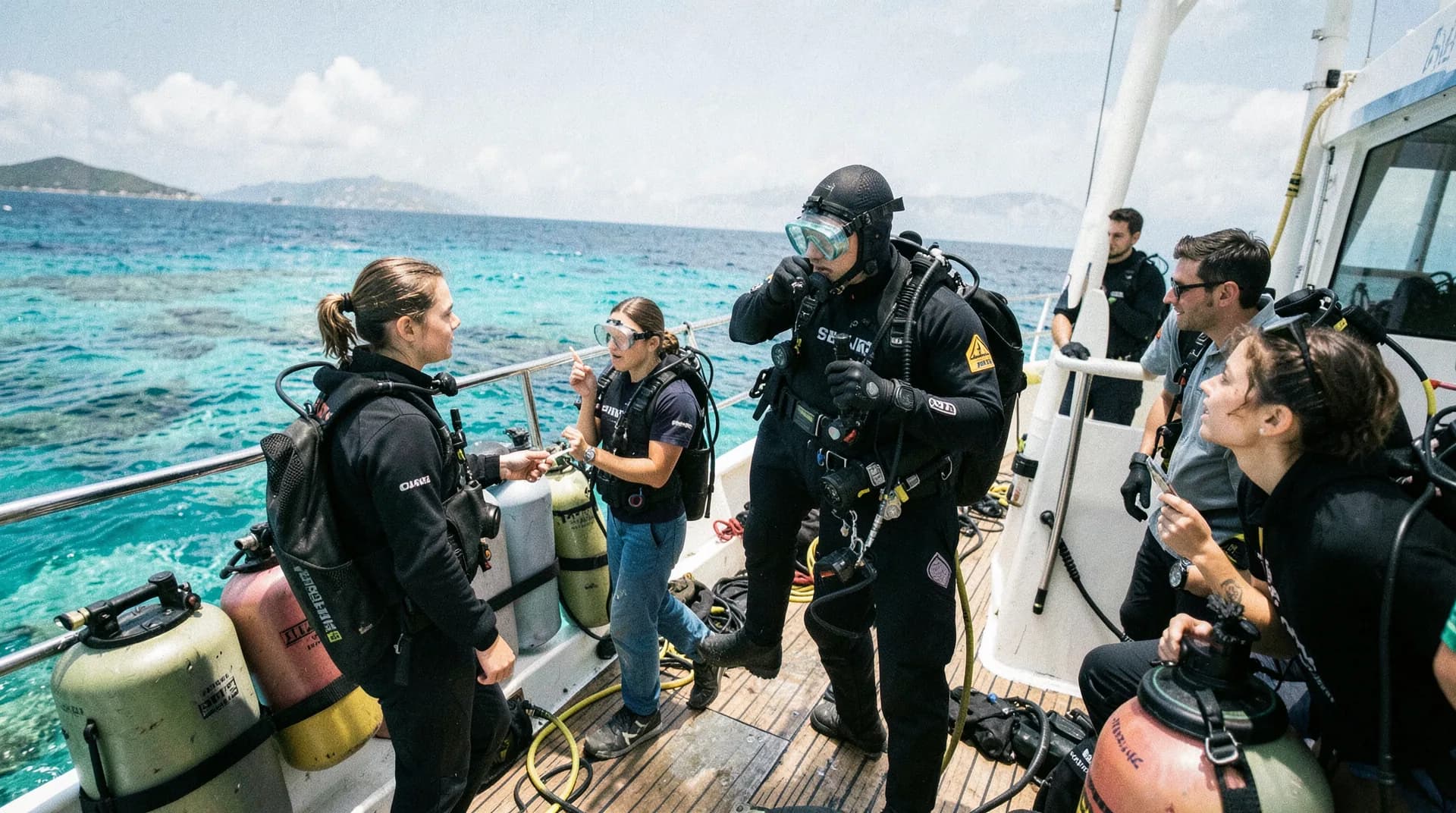
Open-water diving instructors teach recreational divers the techniques, safety procedures, and equipment handling needed to dive in open water. They run pool and confined-water sessions, supervise open-water training dives, certify students against agency standards, and manage the safety of groups in the water. Many also maintain dive gear, brief on local conditions, and lead guided dives between teaching schedules.
The work clusters where the diving is. Queensland dominates, driven by the Great Barrier Reef tourism centres at Cairns and the Whitsundays, with further demand around coastal New South Wales, Western Australia's Ningaloo coast, and parts of South Australia and Tasmania. Employers are dive shops, liveaboard operators, resorts, and training schools. The role is seasonal and tourism-dependent in many locations, so hours and earnings can swing with the visitor calendar.
Certification governs everything. Instructors must hold a current instructor rating from a recognised agency such as PADI, SSI, or SDI, and keep it active. An expired or lapsed rating effectively removes the right to teach, which makes ongoing professional registration a live part of the migration picture rather than a one-off box to tick.
ANZSCO Code 452311 Explained
ANZSCO 452311 covers a Diving Instructor (Open Water) who teaches recreational or commercial open-water divers in diving techniques, safety, and the correct use of diving equipment.
Core tasks summarised from the ANZSCO description include planning and conducting diving courses, demonstrating equipment use and safety procedures, supervising training dives in pools and open water, assessing student competence against certification standards, maintaining diving equipment, and ensuring compliance with safety regulations. This is distinct from commercial or construction diving, which falls under different classifications. If your work is industrial diving rather than recreational instruction, check the alternatives through the ANZSCO code finder.
Skills Assessment with VETASSESS
VETASSESS assesses Diving Instructor (Open Water). It is benchmarked at AQF Certificate III or higher.
Requirements. A positive outcome needs a qualification and employment combination:
- Certificate IV or higher in a highly relevant field, plus at least one year of post-qualification highly relevant employment in the last five years
- Certificate IV or higher not in a highly relevant field, plus at least two years of post-qualification highly relevant employment
- Certificate III in a highly relevant field, plus at least three years of post-qualification highly relevant employment
Employment must be paid and at least 20 hours per week. The role also carries a registration or licensing requirement, satisfied through a current instructor rating from a recognised diver-training agency.
Assessment cost. AUD $1,096 for the standard offshore application. Priority processing adds AUD $825.
Processing time. Around 6 to 10 weeks for standard processing, with priority processing returning an outcome in about 10 business days.
Common rejection reasons. Instructor certifications from training agencies do not always map neatly to an AQF-comparable qualification, so applicants can find themselves pushed onto a longer employment pathway. References that describe dive-guiding or divemaster work rather than instruction also fall short, because the occupation turns on teaching and certifying students. Evidence of an active instructor rating plus letters detailing courses taught and students certified gives the strongest result. See how VETASSESS compares with other assessors in the skills assessment bodies list.
Visa Pathways for Diving Instructors
Diving Instructor is on the CSOL and the STSOL, which shapes which subclasses apply. STSOL listing keeps the points-tested options to the 190 and 491.
Subclass 482 — Skills in Demand Visa
The 482 is the common route for instructors recruited by a dive operator.
- Visa fee: from AUD $3,210 (Core Skills stream, primary applicant)
- Eligibility note: salary must meet the Core Skills Income Threshold and the market rate; seasonal or part-season roles can struggle to meet this
- Processing time: faster for accredited sponsors
- Quirk that matters: dive operators in major reef tourism centres are the realistic sponsors, and year-round operations meet the salary test more easily than seasonal ones
Subclass 190 — Skilled Nominated Visa
A points-tested permanent visa requiring state or territory nomination, which adds 5 points.
- Visa fee: from AUD $6,140 (primary applicant)
- Eligibility note: the nominating state must list the occupation; you commit to living there for the nomination period
- Processing time: published Home Affairs times apply
- Quirk that matters: states with strong dive tourism are the ones most likely to consider this occupation
Subclass 491 — Skilled Work Regional (Provisional)
A points-tested regional visa adding 15 points, leading to permanent residency.
- Visa fee: from AUD $6,140 (primary applicant)
- Eligibility note: most Australian dive destinations are in designated regional areas, which suits this subclass well
- Processing time: published Home Affairs times apply
- Quirk that matters: Cairns, the Whitsundays, and the Ningaloo coast all sit in regional zones, so the regional residence requirement aligns naturally with where the jobs are
Subclass 186 — Employer Nomination Scheme
Permanent residency through an employer.
- Visa fee: from AUD $6,140 (primary applicant)
- Eligibility note: Direct Entry needs three years of relevant experience and a positive assessment
- Processing time: published Home Affairs times apply
For the points-tested 190 and 491, you lodge an Expression of Interest first. The mechanics are explained in the SkillSelect EOI guide.
Points Test Strategy
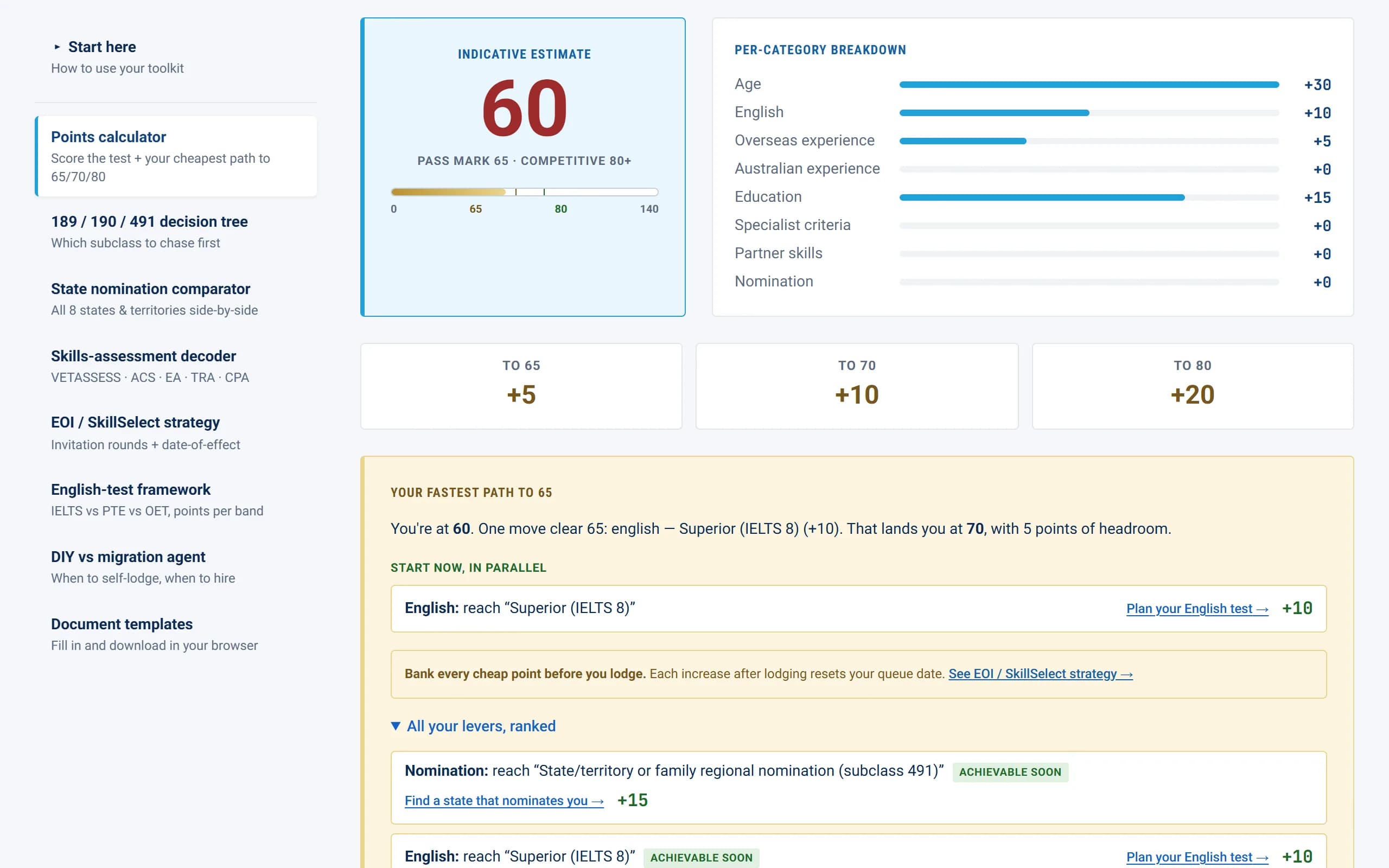
For the 190 and 491, the standard points factors apply.
| Points Factor | Points |
|---|---|
| Age (25-32) | 30 |
| Age (33-39) | 25 |
| English (Proficient — 7.0) | 10 |
| English (Superior — 8.0+) | 20 |
| Diploma / trade qualification | 10 |
| Skilled employment (overseas, 5-8 yrs) | 10 |
| State nomination (190) | 5 |
| Regional nomination (491) | 15 |
| Partner skills | 5-10 |
Realistic Scenarios
Scenario 1 — Regional dive-town candidate. A 29-year-old instructor with a Certificate IV, six years of teaching experience, and Proficient English: 30 (age) + 10 (English) + 10 (qualification) + 10 (experience) = 60, plus 15 for a 491 regional nomination = 75 points.
Scenario 2 — Younger candidate with strong English. A 26-year-old with Superior English and four years of experience: 30 (age) + 20 (English) + 10 (qualification) + 5 (experience) = 65, plus 5 for a 190 state nomination = 70 points, or plus 15 for a 491 = 80 points.
The 189 independent visa does not apply because the occupation is on the STSOL rather than the points-tested independent list.
State Nomination
State and territory programs nominate Diving Instructor only where the local dive-tourism economy supports it, and the lists are reviewed each year. Queensland's reef tourism corridor is the obvious candidate region, with Western Australia and other coastal states sometimes including the occupation. Eligibility must be confirmed against each state's published nomination list at the time you apply, since these lists change and a code listed one year may drop the next. Verify the current position with the state directly before lodging an Expression of Interest.
Salary and Employment Outlook
Diving instructor pay is moderate and shaped by season and location.
| Role | Typical Salary Range |
|---|---|
| Open-water instructor (entry) | AUD $60,000-$68,000 |
| Experienced instructor | AUD $68,000-$75,000 |
| Instructor trainer / course director | AUD $75,000-$85,000+ |
Figures draw on Indeed, Jora, and SalaryExpert data current to 2026. Superannuation of 11.5% applies on top of base pay. Earnings rise with seniority, instructor ratings held, and year-round versus seasonal employment. Liveaboard and resort roles sometimes include accommodation, which improves the real value of a lower headline salary.
The strongest demand is in established reef and coastal tourism centres, with the highest pay going to instructor trainers and course directors who can certify other instructors. Seasonal swings are a feature of the work, so a year-round operation usually offers steadier earnings than a seasonal dive town. Compare against other roles in the salary expectations guide.
Tips for a Successful Application
- Keep your instructor rating current throughout the process. The occupation requires active registration. A lapsed PADI, SSI, or SDI instructor rating undermines both the skills assessment and the genuineness of any sponsored role.
- Show teaching, not guiding. VETASSESS assesses instruction and certification of students. References that describe divemaster or guiding duties miss the mark; ask employers to detail courses run and students certified.
- Aim for a regional location. Most Australian dive jobs are in designated regional areas, so the 491 regional route lines up neatly with where you would work. That adds 15 points and reduces competition.
- Target year-round operators for sponsorship. Seasonal roles can fall short of the salary threshold a 482 needs. Reef-corridor operators that run all year are better placed to sponsor.
- Bundle your certifications into the qualification evidence. Where agency ratings do not map to a formal AQF qualification, strong documentation of training hours and competencies helps VETASSESS place your experience.
Step-by-Step Migration Roadmap
- Confirm your ANZSCO code with the ANZSCO code finder — recreational instruction, not commercial diving.
- Check list status on the Core Skills Occupation List.
- Confirm your instructor rating is current with a recognised agency.
- Gather employer references detailing courses taught and students certified.
- Lodge the VETASSESS skills assessment (AUD $1,096).
- Sit an English test, aiming for Superior for maximum points.
- For the 190 or 491, submit an Expression of Interest through SkillSelect.
- Apply for state or regional nomination, or secure a sponsoring dive operator for a 482 or 186.
- Receive the invitation or nomination approval.
- Lodge the visa application.
- Complete health and character checks.
- Receive the visa grant and relocate to the dive region.
Frequently Asked Questions
Can a scuba diving instructor get an Australian skilled visa?
Yes. Diving Instructor (Open Water), ANZSCO 452311, is on the Core Skills Occupation List and the STSOL. That opens the 190, 491, 482, and 186 visas. The regional 491 often suits the occupation because most Australian dive jobs are in designated regional areas.
Do I need a PADI or SSI rating to migrate as a diving instructor?
In practice, yes. The occupation requires registration or licensing, which is met through a current instructor rating from a recognised diver-training agency such as PADI, SSI, or SDI. The rating must be active, since teaching without it is not permitted.
Is Diving Instructor eligible for the 189 visa?
No. The occupation is on the Short-Term Skilled Occupation List rather than the points-tested independent list, so the subclass 189 does not apply. The points-tested options are the 190 and the regional 491.
Where are the best locations in Australia for diving instructor jobs?
Queensland's reef tourism centres around Cairns and the Whitsundays carry the most demand, followed by Western Australia's Ningaloo coast and parts of New South Wales, South Australia, and Tasmania. Most of these sit in designated regional areas, which aligns with the 491 pathway.
How much do diving instructors earn in Australia?
Pay generally runs from about AUD $60,000 for entry-level instructors to $85,000 or more for instructor trainers and course directors. Earnings depend heavily on seniority, ratings held, and whether the role is seasonal or year-round.