Insurance Loss Adjuster Visa Pathway to Australia: Complete 2026 Guide
Updated: 16 August 2026
Australia classifies insurance loss adjusters under ANZSCO 599612. VETASSESS conducts the skills assessment. The occupation sits on the Core Skills Occupation List, which unlocks subclasses 190, 491, 482 and 186. Subclass 189 is not available. Typical 2026 salaries range AUD $80,000 to $112,000, with experienced adjusters reaching close to AUD $150,000 in catastrophe and commercial work.
Quick Facts: Insurance Loss Adjuster Migration Pathway
| Detail | Information |
|---|---|
| ANZSCO Code | 599612 (Insurance Loss Adjuster) |
| Skill Level | 3 (AQF Certificate IV, or Certificate III with at least two years on-the-job training) |
| Skills Assessment | VETASSESS (Vocational Education and Training Assessment Services) |
| Occupation List | CSOL (Core Skills Occupation List) |
| Visa Options | 190, 491, 482, 186 |
| Demand Level | Moderate to high — claims volume rises with each major weather event |
| Salary Range | AUD $80,000-$112,000 (SEEK and Talent.com, 2026) |
| Typical 189 Score | Not applicable — 599612 is not on the MLTSSL |
| Key Challenge | No subclass 189; every route needs nomination or sponsorship |
What an Insurance Loss Adjuster Does in Australia
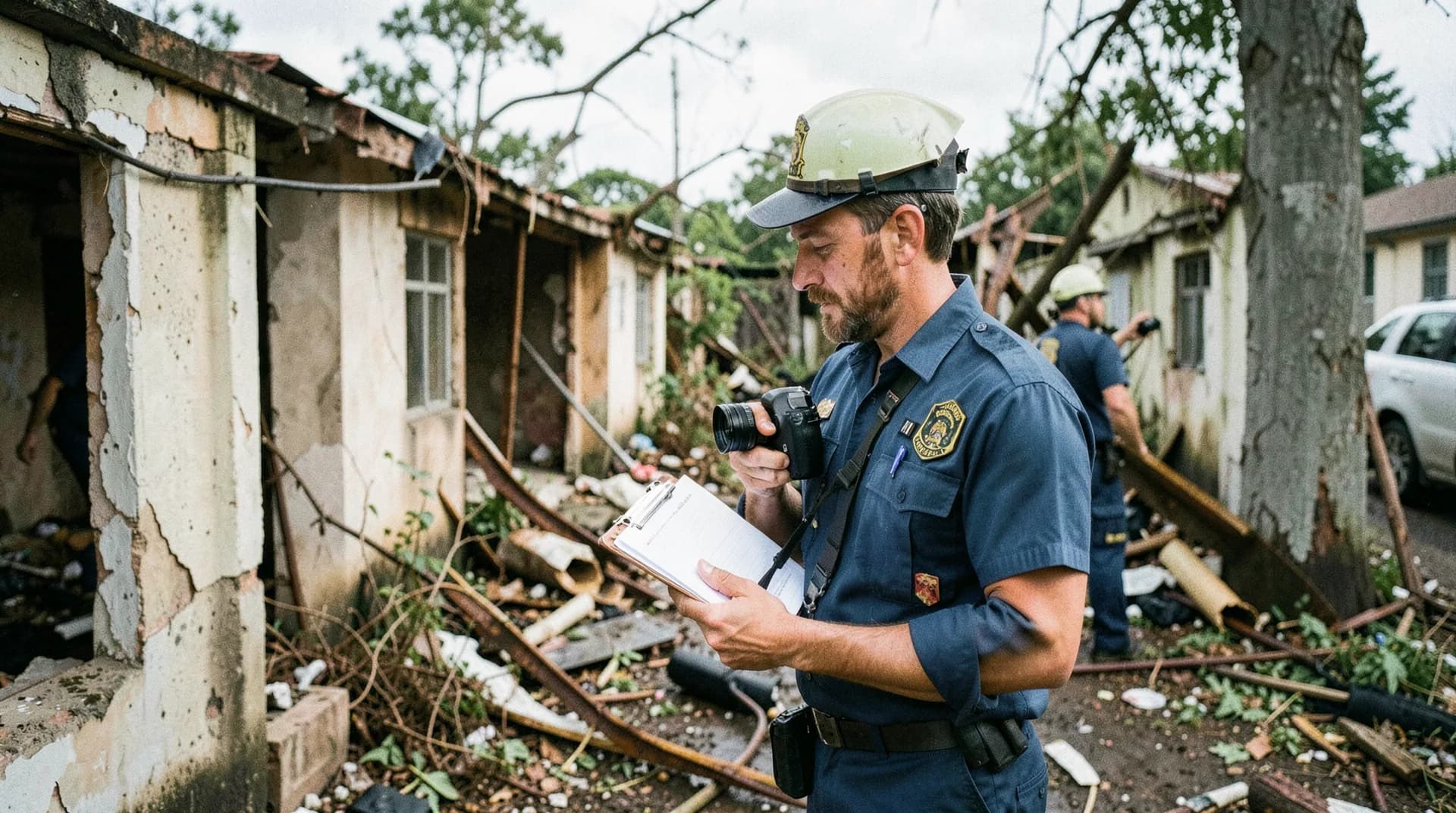
A loss adjuster investigates an insurance claim and decides what it should cost. After a fire, storm, theft or business interruption, the adjuster inspects the damage, gathers evidence, interprets the policy, and reports to the insurer on the extent of the loss and the fair settlement figure. The role is part field investigation, part technical assessment, part negotiation. Adjusters work across domestic property, commercial property, motor, marine, liability and business interruption claims.
Australia's exposure to natural catastrophe shapes the profession. Bushfire seasons, east-coast floods, cyclones in the north and hailstorms in the capitals each produce surges of claims that the local adjusting workforce cannot always absorb. Major firms such as the global loss-adjusting networks and domestic specialists scale up after every event, and that cyclical demand is part of why the occupation stays on the skilled lists. Most adjusters work for independent adjusting firms, insurers' in-house teams, or as self-employed contractors during catastrophe peaks.
The work is concentrated where the population and the weather risk are: Victoria and Queensland together account for a large share of the workforce, with New South Wales and South Australia following. Commercial and large-loss adjusting clusters in the capital cities, while catastrophe work pulls adjusters into regional and coastal zones.
ANZSCO Code 599612 Explained
Insurance Loss Adjuster carries ANZSCO code 599612. It sits in unit group 5996, Insurance Investigators, Loss Adjusters and Risk Surveyors, alongside Insurance Investigator (599611) and Insurance Risk Surveyor (599613). The Australian Bureau of Statistics describes the occupation as inspecting and assessing damage and loss to insured property and business, estimating insurance costs, and acting to minimise the cost of claims to an insurer.
The indicative tasks include inspecting damaged buildings, equipment and vehicles and estimating repair costs, estimating business losses from fire, theft or disruption, and reporting the extent of damage and estimated costs to the insurer. The skill level is 3, which the ABS links to an AQF Certificate IV, or a Certificate III with at least two years of on-the-job training. Choosing 599612 over the related codes matters: if your duties centre on investigating fraud or interviewing witnesses, Insurance Investigator (599611) may fit better. Check your duties against the ANZSCO code finder before lodging.
Skills Assessment: VETASSESS
VETASSESS is the assessing authority for insurance loss adjusters. The occupation is assessed under Group D, which weighs both your qualification and your work history.
VETASSESS Requirements
- Qualification: assessed as comparable to an AQF Certificate III or IV, or higher, in a highly relevant field such as general insurance, loss adjusting, risk management or business.
- Employment: post-qualification employment at the required skill level, at least 20 hours per week, within the last five years.
The employment requirement scales to the qualification. A highly relevant Certificate IV or higher needs one year of recent relevant employment. A non-relevant Certificate IV needs two years. A highly relevant Certificate III needs three years. A more general pathway requires four years of total employment including one recent relevant year.
Assessment cost: AUD $1,096 if you are not an Australian tax resident (GST-exclusive); AUD $1,205.60 onshore (GST-inclusive). Priority processing adds AUD $825 to $907.50. Processing time: around seven weeks for standard professional-occupation assessments; confirm on the VETASSESS processing times page.
Common rejection reasons: generic insurance experience that does not show damage assessment and loss estimation is the usual stumbling block. A reference that reads like a claims-handler or broker role, rather than field adjusting, often draws a negative outcome.
Visa Pathways for Insurance Loss Adjusters
Insurance Loss Adjuster is on the Core Skills Occupation List. It is not on the MLTSSL, so subclass 189 is closed. Every pathway runs through state nomination or employer sponsorship. The points-tested 190 and 491 are realistic because nomination adds meaningful points to a Skill Level 3 occupation.
Subclass 190 — Skilled Nominated
Permanent residency through the points test, with state nomination adding five points.
- Visa fee: AUD $6,140 (primary applicant).
- Eligibility constraint: requires a positive VETASSESS assessment and state nomination of 599612.
- Quirk: you commit to living in the nominating state, so target a state where insurance and claims work is concentrated.
Subclass 491 — Skilled Work Regional (Provisional)
A five-year provisional visa with a pathway to permanent residency through subclass 191. Regional nomination adds 15 points, which often makes the difference for a Skill Level 3 occupation.
- Visa fee: AUD $6,140 (primary applicant).
- Eligibility constraint: you must live and work in a designated regional area.
- Quirk: catastrophe claims frequently arise in regional zones, so regional adjusting demand is genuine, not theoretical.
Subclass 482 — Skills in Demand
Employer-sponsored temporary visa under the Core Skills stream.
- Visa fee: AUD $3,210 (Core Skills stream, primary applicant).
- Eligibility constraint: the role must meet the Core Skills Income Threshold, AUD $76,515 for nominations up to 30 June 2026, rising to AUD $79,499 from 1 July 2026.
- Quirk: adjusting firms scaling up after a major event are a natural source of sponsorship.
Subclass 186 — Employer Nomination Scheme
Permanent residency through employer sponsorship.
- Visa fee: AUD $6,140 (primary applicant).
- Eligibility constraint: the Direct Entry stream draws on the CSOL; the Temporary Residence Transition stream suits adjusters who have held a 482 with the same employer.
- Quirk: the 186 often follows a period on a 482 with an established adjusting firm.
Points Test Strategy
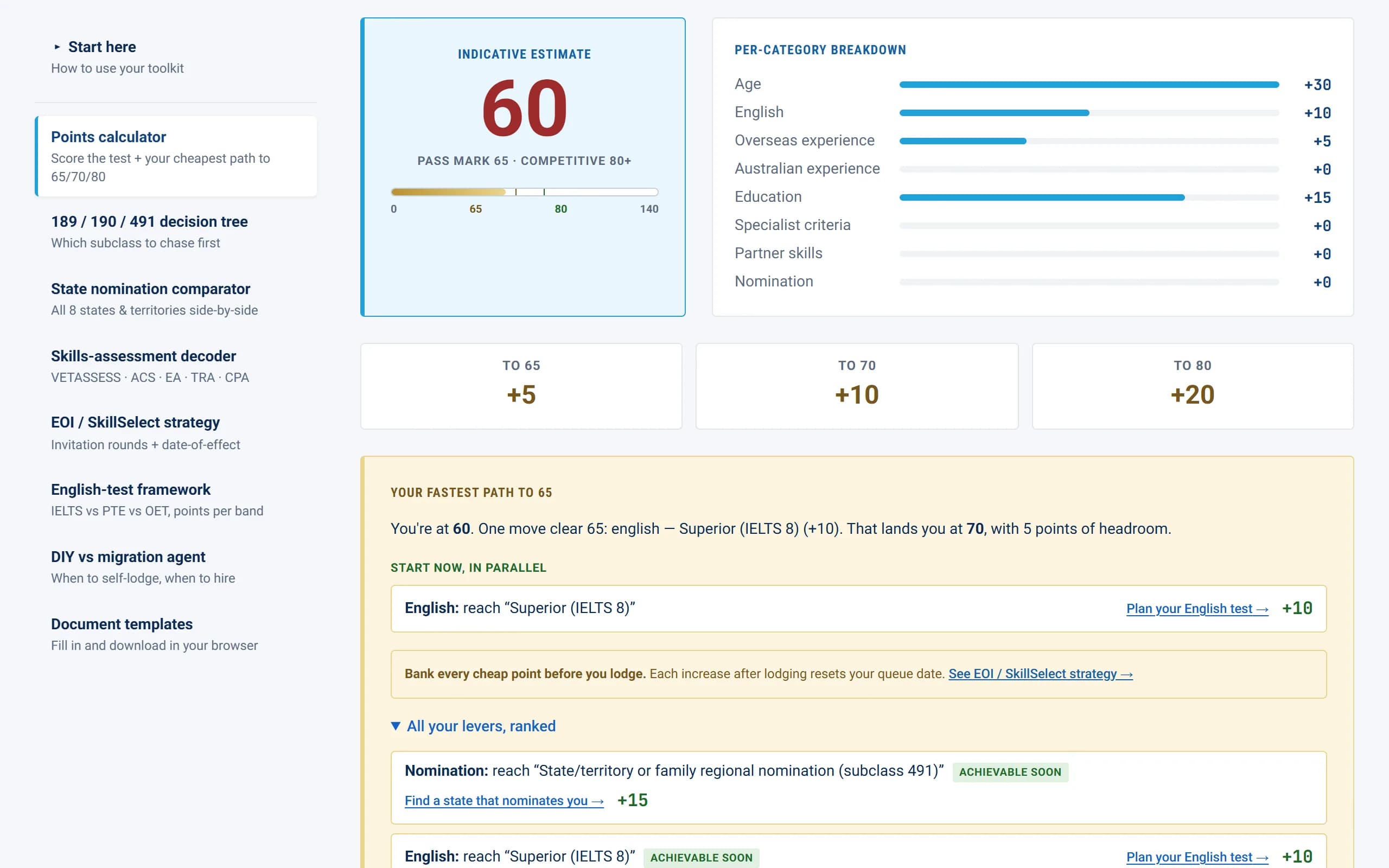
The points test applies to the 190 and 491 routes. Here is how a Skill Level 3 occupation like loss adjusting typically scores.
| Points Factor | Points | Notes |
|---|---|---|
| Age (25-32) | 30 | Maximum bracket |
| Age (33-39) | 25 | Common for experienced adjusters |
| English (Superior — 8.0+) | 20 | Strong points if achievable |
| English (Proficient — 7.0) | 10 | More realistic baseline |
| Qualification (Bachelor) | 15 | If a degree applies |
| Qualification (Diploma/trade) | 10 | Common for this occupation |
| Skilled Employment (8+ years overseas) | 15 | Field adjusting experience |
| State Nomination (190) | 5 | Adds to the total |
| Regional Nomination (491) | 15 | The bigger lever |
| Partner Skills | 5-10 | If partner has a skilled occupation |
Realistic Score Scenarios
Scenario 1: Mid-career adjuster, 34, Proficient English, 8 years experience, 491 regional nomination
- Age 25 + English 10 + Diploma 10 + Experience 15 + Regional 15 = 75 points. Competitive for a 491.
Scenario 2: Younger adjuster, 29, Superior English, 5 years experience, 190 state nomination
- Age 30 + English 20 + Diploma 10 + Experience 10 + Nomination 5 = 75 points. Competitive for a 190 if a state nominates the occupation.
State Nomination for Insurance Loss Adjusters
State and territory nomination for 599612 changes every program year, and a state may nominate the occupation in one cycle and drop it the next. We do not name specific states here because the 2025-26 lists must be checked live against each government's own published occupation list. Before you commit, confirm 599612 against the relevant program for NSW, Victoria, Queensland, South Australia, Western Australia, Tasmania, the Northern Territory or the ACT. Victoria and Queensland hold the largest share of the adjusting workforce, which makes them sensible places to check first, but list inclusion is what matters, not workforce size.
Salary and Employment Outlook
| Role | Typical Salary Range (AUD) |
|---|---|
| Trainee / Junior Loss Adjuster | $65,000-$80,000 |
| Loss Adjuster (Experienced) | $85,000-$110,000 |
| Senior / Commercial Loss Adjuster | $110,000-$140,000 |
| Major Loss / Catastrophe Specialist | $130,000-$160,000+ |
| Adjusting Team Manager | $130,000-$170,000 |
SEEK's advertised average for loss adjusters sits near AUD $80,000, reflecting base salaries on job ads. Talent.com reports a broader average closer to AUD $112,500, with experienced adjusters reaching about AUD $149,500. The gap reflects how the two sources measure pay: advertised base versus total earnings across a wider dataset. Superannuation at 11.5% sits on top, and catastrophe contracting can lift income sharply during peak events.
The highest earnings come from commercial and major-loss adjusting, marine and liability specialisation, and catastrophe contracting after large weather events. Geographic pay variation is less pronounced than seniority and specialisation, though capital-city commercial work tends to pay more than routine domestic claims.
Tips for a Successful Application
- Pick the right code in unit group 5996. If you assess damage and estimate losses, you are a loss adjuster (599612). If you investigate fraud or interview witnesses, Insurance Investigator (599611) may fit better, and the wrong code fails the assessment.
- Make references show field adjusting. Ask referees to describe inspecting damage, estimating repair or business-interruption costs, and reporting settlement figures, not general claims handling.
- Use regional nomination to lift your points. A 491's 15 points often pushes a Skill Level 3 occupation into a competitive range where the 190 alone would not.
- Time your sponsorship around the cycle. Adjusting firms hire hardest after major catastrophes, so monitor the season for sponsorship opportunities.
- Verify the salary clears the threshold. Junior adjusting roles can sit near the Core Skills Income Threshold, so confirm any 482 offer meets it before lodging.
Step-by-Step Migration Roadmap
- Confirm your ANZSCO code as 599612 using the ANZSCO code finder.
- Check the list status on the Core Skills Occupation List and the 2026 skilled occupation list.
- Prepare employment references that describe damage assessment and loss estimation.
- Sit an English test and aim as high as your timeline allows.
- Lodge your VETASSESS skills assessment through the skills assessment bodies list.
- Calculate your points for the 190 and 491 routes.
- Submit an Expression of Interest through SkillSelect.
- Apply for state or regional nomination, or secure a sponsoring employer for the 482 or 186.
- Receive your invitation or nomination and lodge the visa.
- Complete health and character checks.
- Receive the visa grant and relocate.
- Meet residence conditions to move a provisional visa to permanent residency.
Frequently Asked Questions
Can I apply for a subclass 189 as an insurance loss adjuster?
No. ANZSCO 599612 sits on the Core Skills Occupation List but not on the MLTSSL, so the points-tested subclass 189 independent visa is not available. Your options are state nomination through the 190 or 491, or employer sponsorship through the 482 or 186.
What is the difference between a loss adjuster and an insurance investigator for migration?
They are separate ANZSCO codes in the same unit group. A loss adjuster (599612) inspects damage and estimates the cost of a claim. An insurance investigator (599611) investigates the circumstances of a claim, often looking at fraud. Your skills assessment will fail if your references describe one occupation while you nominate the other, so match the code to your actual duties.
Is employer sponsorship easier than the points test for loss adjusters?
It can be. The 482 does not require a points test, only a positive VETASSESS assessment and a qualifying job offer that meets the Core Skills Income Threshold. Adjusting firms scaling up after major weather events are a realistic source of sponsorship. The trade-off is that you depend on an employer rather than controlling the timeline yourself.
What is the demand outlook for loss adjusters in Australia in 2026?
Demand is cyclical but structurally firm. Each major bushfire, flood, cyclone or hailstorm produces a surge in claims that the local workforce cannot fully absorb, and the occupation has stayed on the skilled lists as a result. Commercial and catastrophe specialists are the most sought after. See the most in-demand occupations overview for wider context.
Will my overseas loss-adjusting experience be recognised?
Often yes, provided your references clearly describe damage assessment, loss estimation and reporting to insurers at the required skill level. VETASSESS assesses both your qualification and your employment. The most common reason overseas experience is discounted is that references read like general claims or broking work rather than field adjusting.