Insurance Broker Visa Pathway to Australia: Complete 2026 Guide
Updated: 16 August 2026
Australia classifies Insurance Broker under ANZSCO 222113. VETASSESS conducts the skills assessment as a Group C occupation. The role sits on the CSOL (and STSOL) but not the MLTSSL, which unlocks subclasses 190, 491, 482 and 186 — no 189 access. Typical 2026 salaries range AUD $80,000-$152,000 base by SEEK city data, with Melbourne and Sydney paying highest. NSW and Victoria together account for around 60% of insurance broker employment, and Tier 1 RG 146 accreditation is mandatory to give personal advice once onshore.
Quick Facts: Insurance Broker Migration Pathway
| Detail | Information |
|---|---|
| ANZSCO Code | 222113 (Insurance Broker) |
| Skill Level | 2 (AQF Associate Degree, Diploma or Advanced Diploma, or three years relevant experience) |
| Skills Assessment | VETASSESS (Vocational Education and Training Assessment Services) — Group C |
| Occupation List | CSOL and STSOL — not on MLTSSL |
| Visa Options | 190, 491, 482 (Core Skills stream), 186 |
| Demand Level | Moderate — eased from shortage in 2025, succession gap in the industry |
| Salary Range | AUD $80,000-$152,000 base + commission (SEEK 2026) |
| Typical 190 Score | 75-85 (CSOL clears below MLTSSL ICT thresholds) |
| Key Challenge | No 189 access; Tier 1 ASIC accreditation and ACL authorisation needed before placing personal advice |
What Insurance Brokers Actually Do in Australia
An Insurance Broker acts as an independent agent for the client — not the insurer — arranging policies across multiple underwriters. The two main streams are general insurance (commercial property, liability, motor fleet, professional indemnity, marine, cyber) and specialist personal lines (high-value home and contents, expat cover, niche risks). Life insurance broking exists but is largely separated into financial advice channels under different regulation.
The Australian market is concentrated. The largest networks — Aon, Marsh, Willis Towers Watson, Honan, Steadfast Group (the largest broker network), and Austbrokers (now Envest) — write the bulk of commercial premium. Underneath sit hundreds of independent broker firms, most aligned to Steadfast or Austbrokers/Envest cluster groups for scale. Sydney is the centre of corporate broking, Melbourne hosts strong mid-market and SME broking, and Brisbane's broker community has grown around resources and construction risk.
The industry is dealing with two pressures. Premium hardening from 2020-2024 has eased but renewals remain complex, especially in cyber and natural-catastrophe-exposed property. And an ageing broker workforce — average broker age sits well above the national workforce average — has created a succession gap that Jobs and Skills Australia reports as eased shortage rather than zero demand. Mid-career migrant brokers walk into a market with willing employers but cautious credentialling.
ANZSCO Code 222113 — What the Description Covers
ANZSCO 222113 sits inside Unit Group 2221 (Financial Brokers). The official description covers a professional who operates as an independent agent to arrange life, fire, accident, industrial or other forms of insurance for a range of insurance companies. Registration or licensing is required.
The distinction VETASSESS enforces hardest is broker versus agent. An Insurance Agent represents one insurer only — that work does not qualify as Insurance Broker for 222113 purposes. The broker must be free to place business across multiple underwriters in the client's interest. If your offshore role was a captive agent or single-company employee, your skills assessment will likely fail.
If your actual work is arranging loans rather than insurance, ANZSCO 222112 (Finance Broker) is the correct code — see the Finance Broker visa pathway. Underwriters map to 599612 (Insurance Loss Adjuster) or unit group 2522 depending on the role. Insurance Investigators are a separate code (599613).
Skill Level 2 means VETASSESS requires at least an AQF Diploma equivalent in a highly relevant field, or qualifying experience under one of the alternative pathways.
Skills Assessment — VETASSESS Group C
VETASSESS assesses Insurance Broker. The body classifies 222113 as a Group C occupation requiring AQF Diploma level qualifications or above.
Authority site: vetassess.com.au/check-my-occupation/professional-occupations/insurance-broker
Highly relevant field of study: Insurance Broking.
In practice VETASSESS accepts qualifications across business, commerce, finance, risk management and economics when paired with relevant employment, but a dedicated insurance broking qualification produces the cleanest outcome.
Four assessment pathways:
- Pathway 1 — Diploma or higher in a highly relevant field plus at least one year of post-qualification highly relevant employment in the last five years.
- Pathway 2 — Diploma or higher in a non-relevant field plus a Certificate IV in a relevant field plus at least one year of post-qualification employment in the last five years.
- Pathway 3 — Diploma or higher in a non-relevant field plus at least two years of post-qualification highly relevant employment in the last five years.
- Pathway 4 — Any diploma or higher plus at least four years of total employment, with at least one year of highly relevant work in the last five years.
All employment evidence must show at least 20 hours per week and tasks aligned to the ANZSCO description — interviewing clients about cover requirements, arranging insurance through multiple companies, advising on risk changes, processing claims and negotiating policy terms.
Assessment fees (effective from 22 October 2025):
- Skills Assessment — online, outside Australia: AUD $1,096
- Skills Assessment — online, within Australia (incl. GST): AUD $1,205.60
- Priority Processing add-on: AUD $825 (outside Australia) / AUD $907.50 (within Australia)
- Points Test Advice only: AUD $311 outside / AUD $342.10 within Australia
Processing time: 8-10 weeks standard, around 2-4 weeks with Priority Processing.
Common rejection reasons: The dominant fail is "agent not broker" — references describing single-insurer employment, bancassurance roles or call-centre claims handling. The second is reference letters that focus on administrative claims processing rather than the placement and advisory tasks that define the broker role. Provide letters of authority, panel access evidence and a sample renewal report if available.
For a side-by-side of all bodies, see the skills assessment bodies complete list.
ASIC Licensing and Tier 1 Accreditation — A Separate Hurdle
Skills assessment confirms migration eligibility. Placing insurance in Australia is regulated separately. To advise and arrange general insurance once onshore, a broker must:
- Operate under an Australian Financial Services Licence (AFSL) — either the broker's own or as an authorised representative of an AFSL-holding brokerage.
- Hold Tier 1 RG 146 accreditation in General Insurance (and Insurance Broking where personal advice is given). The RG 146 Tier 1 Insurance Broking program is offered by ANZIIF, Kaplan and several other providers.
- Membership of NIBA (National Insurance Brokers Association) is the industry standard and confers the QPIB designation after the Diploma of Insurance Broking and three years of experience.
- Carry Professional Indemnity insurance — most AFSL holders provide this at the firm level.
- Complete annual CPD as set by ASIC and NIBA.
Most migrant brokers slot under an established AFSL by joining a Steadfast-network or Envest/Austbrokers brokerage rather than holding their own licence. The RG 146 Tier 1 study load is around 16 weeks part-time and can be done in parallel with the visa wait.
Visa Pathways for Insurance Brokers
Subclass 482 — Skills in Demand (Core Skills stream)
The 482 is the most common entry point because 222113 has no 189 access and offshore-only applicants struggle to reach 190 invitation thresholds.
- Visa fee (Core Skills stream, primary applicant): AUD $4,015
- Salary threshold: Core Skills Income Threshold (CSIT) AUD $79,423, indexed annually
- Processing time: Core Skills median around 4 months, 90th percentile 7-8 months (early 2026 data)
- Duration: Up to 4 years
- Quirk: Steadfast-network and Aon/Marsh-tier corporate brokers are experienced 482 sponsors. Smaller suburban broker firms often do not hold standard business sponsor status — confirm before accepting a job offer.
Subclass 190 — Skilled Nominated
State nomination delivers permanent residency plus five points.
- Visa fee: AUD $6,140 (primary applicant)
- Processing time: 6.5-22 months end-to-end including state nomination
- Realistic invitation points: 75-85 for CSOL occupations
- Quirk: Insurance broking competes with banking, accounting and ICT for finite NSW and Victorian invitations. Onshore work history is the single largest invitation predictor.
Subclass 491 — Skilled Work Regional
A five-year provisional visa with a pathway to permanent residency via the 191.
- Visa fee: AUD $6,140 (primary applicant)
- Processing time: Median 6-20 months, 90th percentile 15-28 months
- Points boost: +15 for regional nomination
- Quirk: Regional broker firms in Newcastle, Wollongong, Geelong, Townsville, Cairns and the Sunshine Coast routinely sponsor under 491 because metro brokerages don't service regional commercial accounts well. Rural and agricultural broking is a strong niche.
Subclass 186 — Employer Nomination Scheme
Permanent residency through direct employer sponsorship.
- Visa fee: AUD $6,140 (primary applicant)
- Streams: Direct Entry (three years relevant experience plus positive VETASSESS) or Temporary Residence Transition after two years on a 482
- Quirk: Corporate broker firms tend to prefer TRT — they test the relationship on a 482 first. Direct Entry is more common when senior brokers are recruited from London, Singapore or Auckland for specialist lines.
Subclass 189 is not available because 222113 is not on the MLTSSL.
Points Test Strategy
| Points Factor | Points | Notes |
|---|---|---|
| Age 25-32 | 30 | Maximum bracket |
| Age 33-39 | 25 | Still competitive |
| Bachelor's degree | 15 | Common for VETASSESS Group C |
| Master's | 15 | Same band as bachelor unless PhD |
| PhD | 20 | Rare in broking |
| English Proficient (7.0) | 10 | Realistic |
| English Superior (8.0+) | 20 | Top differentiator |
| Overseas experience (5-8 yrs) | 10 | After any VETASSESS deduction |
| Australian skilled experience | 5-20 | Onshore broking experience |
| State Nomination (190) | 5 | Required — no 189 access |
| Regional Nomination (491) | 15 | Strongest single boost |
| Partner Skills | 10 | If partner has positive assessment |
| Single applicant | 10 | Same value as partner-skilled |
Realistic Score Scenarios
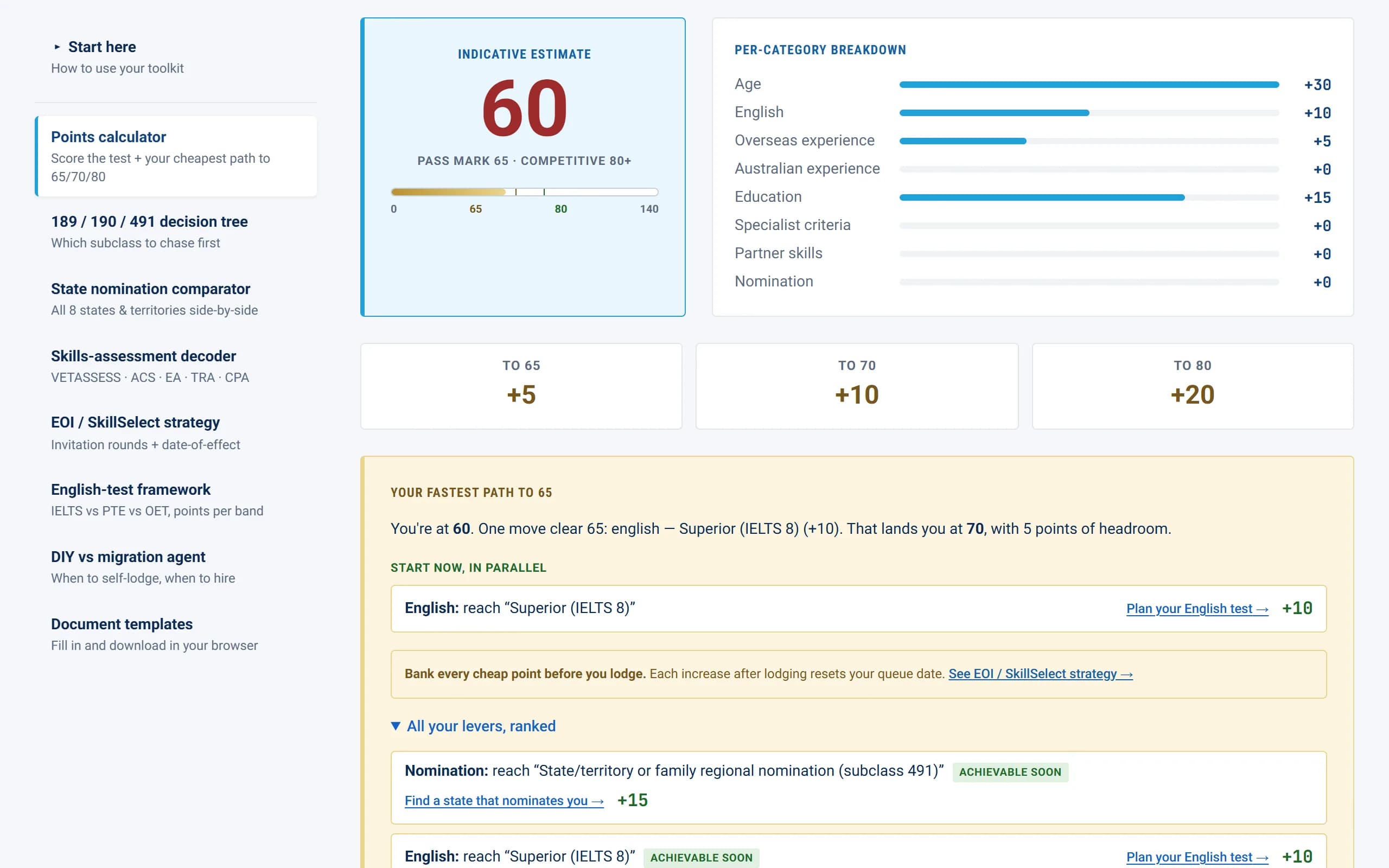
Scenario 1 — Offshore broker, 30, Bachelor's, Proficient English, 6 years experience Age 30 + Bachelor's 15 + English 10 + Experience 10 = 65 points. Add 190 nomination (+5) = 70. Below 2026 invitation levels for non-priority CSOL. Pivot to 491 (+15) = 80, which is invitable in regional rounds, or pursue 482 employer sponsorship.
Scenario 2 — Onshore broker, 29, Bachelor's, Superior English, 3 years offshore + 2 years Australian experience Age 30 + Bachelor's 15 + English 20 + Australian experience 10 + Overseas 5 = 80 points. Add 190 (+5) = 85, which competes well in 2026 invitation rounds. Onshore work is the lever that flips CSOL outcomes.
For most offshore-only candidates, 482 employer sponsorship is the faster route, and 491 the most realistic permanent path.
State Nomination
Insurance Broker is on the CSOL, so any state's CSOL-accepting list could nominate. In practice a few states invite 222113 with material frequency.
New South Wales
NSW accounts for around 34% of insurance broker employment and is the corporate broking capital. NSW accepts CSOL for 190 and 491 but prioritises healthcare, ICT, engineering and education. Insurance Broker invitations exist but typically require strong Australian work experience or a Sydney brokerage offer. The NSW regional 491 program targets brokerages in Newcastle, Wollongong, Tweed and Wagga.
Victoria
Victoria accounts for around 27% of insurance broker employment and prioritises critical-skills occupations. Victoria does not publish a separate state list — it accepts the national SOL. Melbourne corporate broking and the mid-market SME segment around the inner south-east are the largest hiring centres. Regional Victoria (Geelong, Ballarat, Bendigo) provides 491 options for candidates willing to commit two years.
South Australia
South Australia takes a broader slice of CSOL than NSW or Victoria and is often the most realistic 491 destination for an offshore-only Insurance Broker. Adelaide's broker community is small but the state nomination thresholds are lower.
Queensland
Queensland's BSMQ program nominates CSOL occupations with job offers, particularly outside Brisbane CBD. Construction, mining and tourism risks create work for regional Queensland brokers — Townsville, Mackay, Cairns and the Sunshine Coast each have established brokerages.
Tasmania, ACT and Northern Territory
Smaller programs occasionally invite for 222113 where the candidate has a confirmed offer or onshore study completion. Check the 2026 SOL hub and the CSOL hub for current state list status.
Salary and Employment Outlook
What Insurance Brokers Earn in 2026
| Role | Typical Base Range | Notes |
|---|---|---|
| Broker Assistant / Account Coordinator | AUD $60,000-$80,000 | Entry roles, RG 146 in progress |
| Account Manager / Broker | AUD $80,000-$110,000 | First-line client portfolio |
| Senior Account Executive | AUD $110,000-$150,000 | Owned book, complex placements |
| Corporate Broker (large risks) | AUD $130,000-$200,000 | Aon, Marsh, Willis, Honan tier |
| Specialist Lines (Cyber, M&A, FinPro) | AUD $140,000-$220,000 | Highest growth, scarce skills |
| Authorised Representative / Principal | AUD $150,000-$400,000+ | Commission economics |
SEEK's 2026 city averages range from AUD $90,000 in Perth to AUD $152,500 in Melbourne (advertised job postings). Sydney sits at AUD $112,500 by the same data. Total packages typically include superannuation at 12% (from 1 July 2025), an annual bonus tied to portfolio growth and retention, and in some firms a profit-share or equity component for senior account executives.
Highest-Paying Segments
- Corporate and large-account broking — top-tier multinationals, ASX-listed clients
- Specialist lines — cyber, professional indemnity, directors and officers, marine, energy
- Reinsurance and wholesale broking — Lloyd's and London-market interfaces
- Mergers and acquisitions / transactional liability — small pool, high commissions
- Authorised representative principals — broker-owners under a network AFSL
Tips for a Successful Application
1. Prove "broker not agent" upfront
The most common VETASSESS failure for 222113 is references that read like single-insurer agency work. Ask referees to state plainly that you placed business across multiple insurers, held authorities to bind on behalf of clients (not insurers), and acted in the client's interest. Provide screenshots of your panel access or quote-system insurer lists if you have them.
2. Choose Pathway 1 if your degree fits
A commerce, finance, business or risk-management degree gets you to Pathway 1 with just one year of post-qualification employment — the fastest VETASSESS route. If your degree is unrelated, do the Cert IV in Insurance Broking and use Pathway 2 rather than waiting two years under Pathway 3.
3. Plan RG 146 Tier 1 in parallel with visa lodgement
You cannot provide personal advice or place insurance under an AFSL in Australia without RG 146 Tier 1 accreditation. The course runs around 16 weeks part-time and is recognised across the industry. Complete it during the visa wait so you arrive plug-and-play.
4. Target a Steadfast-network or Envest brokerage for sponsorship
The two largest broker networks in Australia — Steadfast Group and Envest (formerly Austbrokers) — together represent hundreds of broker firms. Their member firms are experienced sponsors with established AFSL infrastructure. Aon, Marsh and Willis Towers Watson sponsor at the corporate-broker level. Boutique single-office brokers often lack standard business sponsor status.
5. Use 491 regional pathways for the succession-gap opportunity
The industry's age profile means many regional brokerages need successors. A 491-sponsored broker in Townsville, Cairns, Geelong or Newcastle can buy into the firm over three to five years. Negotiate the commercial structure before you sign the sponsorship paperwork.
Step-by-Step Migration Roadmap
- Confirm 222113 fits your real duties (not 222112 Finance Broker or 599612 Loss Adjuster) — use the ANZSCO code finder.
- Verify CSOL status on the 2026 SOL page and the CSOL hub.
- Choose your VETASSESS pathway (1-4) based on qualification and experience fit.
- Sit IELTS or PTE — aim for Superior (8.0+ / 79+) for the points jump.
- Lodge the VETASSESS Skills Assessment with employment evidence (AUD $1,096-$1,205, 8-10 weeks).
- Enrol in RG 146 Tier 1 Insurance Broking in parallel.
- Submit EOI in SkillSelect for 190 or 491, or secure a 482-sponsoring brokerage.
- Apply for state nomination if pursuing 190 or 491.
- Receive invitation and lodge the visa within 60 days.
- Complete health, character and biometrics checks.
- Arrive in Australia and join an AFSL-holding brokerage as an authorised representative.
- Maintain CPD and consider NIBA membership and the QPIB designation as you build tenure.
Frequently Asked Questions
Is Insurance Broker on the MLTSSL or just the CSOL?
222113 is on the CSOL (and STSOL), not the MLTSSL. That rules out subclass 189. Every pathway requires either state nomination (190 or 491) or employer sponsorship (482 or 186). The CSOL is the main list used for the skilled program from late 2024 onwards.
Will my offshore insurance experience count if I was a single-insurer agent?
Probably not. VETASSESS draws a hard line between Insurance Broker (multi-insurer, client-side) and Insurance Agent (single-insurer, insurer-side). If your offshore role was a captive agent or bancassurance representative, the application will likely be rejected. You may need to switch roles to a true broker before lodging.
Can I work in insurance broking immediately after my visa is granted?
Not without RG 146 Tier 1 accreditation and an AFSL authorisation. The skills assessment confirms migration eligibility — ASIC regulates the right to advise on and place insurance. Most migrants complete RG 146 Tier 1 during the visa wait and slot under an existing brokerage's AFSL on arrival.
Why did Insurance Broker drop off the 2025 shortage list?
Jobs and Skills Australia's 2025 Occupation Shortage List moved most Business and Finance occupations from "in shortage" to "no shortage" after the post-COVID hiring crunch eased. The industry's succession gap — many brokers nearing retirement — means real demand exists, but employers are no longer at the desperate end of the scale that drives shortage classification.
Which states actually nominate Insurance Brokers?
NSW and Victoria account for around 60% of national employment but rarely prioritise 222113 in nomination rounds because banking and ICT outcompete it. South Australia, Queensland and Tasmania are more realistic destinations for offshore-only candidates, especially under 491 regional. Confirm current state lists before lodging EOI — they change each program year.
What's the difference between an Insurance Broker and a Financial Adviser?
An Insurance Broker arranges insurance policies (general, life, specialist lines) and is regulated under AFSL and RG 146. A Financial Adviser provides personal financial product advice across investments, super and insurance under more demanding FASEA and Treasury-set education standards. Different ANZSCO codes, different assessing bodies — don't conflate them when choosing your migration pathway.