Insurance Agent Visa Pathway to Australia: Complete 2026 Guide
Updated: 16 August 2026
Australia classifies insurance agents under ANZSCO 611211. VETASSESS conducts the skills assessment. The occupation sits on the Core Skills Occupation List, which unlocks subclasses 190, 491, 482 and 186. Subclass 189 is not available. Typical 2026 salaries range AUD $70,000 to $90,000, with strong commission-based earners exceeding that in life and commercial lines.
Quick Facts: Insurance Agent Migration Pathway
| Detail | Information |
|---|---|
| ANZSCO Code | 611211 (Insurance Agent) |
| Skill Level | 3 (AQF Certificate IV, or Certificate III with at least two years on-the-job training) |
| Skills Assessment | VETASSESS (Vocational Education and Training Assessment Services) |
| Occupation List | CSOL (Core Skills Occupation List) |
| Visa Options | 190, 491, 482, 186 |
| Demand Level | Moderate — steady churn rather than acute shortage |
| Salary Range | AUD $70,000-$90,000 (SEEK, 2026) |
| Typical 189 Score | Not applicable — 611211 is not on the MLTSSL |
| Key Challenge | Australian licensing rules and distinguishing the agent from a broker |
What an Insurance Agent Does in Australia
An insurance agent represents one or more insurers and sells their products to clients. The work runs from the first conversation about a client's needs through to placing cover and servicing the policy. Agents interview clients to identify risk, explain policy terms, conditions, exclusions and premiums, recommend a level of cover, calculate premiums, set up payment, and help settle and monitor claims. Specialisations include life assurance representatives and insurance underwriters who sit within the same unit group.
Australia draws a sharp line between an agent and a broker, and it matters for both licensing and migration. An agent acts for the insurer. A broker acts for the client and shops the market. The personal-advice and product-distribution rules under the Australian financial services framework apply to anyone giving advice on insurance, and agents typically work under an insurer's Australian Financial Services Licence or as an authorised representative. Most agents work for general and life insurers, bancassurance arms of the major banks, and tied-agency networks. The work concentrates in the capital cities where insurer head offices and call centres sit.
Demand is moderate. Insurance is a mature sector with steady turnover, and digital direct channels have reshaped some entry-level selling. The occupation stays on the skilled lists, though it is not flagged as a critical national shortage.
ANZSCO Code 611211 Explained
Insurance Agent carries ANZSCO code 611211. Unlike most occupations on this site, it sits in major group 6, Sales Workers, within unit group 6112, Insurance Agents. The Australian Bureau of Statistics describes the occupation as representing insurance companies in selling insurance to clients, and notes that registration or licensing is required. Recognised specialisations include Insurance Underwriter and Life Assurance Representative.
The indicative tasks include interviewing clients to identify insurance needs, explaining cover, conditions, risk and premiums, helping clients choose the type and level of cover, calculating premiums and arranging payment, reviewing clients' circumstances, settling and monitoring claims, and identifying and contacting potential clients. The skill level is 3, linked to an AQF Certificate IV, or a Certificate III with at least two years of on-the-job training, with three years of relevant experience able to substitute. If your role is broking rather than agency selling, Insurance Broker is a different code; check your duties against the ANZSCO code finder.
Skills Assessment: VETASSESS
VETASSESS assesses insurance agents under Group D, weighing both your qualification and your work history.
VETASSESS Requirements
- Qualification: assessed as comparable to an AQF Certificate III or higher in a highly relevant field such as insurance, business, commerce or management.
- Employment: post-qualification, highly relevant employment at the required skill level, at least 20 hours per week, within the last five years.
The employment requirement scales to the qualification. A highly relevant Certificate IV needs one year. A non-relevant Certificate IV needs two years. A highly relevant Certificate III needs three years.
Assessment cost: AUD $1,096 if you are not an Australian tax resident (GST-exclusive); AUD $1,205.60 onshore (GST-inclusive). Priority processing adds AUD $825 to $907.50. Processing time: around seven weeks for standard professional-occupation assessments; confirm on the VETASSESS processing times page.
Common rejection reasons: the usual problem is a reference that reads like general sales, customer service or claims processing rather than insurance selling and advice. Agents who actually worked as brokers, or whose duties were administrative, often draw a negative outcome.
Visa Pathways for Insurance Agents
Insurance Agent is on the Core Skills Occupation List. It is not on the MLTSSL, so subclass 189 is closed. Every route runs through state nomination or employer sponsorship. The points-tested 190 and 491 are realistic because nomination adds meaningful points to a Skill Level 3 occupation.
Subclass 190 — Skilled Nominated
Permanent residency through the points test, with state nomination adding five points.
- Visa fee: AUD $6,140 (primary applicant).
- Eligibility constraint: requires a positive VETASSESS assessment and state nomination of 611211.
- Quirk: you commit to living in the nominating state, so target a state where insurers and their distribution networks are based.
Subclass 491 — Skilled Work Regional (Provisional)
A five-year provisional visa with a pathway to permanent residency through subclass 191. Regional nomination adds 15 points.
- Visa fee: AUD $6,140 (primary applicant).
- Eligibility constraint: you must live and work in a designated regional area.
- Quirk: most agency selling is metro-based, so a genuine regional role can be harder to source; confirm the position before committing.
Subclass 482 — Skills in Demand
Employer-sponsored temporary visa under the Core Skills stream.
- Visa fee: AUD $3,210 (Core Skills stream, primary applicant).
- Eligibility constraint: the role must meet the Core Skills Income Threshold, AUD $76,515 for nominations up to 30 June 2026, rising to AUD $79,499 from 1 July 2026.
- Quirk: base salaries for entry-level agents can sit near the threshold once commission is excluded, so confirm the guaranteed base meets it.
Subclass 186 — Employer Nomination Scheme
Permanent residency through employer sponsorship.
- Visa fee: AUD $6,140 (primary applicant).
- Eligibility constraint: the Direct Entry stream draws on the CSOL; the Temporary Residence Transition stream suits agents who have held a 482 with the same employer.
- Quirk: the 186 often follows time on a 482 with an insurer or agency network.
Points Test Strategy
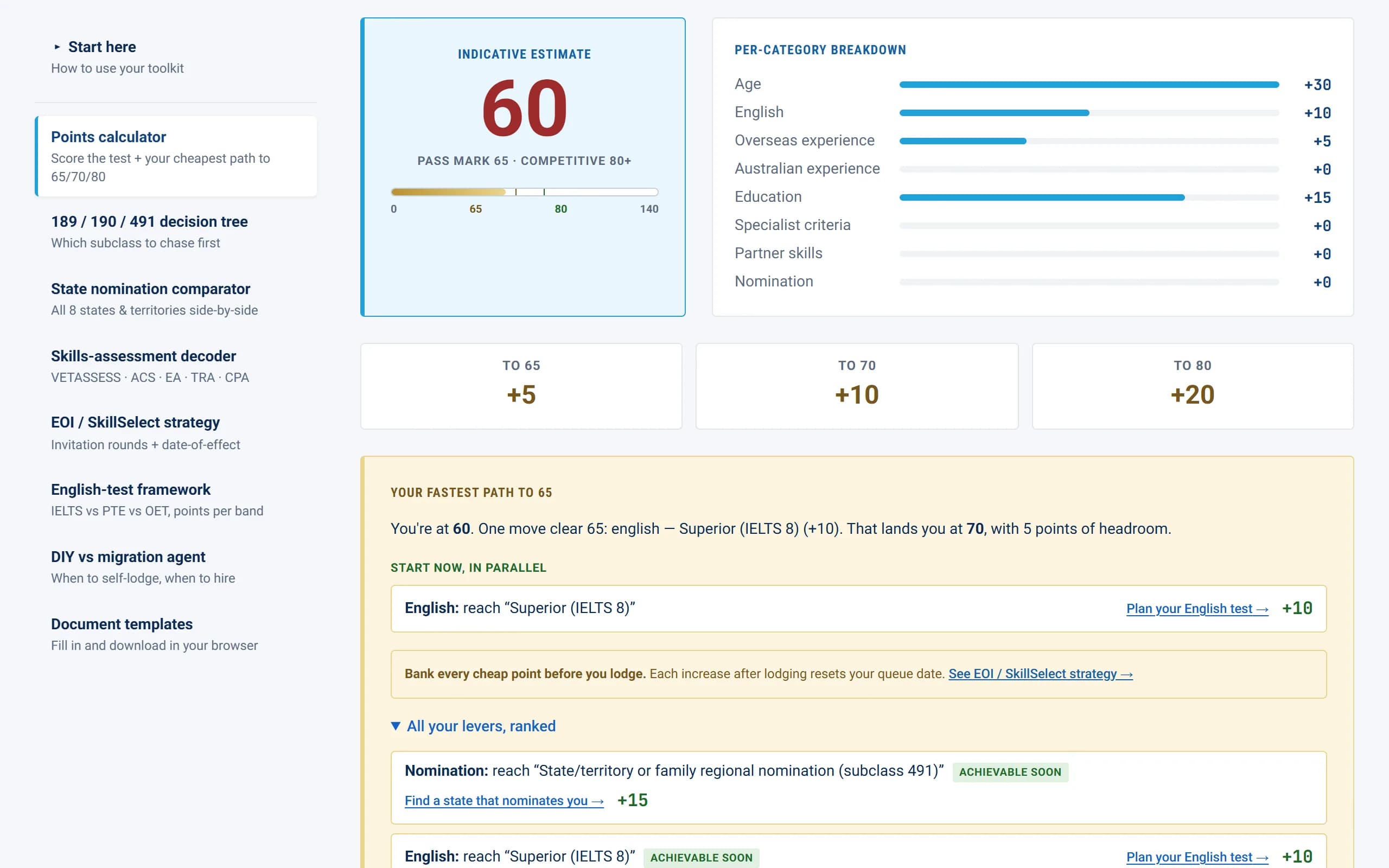
The points test applies to the 190 and 491 routes. A Skill Level 3 occupation like insurance agency selling typically scores as follows.
| Points Factor | Points | Notes |
|---|---|---|
| Age (25-32) | 30 | Maximum bracket |
| Age (33-39) | 25 | Common for experienced agents |
| English (Superior — 8.0+) | 20 | Strong points if achievable |
| English (Proficient — 7.0) | 10 | More realistic baseline |
| Qualification (Bachelor) | 15 | If a degree applies |
| Qualification (Diploma/Cert IV) | 10 | Common for this occupation |
| Skilled Employment (8+ years overseas) | 15 | Insurance selling experience |
| State Nomination (190) | 5 | Adds to the total |
| Regional Nomination (491) | 15 | The bigger lever |
| Partner Skills | 5-10 | If partner has a skilled occupation |
Realistic Score Scenarios
Scenario 1: Experienced agent, 34, Proficient English, 9 years experience, 491 regional nomination
- Age 25 + English 10 + Cert IV 10 + Experience 15 + Regional 15 = 75 points. Competitive for a 491.
Scenario 2: Mid-career agent, 30, Superior English, 6 years experience, 190 state nomination
- Age 30 + English 20 + Bachelor 15 + Experience 10 + Nomination 5 = 80 points. Competitive for a 190 where the occupation is nominated.
State Nomination for Insurance Agents
State and territory nomination for 611211 changes each program year, and an occupation can appear on one state's list and not another's. We do not name specific states here because the 2025-26 lists must be checked live against each government's own published occupation list. Before committing, confirm 611211 against the relevant program for NSW, Victoria, Queensland, South Australia, Western Australia, Tasmania, the Northern Territory or the ACT. Insurer head offices concentrate in Sydney and Melbourne, which is a sensible place to begin checking, but list inclusion is what decides eligibility.
Salary and Employment Outlook
| Role | Typical Salary Range (AUD) |
|---|---|
| Junior Insurance Agent / Consultant | $60,000-$72,000 base |
| Insurance Agent (Experienced) | $72,000-$90,000 base |
| Senior Agent / Account Executive | $90,000-$115,000 base |
| Life / Commercial Specialist | $100,000-$140,000+ with commission |
| Agency / Sales Team Manager | $120,000-$160,000 |
SEEK puts the average for insurance agents and consultants in the AUD $70,000 to $90,000 band in 2026, with capital-city averages varying widely by lines of business. A second source, PayScale, reports an average near AUD $70,000 to $73,000, which sits at the lower end of the SEEK range. Many roles add commission, so total earnings in life and commercial lines can run well above base, while entry-level personal-lines roles sit closer to the base figure. Superannuation at 11.5% applies on top.
The highest earnings come from life and commercial specialists working on commission, account-executive roles servicing larger clients, and agency management. Pay is concentrated where insurers base their distribution teams, which means Sydney and Melbourne lead.
Tips for a Successful Application
- Distinguish agent from broker. An insurance agent (611211) acts for the insurer. If your real role was broking, the duties point to a different code, and the wrong choice fails the assessment.
- Frame references around selling and advice. Ask referees to describe identifying client needs, explaining cover, calculating premiums and placing policies, not general sales or claims admin.
- Account for Australian licensing. Selling insurance in Australia requires the relevant authorisation under the financial services framework, so plan for any local accreditation your employer will require.
- Use regional nomination to lift points. A 491's 15 points often pushes a Skill Level 3 occupation into a competitive range, but confirm a genuine regional role first.
- Check the guaranteed base for a 482. Commission can inflate total pay, but the Core Skills Income Threshold is measured against the guaranteed base, so confirm it clears the figure.
Step-by-Step Migration Roadmap
- Confirm your ANZSCO code as 611211 using the ANZSCO code finder.
- Check the list status on the Core Skills Occupation List and the 2026 skilled occupation list.
- Prepare employment references that describe insurance selling and advice.
- Sit an English test and aim as high as your timeline allows.
- Lodge your VETASSESS skills assessment through the skills assessment bodies list.
- Calculate your points for the 190 and 491 routes.
- Submit an Expression of Interest through SkillSelect.
- Apply for state nomination, or secure a sponsoring insurer for the 482 or 186.
- Receive your invitation or nomination and lodge the visa.
- Complete health and character checks.
- Receive the visa grant and relocate.
- Meet residence conditions to move a provisional visa to permanent residency.
Frequently Asked Questions
Can an insurance agent apply for a subclass 189 visa?
No. ANZSCO 611211 sits on the Core Skills Occupation List but not on the MLTSSL, so the points-tested subclass 189 independent visa is unavailable. The routes are state nomination through the 190 or 491, or employer sponsorship through the 482 or 186.
What is the difference between an insurance agent and a broker for migration?
An insurance agent (611211) represents the insurer and sells its products to clients. A broker acts for the client and compares the market, and is a different ANZSCO occupation. Your skills assessment will fail if your references describe broking while you nominate Insurance Agent, so match the code to what you actually did.
Do I need an Australian licence to work as an insurance agent?
Selling insurance in Australia is regulated under the financial services framework, and agents work under an insurer's Australian Financial Services Licence or as an authorised representative. Your skills assessment and visa do not grant that authorisation; your Australian employer arranges it, and you will usually complete local accreditation after arrival.
What is the demand outlook for insurance agents in 2026?
Demand is moderate. Insurance is a mature sector with steady turnover, and direct digital channels have reshaped some entry-level selling. The occupation remains on the skilled lists but is not flagged as a national shortage. See the most in-demand occupations overview for wider context.
Will my overseas insurance experience be recognised?
Often yes, if your references clearly show insurance selling and advice at the required skill level, such as identifying client needs, explaining cover and placing policies. VETASSESS assesses both qualification and employment. The most common reason overseas experience is discounted is references that read like general sales, customer service or claims administration.