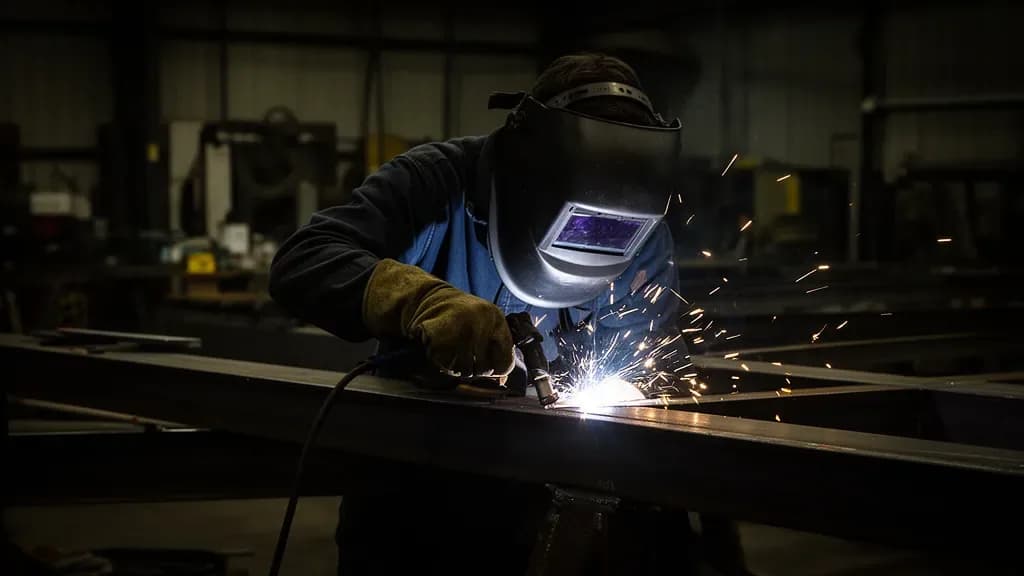
Sheetmetal Worker Visa Pathway to Australia: Complete 2026 Guide
Updated: 16 August 2026
Australia classifies Sheetmetal Trades Worker under ANZSCO 322211. Trades Recognition Australia (TRA) conducts the skills assessment. The occupation sits on the CSOL and MLTSSL, unlocking subclasses 189, 190, 491, 482 and 186. Typical 2026 salaries range AUD $80,000-$95,000, with aerospace and HVAC specialists earning above that band. Demand is strongest in construction-aligned manufacturing across NSW, VIC and QLD.
Quick Facts: Sheetmetal Worker Migration Pathway
| Detail | Information |
|---|---|
| ANZSCO Code | 322211 (Sheetmetal Trades Worker) |
| Skill Level | 3 (AQF Certificate III with two years on-the-job training, or Certificate IV) |
| Skills Assessment | TRA (Trades Recognition Australia) |
| Occupation List | CSOL + MLTSSL |
| Visa Options | 189, 190, 491, 482, 186 |
| Demand Level | High — persistent shortage tied to construction and HVAC manufacturing |
| Salary Range | AUD $80,000-$95,000 (SEEK Salary Hub, May 2026) |
| Typical 189 Score | 70-80 points (trade rounds smaller than ICT, but threshold lower) |
| Key Challenge | Demonstrating ANZSCO-aligned task evidence — many applicants conflate sheetmetal and structural steel work |
What a Sheetmetal Trades Worker Does in Australia
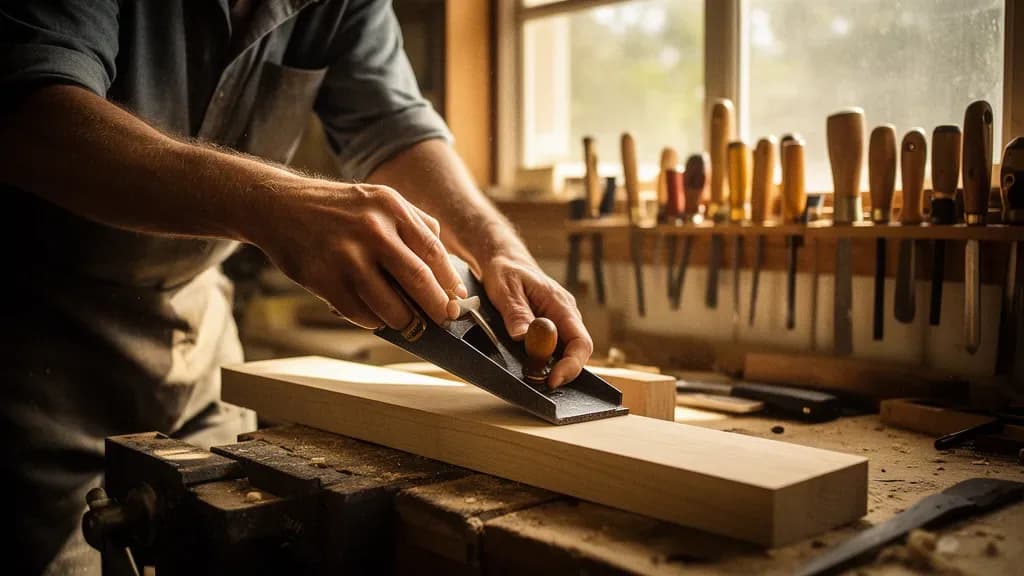
Sheetmetal Trades Workers mark out, cut, shape and join thin metal stock (stainless steel, galvanised iron, aluminium, mild steel and copper) into products and components. The trade powers Australia's heating, ventilation and air-conditioning industry, the food-grade processing sector, aerospace sheet skin fabrication, architectural cladding, and custom kitchen and laboratory fit-out work.
Demand concentrates around metropolitan industrial precincts. Western Sydney, Dandenong and the Melbourne south-east, Brisbane's southern industrial belt, and the Adelaide northern industrial corridor all run shortages. Major employers include HVAC manufacturers (Daikin, Fujitsu, Seeley International), commercial kitchen fabricators, aerospace MRO operators (BAE Systems, Boeing Defence Australia), and the broader construction supply chain that fabricates flashing, ducting, gutters and architectural metal cladding.
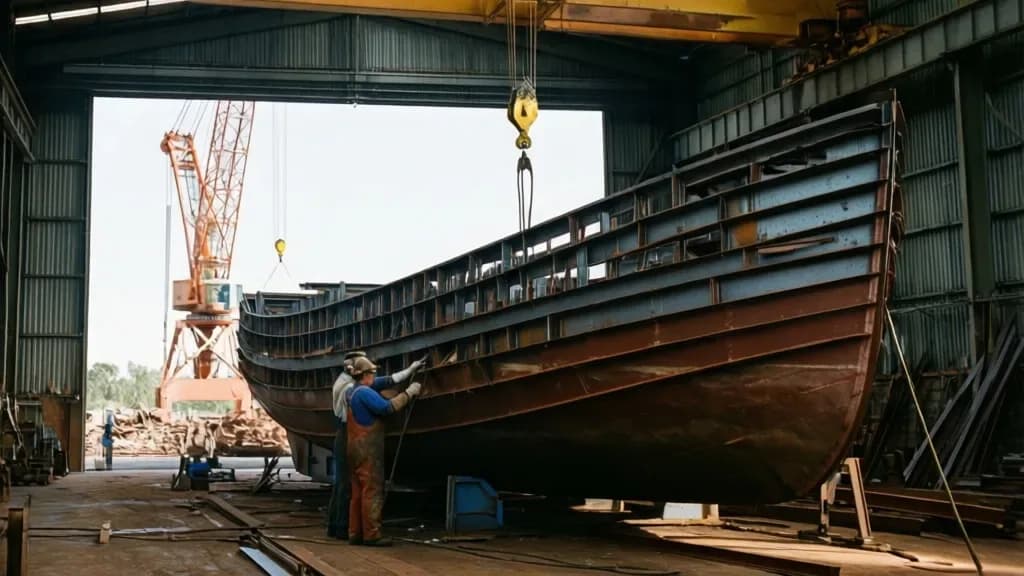
The trade overlaps with metal fabrication (322311) and welding (322313), but ANZSCO treats sheetmetal as distinct because the materials are thinner, the tooling is different (folders, rollers, presses rather than heavy welding plant), and the work emphasises forming and joining rather than structural assembly. See the metal fabricator visa pathway if your work is primarily structural steel.
ANZSCO 322211 — The Code and Tasks
ANZSCO 322211 covers tradespeople who mark out, shape, form and join sheetmetal and other materials to make products and components. The Australian Bureau of Statistics describes core tasks as: studying blueprints, drawings and specifications to determine job, material and equipment requirements; selecting metal stock and checking sizes, gauges and other dimensions; marking out metal stock with reference points and lines using templates, gauges and other measuring instruments; cutting metal stock using hand and power shears, guillotines and drills; shaping and forming cut metal stock using folding and bending machines, rollers, presses and hammers; and fitting and assembling components into final products by welding, riveting, soldering, brazing and otherwise joining.
Specialisations within the code include fabrication, on-site assembly and installation, and aircraft sheetmetal. The last requires advanced drawing interpretation and tighter tolerances. There is no nec fallback within unit group 3222.
Skills Assessment: TRA
Trades Recognition Australia (tradesrecognitionaustralia.gov.au) is the assessing authority. Which TRA program applies depends on your location.
Offshore applicants — Migration Skills Assessment (MSA) or OSAP
Requirements:
- Qualification equivalent to AQF Certificate III with at least two years of on-the-job training, or AQF Certificate IV
- At least three years of paid full-time employment in the occupation (or equivalent part-time hours)
- Detailed identity, qualification and employment evidence including payslips, tax records and employer references describing sheetmetal-specific tasks
Assessment cost: Documentary stage from AUD $300; full MSA fees vary by stage. Refer to the TRA fee schedule for current amounts. Processing time: TRA targets 120 days (around 17 weeks) from a complete submission.
Applicants from the UK, Ireland and several European countries with comparable trade systems may be eligible for the Offshore Skills Assessment Program (OSAP), which includes a practical and technical assessment at an approved centre.
Common rejection reasons: Employment references that read like generic metalwork descriptions; failure to evidence work with thin-gauge sheet (the code is specifically about sheetmetal, not heavy plate); training records from providers TRA does not recognise as equivalent to AQF Certificate III.
Onshore applicants — Job Ready Program (JRP)
The four-stage JRP for applicants already in Australia: Provisional Skills Assessment, Job Ready Employment (12 months of paid Australian work), Job Ready Workplace Assessment, and Final Assessment.
JRWA fee: AUD $2,845 per TRA's published schedule. Other stages carry separate fees. Processing time: 12-18 months end to end.
The JRP demands more time and money than the offshore MSA but produces a strong outcome and is often the right choice for applicants on student or working holiday visas who can secure local employment.
Visa Pathways for Sheetmetal Workers
Subclass 482 — Skills in Demand
Often the most direct route. HVAC manufacturers and aerospace MRO employers sponsor international tradespeople routinely.
Visa fee: AUD $3,210 (primary applicant) Salary threshold: Core Skills stream income threshold around AUD $76,515. Most sheetmetal roles clear it, especially with overtime Processing time: 1-3 months for Core Skills stream nominations Quirk that matters: Labour Market Testing is required and must be evidenced by the employer. Larger HVAC and aerospace firms have approved sponsor status and process applications faster.
Subclass 491 — Skilled Work Regional (Provisional)
Strong pathway for sheetmetal workers willing to work outside the major metro postcodes: regional NSW, regional QLD, all of South Australia and Tasmania, and most of WA outside Perth.
Visa fee: AUD $6,140 (primary applicant) Eligibility constraint: Must live and work in a designated regional area for the visa duration Processing time: 7-12 months Quirk that matters: Pathway to subclass 191 permanent residency after three years of regional residence and income above threshold.
Subclass 190 — Skilled Nominated
Permanent residency through state nomination plus the points test.
Visa fee: AUD $6,140 (primary applicant) Points boost: +5 from state nomination Processing time: 6-10 months Quirk that matters: NSW, VIC, QLD and SA all nominate sheetmetal workers in different financial years — check the current state lists before committing to an EOI strategy.
Subclass 186 — Employer Nomination Scheme
Permanent residency via employer sponsorship.
Visa fee: AUD $6,140 (primary applicant) Processing time: 6-12 months (Direct Entry); shorter for Temporary Residence Transition stream Quirk that matters: Many sheetmetal workers transition from 482 to 186 after two to three years on the temporary visa.
Subclass 189 — Skilled Independent
The points-only permanent residency option for MLTSSL occupations.
Visa fee: AUD $6,135 (primary applicant) Realistic points: 75-80 typically required for invitation Processing time: 8-12 months once invited Quirk that matters: Invitation rounds for non-priority trades have been small in 2026, so most sheetmetal applicants are better served by 190 or 491.
Points Test Strategy
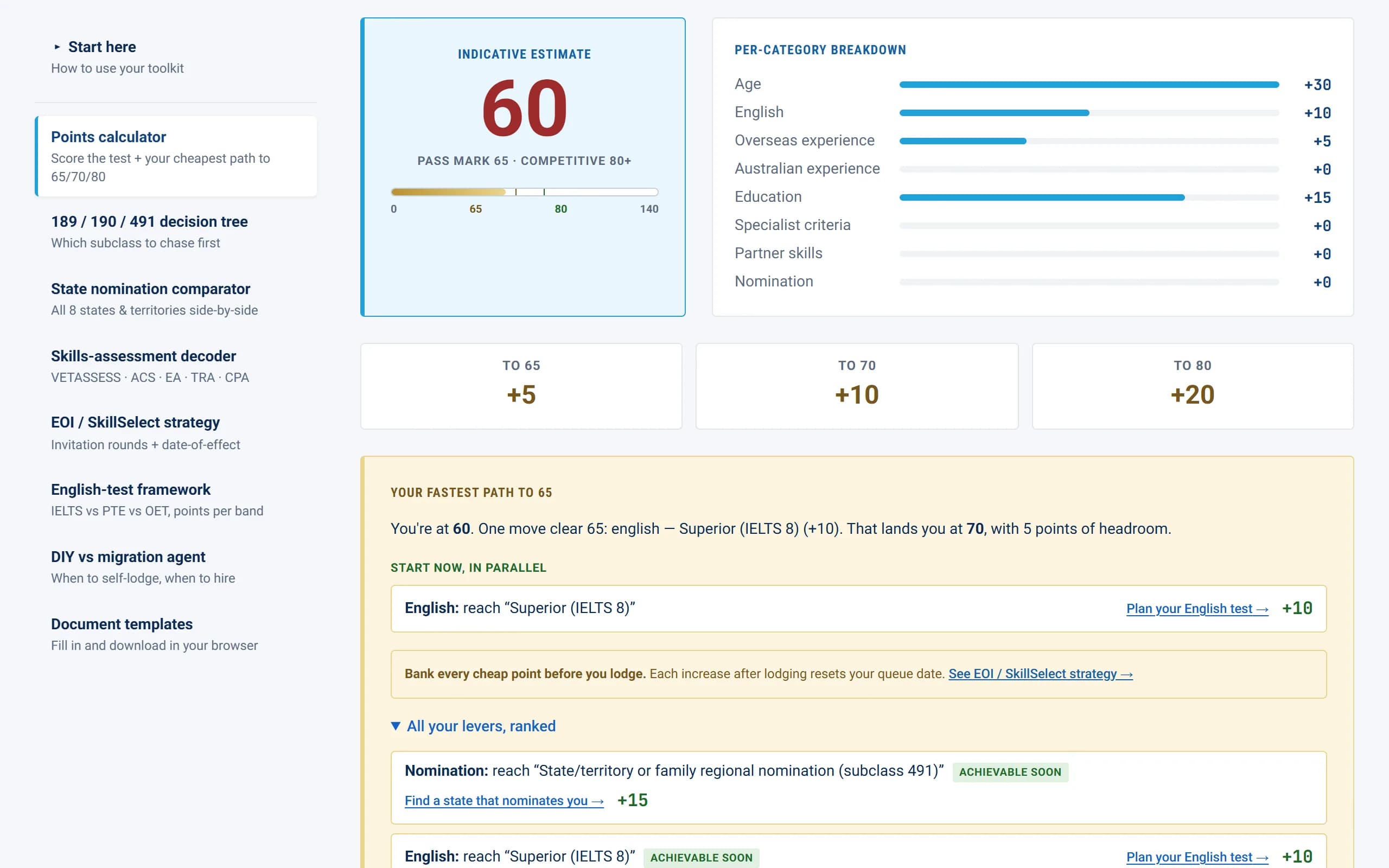
| Points Factor | Points | Notes |
|---|---|---|
| Age (25-32) | 30 | Most favourable bracket |
| Age (33-39) | 25 | Still competitive |
| Trade qualification (AQF III-IV) | 10 | Standard |
| English (Competent 6.0) | 0 | Mandatory minimum |
| English (Proficient 7.0) | 10 | Worth the test prep |
| English (Superior 8.0) | 20 | Decisive in close rounds |
| Overseas skilled experience (5-7 years) | 10 | Common |
| Overseas skilled experience (8+ years) | 15 | Common ceiling |
| Australian skilled work | 5-20 | Strong lever |
| State Nomination (190) | 5 | Modest but meaningful |
| Regional Nomination (491) | 15 | The decisive lever |
| Partner skills | 5-10 | Often overlooked |
Realistic Scenarios
Scenario 1: Offshore sheetmetal worker, age 30, eight years experience, Proficient English, NSW 491 nomination
- Age 30: 30 + Trade qual: 10 + English Proficient: 10 + Experience 8 years: 15 + 491: 15 = 80 points
- Strong position for invitation in current trade rounds
Scenario 2: Onshore JRP completer, age 34, five years total experience, Competent English, VIC 190 nomination
- Age 34: 25 + Trade qual: 10 + English Competent: 0 + Experience 5 years: 10 + 190: 5 + Australian work: 5 = 55 points
- Below typical invitation threshold — would need Proficient English, partner skills, or 491 instead
State Nomination for Sheetmetal Workers
New South Wales
NSW nominates Sheetmetal Trades Worker on both the 190 and 491 streams in financial years where the occupation is included on the state list. Western Sydney's HVAC and food-processing manufacturing creates steady demand. The 491 covers regions including the Illawarra, Central Coast (excluding Gosford metro), Hunter, and North Coast.
Victoria
Victoria's 190 program covers trades including sheetmetal in years where the occupation appears on the priority list. Melbourne's south-east industrial belt (Dandenong, Hallam, Mulgrave) concentrates HVAC and food-grade fabrication. Victoria typically requires Competent English and a valid TRA assessment for nomination.
Queensland
Queensland's QSOL covers sheetmetal trades for 491 nomination in eligible regional areas: Townsville, Cairns, the Sunshine Coast hinterland, and Toowoomba's manufacturing precinct. Migration Queensland accepts casual work of 20+ hours per week as valid skilled employment.
South Australia
SA nominates sheetmetal trades workers under its 190 and 491 streams, with construction and defence-aligned manufacturing demand around Adelaide's northern industrial corridor. SA's program publishes monthly invitation numbers, which makes capacity planning easier than in some other states.
Salary and Employment Outlook
What Can You Expect to Earn?
| Role | Typical Salary Range |
|---|---|
| Apprentice Sheetmetal Worker | AUD $50,000-$60,000 |
| Qualified Sheetmetal Worker | AUD $80,000-$85,000 |
| Senior Sheetmetal Worker | AUD $85,000-$100,000 |
| HVAC Specialist | AUD $90,000-$110,000 |
| Aircraft Sheetmetal Worker | AUD $95,000-$120,000 |
| Workshop Foreman | AUD $100,000-$135,000 |
Source: SEEK Salary Hub (May 2026), with hourly rates of $32-$56 per hour across advertised positions.
Total packages typically include 11.5% superannuation. Industrial roles often add shift loadings, overtime premiums and tool allowances. Aerospace specialists with restricted clearances earn the highest base rates.
Highest-Paying Sectors
- Aerospace MRO — Boeing Defence Australia, BAE Systems, Hawker Pacific
- HVAC manufacturing — Daikin, Seeley International, Fujitsu
- Defence prime contractors — particularly in Adelaide and Williamtown (NSW)
- Architectural metalwork — premium cladding fabricators for high-end commercial construction
- Food-grade processing equipment — stainless steel fabrication for dairy, meat and beverage plants
Tips for a Successful Application
1. Document thin-gauge work explicitly
TRA distinguishes sheetmetal (thin gauge, formed and joined) from structural metalwork (heavy plate, welded). Your employment references must describe sheetmetal-specific tasks: folding, rolling, guillotining, riveting, soldering, brazing, light-gauge welding. References that read like welder or boilermaker job descriptions invite a refusal.
2. Match your specialisation to the labour market
Aircraft sheetmetal applicants are competitive for aerospace MRO roles in Adelaide and the Hunter; HVAC ductwork applicants are competitive for Sydney and Melbourne manufacturing roles. State your specialisation in your CV and TRA references — Australian employers and migration committees both reward specificity.
3. Build evidence of payslips, not just letters
TRA cross-checks employer references against payslips, tax records and superannuation contributions (or equivalent in your country). A glowing reference without supporting financial evidence is a red flag. Start collecting documentation 12 months before you intend to apply.
4. Get your English certification before assessment
Although TRA does not formally require English at the documentary stage, state nomination committees do. Sitting a Proficient English test (IELTS 7.0 or equivalent) before TRA submission means you can move directly into state nomination on receipt of your assessment outcome.
5. Target the right state for your specialisation
Generalist sheetmetal workers should target SA or regional QLD for steady 491 demand. Aerospace specialists should focus on Adelaide (SA) and the Hunter (NSW). HVAC specialists should focus on Sydney's Western Suburbs or Melbourne's south-east — both metropolitan, which means 190 rather than 491.
Step-by-Step Migration Roadmap
- Confirm ANZSCO 322211 fits your duties — check the how to find your ANZSCO code guide if your work overlaps with metal fabrication
- Audit your qualification against AQF Certificate III — gather syllabus and practical hours evidence
- Compile employment evidence — payslips, tax records, employer references aligned with sheetmetal-specific tasks
- Sit your English test — Proficient (7.0) ideally, Competent (6.0) minimum
- Apply to TRA — MSA offshore, JRP onshore, OSAP if available for your country
- Receive your skills assessment outcome — 17 weeks typical for MSA
- Submit your EOI in SkillSelect — flag 482, 190 and 491 according to your strategy
- Apply for state nomination — target the state matching your specialisation
- Or seek employer sponsorship — particularly via 482 for HVAC and aerospace roles
- Receive your invitation to apply — within 60 days, lodge your visa application
- Complete health and character checks — and gather police certificates from every country lived in 12+ months
- Receive grant and relocate — start work in your nominated location
For deeper background see the skills assessment hub and the most-in-demand occupations list.
Frequently Asked Questions
Is Sheetmetal Trades Worker still in shortage in Australia in 2026?
Yes. Jobs and Skills Australia identifies trades as the largest contributor to national shortages, with Skill Level 3 fill rates at 54.3%. HVAC manufacturing, aerospace MRO and construction-aligned fabrication all report persistent vacancies — particularly for tradespeople with experience in stainless steel and aluminium fabrication.
Should I nominate Sheetmetal Worker or Metal Fabricator?
Match the code to your actual work. Sheetmetal Worker (322211) covers thin-gauge forming and joining — ducting, flashing, kitchen fit-out, aircraft skin. Metal Fabricator (322311) covers heavier structural and platework. If your week is split, lead with the code your payslips and references most support. TRA reviewers cross-reference duties against employer evidence.
Do I need separate registration to work as a sheetmetal worker in Australia?
No. Unlike electricians and plumbers, sheetmetal workers do not require a separate state licence. The TRA skills assessment is sufficient for visa purposes. Construction work on commercial sites typically requires a White Card (general construction induction), which is a one-day course completed after arrival.
Can my UK or Irish sheetmetal qualification be recognised?
Often yes. UK NVQ Level 3 and Irish FETAC Level 6 sheetmetal qualifications are usually accepted as equivalent to AQF Certificate III, but TRA still requires the assessment process. Applicants from these countries are usually eligible for the Offshore Skills Assessment Program (OSAP) rather than the longer MSA documentary pathway.
How long does the whole migration process take for a sheetmetal worker?
Realistic end-to-end timelines: 12-18 months for an offshore applicant using MSA followed by 491 or 190, plus visa processing; 18-24 months for an onshore applicant using JRP. Employer-sponsored 482 routes can be faster — sometimes 3-6 months from job offer to visa grant — if the sponsoring employer is an established approved sponsor with strong evidence of labour market need.