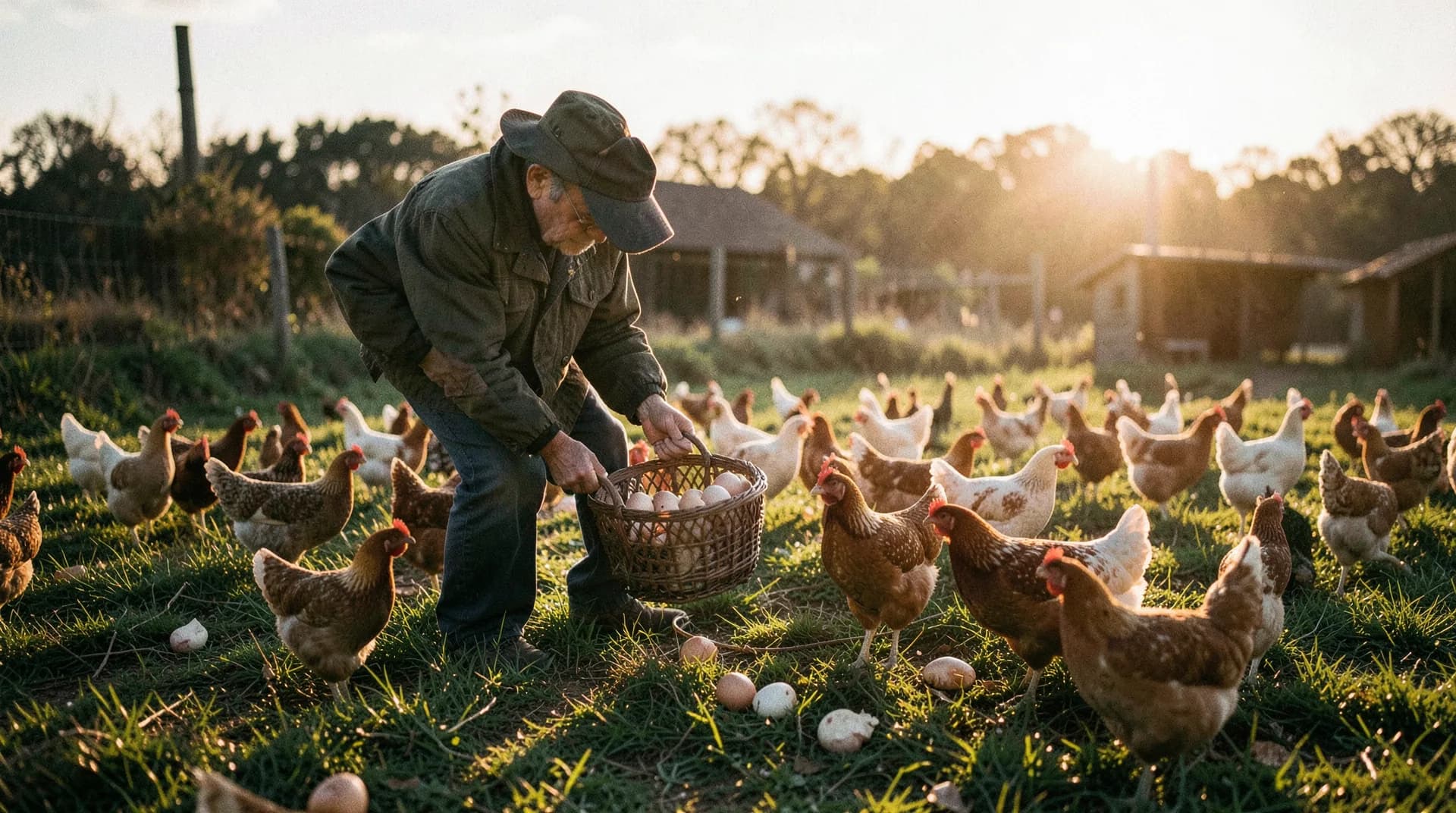
Poultry Farmer Visa Pathway to Australia: Complete 2026 Guide
Updated: 16 August 2026
Australia classifies Poultry Farmer under ANZSCO 121321, a Skill Level 1 occupation. VETASSESS conducts the skills assessment. The occupation sits on the Core Skills Occupation List (CSOL) but not the MLTSSL, so it unlocks subclasses 190, 491, 482 and 186 rather than the independent 189. Typical 2026 salaries run AUD $76,000-$131,000, rising with flock size and management scope.
Quick Facts: Poultry Farmer Migration Pathway
| Detail | Information |
|---|---|
| ANZSCO Code | 121321 (Poultry Farmer) |
| Skill Level | 1 (bachelor degree or higher, or five years of relevant experience) |
| Skills Assessment | VETASSESS (Vocational Education and Training Assessment Services) |
| Occupation List | CSOL and STSOL — not on MLTSSL |
| Visa Options | 190, 491, 482, 186 |
| Demand Level | Moderate — concentrated in egg and broiler regions, steady rather than acute |
| Salary Range | AUD $76,000-$131,000 (SEEK, SalaryExpert 2026) |
| Typical 190/491 Score | 65-75 points with state nomination |
| Key Challenge | No 189 access; pathway runs through state nomination or employer sponsorship |
What a Poultry Farmer Does in Australia
A Poultry Farmer plans, organises and runs the operations that breed and raise chickens, turkeys, ducks and other poultry for eggs, meat and breeding stock. The role is managerial as much as hands-on. You oversee feeding and nutrition programs, monitor flock health, run biosecurity controls, and organise routines such as catching, grading and packaging produce. On a commercial site you also manage staff, budgets, sheds, climate-control systems and compliance with animal-welfare and food-safety law.
Australian poultry production is concentrated in a handful of regions. Broiler (meat chicken) operations cluster around the major capitals to stay close to processing plants, with strong activity in New South Wales, Victoria and Queensland. Egg production is more dispersed. Most birds are raised under contract to large processors such as Inghams and Baiada in the meat sector, which shapes how farms are financed and managed. Demand for skilled managers is steady, driven by consolidation into larger automated sheds and the constant need for people who can run biosecurity to a high standard after recurring avian influenza incidents.
ANZSCO Code 121321 in Detail
The code 121321 falls under ANZSCO unit group 1213, Livestock Farmers. The official description covers planning, organising, controlling, coordinating and performing farming operations to breed and raise poultry. Core tasks include overseeing breeding, feeding and nutrition programs, monitoring flock health and welfare, managing biosecurity and other risks, and organising operations such as drenching, collecting, grading and packaging.
There is no separate "egg farmer" or "broiler manager" code. Both map to 121321. If your work is supervisory on a large site rather than owner-operator, your duties still align with this code, since the ANZSCO definition is built around running the operation, not owning it. Applicants who spend most of their time on general crop or mixed work should check whether Mixed Crop and Livestock Farmer (121399) fits better, because VETASSESS assesses against the duties your references actually describe.
Skills Assessment
VETASSESS (Group B)
VETASSESS assesses Poultry Farmer as a Group B occupation, which means both your qualification and your employment are examined for relevance to the ANZSCO duties.
Requirements:
- A qualification assessed at AQF Bachelor degree level or higher in a highly relevant field, plus at least one year of post-qualification highly relevant employment in the last five years, OR
- A Bachelor degree in any field plus an additional qualification at least at AQF Diploma level in a highly relevant field, plus at least two years of relevant employment, OR
- Where formal qualifications are limited, an extended period of relevant work can be considered under the alternative pathways VETASSESS publishes for general occupations.
Assessment cost: AUD $1,096 for applicants outside Australia (AUD $1,205.60 including GST for online applications within Australia), current after the 22 October 2025 fee increase.
Processing time: Around 7 weeks standard. Priority processing returns an outcome in about 10 business days for an extra AUD $825 (AUD $907.50 including GST).
Common rejection reasons: References that describe general farm labouring rather than the planning, biosecurity and management duties the code requires; and qualifications in an unrelated field with no relevant employment to bridge the gap. From 1 January 2026, Pathway 1 applicants must also lodge a Language, Literacy, Numeracy and Digital Skills assessment with their documents.
Visa Pathways for Poultry Farmers
Because Poultry Farmer is on the CSOL and STSOL but not the MLTSSL, the subclass 189 independent visa is closed to this occupation. The realistic routes are state-nominated, regional, or employer-sponsored.
Subclass 491 — Skilled Work Regional (Provisional)
Often the strongest fit, because poultry farms are usually in regional or peri-urban areas.
- Visa fee: AUD $6,140 (primary applicant)
- Points boost: +15 from regional nomination
- Duration: 5 years, with a pathway to the permanent 191 after meeting income and residence rules
- Quirk: Most poultry employers sit inside designated regional postcodes, so applicants frequently already meet the regional residence expectation.
Subclass 190 — Skilled Nominated (Permanent)
Permanent residency where a state or territory nominates the occupation and you meet its criteria.
- Visa fee: AUD $6,140 (primary applicant)
- Points boost: +5 from state nomination
- Obligation: Live and work in the nominating state for two years
- Quirk: State nomination for this code is selective and tends to track local labour shortages, so availability changes between program years.
Subclass 482 — Skills in Demand (Temporary)
Employer-sponsored. Common where a large producer wants to bring in an experienced manager.
- Visa fee: AUD $1,895 (Core stream) or AUD $3,035 (Specialist stream)
- Eligibility: A sponsoring employer, a positive skills assessment, and a salary meeting the relevant income threshold
- Quirk: Poultry manager salaries can sit near the Core stream threshold, so confirm the offered package clears it before lodging.
Subclass 186 — Employer Nomination Scheme (Permanent)
Permanent residency through an employer, usually after time on a 482.
- Visa fee: AUD $6,140 (primary applicant)
- Streams: Direct Entry or the Temporary Residence Transition stream after qualifying 482 service
Points Test Strategy
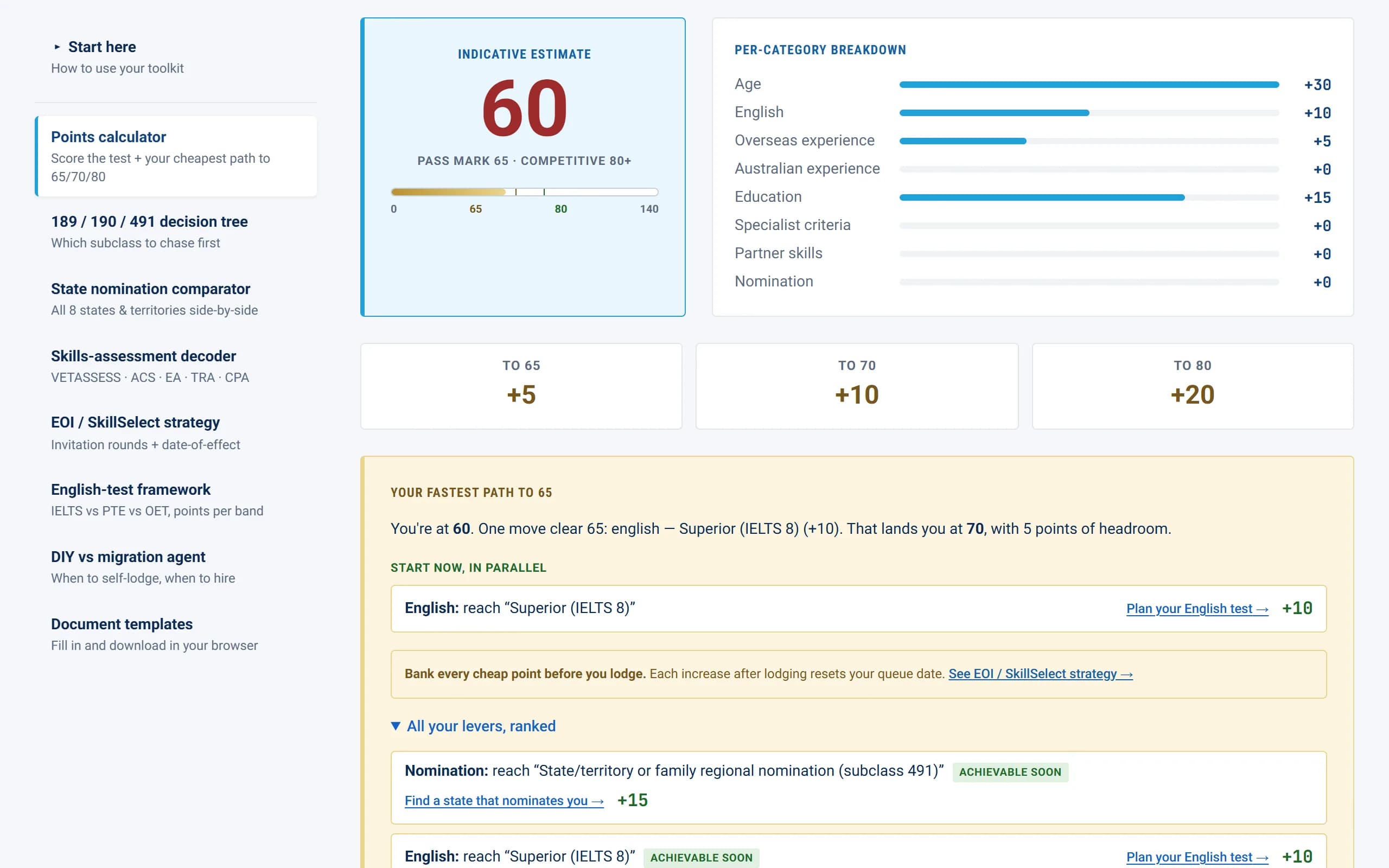
The points test applies to the 190 and 491. The base pass mark is 65, and nomination points are what usually lift a poultry farming applicant into a competitive range.
| Points Factor | Points | Notes |
|---|---|---|
| Age (25-32) | 30 | Maximum bracket |
| Age (33-39) | 25 | Common for experienced managers |
| English (Proficient — 7.0) | 10 | Realistic target for most applicants |
| English (Superior — 8.0+) | 20 | Adds a clear advantage |
| Qualification (Bachelor) | 15 | Minimum for Skill Level 1 |
| Skilled Experience (overseas) | 5-15 | Depends on assessed years |
| State Nomination (190) | 5 | If nominated |
| Regional Nomination (491) | 15 | The largest single lift |
| Partner Skills | 5-10 | If partner has a skilled occupation |
Realistic Score Scenarios
Scenario 1: Experienced manager, 34, Proficient English, eight years on a commercial farm
Age 25 + English 10 + Bachelor 15 + experience 15 = 65, then +15 for a 491 nomination = 80 points. Competitive in a regional program.
Scenario 2: Mid-career applicant, 38, Proficient English, five years experience, vocational qualification plus relevant degree
Age 25 + English 10 + Bachelor 15 + experience 10 = 60, then +5 for a 190 nomination = 65 points. A 491 nomination (+15) would be the stronger play here.
State Nomination
Nomination for 121321 is not offered everywhere, and lists change each program year. Verify the current occupation list on each state's site before committing.
Queensland and New South Wales
Both states host large broiler and egg sectors and have nominated agricultural management roles in regional streams when local shortages appear. Regional Queensland and regional NSW are where most poultry operations sit, which lines up with 491 regional residence rules.
Victoria and South Australia
Victoria's poultry industry is sizeable, and regional Victorian programs periodically include livestock and farming management occupations. South Australia has used skilled migration to fill regional agricultural roles and sometimes applies more flexible criteria for offshore applicants in shortage areas.
Treat all of the above as indicative. A poultry farming nomination depends on the specific state program open at the time you apply.
Salary and Employment Outlook
| Role | Typical Salary Range |
|---|---|
| Poultry Farm Worker / Supervisor | AUD $60,000-$76,000 |
| Poultry Farmer (entry management, 1-3 yrs) | AUD $76,000-$90,000 |
| Poultry Farm Manager | AUD $90,000-$110,000 |
| Senior / Multi-site Manager (8+ yrs) | AUD $110,000-$131,000 |
SEEK job-ad data places poultry farm management around AUD $77,500 on average, while SalaryExpert reports an average closer to AUD $106,000 once bonuses and larger operations are included. Senior managers running automated multi-shed sites reach the top of the range. Packages usually add superannuation at 11.5%, and on-farm housing or a vehicle is common because of the remote locations.
The highest-paying roles tend to sit with the large integrated producers and contract-growing operations, where managers carry profit-and-loss responsibility for several sheds. Egg producers transitioning to free-range and cage-free systems also need experienced managers to handle the operational change.
Tips for a Successful Application
- Frame your references around management, not labour. VETASSESS is checking for planning, biosecurity, nutrition and staff oversight. References that read like a general farmhand description are the most common reason this assessment fails.
- Choose 491 first if your work is regional. The +15 regional points usually do more for your total than any other single factor, and most poultry farms already sit in eligible postcodes.
- Confirm the salary clears the 482 threshold before relying on sponsorship. Poultry management pay can land near the Core stream floor, so get the offer in writing and check the current income figure.
- Prepare your LLND assessment early. From January 2026 it must be lodged with your VETASSESS documents, and chasing it afterwards stalls the file.
- Document biosecurity experience explicitly. After repeated avian influenza outbreaks, Australian employers value managers who can prove they have run disease-control programs. Make that part of your reference letters.
Step-by-Step Migration Roadmap
- Confirm your ANZSCO code using the ANZSCO code finder and check 121321 fits your duties.
- Confirm CSOL status on the Core Skills Occupation List and the wider Skilled Occupation List for 2026.
- Gather employment references that describe planning, biosecurity and management duties.
- Sit an English test, aiming for Proficient or higher.
- Lodge your VETASSESS skills assessment with the LLND assessment included.
- Calculate your points against the 190 and 491 thresholds.
- Submit an Expression of Interest through SkillSelect.
- Apply for state or regional nomination, or secure an employer for a 482.
- Receive an invitation and lodge the visa within the deadline.
- Complete health and character checks.
- Receive the grant and relocate to the nominating region.
Frequently Asked Questions
Can a Poultry Farmer apply for the subclass 189 visa?
No. Subclass 189 is only open to occupations on the MLTSSL, and Poultry Farmer (121321) is on the CSOL and STSOL but not the MLTSSL. The realistic permanent routes are the 190 (state nominated) and the 186 (employer sponsored), with the 491 regional visa as a provisional pathway that later leads to permanent residency.
Do I need to own a poultry farm to qualify?
No. The ANZSCO definition is built around planning and running poultry operations, which covers salaried farm managers as well as owner-operators. Your skills assessment turns on the duties your employment references describe, not on whether you hold a stake in the business.
How long does the whole pathway take?
Allow several months for English testing and document gathering, around seven weeks for a standard VETASSESS assessment, then the nomination and visa stages. State nomination and visa processing vary, so a realistic end-to-end timeline often runs 12 to 18 months from first step to grant.
Which states are most likely to nominate Poultry Farmer?
States with large poultry sectors and regional labour shortages, chiefly Queensland, New South Wales and Victoria, are the most likely to include the occupation in regional streams. Lists change each program year, so check the current state nomination list before lodging an Expression of Interest.
What salary should I expect as a poultry farm manager?
SEEK job-ad data centres on around AUD $77,500, while broader datasets that include bonuses and senior multi-site roles report averages near AUD $106,000, with experienced managers reaching AUD $131,000. On-farm housing and a vehicle are common additions because of the regional locations.