Telecommunications Network Planner Visa Pathway to Australia: Complete 2026 Guide
Updated: 16 August 2026
Australia classifies Telecommunications Network Planner under ANZSCO 313213. Engineers Australia conducts the skills assessment via the Migration Skills Assessment pathway. The occupation is on the MLTSSL and CSOL, unlocking subclasses 189, 190, 491, 482, 186 and 494. Typical 2026 salaries range AUD $95,000-$160,000. NSW and Victoria carry the deepest hiring demand because of 5G rollout and fixed-line upgrades.
Quick Facts: Telecommunications Network Planner Migration Pathway
| Detail | Information |
|---|---|
| ANZSCO Code | 313213 (Telecommunications Network Planner) |
| Skill Level | 2 (Associate Degree, Advanced Diploma or Diploma, plus three years relevant experience) |
| Skills Assessment | EA (Engineers Australia) — Migration Skills Assessment |
| Occupation List | MLTSSL and CSOL |
| Visa Options | 189, 190, 491, 482, 186, 494 |
| Demand Level | Moderate — steady demand from 5G, NBN upgrades and enterprise networks |
| Salary Range | AUD $95,000-$160,000 (SEEK Career Advice, 2026) |
| Typical 189 Score | 80-90 (ICT codes pull invitations above the floor) |
| Key Challenge | Skill Level 2 means qualifications must be assessed against an AQF Associate Degree or Diploma plus solid vendor evidence |
Role Context in Australia
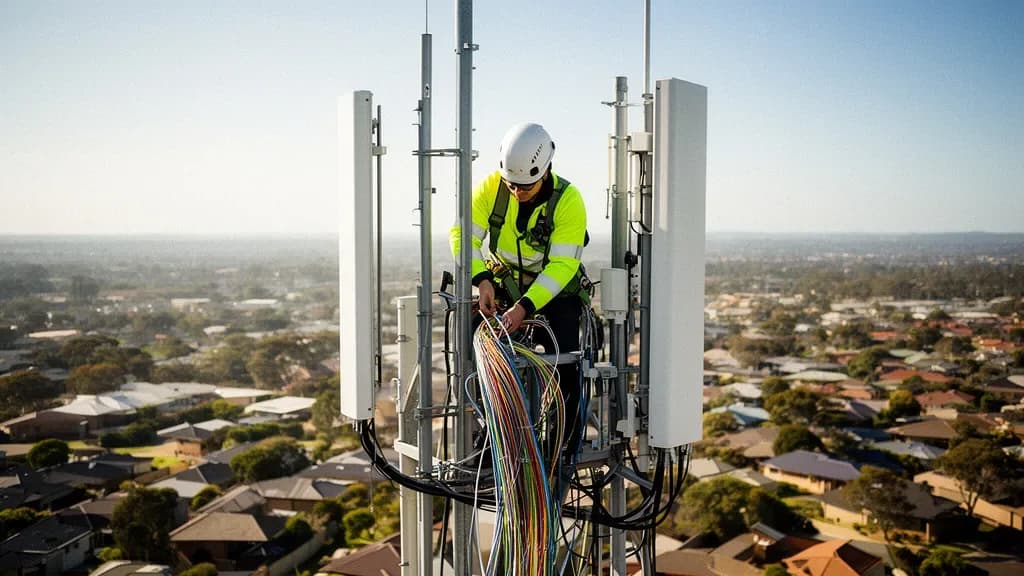
Telecommunications Network Planners design, dimension and modify access and core network infrastructure for carriers, system integrators and large enterprises. The day-to-day work covers radio planning for mobile networks, fibre and HFC routes for fixed access, microwave backhaul, capacity forecasting, and the network designs that feed civil construction crews. Strong commercial demand sits with Telstra, Optus, TPG Telecom and the wholesale carrier Vocus, plus contractors building for NBN Co, transport operators and mining majors.
Sydney and Melbourne hold the largest planning teams because vendor head offices and Tier 1 carrier engineering hubs concentrate there. Brisbane, Perth and Adelaide carry meaningful work tied to defence, resources and regional NBN expansion. The 5G standalone rollout, the multi-year copper-to-fibre migration program, and private enterprise networks across mining and ports keep planning hiring steady rather than spectacular. This is not the white-hot demand of cyber security or cloud engineering, but invitations under MLTSSL pathways remain achievable for candidates with current vendor certifications.
ANZSCO Code Mapping
ANZSCO 313213 covers the planning of customer access telecommunications network infrastructure. Tasks include analysing existing networks, designing modifications, costing equipment, coordinating with construction teams, and documenting designs for regulatory and commercial approval. The code sits inside Unit Group 3132 Telecommunications Technical Specialists, alongside 313214 Telecommunications Technical Officer or Technologist.
If your day-to-day work skews toward installation, fault diagnosis or commissioning rather than design and capacity modelling, 313214 Telecommunications Technical Officer or Technologist is the better fit. If you hold a full engineering degree and lead the technical architecture of carrier networks, the higher-skilled 263311 Telecommunications Engineer code may apply. The right code is the one that matches your employment references — not the one with the easiest pathway.
For a structured approach to picking the right code, see how to find your ANZSCO code.
Skills Assessment
Engineers Australia — Migration Skills Assessment
Engineers Australia is the designated authority for occupations in Unit Group 3132. The standard route is the Migration Skills Assessment (MSA) supported by a Competency Demonstration Report (CDR) where qualifications are not from a Washington, Sydney or Dublin Accord institution.
Requirements:
- AQF Associate Degree, Advanced Diploma or Diploma in telecommunications, electronics or a related engineering field — or three years of relevant experience and vendor certifications in lieu
- A Competency Demonstration Report covering Career Episodes, a Summary Statement and a Continuing Professional Development list, unless your qualification is recognised under an accord
- English at Competent level (IELTS 6.0 in each band, or equivalent PTE/TOEFL)
Assessment cost: AUD $1,034 standard MSA. Fast Track adds AUD $396 if you need allocation to an assessor within 20 business days.
Processing time: Allocation to an assessor inside 20 business days for Fast Track, otherwise 8-15 weeks end-to-end depending on document quality.
Common rejection reasons: CDR Career Episodes that read like job descriptions rather than first-person engineering narratives. Reusing project descriptions across multiple Career Episodes. Insufficient evidence that your duties match planning rather than installation or sales engineering.
For a broader overview of every body that conducts assessments, see the skills assessment bodies complete list.
Visa Pathways
Order matters. For network planners with current carrier experience offshore, employer-sponsored 482 is often the fastest route because Tier 1 carriers and contractors have established sponsorship programs.
Subclass 482 — Skills in Demand Visa (Core Skills stream)
The dominant entry pathway for offshore planners with a confirmed job offer.
- Visa fee: AUD $4,015 primary applicant
- Salary threshold: Core Skills Income Threshold AUD $79,423 (from 1 July 2026; previously AUD $76,515)
- Duration: Up to 4 years
- Quirk: Network planning salaries comfortably exceed CSIT, and many sit above the AUD $146,576 Specialist threshold once you factor in shift loadings for carrier on-call work
Subclass 189 — Skilled Independent Visa
Permanent residency through the points system. Available because 313213 is on the MLTSSL.
- Visa fee: AUD $6,135 primary applicant
- Realistic invitation score: 80-90 in 2026
- Processing time: 6-12 months from invitation
- Quirk: Skill Level 2 occupations cap qualification points at 10 (Diploma) unless you also hold a degree — recalculate before lodging
Subclass 190 — Skilled Nominated Visa
State nomination adds 5 points and grants permanent residency on grant.
- Visa fee: AUD $6,140
- Obligation: Live and work in the nominating state for two years
- Quirk: NSW and Victoria reach for ICT and engineering codes when telco workforce planning gaps open
Subclass 491 — Skilled Work Regional Visa
Five-year provisional with a 191 pathway to permanent residency. Regional nomination adds 15 points.
- Visa fee: AUD $6,140
- Quirk: Regional telcos in northern NSW, Tasmania and South Australia regularly nominate planning roles tied to fibre and tower buildouts
Subclass 186 — Employer Nomination Scheme
Permanent residency via employer sponsorship.
- Visa fee: AUD $6,140
- Streams: Direct Entry (three years skilled experience plus positive assessment), or Temporary Residence Transition after holding a 482
Subclass 494 — Skilled Employer Sponsored Regional
Five-year provisional, regional employer sponsored. Used by NBN contractors and regional carriers.
- Visa fee: AUD $4,910
- Quirk: Pairs well with regional infrastructure rollouts where head offices sit in capital cities but the planning team is based regionally
Points Test Strategy
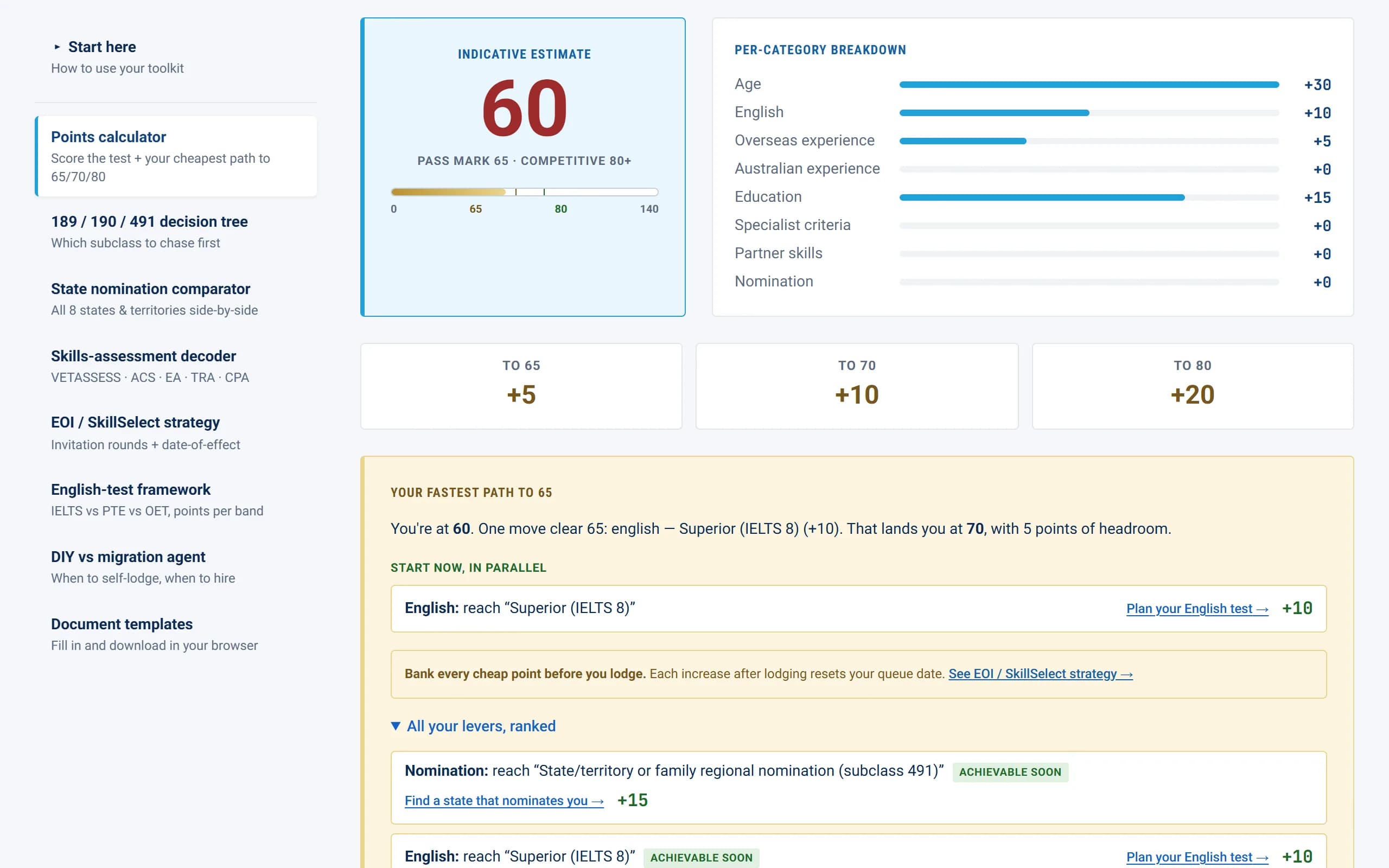
Network planners typically calculate points around qualification ceiling and the Engineers Australia experience deduction.
| Points Factor | Points | Notes |
|---|---|---|
| Age (25-32) | 30 | Maximum bracket |
| Qualification (Bachelor or higher) | 15 | If you have a degree above the Diploma minimum |
| Qualification (Diploma) | 10 | Skill Level 2 floor |
| English (Proficient, IELTS 7) | 10 | Standard target |
| English (Superior, IELTS 8) | 20 | Worth chasing |
| Overseas experience 5-7 years | 10 | After EA deduction |
| Overseas experience 8+ years | 15 | After EA deduction |
| Australian experience | 5-20 | Where applicable |
| State nomination (190) | 5 | If invited |
| Regional nomination (491) | 15 | Strongest single boost |
| Partner skills | 5-10 | If partner clears assessment |
| NAATI/CCL | 5 | Community language credential |
Realistic Scenarios
Scenario 1: Mid-career planner with vendor-only qualifications
- Age 31 (30) + Diploma (10) + Competent English IELTS 7 (10) + 8 years experience (15) = 65 points
- Add 491 regional nomination (+15) = 80 points — competitive for regional invitation
Scenario 2: Degree-qualified senior with strong English
- Age 29 (30) + Bachelor (15) + Superior English IELTS 8 (20) + 8 years (15) = 80 points
- Add 190 nomination (+5) = 85 points — strong position for state invitation
State Nomination
New South Wales
NSW publishes nomination lists at four-digit ANZSCO unit group level for 2025-26, so 3132 Telecommunications Technical Specialists is captured at the group level. The state allocated 2,100 places to subclass 190 and 1,500 places to subclass 491 for the program year. NSW closed Pathway 1 and Pathway 3 of the 491 program early due to high demand — check current pathway status before lodging an EOI.
Victoria
Victoria's nomination program leans into ICT and engineering occupations when carriers expand engineering teams in Melbourne. Applicants typically need recent professional experience and a clear settlement plan for Melbourne or a Victorian regional centre.
Queensland
Queensland allocated 2,600 places across subclasses 190 (1,850) and 491 (750) for 2025-26. The Queensland Skilled Occupation List is updated annually and requires Competent English at minimum. Telecommunications roles tied to defence work at Amberley and Townsville show up in regional 491 invitations.
South Australia and Tasmania
Both states nominate engineering and telecommunications occupations when regional fibre and tower work is funded. South Australia has historically been open to offshore applicants with two years recent overseas experience. Tasmania is a strong 491 option for candidates willing to settle in Hobart or Launceston with verifiable employment or study links.
Salary and Employment Outlook
| Role | Typical Salary Range |
|---|---|
| Junior Network Planner | AUD $80,000-$100,000 |
| Mid-Level Network Planner | AUD $110,000-$135,000 |
| Senior Network Planner | AUD $135,000-$160,000 |
| Lead/Principal Planner | AUD $160,000-$200,000 |
| Contractor (day rate) | AUD $900-$1,300/day |
Sources: SEEK Career Advice telecommunications engineering data 2026, Hays Salary Guide telecommunications band. Total packages include the 11.5% superannuation guarantee plus carrier-specific bonuses and on-call allowances.
The Australian Bureau of Statistics shows telecommunications employment grew modestly in the 12 months to early 2026 despite headline carrier headcount reductions, because contractor and integrator demand absorbed the slack. The strongest hiring sits with NBN contractors, state government digital agencies, mining tier-ones building private LTE, and defence systems integrators.
Tips for a Successful Application
-
Get the CDR Career Episodes right the first time. Engineers Australia returns more than a third of CDRs for revision. Each Career Episode must be 1,000-2,500 words, written in first person, focused on engineering decisions you made personally, and mapped to specific competency elements.
-
Document vendor certifications separately. If you are leaning on three years of experience plus vendor credentials in lieu of an AQF Diploma equivalent, supply Cisco, Nokia, Ericsson or Huawei certificates with verification links — not just PDFs.
-
Match employment references to design-side duties. ANZSCO 313213 is planning, not installation. References must describe network design, capacity modelling, RF planning or transmission design — not field installation or NOC operations.
-
Calculate Engineers Australia's experience deduction before you lodge an EOI. EA typically deducts pre-qualification experience and may discount work that does not closely match the nominated occupation. Build your points table around the post-assessment figure.
-
Investigate the Skills in Demand pathway in parallel. If your points sit below 80, the 482 route via a Tier 1 carrier or system integrator is often faster than waiting for a 189 invitation. Specialist stream is rare for planners, so target Core Skills stream and prove the salary on offer exceeds CSIT.
Step-by-Step Migration Roadmap
- Confirm 313213 matches your duties using the ANZSCO code finder
- Verify the occupation against the Skilled Occupation List 2026 and Core Skills Occupation List
- Sit an English test — target Proficient (IELTS 7) at minimum, Superior (IELTS 8) for 189 competitiveness
- Prepare your Competency Demonstration Report — three Career Episodes, Summary Statement, CPD list
- Lodge the Engineers Australia Migration Skills Assessment (AUD $1,034 standard)
- Receive a positive outcome and re-calculate points using the assessed experience
- Submit an Expression of Interest in SkillSelect for 189, 190 or 491
- For employer-sponsored routes, secure a job offer with a CSOL-eligible sponsor and lodge nomination plus 482 in parallel
- Apply for state nomination if pursuing 190 or 491
- Receive an invitation and lodge the visa within 60 days
- Complete health, character and biometric requirements
- Receive grant and relocate — register with the Australian Communications and Media Authority if your work involves licensed radio spectrum
Frequently Asked Questions
Is 313213 a competitive ICT occupation for 189 invitations?
Telecommunications occupations historically receive fewer 189 invitations than mainstream ICT codes like Software Engineer because the candidate pool is smaller and EOI volumes are lower. Cut-offs typically land in the 80-90 range. If your unadjusted score is below 80, state nomination or employer sponsorship is more reliable than holding out for 189.
Can I use a Cisco or Nokia certification in place of an Australian Diploma equivalent?
Engineers Australia accepts vendor certifications as supporting evidence but rarely as a full substitute for AQF-level qualifications. The expected route is three years of relevant experience plus vendor credentials assessed alongside a recognised tertiary qualification. Candidates with a full Bachelor's degree in telecommunications engineering have the cleanest assessment route and may qualify under the higher 263311 Telecommunications Engineer code.
Which Australian carriers actively sponsor international planners?
Telstra, Optus, TPG Telecom, NBN Co, Vocus, and system integrators including Ericsson, Nokia and Service Stream all sponsor 482 visas for telecommunications engineering roles. Contractor demand fluctuates with rollout cycles — 5G capacity work, fibre access upgrades, and private LTE for mining majors drive most current vacancies.
What is the demand outlook for network planners in 2026 and 2027?
Demand is moderate and steady rather than booming. Jobs and Skills Australia recorded modest growth in telecommunications technical specialist roles through 2025-26. The multi-year 5G standalone rollout, the copper-to-fibre migration tail, and private enterprise networks in mining, transport and defence will keep planning hiring active through 2028. The number of new permanent positions is smaller than ICT broadly, which is why state nomination cut-offs can be unpredictable.
Why is 313213 Skill Level 2 instead of Skill Level 1?
ANZSCO classifies network planning at Skill Level 2 because the base entry qualification is an Associate Degree, Advanced Diploma or Diploma plus relevant experience. Many practitioners hold a Bachelor's degree, but the occupation's minimum entry standard sets the skill level. This affects qualification points in the 189/190 test — a Diploma scores 10 points, a Bachelor's degree scores 15 points, and a Master's by research or PhD scores 20 points.