Telecommunications Technical Officer or Technologist Visa Pathway to Australia: Complete 2026 Guide
Updated: 16 August 2026
Australia classifies Telecommunications Technical Officer or Technologist under ANZSCO 313214. Engineers Australia conducts the skills assessment via the Migration Skills Assessment route. The occupation is on the MLTSSL and CSOL, unlocking subclasses 189, 190, 491, 482, 186 and 494. Typical 2026 salaries range AUD $85,000-$135,000. Demand concentrates in carrier operations centres, NBN delivery contractors and defence systems integrators.
Quick Facts: Telecommunications Technical Officer or Technologist Migration Pathway
| Detail | Information |
|---|---|
| ANZSCO Code | 313214 (Telecommunications Technical Officer or Technologist) |
| Skill Level | 2 (Associate Degree, Advanced Diploma or Diploma, plus three years experience) |
| Skills Assessment | EA (Engineers Australia) — Migration Skills Assessment |
| Occupation List | MLTSSL and CSOL |
| Visa Options | 189, 190, 491, 482, 186, 494 |
| Demand Level | Moderate — steady from 5G rollout, NBN maintenance, defence systems |
| Salary Range | AUD $85,000-$135,000 (SEEK Career Advice, 2026) |
| Typical 189 Score | 80-85 (lower EOI volumes than software roles) |
| Key Challenge | Demonstrating that hands-on technical work meets EA's engineering competency standard |
Role Context in Australia
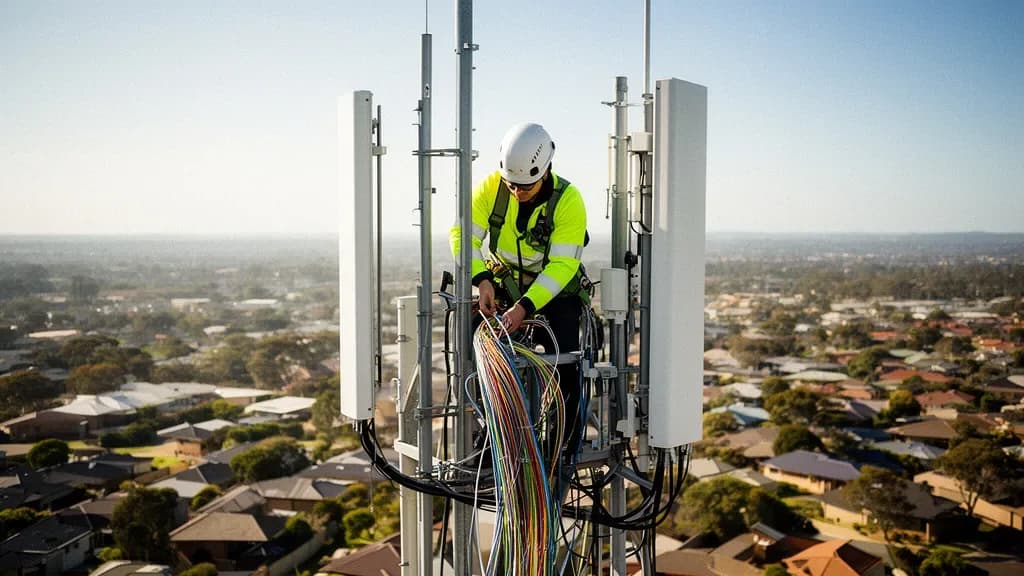
Telecommunications Technical Officers and Technologists develop, install, maintain and provide technical support for the systems carriers and enterprises rely on every day. The work covers radio frequency systems, microwave and satellite links, multiplexing and transmission gear, fibre splicing and OTDR fault-finding, copper line testing, and the installation and commissioning of base stations and core network equipment. Where the network planner draws the picture, the technical officer makes it work in the real world.
Sydney, Melbourne and Brisbane carry the bulk of permanent technical officer roles because Telstra, Optus, NBN Co and major contractors run their operations centres and equipment depots from those cities. Perth, Darwin and regional Queensland sit on a different rhythm — defence projects, mining private networks and remote site rollouts drive contracting demand. The introductory phases of 5G, plus the multi-year work to retire copper in favour of fibre, sustain a steady hiring baseline rather than a boom.
ANZSCO Code Mapping
ANZSCO 313214 covers technical support, installation and maintenance work on telecommunications networks — including microwave, satellite, multiplexing, telemetry and radio systems. The code sits in Unit Group 3132 Telecommunications Technical Specialists alongside 313213 Network Planner.
Decide between 313213 and 313214 on the basis of your dominant duties. If you spend most of your time designing networks and forecasting capacity, the Network Planner code fits. If you install equipment, diagnose faults, run commissioning tests and provide field technical support, 313214 is your code. If you hold a four-year engineering degree and lead the technical architecture, 263311 Telecommunications Engineer is more appropriate. Read the full ANZSCO description before nominating — see how to find your ANZSCO code for a structured approach.
Skills Assessment
Engineers Australia — Migration Skills Assessment
Engineers Australia is the designated authority for Unit Group 3132. ANZSCO 313214 is classified at the Engineering Associate level for assessment purposes, which sits below Engineering Technologist and Professional Engineer in EA's competency framework.
Requirements:
- AQF Associate Degree, Advanced Diploma or Diploma in telecommunications, electronics, electrical engineering or related field — or three years relevant experience plus current vendor certifications
- Competency Demonstration Report covering three Career Episodes, a Summary Statement and a CPD list — unless your qualification is accredited under the Dublin Accord
- English at Competent level (IELTS 6.0 in each band, or equivalent PTE or TOEFL)
Assessment cost: AUD $1,034 standard MSA. Fast Track allocation adds AUD $396.
Processing time: Allocation within 20 business days under Fast Track. Standard processing 8-15 weeks depending on application quality.
Common rejection reasons: Career Episodes that describe installation work as if it were design work (EA penalises stretched claims). Insufficient evidence of independent technical judgement — assessors look for fault diagnosis, root cause analysis and original troubleshooting, not just following SOPs. Vendor certifications presented without verification or job-context evidence.
For the full picture of every assessing body, see the skills assessment bodies complete list.
Visa Pathways
For mid-career technical officers with confirmed offers from Australian carriers or contractors, the 482 Skills in Demand visa is usually the fastest entry route. The 189 invitation cut-off has historically required strong English plus state-equivalent points.
Subclass 482 — Skills in Demand Visa
Core Skills stream dominates for this occupation because most senior technical officer roles clear the salary threshold comfortably.
- Visa fee: AUD $4,015 primary applicant
- Salary threshold: Core Skills Income Threshold AUD $79,423 (from 1 July 2026; previously AUD $76,515)
- Duration: Up to 4 years
- Quirk: Field-based roles with travel allowances and on-call loadings often clear CSIT comfortably even when the base salary sits at the lower end of the range
Subclass 189 — Skilled Independent Visa
Permanent residency through points, available because 313214 sits on the MLTSSL.
- Visa fee: AUD $6,135 primary applicant
- Realistic invitation score: 80-85 in 2026
- Processing time: 6-12 months from invitation
- Quirk: ANZSCO Skill Level 2 caps qualification points at 10 for Diploma holders unless you also hold a Bachelor's degree
Subclass 190 — Skilled Nominated Visa
State nomination adds 5 points and grants permanent residency.
- Visa fee: AUD $6,140
- Obligation: Two years living and working in the nominating state
- Quirk: NSW and Victoria look favourably on technical officers when carriers expand operations centre capacity in Sydney's North Ryde or Melbourne's Burwood corridor
Subclass 491 — Skilled Work Regional Visa
Five-year provisional visa with a pathway to permanent residency via subclass 191. Regional nomination adds 15 points.
- Visa fee: AUD $6,140
- Quirk: Regional NBN contractors, mining-sector private network operators and defence integrators in Townsville, Cairns and Darwin sponsor 491s regularly
Subclass 186 — Employer Nomination Scheme
Permanent residency via employer sponsorship.
- Visa fee: AUD $6,140
- Streams: Direct Entry (three years skilled experience plus positive assessment) or Temporary Residence Transition after holding a 482
Subclass 494 — Skilled Employer Sponsored Regional
Five-year provisional regional employer-sponsored visa.
- Visa fee: AUD $4,910
- Quirk: NBN Co regional contracts and defence systems integration projects routinely use 494 for technical officer roles in regional centres
Points Test Strategy
| Points Factor | Points | Notes |
|---|---|---|
| Age (25-32) | 30 | Maximum bracket |
| Qualification (Bachelor) | 15 | If you hold a degree above the Diploma floor |
| Qualification (Diploma) | 10 | Skill Level 2 minimum |
| English (Proficient, IELTS 7) | 10 | Standard target |
| English (Superior, IELTS 8) | 20 | Worth chasing for 189 |
| Overseas experience 5-7 years | 10 | After EA deduction |
| Overseas experience 8+ years | 15 | After EA deduction |
| State nomination (190) | 5 | If invited |
| Regional nomination (491) | 15 | Largest single boost |
| Partner skills | 5-10 | If partner clears assessment |
| NAATI/CCL | 5 | Community language credential |
Realistic Scenarios
Scenario 1: Diploma-qualified field technician
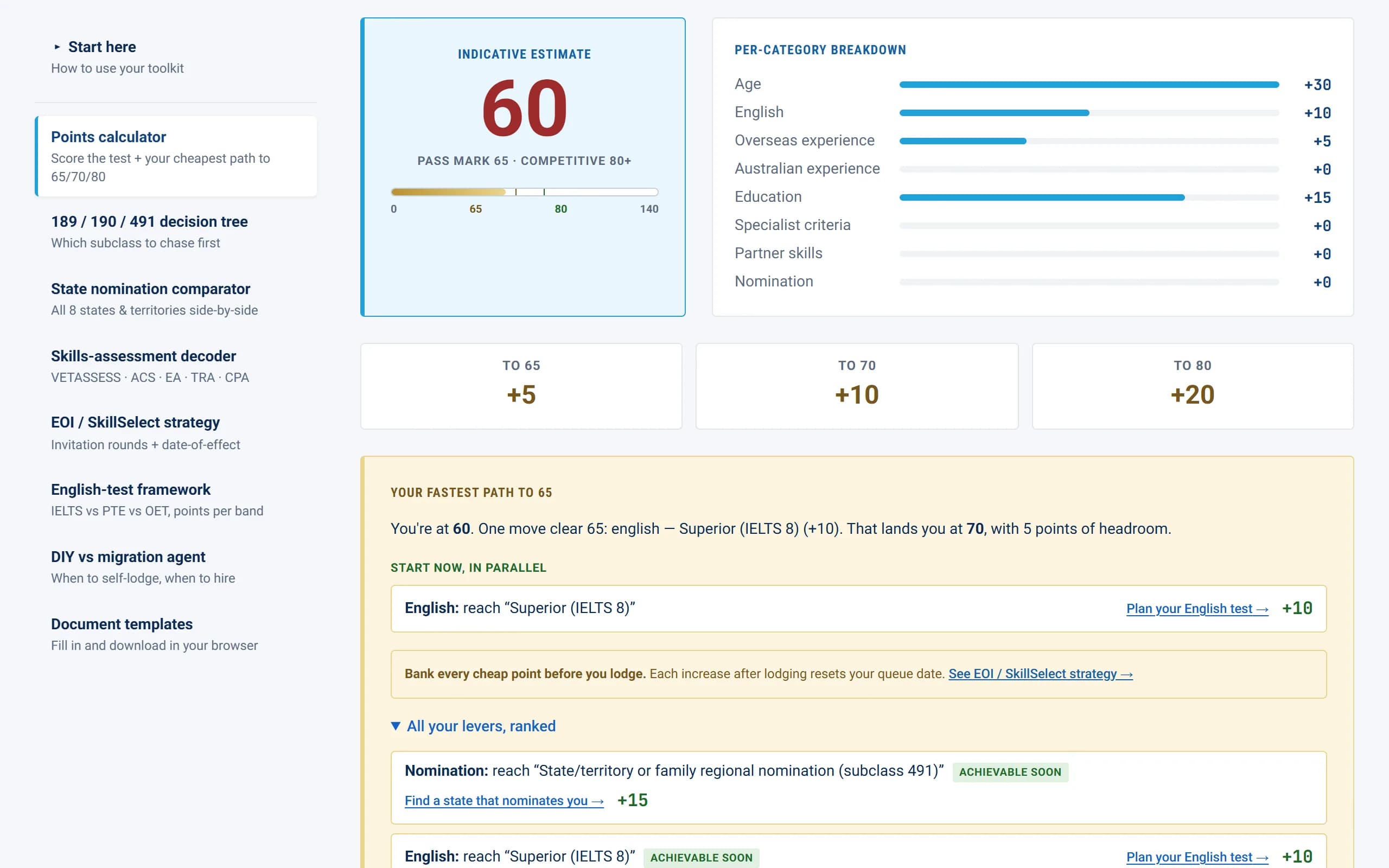
- Age 30 (30) + Diploma (10) + Proficient English (10) + 6 years experience (10) = 60 points
- Add 491 regional nomination (+15) = 75 points — workable for regional invitations
Scenario 2: Degree-qualified senior with strong English
- Age 28 (30) + Bachelor (15) + Superior English (20) + 8 years experience (15) = 80 points
- Add 190 nomination (+5) = 85 points — competitive for permanent state nomination
State Nomination
New South Wales
NSW publishes nomination lists at four-digit unit group level for 2025-26, capturing 3132 Telecommunications Technical Specialists. Allocations sit at 2,100 for subclass 190 and 1,500 for subclass 491. NSW closed two of three 491 pathways early in the 2025-26 program year due to high demand.
Victoria
Victoria's program prioritises ICT and engineering occupations when targeted skills gaps emerge. Applicants typically need recent professional experience in Victoria or a settlement plan tied to Melbourne or a designated regional centre.
Queensland
Queensland allocated 2,600 places across 190 (1,850) and 491 (750) for 2025-26 with strict English thresholds. Defence projects at Amberley, RAAF Townsville and the Brisbane-based shipbuilder Civmec drive technical officer demand in the state.
Western Australia
Mining and resources operators in Perth and the Pilbara sponsor technical officers through both 491 and 494 for private network rollouts. WA's nomination program requires evidence of relevant work history and a willingness to settle in regional WA.
Tasmania and South Australia
Both states nominate engineering and telecommunications occupations when regional fibre, defence shipbuilding (Adelaide) or maritime systems work is funded. Tasmania's 491 program suits candidates with study or employment links to the state.
Salary and Employment Outlook
| Role | Typical Salary Range |
|---|---|
| Junior Technical Officer | AUD $70,000-$90,000 |
| Mid-Level Technical Officer | AUD $90,000-$115,000 |
| Senior Technical Officer | AUD $115,000-$140,000 |
| Lead Technologist | AUD $135,000-$170,000 |
| Field Contractor (day rate) | AUD $700-$1,100/day |
Sources: SEEK Career Advice telecommunications technician and technical officer pages 2026, Hays Salary Guide. Total packages include 11.5% superannuation, plus field allowances, vehicle allowances and on-call loadings that can add 15-25% on top of base salary.
Field-based work in remote mining, defence and oil and gas sites typically pays a premium of 20-40% above metropolitan base rates because of travel, swing rosters and remote location loadings. The Australian Bureau of Statistics records modest employment growth in telecommunications technical specialists through 2025-26, driven by NBN tail work, 5G upgrades and private enterprise networks.
Tips for a Successful Application
-
Make your Career Episodes engineering-flavoured, not procedural. EA assessors want to see independent technical judgement — fault diagnosis with root cause analysis, design decisions you made under constraint, optimisation work where you measured outcomes. Step-by-step procedural narratives get pushed back.
-
Account for the EA experience deduction in your points table. Engineers Australia routinely discounts work that does not closely match the nominated occupation, and may exclude pre-qualification experience. Build your EOI around the assessed figure.
-
Document vendor certifications with verification links. Cisco, Nokia, Ericsson, Huawei and CommScope certificates should be paired with portal verification URLs or signed letters from the certifying body. Photocopies alone are not enough.
-
Use the Fast Track service when you have a confirmed sponsor. If a 482 sponsor is waiting, the AUD $396 Fast Track surcharge often shaves six to ten weeks off the timeline — a small price relative to the value of a quicker job start.
-
Don't conflate Telecommunications Technical Officer with Telecommunications Engineer. Nominating 263311 Telecommunications Engineer without a four-year engineering degree at AQF Level 7 leads to an Engineering Associate outcome at best. Match the nomination to your qualification level.
Step-by-Step Migration Roadmap
- Confirm 313214 against your actual duties using the ANZSCO code finder
- Cross-check 313214 against the Skilled Occupation List 2026 and Core Skills Occupation List
- Sit an English test — target Proficient (IELTS 7) at minimum
- Draft a CDR — three Career Episodes, Summary Statement, CPD list
- Lodge Engineers Australia MSA (AUD $1,034 standard, plus AUD $396 for Fast Track)
- Receive the positive outcome and adjust your points table for any experience deduction
- Submit an EOI in SkillSelect for 189, 190 or 491
- For employer-sponsored routes, secure an offer from a CSOL-eligible sponsor and lodge nomination plus 482 in parallel
- Apply for state nomination if pursuing 190 or 491
- Receive an invitation and lodge the visa within 60 days
- Complete health, character and biometric checks
- Receive grant — register with employer payroll and any state-level licensing for cabling work (ACMA Cabler Registration for telecommunications cabling)
Frequently Asked Questions
What's the difference between 313213 and 313214?
313213 Telecommunications Network Planner is about design and capacity work — building the picture of the network and forecasting growth. 313214 Telecommunications Technical Officer or Technologist is about making it work — installation, commissioning, fault diagnosis and maintenance. Your employment references must match the code you choose, and assessors will reject applications where references describe one set of duties and the code claims another.
Do I need an ACMA Cabler Registration before I migrate?
Not before migration, but you'll need one to perform telecommunications cabling work in Australia. The Australian Communications and Media Authority registration is administered by accredited registrars and requires evidence of qualifications or experience. Most carrier and contractor employers manage this in onboarding, so it's typically an arrival task rather than a pre-arrival requirement.
Can I use this code if I primarily work in a Network Operations Centre?
Yes — NOC technical officers fit 313214 cleanly because the work covers monitoring, fault management, escalation and troubleshooting of live network elements. Career Episodes should highlight the technical judgement involved (root cause analysis, capacity decisions under load) rather than ticket-handling routine.
Is the 482 visa salary threshold a problem for technical officers?
Rarely at mid-career and above. The Core Skills Income Threshold sits at AUD $79,423 from 1 July 2026 (AUD $76,515 in 2025-26). Senior technical officer base salaries in metro markets clear this comfortably, and field-based roles with site allowances clear it even at mid-career. Junior roles starting under AUD $80,000 are the only realistic friction point.
What's the demand outlook in 2026 and 2027?
Demand is steady. Major drivers include the rolling 5G standalone deployment, the copper-to-fibre access migration, and growing private enterprise networks in mining, ports, defence and transport. Telecommunications carriers reduced headline workforces over 2024-25 but contractor and integrator hiring offset most of the reduction. State invitations for 3132 unit group codes have been issued regularly through 2025-26 in NSW and Queensland.