Electronic Instrument Trades Worker (General) Visa Pathway to Australia: Complete 2026 Guide
Updated: 16 August 2026
Australia classifies Electronic Instrument Trades Worker (General) under ANZSCO 342314. Trades Recognition Australia (TRA) conducts the skills assessment, and OSAP is the offshore pathway. The role sits on the MLTSSL and CSOL, unlocking subclasses 189, 190, 491, 482 and 186. Typical 2026 salaries range AUD $90,000-$140,000, with mining and resources roles paying premiums.
Quick Facts: Electronic Instrument Trades Worker (General) Migration Pathway
| Detail | Information |
|---|---|
| ANZSCO Code | 342314 (Electronic Instrument Trades Worker (General)) |
| Skill Level | 3 (AQF Certificate III with at least two years on-the-job training, or AQF Certificate IV) |
| Skills Assessment | TRA via OSAP (offshore applicants) |
| Occupation List | MLTSSL and CSOL |
| Visa Options | 189, 190, 491, 482, 186, 494 |
| Demand Level | High — instrumentation roles in mining, oil and gas, water utilities, and manufacturing report sustained shortages |
| Salary Range | AUD $90,000-$140,000 (SEEK Salary Hub, 2026; mining/resources higher) |
| Typical 189 Score | 70-85 (trades clear at lower scores than ICT) |
| Key Challenge | Distinguishing "General" duties (342314) from "Special Class" instrumentation (342315) — affects which code applies |
What Electronic Instrument Trades Workers Do in Australia
Electronic Instrument Trades Workers install, modify, maintain and repair electronic instruments and control systems. The work spans process instrumentation (flow, pressure, level, temperature transmitters), control valves and actuators, PLC and DCS interfaces, calibration of analytical instruments, and increasingly, integration of industrial IoT and SCADA platforms. Day-to-day, the role combines field maintenance — diagnosing loop faults, calibrating transmitters with HART communicators, replacing control valves — with bench work in the calibration lab and increasingly with industrial network configuration (Profibus, Foundation Fieldbus, EtherNet/IP).
Demand is concentrated in five industries. Mining and resources is the largest single employer, particularly iron ore and LNG operations in Western Australia. Oil and gas — onshore and offshore production, pipelines, downstream — drives steady demand in WA, Queensland, and the Northern Territory. Water and wastewater utilities run large instrumentation maintenance teams in every capital. Manufacturing — food and beverage, pharmaceutical, chemical — maintains substantial instrumentation requirements across all states. Energy generation, particularly renewables and battery storage, adds new instrumentation footprints. Jobs and Skills Australia's 2025 review of electronics trades flagged supply constraints across all of these sectors.
ANZSCO 342314 — Code Mapping
ANZSCO 342314 covers electronic instrument trades workers (general) who install, modify, maintain and repair electronic instruments and control systems. The "General" designation distinguishes this from 342315 Electronic Instrument Trades Worker (Special Class), which applies where the work involves specialised systems — typically nuclear, defence-rated, aviation instrumentation, or highly specialised process control.
The role sits inside ANZSCO Unit Group 3423 — Electronics Trades Workers, alongside Electronics Equipment Trades Worker (342313), Telecommunications Cable Jointer (342411), and Special Class instrumentation (342315). Choose the code that matches the dominant duty set. If your work is mainstream process instrumentation, control loops, calibration and PLC interfacing, 342314 is the correct fit. Review the ANZSCO code finder before lodging — incorrect code selection is the single most common skills assessment failure.
Skills Assessment with TRA
Offshore Electronic Instrument Trades Workers must complete TRA's Offshore Skills Assessment Program (OSAP). The MSA documentary-only pathway is not open for this occupation.
Offshore Skills Assessment Program (OSAP)
OSAP runs as three stages: documentary evidence assessment, technical interview, and practical demonstration through a TRA-approved Registered Training Organisation (RTO).
- Requirements: Recognised trade qualification equivalent to AQF Certificate III in Instrumentation and Control (UEE31220) or AQF Certificate IV in Instrumentation and Control (UEE40920), plus three years post-qualification employment. Six years' on-the-job training accepted in place of formal qualification.
- Assessment cost: Fees vary by RTO and stage. Total OSAP costs typically range AUD $2,500-$4,500 (Section 2.1 of OSAP Applicant Guidelines, 2025).
- Processing time: 12-18 months end to end, depending on RTO scheduling for the practical demonstration.
- Common rejection reasons: Insufficient evidence of process instrumentation work (some applicants present mostly electronic repair or telecommunications experience, which fits adjacent codes); employment references that describe technician work without confirming hands-on calibration, loop tuning and control valve maintenance; practical demonstration scored against Australian process safety requirements not covered in overseas training.
Post-Arrival Considerations
A successful TRA assessment is the migration-side check. Most instrumentation work in Australia is performed under a sponsoring electrical licence or under specific site authorisation rather than a separate licence for instrumentation. However, where the work touches on hazardous areas (Ex-rated zones), specific certification on AS/NZS 60079 series may be required by employers — often delivered as a short course after employment commences. Confirm with the destination state regulator and your sponsoring employer.
Visa Pathways for Electronic Instrument Trades Workers
Subclass 482 — Skills in Demand Visa (Core Skills stream)
The 482 is the dominant pathway for offshore instrumentation tradespeople. Mining contractors, oil and gas operators, and water utilities sponsor offshore as a default recruitment strategy.
- Visa fee: AUD $3,210 (primary applicant)
- Salary threshold: Core Skills Income Threshold (CSIT) AUD $76,515 until 30 June 2026, rising to AUD $79,499 from 1 July 2026
- Processing time: Median 2-3 months for Core Skills stream
- Quirk: Specialist Skills stream (AUD $141,210 threshold, 7-day median processing) is reachable for senior instrumentation roles on FIFO mining contracts, particularly Pilbara iron ore and Northwest Shelf LNG.
Subclass 491 — Skilled Work Regional (Provisional)
Strong fit because most instrumentation work — mines, LNG plants, water treatment in regional centres, manufacturing in industrial regional cities — is located outside metro areas.
- Visa fee: AUD $6,140 (primary applicant)
- Points boost: +15 for regional nomination
- Processing time: 12-14 months
- Quirk: Regional WA, regional Queensland, regional South Australia and Tasmania have all nominated instrumentation tradespeople under their 491 streams.
Subclass 190 — Skilled Nominated
Permanent residency via state nomination. ANZSCO 342314 has been included on several state lists each program year.
- Visa fee: AUD $6,140 (primary applicant)
- Points boost: +5 from state nomination
- Processing time: 8-15 months
- Quirk: Western Australia leads on instrumentation nomination due to mining and LNG demand. Queensland and South Australia regularly include the code.
Subclass 189 — Skilled Independent
Available because the occupation sits on the MLTSSL.
- Visa fee: AUD $6,135 (primary applicant)
- Minimum points: 65 (instrumentation trades have historically cleared at 70-80)
- Processing time: 8-15 months
Subclass 186 — Employer Nomination Scheme
Permanent residency through employer sponsorship. Most reach 186 via Temporary Residence Transition after a qualifying period on a 482.
- Visa fee: AUD $6,140 (primary applicant)
- Streams: Direct Entry (with TRA assessment) or Temporary Residence Transition
Subclass 494 — Skilled Employer Sponsored Regional
For regional employers in mining, oil and gas, and remote infrastructure.
- Visa fee: AUD $4,910 (primary applicant)
- Processing time: 9-12 months
- Quirk: PR pathway via subclass 191 after three years of regional work.
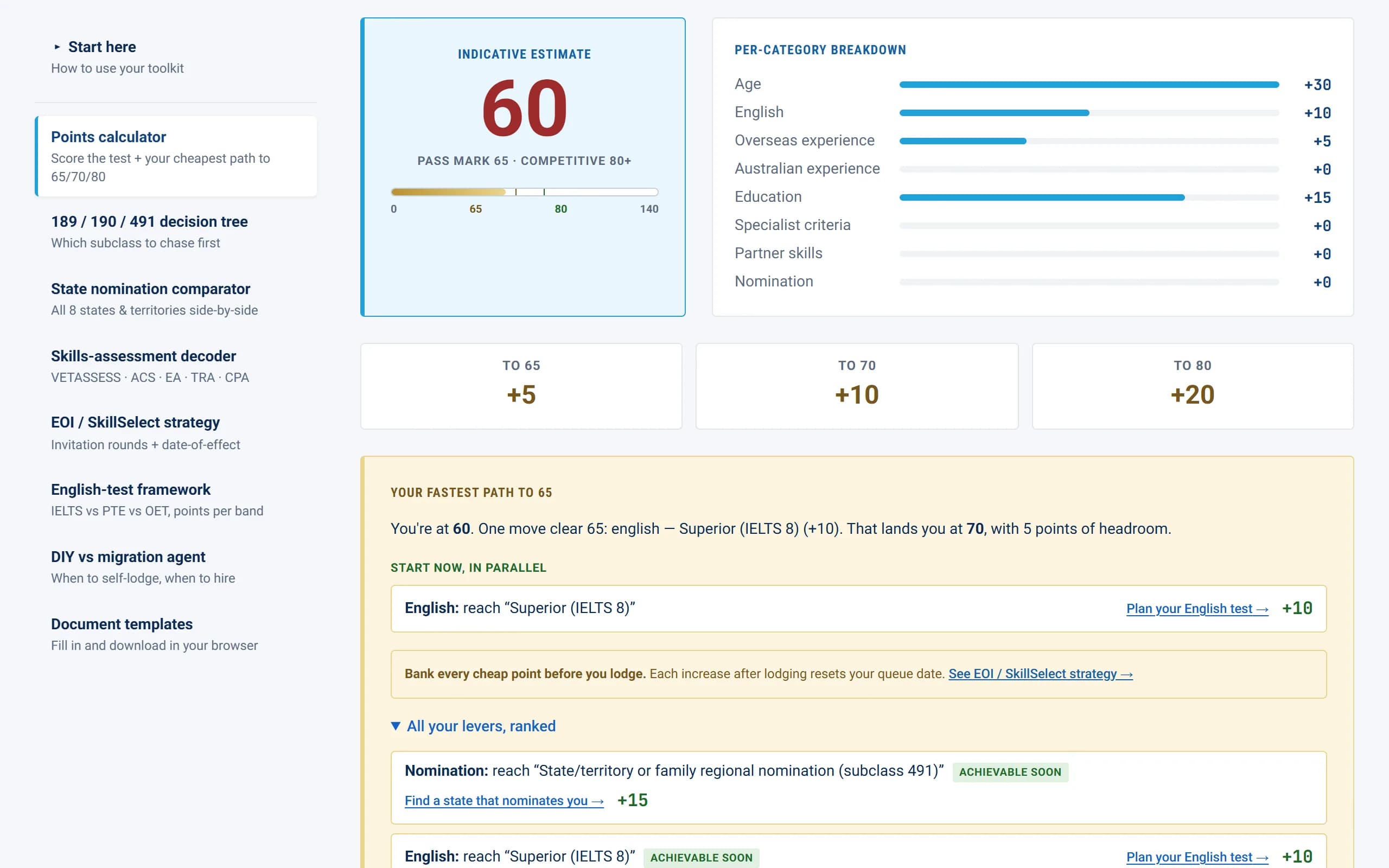
Points Test Strategy
| Points Factor | Points | Notes |
|---|---|---|
| Age (25-32) | 30 | Maximum bracket |
| Age (33-39) | 25 | Strong |
| English (Superior — 8.0+) | 20 | Stretches for many trades applicants |
| English (Proficient — 7.0) | 10 | More common target |
| Qualification (Trade certificate/Diploma) | 10 | AQF Certificate III equivalent |
| Overseas Experience (5-7 years) | 10 | After deductions |
| Overseas Experience (8+ years) | 15 | Top bracket |
| Australian Experience | 5-20 | If you have local work history |
| State Nomination (190) | 5 | |
| Regional (491) | 15 | |
| Partner Skills | 5-10 | If partner has skilled occupation |
Realistic Score Scenarios
Scenario 1: Mid-Career Process Instrumentation Technician
- Age 30 (30) + Trade qualification (10) + Proficient English (10) + 6 years overseas experience (10) = 60 points
- Add 491 nomination (+15) = 75 points — competitive in most rounds with regional employer offer.
Scenario 2: Senior LNG/Mining Instrumentation Specialist
- Age 36 (25) + Trade qualification (10) + Superior English (20) + 12 years overseas experience (15) = 70 points
- Add 190 nomination (+5) = 75 points; consider 491 (+15) to reach 85 for stronger position.
State Nomination for Electronic Instrument Trades Workers
Western Australia
WA is the strongest nominator for instrumentation trades because the Pilbara iron ore operations (Rio Tinto, BHP, FMG) and Northwest Shelf LNG (Woodside, Chevron) all run large instrumentation maintenance teams. WA's Graduate Occupation List and Skilled Migration Occupation List have consistently included 342314.
Queensland
Queensland nominates instrumentation tradespeople for both 190 and 491. The Bowen Basin coal sector, Gladstone LNG and the Brisbane food and beverage cluster generate steady demand.
South Australia
South Australia has nominated 342314 with a focus on defence and process industries. Whyalla steel, the Olympic Dam mining operation, and the Adelaide defence build-out anchor demand.
New South Wales
NSW nominates instrumentation tradespeople for both metro and regional streams. Water utilities (Sydney Water, Hunter Water), manufacturing in Western Sydney, and process industries in the Hunter region drive demand.
Victoria
Victoria has included 342314 on its nomination list periodically, with strongest interest from food and beverage processing in regional Victoria and from water utilities.
Tasmania
Tasmania nominates for 491 and onshore 190. Hydro-electric operations, aquaculture and food processing all use instrumentation tradespeople.
Northern Territory
The NT's DAMA covers instrumentation trades, with mining, LNG (INPEX Ichthys) and remote utility operations driving demand.
Salary and Employment Outlook
What Electronic Instrument Trades Workers Earn in Australia
| Role | Typical Salary Range |
|---|---|
| Instrumentation Apprentice / Trade Assistant | AUD $50,000-$65,000 |
| Instrumentation Technician (1-3 years post-qualification) | AUD $85,000-$105,000 |
| Process Instrumentation Technician (5+ years) | AUD $100,000-$125,000 |
| Senior Instrumentation Technician | AUD $115,000-$145,000 |
| Mining Instrumentation Specialist (FIFO) | AUD $130,000-$170,000 |
| LNG / Oil and Gas Instrumentation | AUD $140,000-$200,000+ |
| Commissioning / Project Lead | AUD $140,000-$180,000 |
SEEK Salary Hub 2026 reports instrumentation technician salaries averaging AUD $93,000-$120,000 nationally, with the Mining, Resources and Energy sector averaging AUD $119,931. Total packages typically include 11.5% superannuation, FIFO uplifts, on-call allowances and overtime.
Where the Money Is
- Iron ore — Pilbara — Rio Tinto, BHP, Fortescue Metals Group. Maintenance contractor sponsorship is common.
- LNG — Northwest Shelf, Pluto, Wheatstone, Gorgon, Ichthys — Woodside, Chevron, INPEX.
- Coal — Bowen Basin — BHP Mitsubishi Alliance, Glencore, Anglo American.
- Water utilities — Sydney Water, Melbourne Water, SEQ Water, Water Corporation (WA), SA Water.
- Manufacturing — food, beverage, dairy, meat processing across all states.
- Renewable energy and battery storage — emerging instrumentation footprint at large-scale solar, wind and BESS sites.
The 2025 Occupation Shortage List confirmed electronics trades remain in shortage across the resource-rich states. The Skill Level 3 trade fill rate of 54.3% nationally — the lowest of any skill band — applies to instrumentation alongside other technical trades.
Tips for a Successful Application
1. Distinguish General from Special Class Carefully
342314 covers mainstream process instrumentation. 342315 (Special Class) is reserved for specialised systems — nuclear, defence-rated, aviation, certain medical instrumentation. Most offshore applicants fit 342314. Claiming Special Class without strong supporting evidence is a rejection trigger; conversely, applicants doing genuine Special Class work should not undersell themselves.
2. Document Process Instrumentation Hours Specifically
Employment references should specify instrument types (flow, pressure, level, temperature transmitters), brands (Endress+Hauser, Emerson Rosemount, Yokogawa, Honeywell), control valves and actuator types, and PLC/DCS platforms (Allen-Bradley, Siemens, Schneider, Honeywell Experion, ABB 800xA, Yokogawa Centum). Generic "maintain electronic equipment" descriptions are weak.
3. Map Qualification Against UEE31220 or UEE40920
The Australian benchmark qualifications are Certificate III in Instrumentation and Control (UEE31220) and Certificate IV in Instrumentation and Control (UEE40920). Send your transcripts to TRA or a migration agent for preliminary mapping. Common gaps are hazardous areas (Ex), process safety, and Australian electrical safety units.
4. Target the Resource-Rich States First
Western Australia and Queensland are where the majority of high-paying instrumentation work sits. A 491 visa with a regional WA or regional Queensland nomination combines the +15 points boost with direct access to mining and LNG operators that sponsor most aggressively.
5. Use 482 Sponsorship via Major Contractors
Mining and LNG operators rarely sponsor offshore directly — they use maintenance contractors (Monadelphous, Worley, Wood, UGL, Mader Group). These contractors run continuous offshore recruitment for instrumentation trades. The 482 Skills in Demand visa via a major contractor is often the fastest route into the Pilbara or onto an LNG facility.
Step-by-Step Migration Roadmap
- Confirm ANZSCO 342314 fits your duties — review the ANZSCO code finder and distinguish from Special Class (342315) and adjacent codes.
- Gather employment references specifying instrument types, control systems, and project examples.
- Sit IELTS or PTE — Competent English (IELTS 6.0) minimum; Superior 8.0+ earns 20 points.
- Lodge TRA OSAP application through your country's approved RTO; book the practical assessment slot early.
- Complete documentary evidence stage — qualifications, employment evidence, pay records.
- Attend technical interview and complete practical demonstration through the RTO.
- Receive successful TRA outcome — valid three years for migration.
- Submit EOI in SkillSelect for 189, 190 or 491.
- Apply for state nomination if pursuing 190 or 491 — WA and Queensland have the highest historical nomination volumes for this code.
- Receive invitation and lodge visa within 60 days via ImmiAccount.
- Complete health and character checks including AFP police check and HAP-ID medical.
- After grant, complete site or contractor authorisation including Ex-rated hazardous areas certification where required by employer.
Frequently Asked Questions
Is Electronic Instrument Trades Worker (General) on the MLTSSL in 2026?
Yes. ANZSCO 342314 remains on the Medium and Long-Term Strategic Skills List in 2026, keeping subclass 189 access open. It is also on the Core Skills Occupation List used by the 482 visa and on several state nomination programs.
What is the difference between 342314 General and 342315 Special Class?
342314 (General) covers mainstream electronic instrument work — process instrumentation, control loops, calibration, control valves, PLC/DCS interfaces. 342315 (Special Class) is reserved for specialised systems including nuclear, defence-rated, aviation instrumentation, or systems requiring specialised endorsements. Most migrants fit 342314. Choose the code that matches the majority of your actual work.
Do I need a separate licence to work in Australia?
Most instrumentation work is performed under an employer's electrical licence or under specific site authorisation, rather than a separate national instrumentation licence. Where the work crosses into electrical, plumbing or hazardous areas, additional state-level licensing or AS/NZS 60079 (Ex) certification may apply. Confirm requirements with the destination state regulator and sponsoring employer.
Which industries hire the most offshore instrumentation tradespeople?
Mining and resources (particularly Pilbara iron ore and Northwest Shelf LNG), oil and gas (Queensland coal seam gas, Northern Territory Ichthys), water utilities (every capital), and manufacturing (food, beverage, pharmaceutical) are the largest offshore-recruiting sectors. Major maintenance contractors — Monadelphous, Worley, Wood, UGL, Mader Group — run continuous offshore campaigns.
Will my international PLC/DCS experience transfer to Australian work?
Yes, generally. The major control system platforms in Australia (Siemens, Allen-Bradley, Honeywell, Yokogawa, Emerson DeltaV, ABB 800xA) are the same as those used internationally. Australia-specific elements typically cover process safety standards (AS 61511), hazardous areas (AS/NZS 60079), and site safety procedures — these are usually delivered as short courses by the employer after arrival.
What is the demand outlook for instrumentation trades through 2030?
Strong across mining, LNG, water utilities and manufacturing. Renewable energy and battery storage are adding new instrumentation footprints. The 2025 Occupation Shortage List confirms electronics trades remain in shortage in the resource-rich states, with no near-term sign of relief. Skill Level 3 trades nationally posted a 54.3% recruitment fill rate in 2025 — the lowest of any skill band — and instrumentation is at the tighter end of that band.