Environmental Scientist (nec) Visa Pathway to Australia: Complete 2026 Guide
Updated: 16 August 2026
Australia classifies Environmental Scientist (nec) under ANZSCO 234399. VETASSESS conducts the skills assessment. The occupation is on the MLTSSL and the Core Skills Occupation List, unlocking subclasses 189, 190, 491, 482, and 186. Typical 2026 salaries range AUD $80,000-$130,000. NSW is currently the only state with a published 190/491 nomination pathway for the 2343 group.
Quick Facts: Environmental Scientist (nec) Migration Pathway
| Detail | Information |
|---|---|
| ANZSCO Code | 234399 (Environmental Scientists nec) |
| Skill Level | 1 (Bachelor degree or higher) |
| Skills Assessment | VETASSESS (Vocational Education and Training Assessment Services) — Group A |
| Occupation List | MLTSSL and CSOL |
| Visa Options | 189, 190, 491, 482, 186 |
| Demand Level | Moderate — OSL 2025 records "No Shortage" nationally, but state demand exists in NSW and resources-heavy regions |
| Salary Range | AUD $80,000-$130,000 (SEEK Salary Hub, May 2026) |
| Typical 189 Score | 80-90 points for invitation, given the smaller occupation ceiling |
| Key Challenge | "nec" residual code — applicants must prove their work does not fit a more specific scientist code |
What an Environmental Scientist Does in Australia
The "nec" suffix (not elsewhere classified) covers environmental scientists whose work does not fit cleanly into the four more specific codes within the 2343 unit group: Environmental Consultant (234311), Environmental Research Scientist (234312), Environmental Officer (234313), or Park Ranger (234314). In practice, 234399 captures specialists working in environmental restoration, ecotoxicology, climate adaptation modelling, regulatory science, sustainability strategy roles inside heavy industry, and policy science roles that combine analytical work with stakeholder engagement.
Demand is concentrated around three industries. Mining and resources companies in WA and QLD employ environmental scientists for impact assessment, mine rehabilitation, and post-closure monitoring. State environmental regulators — EPA NSW, EPA Victoria, the Queensland Department of Environment — recruit for compliance science and policy. Engineering consultancies (GHD, Jacobs, AECOM, ERM, Arcadis) hire across all states for client-side environmental assessment work feeding into project approvals.
ANZSCO 234399 — Code Mapping
ANZSCO 234399 is the residual code for environmental scientists whose duties do not align with the four named occupations in the 2343 group. The Australian Bureau of Statistics defines the broader unit group as professionals who study, develop, implement, and advise on policies and plans for managing and protecting the environment, flora, fauna, and other natural resources.
Common job titles assessed under 234399 include:
- Climate Change Adaptation Specialist
- Ecotoxicologist
- Air Quality Scientist
- Contaminated Land Specialist
- Sustainability Scientist
- Environmental Policy Analyst (where the role is substantively scientific, not purely policy)
If your work fits a more specific code — particularly 234312 Environmental Research Scientist or 234311 Environmental Consultant — use that code instead. "nec" codes attract closer scrutiny from VETASSESS because applicants sometimes default to them when their actual duties match a named occupation more cleanly.
Skills Assessment — VETASSESS Group A
Environmental Scientist (nec) is assessed by VETASSESS under Group A criteria. Both qualification and employment must be assessed as suitable for an overall positive outcome.
Qualification requirements:
- Qualification comparable to an Australian Bachelor degree or higher
- Highly relevant field of study — Environmental Science, Environmental Studies, Environmental Management, Ecology, or a closely aligned natural science degree where the major aligns with the specific 234399 role
Employment requirements:
- At least one year of post-qualification employment in the last five years
- Minimum 20 hours per week
- Duties highly relevant to the nominated occupation
Assessment cost:
- Offshore applicants: AUD $1,096
- Onshore applicants (incl. GST): AUD $1,205.60
- Priority processing surcharge: AUD $825 (offshore) / AUD $907.50 (onshore)
Processing time: 12-14 weeks standard. Priority processing aims to complete within 10 business days.
Common rejection reasons: Insufficient evidence that day-to-day duties are substantively scientific rather than administrative or policy-focused; qualifications in non-aligned fields like general environmental management without a hard-science major; employment references that describe project management language without scientific method, sampling, analysis, or modelling.
Visa Pathways for Environmental Scientists
Subclass 190 — State Nominated Visa
The 190 is the most realistic permanent residency route for this occupation in 2026, because NSW publishes the 2343 group on its skilled occupation list.
- Visa fee: AUD $6,140
- Points boost: +5 from state nomination
- Processing time: 15-25 months (Home Affairs published range)
- Obligation: Live in the nominating state for 2 years
Subclass 491 — Skilled Work Regional Visa
NSW also nominates 2343 occupations for the regional 491. A 5-year provisional visa converting to permanent residency via subclass 191 after 3 years of regional residence and tax-record compliance.
- Visa fee: AUD $6,140
- Points boost: +15 from regional nomination
- Processing time: 21-29 months
Subclass 482 — Skills in Demand Visa
Employer sponsorship is viable because 234399 sits on the Core Skills Occupation List. The 482 SID visa replaced the legacy TSS framework and operates under three streams.
- Visa fee: AUD $3,210 (Core Skills stream, primary applicant)
- Salary threshold: Core Skills stream applies to roles paying at or above the Core Skills Income Threshold; Specialist Skills stream requires AUD $141,210+
- Duration: Up to 4 years
- Reality: Most environmental scientist roles at consultancies and resources companies sit comfortably above the Core Skills threshold
Subclass 186 — Employer Nomination Scheme
Permanent residency through employer sponsorship via the Direct Entry stream or the Temporary Residence Transition (TRT) stream after two years on a 482.
- Visa fee: AUD $6,140
- Streams: Direct Entry or TRT
Subclass 189 — Skilled Independent Visa
The 189 is open in principle because 234399 is on the MLTSSL, but the program has run at sharply reduced capacity since 2023. Treat the 189 as a secondary option behind state nomination or employer sponsorship.
- Visa fee: AUD $6,135
- Processing time: 3-12 months when invitations issue
- Realistic points target: 85+ for a competitive position in the smaller 2343 occupation ceiling
Points Test Strategy
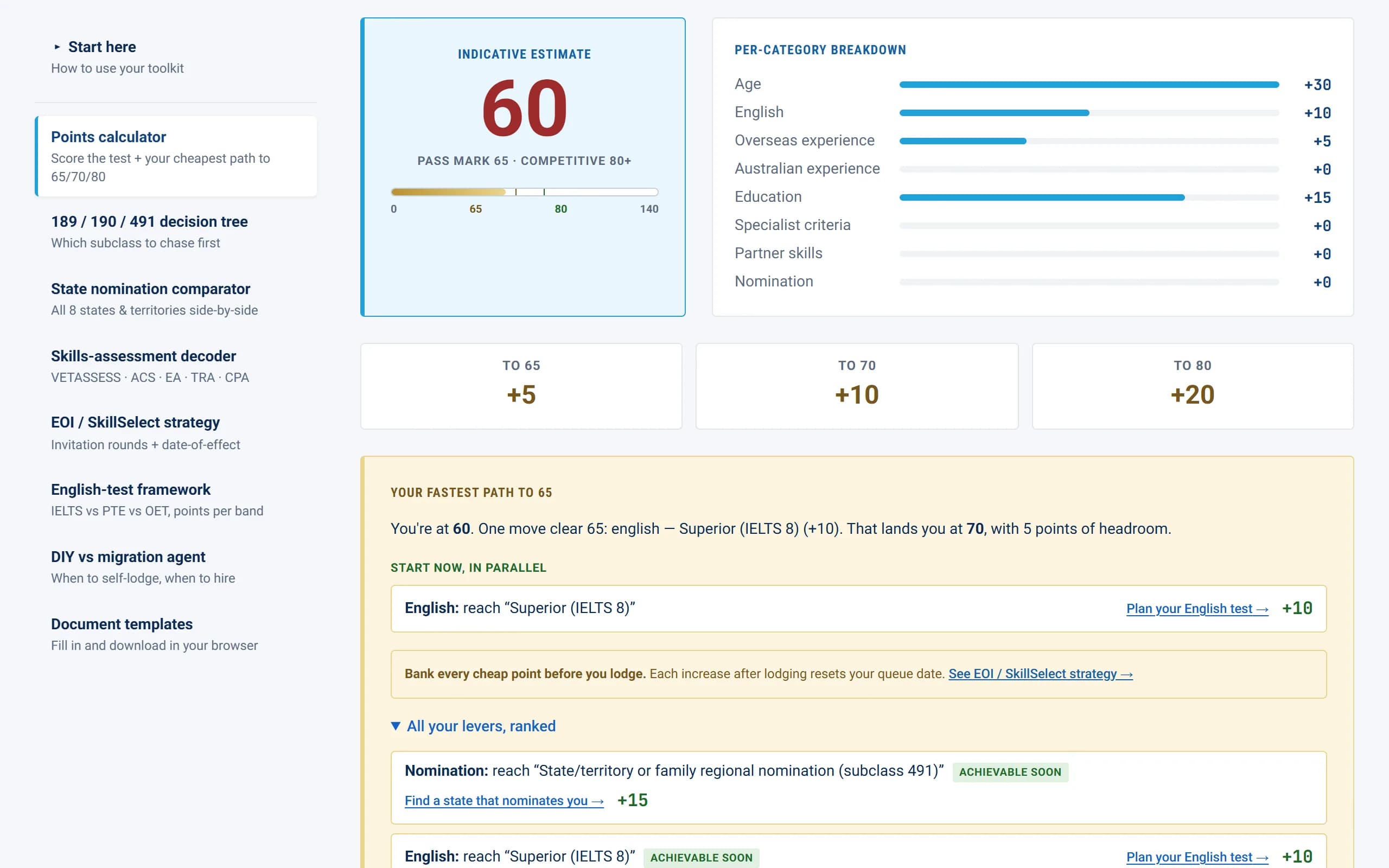
| Points Factor | Points | Notes |
|---|---|---|
| Age (25-32) | 30 | Maximum bracket |
| Age (33-39) | 25 | Still strong |
| Qualification (PhD) | 20 | Common in research roles |
| Qualification (Master's) | 15 | Standard for senior consultants |
| Qualification (Bachelor's) | 15 | Skill Level 1 minimum |
| English (Superior — 8.0+) | 20 | Material to the total |
| English (Proficient — 7.0) | 10 | Realistic for many applicants |
| Overseas Experience (5-7 years) | 10 | After VETASSESS confirms relevant experience |
| Australian Experience (3 years) | 10 | If you have local industry exposure |
| State Nomination (190) | 5 | NSW |
| Regional (491) | 15 | NSW regional |
| Partner Skills (skilled) | 10 | If partner has positive assessment |
| NAATI/CCL | 5 | Community language credential |
Scenario 1 — PhD researcher, 31, Superior English, 4 years experience
30 (age) + 20 (PhD) + 20 (English) + 10 (experience) = 80. Adding NSW 190 nomination reaches 85, which is realistic for invitation in 2026.
Scenario 2 — Mid-career consultant, 34, Proficient English, 8 years experience
25 (age) + 15 (Master's) + 10 (English) + 15 (overseas experience 8+ years) = 65. The 491 regional route through NSW lifts this to 80, which is the working threshold.
State Nomination
New South Wales
NSW publishes ANZSCO 2343 Environmental Scientists on both its 190 and 491 skilled occupation lists for 2025-26. NSW does not accept direct applications — the program operates by ranking EOIs in SkillSelect and contacting the highest-scoring profiles. Sectors NSW flags as priorities include health, education, ICT, and infrastructure, and environmental science nominations tend to favour candidates with NSW-based work experience, infrastructure-sector exposure, or a regional offer of employment.
For the 491, NSW regional sponsorship is administered through Regional Development Australia (RDA) committees in each region. Candidates can apply directly to an RDA committee in the area where they intend to live and work.
Victoria, Queensland, SA, WA, and Tasmania do not currently publish 234399 on their 2025-26 nominated occupation lists. If a state opens a separate pathway during the program year, check the relevant state government migration page before lodging.
Salary and Employment Outlook
What Environmental Scientists Earn in 2026
| Role | Typical Salary Range |
|---|---|
| Graduate Environmental Scientist | AUD $70,000-$85,000 |
| Environmental Scientist (Mid-Level) | AUD $90,000-$115,000 |
| Senior Environmental Scientist | AUD $115,000-$140,000 |
| Principal / Technical Lead | AUD $140,000-$180,000 |
| Environmental Consultant (Day Rate) | AUD $700-$1,100/day |
SEEK Salary Hub records median environmental scientist salaries in the $80,000-$100,000 band for May 2026, with Perth and Mandurah/Peel showing higher medians (up to $130,000) reflecting the resources-sector premium. Total packages typically include the standard 11.5% superannuation and, in resources roles, fly-in fly-out allowances.
Highest-Paying Sectors
- Resources and mining — BHP, Rio Tinto, Fortescue, Glencore, and mid-tier miners pay the strongest base salaries, especially for FIFO mine rehabilitation roles
- Environmental consulting — GHD, Jacobs, AECOM, ERM, SLR, Arcadis recruit across all major cities
- State environmental regulators — EPA NSW, EPA Victoria, QLD DES — competitive on conditions and superannuation, lower on base
- Federal agencies — Department of Climate Change, Energy, the Environment and Water; CSIRO Land and Water
- Renewables and infrastructure developers — wind, solar, transmission, and battery project pipelines
Geographic Concentration
Perth and Brisbane are the highest-paying markets due to resources industry concentration. Sydney pays mid-range with the deepest consultancy market. Melbourne and Canberra dominate federal and state policy roles. Regional Queensland (Mackay, Townsville, Gladstone) and the Pilbara have ongoing demand tied to project approvals.
Tips for a Successful Application
1. Justify the "nec" classification
VETASSESS scrutinises applicants who select 234399 when their work fits 234311 (Environmental Consultant) or 234312 (Environmental Research Scientist). In your statement of duties, explain why neither named occupation captures your role. If you spend most of your time on contaminated land work, ecotoxicology, or climate adaptation modelling, this is straightforward. If you spend it advising clients on regulatory approvals, 234311 is the correct code.
2. Match academic qualification to actual duties
A Master's in environmental management with no hard-science undergraduate component will struggle for VETASSESS Group A. Strongest profiles pair an undergraduate degree in Environmental Science, Ecology, Chemistry, or Geoscience with postgraduate specialisation.
3. Document the scientific method in employment references
VETASSESS Group A assessments fail when reference letters describe project management duties without scientific content. Reference letters should describe hypothesis development, field sampling design, laboratory or modelling analysis, peer review or technical reporting, and how findings informed decisions.
4. Pursue NSW nomination as the primary route
Because NSW is the only state currently nominating 2343 in 2025-26, route your strategy around NSW. Build EOI score above 85 if possible, and prepare evidence of NSW commitment (job offers, market research, professional registration with an NSW-based body).
5. Consider regional 491 if NSW 190 is competitive
NSW regional invitation rounds typically clear at lower points totals than the metropolitan 190 program. If your points total sits in the 70-80 band, the 491 via an RDA-nominated regional area is often the faster route to a grant.
Step-by-Step Migration Roadmap
- Confirm the correct ANZSCO code — verify your duties fit 234399 rather than 234311, 234312, 234313, or 234314 via the how to find your ANZSCO code guide
- Confirm list assignment — check the Core Skills Occupation List and the Skilled Occupation List 2026
- Gather qualification documents — transcripts, completion letters, syllabus extracts if the degree title is non-obvious
- Prepare employment references — duties statement on company letterhead from each employer, dated, signed, with referee contact details
- Sit your English test — IELTS, PTE, TOEFL iBT, OET, or Cambridge — aim for 8.0 (Superior) for maximum points
- Apply to VETASSESS — full skills assessment, $1,096-$1,205.60
- Submit EOI in SkillSelect — for 189, 190, or 491
- Apply for NSW state nomination — through the NSW skilled migration portal or via an RDA committee for 491
- Receive invitation and lodge visa — within 60 days of invitation
- Complete health and character checks — BUPA Medical Visa Services panel doctor; AFP and overseas police clearances
- Receive visa grant
- Plan relocation — coordinate start date with sponsoring employer or state nomination obligations
Frequently Asked Questions
Should I use 234399 or 234312 (Environmental Research Scientist)?
Use 234312 if you spend most of your time conducting primary research with publication output, working in a research institution, university, CSIRO, or industry R&D environment. Use 234399 if your work sits outside research but doesn't fit 234311 (consultant) or 234313 (officer) — for example, ecotoxicologists in commercial labs, air-quality specialists at regulators, or contaminated land specialists in industry positions.
Why is the OSL 2025 status "No Shortage" if I see job ads everywhere?
Jobs and Skills Australia's Occupation Shortage List measures whether employers can fill vacancies within a reasonable time. "No Shortage" reflects that job advertisements close with adequate candidate flow at the national level. State demand can still be strong — NSW publishes the 2343 group precisely because there is regional and metropolitan demand that the national OSL does not capture.
Can I work in environmental policy on a 234399 assessment?
Only if the role is substantively scientific. Pure policy roles are typically assessed under 224412 (Policy Analyst) by VETASSESS. If your role combines scientific analysis (modelling, sampling, technical review) with policy advice, you can make the case for 234399, but VETASSESS will want to see scientific output in your duties statement.
What if my degree is in geography or general environmental management?
These degrees can support a Group A assessment if the major sequence has hard-science content — biology, chemistry, ecology, hydrology, geology, statistics. A geography degree heavily weighted to human geography or planning is unlikely to satisfy VETASSESS for 234399. Consider whether a postgraduate Master's of Environmental Science would strengthen the application before lodging.
Does NSW invite environmental scientists every round?
NSW does not publish ranked occupation invitation data round-by-round, but EOI submissions for 2343 occupations have historically cleared at 80-90 points in the 190 program and 70-85 in the 491 program. Submit your EOI early in the program year (July-September) for the strongest chance of invitation before NSW exhausts its allocation.