Fitter-Welder Visa Pathway to Australia: Complete 2026 Guide
Updated: 16 August 2026
Australia classifies Fitter-Welder under ANZSCO 323213. Trades Recognition Australia conducts the skills assessment, almost always through the Job Ready Program. The occupation appears on both the MLTSSL and the Core Skills Occupation List, unlocking subclasses 189, 190, 491, 482, and 186. Typical 2026 salaries range AUD $80,000-$130,000, with structural and pressure welding in mining and offshore-resources pushing toward AUD $180,000.
Quick Facts: Fitter-Welder Migration Pathway
| Detail | Information |
|---|---|
| ANZSCO Code | 323213 (Fitter-Welder) |
| Skill Level | 3 (AQF Certificate III or IV with on-the-job training) |
| Skills Assessment | TRA (Trades Recognition Australia) via Job Ready Program |
| Occupation List | CSOL and MLTSSL |
| Visa Options | 189, 190, 491, 482, 186 |
| Demand Level | Critical — welder and pressure welder both flagged on the 2025 Occupation Shortage List |
| Salary Range | AUD $80,000-$130,000 (SEEK Salary Hub, 2026) |
| Typical 189 Score | 65-75 points (trades less competitive than ICT) |
| Key Challenge | Workplace assessment must confirm both fitting and welding as core duties |
What a Fitter-Welder Does in Australia
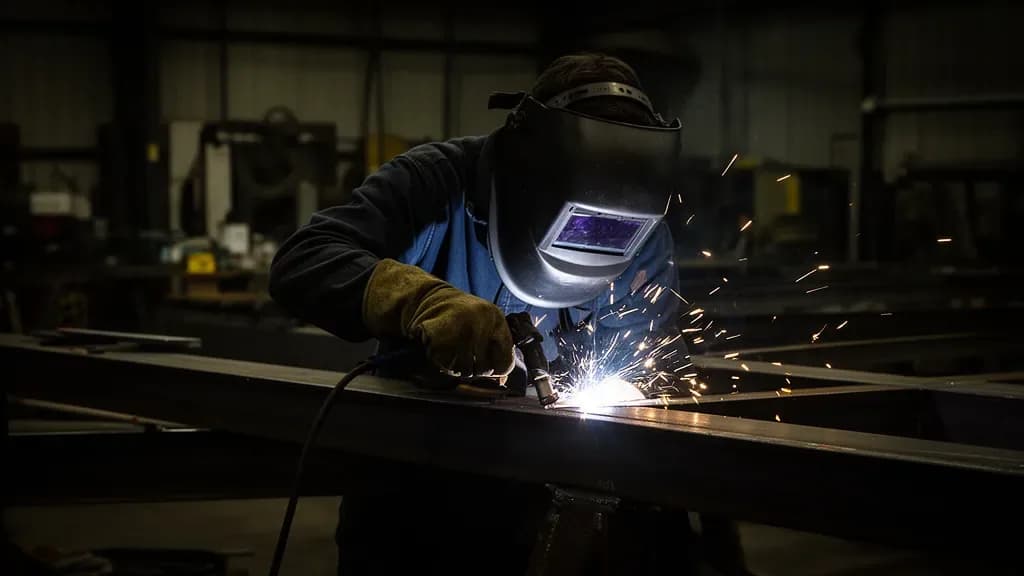
Fitter-welders fabricate, assemble, and repair metal structures and mechanical equipment using both fitting techniques and welding processes. The work spans MIG, TIG, stick, and increasingly automated welding on carbon steel, stainless, aluminium, and specialist alloys. The trade differs from a pure welder (322313 Welder First Class) in that the role also includes reading drawings, marking off, cutting and fabricating stock, and assembling mechanical components — not just laying weld.
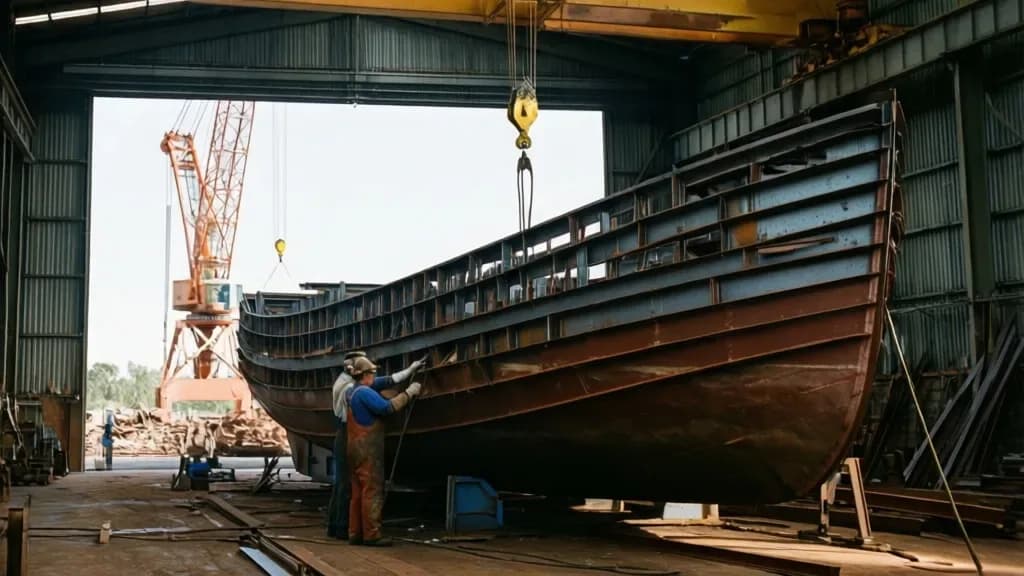
The work concentrates in shipbuilding (Henderson WA, Osborne SA), oil and gas (Karratha LNG facilities, Bass Strait platforms), heavy fabrication (BlueScope Port Kembla, Liberty Whyalla), mining (workshop fabrication for mobile and fixed plant), and structural steel for major infrastructure projects (Inland Rail, Sydney Metro West, Snowy Hydro 2.0).
Australia has a structural shortage of welders that has worsened through 2025-26. Weld Australia and steel industry bodies have publicly raised alarm about the gap, and Jobs and Skills Australia added welder, pressure welder, and fitter-welder to the Priority List. Skill Level 3 trade fill rates dropped to 54.3% nationally. Demand is so pronounced that some major projects have flown in welders on short-term arrangements while sponsorship was processed.
ANZSCO Code 323213 — Fitter-Welder
The 323213 code applies to fitters whose work routinely combines mechanical fitting and assembly with significant welding activity. Welding must be a core daily task, not occasional. Core duties include:
- Studying engineering drawings and welding procedure specifications
- Marking off, cutting, and shaping metal stock
- Welding metal components using MIG, TIG, stick, and other processes
- Fitting and assembling fabricated parts into structures or machinery
- Performing weld repairs on damaged or worn equipment
- Operating welding equipment safely to Australian Standards
Three adjacent codes are worth understanding:
- 323211 Fitter (General) — for fitters whose work does not include significant welding. See the Fitter (General) pathway.
- 323212 Fitter and Turner — for fitters whose work centres on lathe operation. See the Fitter and Turner pathway.
- 322313 Welder (First Class) — for pure welders whose work is dominated by welding without significant fitting or assembly. If you are a coded pressure welder or production welder without fitting duties, 322313 is the better match.
Choose 323213 only if your employment references can substantiate both fitting and welding as core daily activities. TRA assessors look for evidence of both during the workplace assessment.
Skills Assessment — Trades Recognition Australia
TRA handles 323213 through three programs.
Job Ready Program (JRP) — the standard offshore pathway
The JRP is the route for almost all offshore-trained fitter-welders. Four sequential steps:
- Provisional Skills Assessment (PSA) — documentary verification of qualification and 12 months recent employment
- Job Ready Employment (JRE) — TRA registration to start 1,725 paid hours of Australian work
- Job Ready Workplace Assessment (JRWA) — onsite assessment with the candidate observed welding and fitting
- Job Ready Final Assessment (JRFA) — outcome document for visa lodgement
Combined cost across the four steps: approximately AUD $3,000-$3,500 Total duration: 12-18 months minimum Required qualification: AQF Certificate III in Engineering — Fabrication Trade (or comparable overseas qualification), or three years of full-time equivalent post-qualification experience
The JRWA for 323213 is more demanding than for general fitters because the assessor checks both welding quality (visual inspection of welds, sometimes destructive testing) and fitting accuracy. Failed assessments most commonly arise from one of two issues: the candidate's Australian role is dominated by welding only (TRA redirects to 322313), or the welds do not meet Australian Standards. Sponsoring employers should match candidates to genuine fitter-welder roles rather than production welding lines.
Migration Skills Assessment (MSA) — Australian-qualified or bilateral
The MSA is documentary and faster, but requires either an Australian apprenticeship completion, an AQF qualification obtained in Australia, or a recognised qualification under bilateral arrangements. Most offshore-trained fitter-welders do not qualify.
Offshore Skills Assessment Program (OSAP) — limited
OSAP supports paper assessments for select country qualifications. Check eligibility with TRA before relying on it.
Visa Pathways for Fitter-Welders
Subclass 482 — Skills in Demand
The 482 is the practical first step for most offshore fitter-welders because it provides the Australian employment needed for the JRP work hours.
- Visa fee: AUD $3,210 (primary applicant)
- Core Skills Income Threshold (CSIT): AUD $76,515 (FY2025-26), rising to AUD $79,499 from 1 July 2026
- Duration: Up to 4 years
- Stream: Core Skills (323213 is on the Core Skills Occupation List)
- Quirk: Fabrication employers in shipbuilding and resources routinely pay well above CSIT, often AUD $90,000-$120,000 base for experienced welders
Subclass 186 — Employer Nomination Scheme
Permanent residency through employer sponsorship. Direct Entry stream (with a positive TRA outcome in hand) or TRT stream (after two years on a 482).
- Visa fee: AUD $6,140 (primary applicant)
- Streams: Direct Entry or TRT
- Reality: TRT is the most common route — sponsored fitter-welders typically transition after two years
Subclass 491 — Skilled Work Regional
A 5-year regional provisional visa carrying a 15-point boost. Many fabrication and welding employers operate in regional centres (Whyalla, Newcastle, Mackay, Geraldton), so the 491 living obligation rarely conflicts with the job.
- Visa fee: AUD $6,140 (primary applicant)
- Living obligation: 3 years in a designated regional area before applying for 191 PR
- Quirk: South Australia regional zones cover most of Adelaide-adjacent industrial areas, making the 491 unusually accessible
Subclass 190 — Skilled Nominated
State-sponsored permanent residency. NSW, Victoria, Queensland, and South Australia all currently nominate 323213.
- Visa fee: AUD $6,140 (primary applicant)
- Points boost: +5 from state nomination
- Live-in obligation: 2 years in the nominating state
Subclass 189 — Skilled Independent
Trade occupations face less competition than ICT, but 189 invitation rounds since late 2024 have been heavily weighted toward healthcare. Lodge for 189 in parallel but plan on a sponsored or regional outcome.
- Visa fee: AUD $6,135 (primary applicant)
- Minimum points: 65 (realistic invitations 75+)
Points Test Strategy
| Points Factor | Points | Notes |
|---|---|---|
| Age (25-32) | 30 | Maximum |
| Age (33-39) | 25 | Strong |
| English (Proficient — IELTS 7) | 10 | Standard target |
| English (Superior — IELTS 8) | 20 | Worth the prep effort |
| Skilled Employment (5-7 yrs overseas) | 10 | Typical |
| Skilled Employment (8+ yrs overseas) | 15 | Common for experienced fitter-welders |
| Australian Skilled Employment (1-2 yrs) | 5 | Relevant once on 482 |
| Qualification (AQF Cert III/IV equivalent) | 10 | Standard |
| State Nomination (190) | 5 | NSW, VIC, QLD, SA all nominate |
| Regional Nomination (491) | 15 | The dominant points booster for trades |
| Partner Skills | 5-10 | If partner holds a CSOL occupation |
Realistic Scenarios
Scenario 1 — Offshore fitter-welder, 29 years old, IELTS 6, 8 years experience
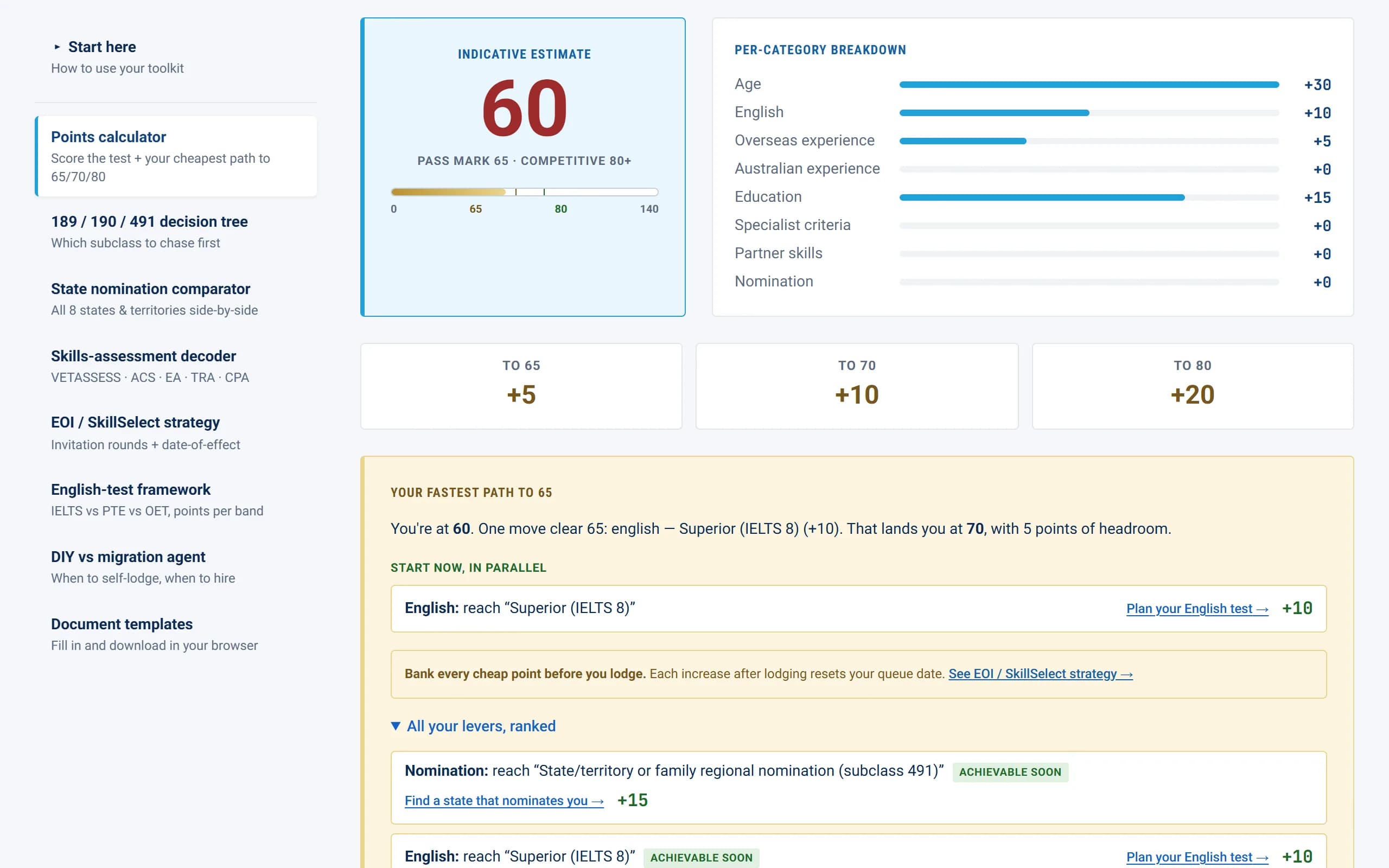
Age 30 + English 0 + Experience 15 + Qualification 10 = 55 points. Improve English to Proficient (+10) for 65, or pursue 491 regional nomination (+15) for 70-75.
Scenario 2 — Onshore fitter-welder on 482 in regional WA, 32 years old, IELTS 7, 7 years overseas plus 2 years Australian
Age 30 + English 10 + Overseas 10 + Australian 5 + Qualification 10 + 491 Regional 15 = 80 points. Highly competitive.
State Nomination
New South Wales
NSW nominates Fitter-Welder under both 190 and 491 in the 2025-26 program. Demand concentrates around Newcastle fabrication shops servicing the Hunter Valley coal sector, the Illawarra steel precinct (BlueScope), and Western Sydney structural-steel fabricators. NSW expects three years of skilled employment in the nominated occupation and prefers candidates with a current NSW job offer.
Victoria
Victoria's 2025-26 list includes fitter-welder among trades expressly receiving invitations. The state allocates 2,700 places to 190 and 700 to 491. Welding demand sits in Melbourne's western industrial corridor (Laverton, Sunshine), Geelong's defence and renewables ecosystem, and the Latrobe Valley energy transition projects. Three years of recent post-qualification experience plus a current Victorian role or genuine intent is the typical bar.
Queensland
Migration Queensland prioritises trades. Fitter-welders are in heavy demand for the Gladstone industrial precinct, the Mackay mining-services corridor, and the Bowen Basin coal sector. Queensland favours a current Queensland job offer for 190; the 491 pathway is more accessible from offshore.
South Australia
South Australia is among the most accessible states for fitter-welders because of the Osborne shipbuilding precinct (BAE Hunter-class frigates, ASC submarines) and the Whyalla steelworks. SA allocates 3,000 places to 190 and 800 to 491 in 2025-26, with reduced English thresholds for some shortage occupations. Three years of skilled employment in the previous five is the standard bar.
Western Australia
WA's nomination program is smaller but actively targets resources-sector trades, particularly for the LNG and iron ore industries on the Pilbara coast. Welders with pressure welding tickets are particularly sought after.
Salary and Employment Outlook
What Fitter-Welders Earn
| Role / Sector | Typical Salary Range (AUD) |
|---|---|
| Entry-level Fitter-Welder (Cert III, 0-2 yrs) | $70,000-$85,000 |
| Experienced Fitter-Welder (5+ yrs) | $85,000-$105,000 |
| Structural Welder (commercial construction) | $90,000-$120,000 |
| Pressure Welder (oil and gas, mining) | $130,000-$180,000 |
| Shipbuilding Welder (Adelaide/Henderson) | $95,000-$125,000 |
| Mining-sector Fitter-Welder (FIFO) | $130,000-$180,000 |
| Welding Supervisor / Leading Hand | $110,000-$140,000 |
Source: SEEK Salary Hub 2026, Hays Salary Guide 2026. Welder average sits around AUD $80,000-$85,000 nationally; specialised pressure and coded welders earn substantially more. Mining, resources, and offshore work pay the highest premiums. FIFO arrangements often include AUD $300-$500 per day site allowances on top of base.
Total packages typically include superannuation at 11.5%, FIFO travel, accommodation, site allowances, and overtime at penalty rates (1.5x-2.5x base).
Highest-Paying Sectors
- Oil and gas — Karratha LNG, Bass Strait platforms, Darwin LNG
- Defence and shipbuilding — Hunter-class frigates (Osborne), Henderson WA shipyards
- Mining — fixed-plant and mobile-plant fabrication and repair
- Heavy structural steel — Inland Rail, Snowy Hydro 2.0, Sydney Metro West
- Renewables — wind tower fabrication, transmission tower welding
Tips for a Successful Application
1. Make sure references describe both fitting and welding
The single most common TRA decision against 323213 is "welding-dominated work — should be 322313 Welder (First Class)". References must explicitly describe fitting, assembly, drawing interpretation, marking-off, and stock preparation alongside welding processes. Generic references that emphasise welding tickets without fitting language steer the assessor toward the wrong code.
2. Get welding tickets that match Australian Standards
Pressure welding tickets to AS 3992, AS 1796, or AS/NZS 2980 are highly valued and unlock the highest-paying roles. If you hold ASME IX, EN ISO 9606, or other international tickets, get them mapped to Australian equivalents through a recognised testing body before applying for jobs. Many employers will not interview without Australian-recognised certifications.
3. Target shipbuilding sponsorship if your work suits naval fabrication
The Hunter-class frigate program at Osborne (BAE) and the AUKUS submarine program (ASC) are multi-decade programs with sustained welder demand. Both have specific security and citizenship considerations, but the underlying sponsorship pipeline for offshore welders is large and stable.
4. Allow 14-18 months for the JRP, and budget for it
PSA application, the 1,725 paid hours of Australian employment, JRWA scheduling, and JRFA processing collectively take 14-18 months. Budget AUD $3,000-$3,500 for TRA fees, plus AUD $3,210 for the 482 visa, plus English testing, medical, and police checks. Total out-of-pocket through to PR can reach AUD $12,000-$15,000.
5. Sit IELTS or PTE before applying
A Proficient English result (IELTS 7 / PTE 65) unlocks state nomination options that are closed at Competent (IELTS 6) and adds 10 points to the points test. Skilled trade applicants frequently underestimate the points impact of English.
Step-by-Step Migration Roadmap
- Confirm 323213 is the right code — check duties against the ANZSCO code finder
- Check the occupation list — confirm 323213 on the CSOL and SOL 2026
- Sit IELTS or PTE — aim for Proficient (7.0) minimum
- Lodge the TRA Provisional Skills Assessment — AUD $300
- Secure a sponsoring Australian employer offering genuine fitter-welder work — fabrication shops, shipyards, mining contractors
- Apply for a subclass 482 visa — AUD $3,210
- Register for Job Ready Employment — AUD $490
- Complete 1,725 paid hours of fitter-welder work — approximately 12 months
- Sit the JRWA — onsite welding and fitting assessment
- Receive Job Ready Final Assessment — positive outcome for visa purposes
- Apply for 186 (TRT) or 190 / 491 — AUD $6,140
- Receive PR grant — relocate or remain per state obligations
Frequently Asked Questions
What is the difference between Fitter-Welder (323213) and Welder First Class (322313)?
323213 covers roles where both fitting and welding are core daily activities — reading drawings, marking off, cutting, fabricating, assembling, and welding. 322313 covers pure welders whose work is dominated by laying weld, often as production welders or coded pressure welders. If your employment is essentially "I weld all day on coded joints", 322313 is the better fit. If you fabricate complete structures from raw stock and weld them up, 323213 fits.
Do I need Australian welding tickets before applying for a visa?
Not for the visa itself — TRA recognises overseas qualifications during the Provisional Skills Assessment. But for the Australian employer who will sponsor you, Australian-recognised tickets (especially AS 3992 for pressure welding) significantly improve your hireability. Many employers either require Australian tickets at hire or pay for testing on arrival.
Is mining welding really as well-paid as the salary tables suggest?
Yes, for specialist roles. A coded pressure welder on a FIFO roster with a major mining contractor can clear AUD $180,000-$220,000 in good years once site allowances, overtime, and travel benefits are factored in. The trade-off is the roster — 2-week-on / 1-week-off or 3-and-1 schedules, and physically demanding work in remote environments. Workshop welders earning AUD $90,000-$110,000 in capital cities trade off salary for stability and family life.
Can I move from a 482 fitter-welder role into a different welding job during the Job Ready Program?
In principle, yes. The 482 allows employer changes through a new nomination. But changing employers mid-JRP usually restarts parts of the work-hours requirement, because TRA assesses the most recent 1,725 hours with a single employer. Plan to stay with the sponsoring employer through the JRWA unless the original role is fundamentally not delivering the required duties.
How is the 2026 welder shortage actually affecting employer behaviour?
Sponsoring employers have become noticeably more willing to engage with offshore candidates and pay for relocation. Some major-project welding subcontractors have engaged migration agents to actively source offshore. Pressure welders for the LNG and energy-transition sector are in particularly short supply. The 2026 CSIT increase to AUD $79,499 has not slowed sponsorship in this trade because most welder packages already exceed it.
What happens to my JRP if my sponsoring employer goes out of business?
You have 60 days under the 482 to find a new sponsor. JRP hours completed with the previous employer typically count toward the 1,725-hour total provided the duties match 323213. Notify TRA promptly of the change and obtain a written employment confirmation from the new employer for the JRE record. Engage a migration agent if this scenario arises — it is recoverable but procedurally complex.